A regional education push with unusually high stakes
In South Korea, where the capital region around Seoul has long pulled in jobs, investment and young people, officials in smaller cities and rural provinces are increasingly asking a question that would sound familiar in parts of the American Midwest or Appalachia: How do you keep a region alive when its young people leave for bigger opportunities elsewhere?
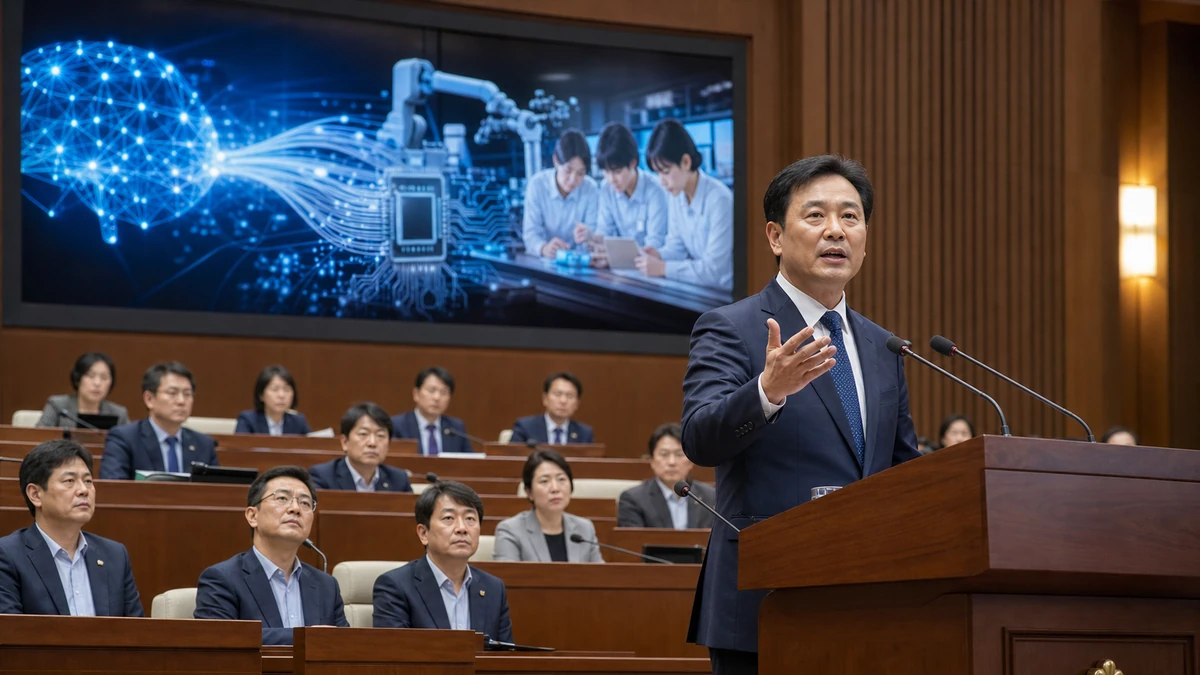
Kim Dae-jung, the education superintendent overseeing the southwestern Korean regions of Gwangju and South Jeolla, offered one answer this week. Speaking at a plenary session of the regional assembly in Namak, Kim said he plans to move quickly on a project aimed at developing 100,000 workers and students with skills tied to artificial intelligence and other advanced industries.
On its face, that may sound like another government workforce initiative wrapped in the global hype around AI. But in the Korean context, the proposal carries broader meaning. Kim is not simply calling for more coding classes or a handful of robotics clubs. He is arguing that education itself should become the central engine of regional survival and economic renewal, linking what students learn in school to the industries local officials hope will anchor the future of the region.
That is a major statement in a country where education already plays an outsized social and political role. South Korea is known internationally for its intense academic culture, high college-going rates and fierce competition around exams. But Kim’s remarks suggest a shift in emphasis: not just academic excellence for its own sake, and not simply preparation for elite universities in Seoul, but education designed to help a region build and keep its own talent base.
The plan remains short on operational detail. Kim did not publicly lay out a full curriculum, a timeline, or a breakdown of who exactly would be counted among those 100,000 trainees. What he did make clear is the direction of travel. In his telling, AI and advanced industry training should be treated not as a niche policy but as a regional priority, one tied to the long-term viability of Gwangju and South Jeolla themselves.
For American readers, the closest comparison may be a governor or state school chief saying that public education must be aligned much more directly with semiconductor manufacturing, data infrastructure and energy research in order to keep a region economically relevant. The difference is that in South Korea, where the nation is smaller, more centralized and more acutely shaped by demographic decline, the pressure is even more intense.
Why “regional extinction” is part of the conversation
One phrase that often appears in Korean policy debates can sound jarring in English: “regional extinction.” It does not mean that cities are literally disappearing overnight. Rather, it refers to a slow-motion crisis in which smaller communities lose population, age rapidly, and struggle to maintain schools, businesses and local institutions as younger residents move away.
That fear is especially potent in South Korea, which has one of the world’s lowest birth rates and one of its most concentrated economies. For years, Seoul and its surrounding metropolitan area have attracted a disproportionate share of the country’s best jobs, top universities and cultural prestige. For many Korean families, success has been linked to moving closer to the capital, or at least sending children there for school and work.
That dynamic leaves places such as Gwangju, a major city in the southwest, and South Jeolla, the surrounding province known for its agricultural base and coastal geography, fighting an uphill battle. These are not backwater areas with no history or identity. Gwangju, in particular, holds a central place in modern Korean democracy because of the 1980 pro-democracy uprising brutally suppressed by the military, a defining event often compared in moral significance to watershed moments in civil rights or democratic protest elsewhere. But historical importance does not automatically translate into future economic security.
Kim framed education as the strongest tool for confronting that regional decline. The idea is straightforward enough: if students can gain meaningful skills tied to industries that actually exist or are being built nearby, they may be more likely to imagine a future for themselves in the region. If they cannot, then local schools risk becoming pipelines feeding talent outward.
That logic resonates far beyond Korea. American local leaders have spent years trying to connect community colleges, public universities and high schools to emerging sectors like battery plants, chip manufacturing and clean energy. Korean officials are operating in a similar space, but with an added urgency created by population loss and a national obsession with educational mobility.
In that sense, Kim’s proposal is not simply about labor supply. It is about whether education can help reverse a long-standing pattern in which ambitious young people view leaving as the default path to advancement. The political message is that schools should not only prepare students to succeed somewhere else. They should also make it plausible to succeed at home.
What the 100,000-talent project appears to mean
The phrase Kim used, “100,000 talent development project,” is large enough to be symbolic. In Korean public policy, round numbers like that often serve as a rallying point as much as a literal program description. It signals scale, ambition and a desire to reach beyond one elite track of students.
At this stage, the term “talent” should not be understood too narrowly. It could eventually refer to future AI engineers, semiconductor technicians, data center workers, researchers, software developers, or students with broad digital literacy who go on to work in related fields. Without a more detailed blueprint, it is impossible to say whether the project will focus mainly on specialized technical training or include a wider effort to raise baseline technological fluency across the student population.
That distinction matters. If the project is framed only as producing high-end specialists, it risks becoming a selective initiative that reaches a relatively small slice of students. If it is broader, it could reshape the entire educational ecosystem, from early exposure in elementary and middle school to more targeted pathways in high school, college and technical training.
Kim’s own language suggests he is thinking in ecosystem terms. He emphasized that the project should connect schools with local industry and position education as the foundation of regional-led growth, not a side support for business development. That is a notable shift in emphasis. In many places, education policy follows economic development. Here, Kim is effectively arguing that education must lead it.
There is also a political subtext. By presenting a six-figure target rather than a boutique pilot program, Kim appears to be signaling that AI education should not be limited to a few model schools or magnet programs. In a society where educational opportunity is closely watched and often hotly contested, scale matters. A project framed for 100,000 people implies public ownership, not just technocratic experimentation.
Still, big numbers can obscure difficult questions. What counts as training? A semester-long elective? A certificate? A degree pathway? An internship? Who will teach these courses, and how quickly can the system prepare enough instructors with up-to-date technical knowledge? How will students in rural areas get the same access as students in urban centers? Those are the questions that will determine whether the project becomes a durable education strategy or a headline-grabbing slogan.
From classroom to industry: the regional strategy behind the plan
Kim also said he wants to build a sustainable foundation for a “5 million megacity” by working with local governments, universities and businesses. The term “megacity” may sound unusual in this context, especially to American readers who associate it with enormous urban corridors like Tokyo or the Northeast megalopolis. In Korean policy debates, however, the word often refers to a broader regional bloc, an integrated economic and living zone created by linking neighboring cities and provinces closely enough to compete with the gravitational pull of Seoul.
The vision here is not that Gwangju and South Jeolla will suddenly become one giant city. Rather, the goal is to stitch together education, transportation, industry and public institutions so the wider region functions as a stronger collective unit. That matters because Korea’s development challenge is not just building isolated facilities; it is building ecosystems robust enough to retain people.
Kim’s emphasis on cooperation among local governments, universities and companies reflects an understanding that schools alone cannot produce advanced-industry talent at the necessary scale. Local governments can set long-term development priorities and help coordinate funding or land use. Universities can provide deeper research capacity and specialized training. Companies can signal what skills are actually needed and offer the apprenticeships, internships and employment pathways that make educational promises feel real.
In the United States, similar partnerships are often praised in theory but harder to execute in practice. Schools teach one thing, employers need another, and students can end up caught in the middle. Korea is hardly immune to that problem. If anything, the challenge may be sharper because the pace of technological change is so fast and because Korean students already face intense pressure to make high-stakes educational choices early.
That is why the structure of the partnership may ultimately matter more than the headline target. A one-time event, a memorandums-and-photo-ops approach, or a loose branding exercise around AI would do little to change students’ lives. A true pipeline would require coordinated curricula, teacher training, industry placements, research links to universities and visible job prospects after graduation.
If Kim’s office can move from rhetoric to that kind of sustained infrastructure, the initiative could become a model for how regional education systems respond to technological change. If it cannot, it risks joining a long list of economic development campaigns that sound visionary but never fully connect to the classroom.
Why semiconductors, data centers and fusion research matter in this story
Part of what gives this proposal weight is Kim’s argument that the region is already seeing major investment in sectors such as semiconductors, AI data centers, a national computing center and even an “artificial sun” research facility, a reference to nuclear fusion research. In other words, he is not proposing AI education in a vacuum. He is linking it to a larger industrial narrative now taking shape in southwest Korea.
For American readers, it may help to think about the way federal investment, state incentives and private capital have converged around semiconductors in places like Arizona, Texas, Ohio and upstate New York. The pitch is not simply that factories will appear, but that whole regional supply chains, research communities and educational pipelines can grow around them. Korea is pursuing a version of that strategy, adapted to its own geography and political economy.
The mention of a national computing center and AI data centers is especially significant. AI, for all the public fascination with chatbots and consumer products, is also deeply physical infrastructure. It depends on land, electricity, cooling, chips, servers and highly specialized technical staff. Data centers and high-performance computing facilities do not just symbolize the future economy; they require a workforce that spans engineers, technicians, system operators and planners.
The same is true for semiconductor investment, which is central to South Korea’s national economic identity. Korea is home to some of the world’s most important chipmakers, and semiconductors are often discussed in the country with the kind of strategic gravity that Americans might attach to aerospace, defense manufacturing or advanced energy technology. If Gwangju and South Jeolla can secure a larger role in that ecosystem, the educational implications are substantial.
Fusion research adds another layer. It is the kind of long-horizon scientific field that may not yield immediate local jobs on a mass scale, but it can anchor prestige, attract researchers and reinforce the image of a region as a place where advanced science happens. That matters in a competition for talent. Students are more likely to see a future in a place when the institutions around them project ambition.
Still, facilities alone do not transform education. A data center being built nearby does not automatically change what a middle school student learns in science class or whether a high school senior can imagine a career in computing without leaving home. That bridge must be constructed deliberately. Kim’s proposal suggests he understands that. The next step is proving the bridge can be built.
The challenge of making AI education meaningful, not just fashionable
Around the world, policymakers have discovered that talking about AI is easy. Building effective AI education is much harder. That challenge is likely to confront this project as well.
There is always a temptation to reduce “AI education” to branding: a few software tools in classrooms, a coding competition, a smart-lab ribbon cutting, or a handful of lectures about the future. But if the objective is to strengthen a region’s long-term capacity, then the educational model has to be broader and deeper than trend-chasing.
Students need foundational digital literacy, but they also need math, science, communication skills and the ability to adapt as technologies evolve. Schools should not be turned into narrow job-training centers that produce graduates for a single moment in the market. The most successful programs will likely be the ones that teach both specific technical competencies and broader problem-solving abilities that can survive shifts in the economy.
That is especially true in AI, where tools and platforms change quickly and where ethical, legal and social questions are inseparable from technical ones. An education system preparing students for an AI-rich economy has to do more than teach them how to use software. It should help them understand data, bias, automation, energy demand, privacy and the real-world institutions that shape how technology is deployed.
There is also the question of equity. Korea’s educational system is famous for its rigor, but it is also marked by stark differences in access to private tutoring and enrichment, especially between the wealthier Seoul area and less affluent regions. If AI education becomes another domain in which students with more resources pull farther ahead, the policy could deepen the very imbalances it aims to fix.
That means the quality of implementation will matter as much as the number of participants. Are rural schools equipped? Are teachers supported? Are vocational and academic tracks both included? Are girls and underrepresented students actively encouraged into advanced technology fields? The details may sound bureaucratic, but they will decide whether the initiative broadens opportunity or simply repackages existing hierarchy with futuristic language.
A test case for Korea’s broader balancing act
Kim said education in Gwangju and South Jeolla should play a leading role in South Korea’s national goal of balanced development, the long-running effort to spread growth beyond the Seoul metropolitan area. That ambition reaches well beyond one regional school system.
For decades, South Korea has wrestled with the concentration of power, wealth and opportunity in and around the capital. Governments of different political stripes have promised to decentralize growth, strengthen provincial regions and make the country less Seoul-centric. Results have been mixed. Infrastructure can be built. Public institutions can be relocated. But people, especially young people, tend to follow opportunity, status and networks, all of which remain heavily concentrated in the capital region.
That is why this education initiative matters as a policy signal. It suggests that at least some regional leaders believe balanced development will fail unless schools become active participants in economic strategy. The premise is that factories, laboratories and data centers are not enough by themselves. A region also needs a convincing narrative for students and families: you can learn here, build expertise here and build a life here.
Whether that narrative holds will depend on more than Kim’s office. It will require buy-in from local governments, universities and companies, along with stable funding and political follow-through. It will also require patience. Workforce ecosystems are not built in a single school year, and public trust is not won by announcements alone.
Still, the significance of the moment should not be understated. In a country often described through the lens of hyper-competitive schooling and the magnetic pull of Seoul, a regional education chief is trying to redefine what success looks like. Instead of treating local schools as stepping stones out, he is positioning them as anchors for regional reinvention.
That is a bold bet. If it works, southwest Korea could offer a template for how education systems in aging, unevenly developed democracies respond to the twin pressures of technological change and geographic inequality. If it fails, it will underscore how difficult it is to use schooling to solve problems that are also economic, demographic and cultural.
For now, the headline number — 100,000 — is the attention grabber. But the more important story lies underneath it. The real measure of success will not be how many people can be counted in a program. It will be whether students in Gwangju and South Jeolla begin to see advanced technology not as something happening somewhere else, in somebody else’s city, but as part of their own future.
Comments
Post a Comment