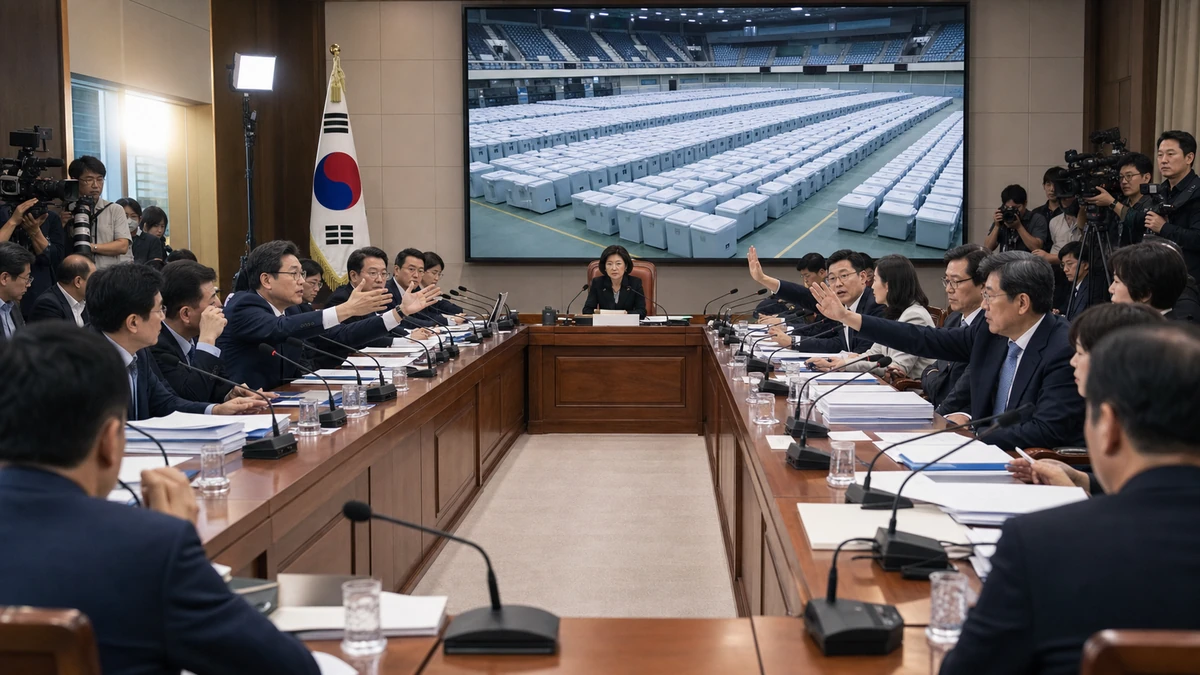
A voting controversy now tests confidence in South Korea’s election system
A high-stakes political fight in South Korea is expanding beyond a dispute over missing ballots and into a broader test of public trust in one of the country’s most important democratic institutions. Lawmakers in Seoul failed this week to agree on when and how to conduct a public recount of roughly 2.47 million ballots linked to a local election controversy, leaving unresolved questions about both the scale of the problem and the credibility of the official response.
The standoff emerged during the first hearing of a special parliamentary committee investigating disruptions in South Korea’s June 3 local elections. At issue is an incident in which some polling places reportedly ran short of ballots, raising the possibility that some voters were unable to cast their votes. Lawmakers are now debating what should happen next with millions of ballots being stored at an Olympic Park facility in Seoul, and whether those ballots should be publicly recounted immediately or only after an independent special prosecutor begins a formal investigation.
For American readers, the closest parallel may be the kind of procedural fight that follows a contested election in the United States, when the argument shifts from the event itself to the process for verifying what happened. But the South Korean case has its own political and institutional context. South Korea’s National Election Commission, or NEC, is an independent constitutional body tasked with running elections and safeguarding their legitimacy. That means a dispute over ballot supply is not being treated as a local administrative error alone. It is being viewed as a stress test for the country’s election management system at large.
Both major political camps say they want the truth. Their disagreement is over sequence, control and credibility. The liberal Democratic Party wants a public recount right away as part of the parliamentary investigation. The conservative People Power Party says the recount should occur under the authority of a special prosecutor, arguing that an independent criminal inquiry should take the lead. On paper, that may sound like a narrow procedural disagreement. In practice, it has become the central battleground in a case that touches on voting rights, government accountability and the fragility of public confidence in election administration.
That matters because in any democracy, the damage from election mismanagement is not measured only by whether the final result changes. It is also measured by whether citizens believe the process was competent, transparent and fair. In that sense, the unanswered questions in South Korea now extend well beyond one election day failure.
The fight is not over whether to recount, but who gets to control it
The most striking feature of the current dispute is that neither side is flatly rejecting a recount. Instead, the argument centers on timing and legal authority. That distinction is important. South Korea’s ruling and opposition parties are not fighting over whether verification is necessary. They are fighting over which institution should conduct that verification and under what framework the results will be judged legitimate.
Supporters of an immediate public recount say speed is essential. Their argument is straightforward: the ballots already exist, public suspicion is growing and a prompt, visible review could help settle at least some factual questions before the political narrative hardens further. In a country where public trust can be shaped quickly by televised hearings, online commentary and intense partisan framing, delay itself can become politically consequential.
Those arguing for a special prosecutor first take a different view. They say a recount should not happen in isolation from a broader inquiry into responsibility. In their telling, the issue is not simply how many ballots were printed, distributed or used. It is also whether there were failures in oversight, reporting, record preservation or institutional decision-making. Under that logic, a recount is not just a counting exercise. It is evidence within a larger investigation.
This is a familiar democratic dilemma. Americans have seen versions of it after major public failures, whether in elections, policing or disaster response: Should officials move immediately to produce visible facts, or should they first construct a more insulated investigative framework designed to withstand accusations of political bias? Each approach carries risks. A rapid recount could be criticized as incomplete or politically staged. A delayed recount conducted only after a formal investigation begins could be attacked as too slow, allowing doubts to spread and records to become more difficult to verify in real time.
That is why procedure now matters almost as much as substance. If the eventual process is not accepted as neutral, even accurate findings may not calm the public. South Korean lawmakers appear to recognize that problem. What they have not yet done is agree on a path that balances speed with independence.
A deceptively small number of disputed voters carries outsized meaning
One of the most sensitive issues raised in the parliamentary hearing was a question that, on its face, sounds simple: How many people were actually unable to vote because of the ballot shortage? The answer remains disputed.
Election authorities reportedly presented one figure, while at least one lawmaker challenged that number and offered a different count based on his own calculations. The gap between the two estimates is not massive in raw terms. But the significance of the discrepancy does not turn on whether the number is in the dozens rather than the hundreds or thousands. It turns on what the discrepancy suggests about record-keeping, classification and institutional competence.
In the United States, readers may be tempted to see a dispute over a few dozen voters as minor unless it could alter the outcome of a race. South Korean lawmakers are emphasizing a different principle, one that is fundamental in any democratic system: even a single voter improperly denied the chance to vote represents a serious failure. If election officials cannot state with precision who was affected, how they were counted and what records exist to back up those claims, the problem becomes bigger than the number itself.
The unresolved questions are basic but essential. How did officials define a voter who was unable to vote? Did that include only those who were formally recorded at the site, or also those who waited, became discouraged and left? Were field reports from local polling places gathered consistently? Did local officials use the same standards when documenting incidents? And if different numbers emerged later, what explains the mismatch?
These are not technical footnotes. They go to the heart of whether the state can reliably identify and acknowledge a violation of political rights. In South Korea, as in the United States, voting is not just a bureaucratic act. It is a civic ritual tied to the legitimacy of the system itself. A ballot shortage can occur for mundane operational reasons, such as forecasting errors or distribution failures. But once officials struggle to explain who was harmed and how the damage was measured, a logistics problem becomes a confidence problem.
That shift is visible in the way lawmakers are framing the investigation. The issue is no longer only why the shortage happened. It is also why the aftermath appears so murky. If authorities had quickly documented the scope of the problem, preserved records and communicated clearly, the controversy might have been contained. Instead, the uncertainty over the number of affected voters is giving the broader scandal fresh life.
The Election Commission now faces scrutiny over management, transparency and record-keeping
South Korea’s National Election Commission occupies a role somewhat analogous to a mix of state election administrators and an independent constitutional watchdog. It is expected not only to organize voting and counting, but also to protect the integrity of the process in a way that keeps partisan actors at arm’s length. That institutional design makes the current controversy especially serious. When problems arise, the commission is not just another agency facing criticism. It is the body meant to reassure the public that elections are sound.
At the hearing, lawmakers from across the political spectrum reportedly converged on one point: whatever caused the ballot shortage, the official response after the fact appears to have fallen short. That cross-party frustration is notable. In polarized political systems, agreement is often hardest to find on questions of institutional failure. The fact that lawmakers with sharply different agendas are criticizing the follow-up suggests the commission’s handling of the aftermath has become a vulnerability in its own right.
Crisis response in election administration depends on a few core steps. Officials must quickly determine the scale of the problem. They must preserve relevant materials, including logs, communications and other records that can later be audited. They must provide the public with a clear and consistent explanation of what happened, what remains unknown and how the facts will be established. If any of those steps are delayed or muddled, suspicion fills the vacuum.
That appears to be what is happening in South Korea. The parliamentary inquiry is focusing not only on the original operational failure, but also on whether the election authorities maintained sufficient control over information once the problem surfaced. Critics are asking whether demand for ballots was properly forecast, whether chain-of-command reporting worked as intended, and why the process of identifying affected voters seems to have become contentious after the fact rather than being settled quickly.
For U.S. audiences, this is one of the most relatable elements of the story. Americans do not need a deep knowledge of Korean politics to understand how bureaucratic confusion after an election problem can feed larger doubts. The details differ by country, but the pattern is familiar: once the public senses that authorities are improvising rather than explaining, every missing detail begins to look like a possible cover-up, even when the original cause may have been ordinary incompetence rather than malice.
That is why the commission’s credibility is now on the line. Even if investigators ultimately conclude that the ballot shortage stemmed from poor planning rather than misconduct, the institution will still need to show it can document mistakes transparently and correct them without partisan prodding. Otherwise, future elections could be shadowed by the same doubts now surfacing in parliament.
Older election records are also drawing attention, widening the controversy
The hearing did not stay confined to the recent local elections. Lawmakers also raised questions tied to an earlier election-related case from 2022 involving a Seoul district, where issues reportedly surfaced around count reporting in a superintendent of education race. That matters because it broadens the inquiry from a single operational breakdown into a more systemic question about how election records are created, stored and attributed.
One lawmaker pressed officials about a document indicating that additional count results would not be reflected in the system following internal discussions. The immediate issue was not merely whether that decision was right or wrong. It was whether the authorship and approval trail of that record could be clearly established. In plain terms: Who wrote it? Who knew about it? Who signed off on it? If no one can say, accountability becomes far more difficult.
In modern election administration, the numbers alone are never enough. Just as important is the paper and digital trail that shows how those numbers were entered, reviewed, revised and finalized. Americans learned versions of that lesson repeatedly in the aftermath of contested local and national races, when the legitimacy of the process often hinged as much on documentation as on outcomes. If a voting system cannot show how a decision was made, it becomes harder to persuade the public that the decision was proper.
The Korean debate now appears to be moving in that direction. Critics are no longer asking only whether the NEC mishandled ballot supply. They are also probing whether the commission’s internal record culture is transparent enough for outside scrutiny. That is a more profound institutional challenge. Operational errors can sometimes be solved with better training or better logistics. Weak record governance is harder to fix because it involves organizational habits, accountability norms and the incentives that shape bureaucratic behavior over time.
To be clear, raising those questions does not prove a broader pattern of wrongdoing. It does, however, suggest why this controversy has grown beyond a single day’s disruption. If lawmakers and the public conclude that election-related decisions cannot be fully traced to identifiable officials and documented reasoning, calls for reform are likely to intensify regardless of what the recount ultimately finds.
Partisan rhetoric is escalating, but the core issue is institutional trust
As in many democracies, South Korea’s partisan camps are framing the same event through different fears. One side warns against allowing unproven suspicions to metastasize into generalized distrust of the election system. The other worries that structural problems inside the election bureaucracy could be minimized as isolated mistakes before they are fully investigated. Both concerns are politically useful. Both also reflect real democratic risks.
That tension was visible in the language surrounding the hearing. Some critics have used loaded political terms to suggest a closed culture or entrenched network inside the election administration system. Such rhetoric is designed to capture public frustration, but it can also outrun the evidence if investigators have not yet established how decisions were made or whether improper relationships influenced them. For that reason, the most consequential findings will not be the sharpest slogans or the most viral exchanges in parliament. They will be the verifiable facts that emerge from documents, testimony and a transparent review process.
For American readers, this is another familiar dynamic. Institutions under pressure are often judged through a partisan lens long before the investigative record is complete. The result can be a feedback loop in which procedure becomes a proxy for political identity. If a recount is done too soon, one side may call it rushed. If it is delayed, the other may call it a stall tactic. That is exactly why legitimacy depends on process design from the outset.
South Korea’s challenge is to prevent the current controversy from hardening into something larger: a durable erosion of faith in election administration itself. That does not mean suppressing criticism or rushing to reassure the public without evidence. It means building a fact-finding process that is both prompt enough to address public concern and independent enough to survive partisan attack. A parliamentary probe alone may not accomplish that. A special prosecutor alone may not either. The unresolved debate in Seoul is over how to combine those tools without undermining the credibility of both.
What comes next could determine whether the inquiry restores confidence or deepens suspicion
The special parliamentary committee has already approved a broad witness list for a second hearing scheduled for later this month, including officials from the national commission as well as election administrators from Seoul and other local jurisdictions. On paper, that suggests a serious effort to map how orders, information and responsibility moved from the central agency to local election offices and back again.
But large witness lists do not automatically produce clarity. The quality of the inquiry will depend on whether lawmakers can move beyond performative confrontation and pin down several key facts: when shortages were detected, how local officials reported them, what contingency plans existed, how many voters were affected, how records were preserved, and who made subsequent decisions about public communication and internal documentation.
The debate over the 2.47 million stored ballots is likely to remain the symbolic center of the controversy. A public recount could serve as a visible act of democratic verification, especially if broadcast or otherwise opened to scrutiny. But unless it is paired with clear rules, well-defined scope and transparent reporting, it may answer only part of the public’s concern. Counting ballots can clarify numerical questions. It cannot by itself explain chain-of-command failures, documentation gaps or inconsistent voter impact estimates.
That is why the broader challenge for South Korea is not simply to decide whether to recount, but to create a sequence of actions that the public sees as both credible and complete. In practical terms, that means avoiding a false choice between speed and rigor. A democracy can do both, but only if political leaders stop treating procedure as a partisan weapon and start treating it as the foundation of legitimacy.
For now, the immediate result from Seoul is deadlock. Yet the stakes are clear. The controversy began with a ballot shortage, a problem that could have been dismissed as administrative failure under other circumstances. It has evolved into something more consequential: a live debate over whether South Korea’s election institutions can convincingly account for mistakes, protect voters’ rights and document their own actions in a way that earns public trust. In a country whose modern democratic identity has been built through hard-won political struggle and high civic participation, that is no minor procedural quarrel. It is a question about how resilient the system remains when confidence is put under strain.
Comments
Post a Comment