Three Korean Go stars advance to a high-stakes international team event, sharpening South Korea’s lineup for one of Asia’s most distinctive rivalries
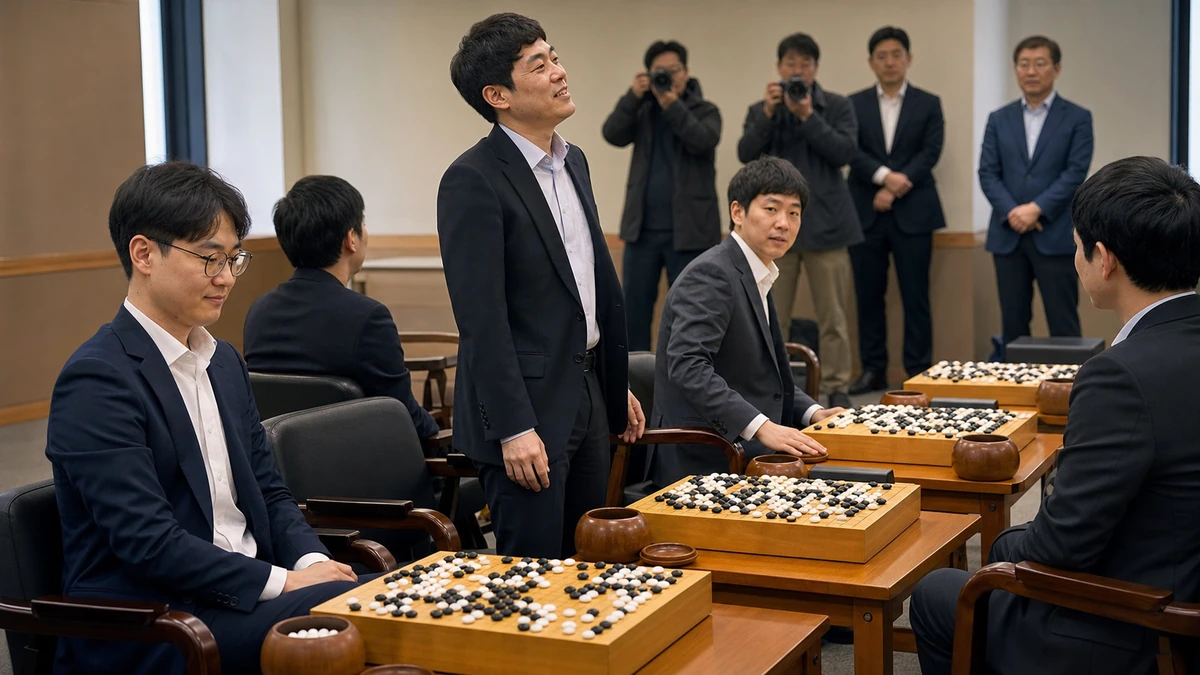
South Korea settles part of its team for a signature international Go showdown
Three of South Korea’s best professional Go players have won their way into the main event of the 28th Nongshim Shin Ramyun Cup, a team world championship that occupies a special place in the sport across East Asia. Park Junghwan, Shin Minjun and Ahn Sungjoon emerged from a fiercely competitive domestic qualifying tournament in Seoul this week, earning spots on the South Korean side for an event often described in Korea as the “Three Kingdoms” of Go — a shorthand for the long-running competitive triangle among South Korea, China and Japan.
To many Americans, Go remains far less familiar than chess, poker or even the recent boom in competitive esports. But in South Korea, top-level Go — known there as baduk — still carries the prestige of a classic mind sport, blending deep cultural tradition, national pride and elite competition. The Nongshim Cup, sponsored by the maker of the instant noodle brand Shin Ramyun, is one of the events where those elements come together most clearly. It is part sporting contest, part regional rivalry, and part showcase of the strategic depth that has made Go revered for centuries.
According to South Korean reports, the final round of the domestic selection tournament concluded Thursday at the Korea Baduk Association, or Korea Baduk Federation, headquarters in Seoul’s Seongdong district. Shin, ranked No. 3 in the country, secured his berth first by defeating Lee Jihyun, ranked No. 7, in the A group final on Wednesday. Ahn, ranked No. 10, followed with one of the most striking wins of the qualifying stage Thursday morning, defeating No. 4 Byun Sangil in the B group final. Later Thursday, Park, South Korea’s No. 2 player, beat Park Geonho, ranked No. 37, in the C group final to complete the trio of qualifiers.
Those results did more than settle three spots in the lineup. They helped clarify how South Korea intends to enter one of the most watched annual team competitions in Asian Go, with a roster that appears to balance star power, form and the simple fact that each player had to survive a pressure-packed one-game qualifying system. In a country where the upper tier of professional baduk is exceptionally crowded, there are few easy paths to an international team jersey.
Why this tournament matters beyond the niche world of Go
For readers in the United States, the Nongshim Shin Ramyun Cup may sound obscure at first glance, but its place in East Asian sports culture is easier to understand with the right comparison. Think of it as a hybrid of the Davis Cup in tennis, an all-star international chess team event and a rivalry series shaped by regional history. Players are not simply representing themselves; they are carrying the expectations of their national baduk communities, especially in South Korea, China and Japan, the three countries most associated with modern professional Go.
The tournament’s Korean nickname, sometimes rendered as “baduk samgukji,” or “the Three Kingdoms of Go,” evokes the classical East Asian idea of three great powers facing one another in prolonged rivalry. Americans may hear “Three Kingdoms” and think of epic novels, strategy games or dynastic history. In the Go world, the phrase signals something more contemporary: a recurring contest among neighboring countries with different styles, traditions and competitive legacies, all playing the same ancient board game at the highest level.
Baduk itself is the Korean name for Go, the abstract strategy game played on a 19-by-19 grid of black and white stones. The objective is to control territory and outmaneuver the opponent through shape, influence and timing. The rules are simple enough to explain quickly, but the game’s complexity is staggering. That complexity is part of what long made Go a symbol of intellectual discipline in East Asia, much as chess did in Europe and the United States. In recent years, Go also became globally recognizable because of artificial intelligence, especially after Google DeepMind’s AlphaGo defeated South Korean star Lee Sedol in 2016, a landmark moment in both technology and sports history.
That history matters here because South Korea remains one of the world’s top centers for professional Go, and international team events still resonate strongly with fans. Even in a media environment crowded by K-pop, streaming dramas, baseball and soccer, major baduk events retain a loyal following, especially when the stakes involve national representation. The Nongshim Cup may be sponsored by a household noodle brand, but that does not make it a novelty. If anything, it reflects a common East Asian model in which major corporations back serious sporting and cultural competitions, weaving them into everyday life.
Park Junghwan delivers what favorites are supposed to deliver
Of the three qualifiers, Park may be the most immediately recognizable name to international followers of the game. Long one of South Korea’s flagship players, Park has built a reputation as a world-class competitor capable of going deep in major events and handling the psychological burden that comes with elite status. His Thursday victory over the much lower-ranked Park Geonho was, on paper, the result many would have expected. In reality, it was the kind of game favorites can lose if they tighten up, misread a fight or let the moment get to them.
That is especially true in a domestic qualifier structured around must-win games. Rankings in Go matter, but they are not guarantees; they are snapshots of performance over time, not insurance policies for a single afternoon. A one-game final leaves no room for recovery, no second leg, no best-of-seven comeback. It is closer to a winner-take-all playoff game than to a long league season. Park’s win therefore mattered not just because he was supposed to advance, but because he successfully converted his status into a result when the stakes were narrow and unforgiving.
In South Korea, where the talent pool at the top is dense, fans and analysts often distinguish between reputation and recent proof. Park’s qualification offered that proof. It confirmed that one of the country’s highest-ranked players remains steady enough to claim a place through direct competition rather than by mere aura. That matters for a national team competition, where the gap between looking formidable on paper and actually surviving selection can be significant.
It also adds a measure of stability to the South Korean contingent. In team events, established stars carry strategic and symbolic value. They reassure fans, but they also shape how opposing countries think about matchups. Park’s inclusion signals that South Korea will not rely solely on emerging talent or automatic selections. At least in his case, one of its cornerstone players fought through the same qualifying pressure as everyone else and came out on top.
Shin Minjun gets there first and underscores the depth of Korea’s elite
If Park’s result reinforced the reliability of an established top-tier player, Shin’s victory highlighted the strength of South Korea’s internal competition. Shin, ranked No. 3, defeated the No. 7 player, Lee Jihyun, in Wednesday’s A group final, becoming the first of the three qualifiers to secure his place. That timing may seem like a small detail, but in a staggered qualifying process it gave Shin the distinction of setting the tone for the rest of the selection stage.
There is a particular kind of pressure in being first. Win, and you put your name on the board before anyone else. Lose, and the rest of the field moves on without you. Shin handled that spot well, taking care of business against an opponent who was hardly an easy draw. A matchup between the country’s No. 3 and No. 7 players is not a routine checkpoint; it is the kind of pairing that reminds outsiders how competitive Korean baduk remains even below the very top ranking.
For American audiences used to power rankings and seeded tournaments, the takeaway is straightforward: South Korea’s player pool is deep enough that a top-seven domestic clash can function as a gatekeeper just to reach an international event. That speaks to the country’s continuing seriousness about Go as a professional discipline. These are not ceremonial selections. Even highly ranked players have to earn their way through dangerous pairings.
Shin’s result also adds another important dimension to the South Korean roster: momentum. A player who secures qualification early in a high-pressure environment often carries a different kind of confidence into the main event. He is not waiting on others, not scoreboard-watching, not hanging on administrative decisions. He won his board, took his spot and moved on. In sports language Americans would recognize, he punched his ticket cleanly and early.
That matters because team events often hinge on poise as much as pure strength. The Nongshim Cup is famous for dramatic swings, long winning streaks and the psychological tension that builds as national lineups thin out. A player who arrives having handled domestic pressure well can be a stabilizing presence once international play begins.
Ahn Sungjoon provides the upset and the most dramatic image of qualifying
The most eye-catching result of the domestic selection tournament belonged to Ahn. Ranked No. 10 in South Korea, he defeated No. 4 Byun Sangil in Thursday morning’s B group final, earning what Korean coverage described as a win by resignation. In Go, that means the losing player concluded before the final counting that the position was no longer salvageable and conceded the game. For readers unfamiliar with the sport, this is closer to a resignation in chess than to a narrow defeat at the buzzer. It suggests the winner built a convincing enough advantage that the opponent saw no realistic path back.
That distinction matters because it helps explain why Ahn’s victory stood out. He did not merely edge out a higher-ranked player in a razor-thin finish; he earned a result that carried visible authority. In a qualifier where nerves can push players into cautious or erratic decisions, Ahn produced the kind of statement win that attracts attention from fans and rivals alike.
Upsets, of course, are a staple of sports everywhere. Americans see them in March Madness, in tennis majors and in NFL wild-card weekends. What made Ahn’s result notable in this case was not just the numerical gap between No. 10 and No. 4, but the setting. This was the final barrier to a prestigious international team event. Beating a higher-ranked opponent there instantly changes the narrative around a player. He is no longer just part of the national top 10; he is the man who took out a favorite when a ticket to the world stage was on the line.
In Korean baduk circles, such wins are often remembered because they reveal something rankings cannot fully capture: form under pressure. Rankings reflect accumulated results. A sudden, high-stakes head-to-head win reveals what a player can do in a single, unforgiving moment. Ahn’s qualification therefore adds intrigue to South Korea’s team picture. He may not have entered the final stage with the most attention, but he left it with one of the strongest storylines.
What these results say about South Korea’s selection system
Taken together, the three outcomes tell a story that goes beyond simple hierarchy. Two favorites — Park and Shin — validated their rankings by winning the games they were expected to win, even if those games carried significant pressure. Ahn, by contrast, overturned the ranking order and forced his way into the conversation. That combination is exactly what a credible selection system is supposed to produce.
In many sports, fan debates over national team rosters center on a familiar question: Should spots go to the biggest names, the highest-ranked performers over time, or the players in the best current form? South Korea’s baduk qualifying stage offered a practical answer. Reputations matter, but they are tested. Rankings matter, but they are not final verdicts. If a lower-ranked player can defeat a higher-ranked one in the defining game, the door is open.
That is one reason the selection process drew strong interest domestically. It was not a ceremonial parade of expected winners. It was a genuine competitive filter. Park and Shin demonstrated why they belong near the top of Korean baduk. Ahn demonstrated that the distance between the top four and the top 10 is not insurmountable when the match is played on the board rather than discussed on paper.
The process also highlighted the emotional texture of one-game qualification. Every athlete knows that a season’s worth of preparation can narrow to one performance. Golf has its Sunday back nine. Baseball has the elimination game. Go has qualifying finals where a single reading error, endgame slip or failed attack can end a campaign. The Korean players who advanced did more than show technical skill. They showed they could absorb that kind of concentrated pressure.
That quality could prove especially important once the international event begins. The Nongshim Cup has long rewarded players who can thrive in tense, highly symbolic situations. Because it functions as a national team competition among three historic rivals, every board carries emotional weight beyond ordinary tournament play. South Korea’s selectors and fans have good reason to value players who arrive battle-tested.
The broader Korean context: national pride, tradition and a changing sports landscape
Baduk no longer dominates the Korean public imagination the way it once did, particularly in an era when global K-pop acts, streaming content and mainstream professional sports command so much attention. Still, it remains an important cultural institution. The game is associated with discipline, patience and strategic intelligence, and top professionals can still become respected public figures, especially among older audiences and dedicated fans.
That enduring prestige helps explain why international team events continue to matter. In South Korea, competition with China and Japan in intellectual or technical fields often carries symbolic meaning. Go is especially suited to that role because it is both ancient and modern: a tradition-rich game now analyzed with AI-level precision, broadcast online to global viewers and discussed with a mix of reverence and cutting-edge tactical language. The Nongshim Cup captures that mix as well as almost any event on the calendar.
The sponsor’s identity is a piece of Korean context worth noting too. Nongshim is best known internationally for instant noodles, especially Shin Ramyun, which many American consumers now recognize from Asian supermarkets and mainstream grocery chains alike. For U.S. readers, the idea of a noodle company sponsoring a major sporting event may feel quirky at first, but it is entirely consistent with broader East Asian sports culture, where major consumer brands often underwrite top competitions in ways that become part of the event’s identity. In this case, the tournament name itself is inseparable from the sponsor.
There is also a soft-power dimension. The Korean Wave, or Hallyu, has made global audiences more familiar with South Korean music, film, beauty brands and food. Baduk is not a mass export on the scale of K-pop or Korean television dramas, but it is part of the same broader picture: a country whose cultural footprint extends from entertainment to cuisine to traditional intellectual pursuits. For Americans encountering the Nongshim Cup through the sponsor name alone, the event offers a reminder that Korean influence travels through many channels, not just pop stardom.
What comes next for South Korea’s lineup
With Park, Shin and Ahn through domestic qualifying, the outline of South Korea’s team is now much clearer. Korean reports indicated that world No. 1-level star Shin Jinseo is also part of the representative picture, giving the country a formidable blend of top-end strength and contrasting stories. That balance may be exactly what fans want heading into an event built on attrition, momentum shifts and national rivalry.
Each of the newly confirmed players arrives with a distinct narrative. Park represents proven excellence and the burden of expectation. Shin represents elite consistency and a clean, early qualification. Ahn represents disruption, opportunity and the reminder that no ranking list can fully script a one-game showdown. Together, they form a roster core with both reliability and edge.
It would be premature to predict the outcome of the international event based solely on these qualifiers. The Korean reports on the domestic tournament do not establish how the eventual games against China and Japan will unfold, nor do they offer evidence for broad forecasting beyond the obvious fact that South Korea has assembled a serious contingent. But that, in a sense, is enough for now. The purpose of qualifying is not to guarantee victory later; it is to ensure the players who advance have earned the right to try.
For American readers less familiar with baduk, the simplest way to view this week’s results is as the sharpening of a national team for one of East Asia’s most distinctive annual mind-sport rivalries. The games were played in quiet rooms, on wooden boards, with no body contact and little outward spectacle. Yet the stakes were unmistakably competitive: national representation, professional credibility and a place in a tournament where individual composure can resonate across an entire sporting culture.
In that sense, the story is bigger than three names on a bracket. It is about how South Korea continues to stage, value and narrate excellence in a traditional game that still carries modern meaning. Park Junghwan, Shin Minjun and Ahn Sungjoon did not simply survive a domestic qualifier. They advanced through a system designed to test whether prestige could hold, whether form could prevail and whether an underdog could seize the moment. By the end of two tense days in Seoul, all three answers were yes.
Comments
Post a Comment