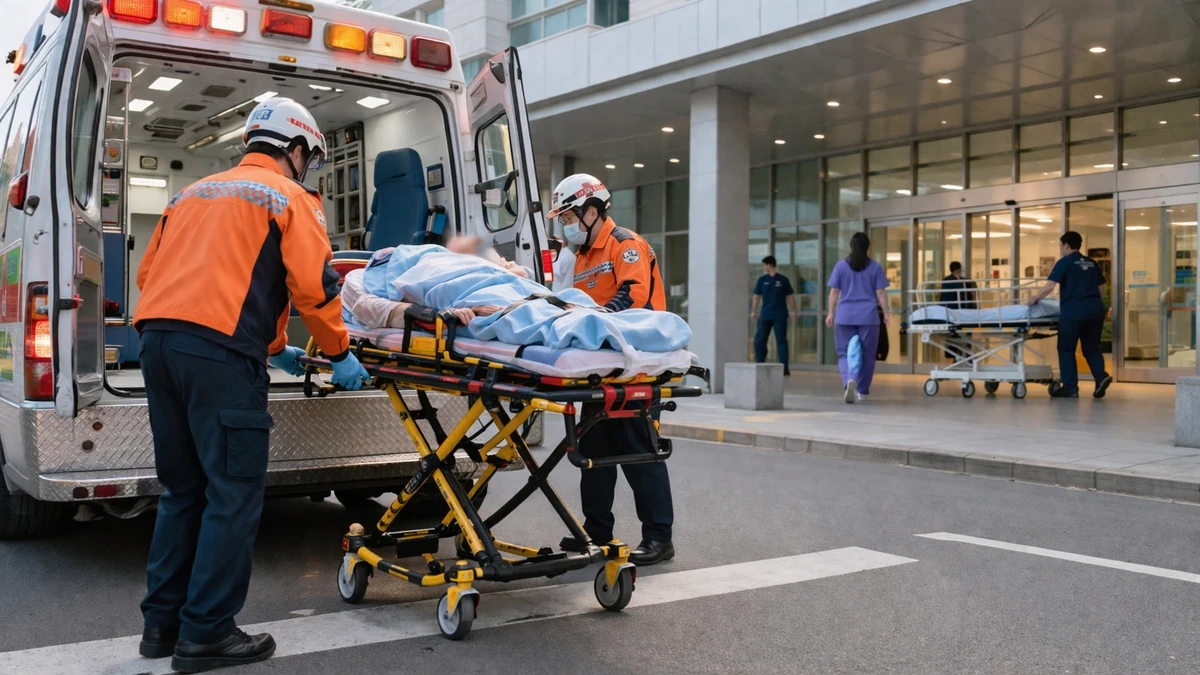
A tragedy in Daegu raises wider questions
A pregnant woman in Daegu, a major city in southeastern South Korea, was reportedly delayed in getting emergency transport and treatment, and one of her twins died in the process. The case, first reported by Yonhap News Agency, has shaken a country that is often praised abroad for its modern hospitals, universal health coverage and advanced medical technology. But as in the United States, impressive medical infrastructure on paper does not always guarantee that the right care is available at the right moment — especially in emergencies that require multiple specialists, an operating room and neonatal care to be ready all at once.
What has been confirmed so far is limited but deeply troubling: The incident happened in Daegu, the patient was carrying twins, emergency transfer was delayed, and one fetus died. Much remains unclear, including how long the delay lasted, whether hospitals declined to accept the patient, what bed capacity looked like in real time, and how communication unfolded among paramedics, dispatchers and hospitals. Those details matter, and they should be established carefully before assigning blame to any one institution.
Still, even without a full timeline, the case is exposing a broader structural problem in South Korea’s medical system: getting a high-risk pregnant patient to a hospital that can actually treat her can be far more complicated than simply calling an ambulance and heading to the nearest emergency room. In obstetric emergencies, minutes can shape outcomes for both mother and child. In a twin pregnancy, where risks are already higher, the margin for error is even thinner.
For American readers, a useful comparison may be the long-running concerns in the U.S. over so-called maternity care deserts — counties with no hospital labor and delivery services or no obstetric providers at all. South Korea is not facing the same geography as rural America, and Daegu is not a remote town. But the underlying challenge is familiar: specialized maternal care is only as strong as the network that connects patients, ambulances, operating rooms, obstetricians, anesthesiologists and neonatal intensive care units in real time.
This is why the Daegu case is not simply a story about an ambulance arriving late or a hospital being slow to respond. It is a story about what happens when a high-risk maternity transfer system appears unable to move fast enough in a moment when speed is the treatment.
Why high-risk pregnancy emergencies are different
Pregnancy emergencies are unlike most other medical emergencies because doctors are effectively treating two patients at once — and sometimes more than two, in the case of twins or other multiple pregnancies. The mother’s blood pressure, breathing, bleeding, signs of infection and overall stability must be monitored while the fetus or fetuses are simultaneously assessed for heart rate, oxygen deprivation and distress. A patient may appear stable on the surface while fetal status is worsening rapidly. Or what looks like a fetal complication may be tied to a sudden deterioration in the mother’s condition.
Twin pregnancies, in particular, carry elevated risks compared with single pregnancies. They are associated with higher chances of preterm labor, emergency cesarean delivery, fetal distress and complications involving the placenta or amniotic sac. That does not mean twins are unusual or automatically dangerous. But when an emergency does arise, the medical response typically has to be faster and more coordinated.
That coordination requires more than an available hospital bed. A hospital may technically have a patient room open and still be unable to accept a high-risk pregnant patient if the delivery room is occupied, the operating room is tied up, the obstetrician is already handling another emergency, the anesthesiology team is unavailable, or the neonatal intensive care unit — often called the NICU — cannot receive premature or distressed newborns.
For readers in the United States, think of the difference between showing up at a general hospital and being routed to a Level I trauma center. In both countries, some emergencies require specialized teams that cannot be improvised on short notice. High-risk obstetric care functions in a similar way. It demands a chain of readiness, not just a building with an emergency department sign on the door.
That is part of why emergency transfers involving pregnant patients can become so fraught. If ambulance crews must call several hospitals to find one that has not only space but also the full clinical team needed for a possible emergency delivery, every phone call becomes lost time. At night, on weekends or during holidays, the problem can intensify because staffing is thinner and hospitals may be juggling multiple emergencies at once.
What the Daegu case appears to reveal about the system
The most important lesson from the Daegu case may be that the bottleneck in maternal emergencies is often not a simple shortage of hospital beds. It is the absence of a functioning, real-time coordination system that tells first responders exactly where a high-risk obstetric patient can be treated immediately.
South Korea’s emergency medical system is widely used and generally accessible, but high-risk obstetric transfers sit at the intersection of several specialties: emergency medicine, obstetrics, surgery, anesthesia and neonatology. If any one link is missing, the transfer can stall. The summary of the Korean reporting suggests that this is precisely the concern under scrutiny: not only whether a hospital existed somewhere in the region, but whether the communication and referral pathway worked quickly enough to connect the patient to that hospital in time.
In practical terms, this means responders need to know more than whether a hospital is “open.” They need to know whether that hospital can perform an emergency C-section right away, whether a neonatal team is standing by, whether an intensive care incubator is available, and whether the required physicians are physically present or can arrive within minutes. If that information is not shared in a centralized, constantly updated system, paramedics and clinicians can end up relying on calls, callbacks and fragmented judgment in the middle of a crisis.
South Korea has wrestled in recent years with signs of strain in essential care fields, including emergency medicine, pediatrics, obstetrics and surgery. Much of the public debate has centered on physician shortages, payment systems and the concentration of top-tier care in major urban hospitals. In the case of maternity care, another trend matters: fewer hospitals nationwide are handling deliveries than in years past, and the burden of complex pregnancies is increasingly concentrated in designated regional centers.
That concentration can make sense from a quality standpoint. High-risk births generally have better outcomes when handled by experienced teams with advanced equipment. But concentration also creates vulnerability. When too much responsibility rests on too few hospitals, any staffing gap, overnight shortage or surge in patient volume can ripple outward quickly.
Daegu is large enough that many Americans might assume specialized maternity care would be easy to access there. That assumption is exactly why this case has resonated. If a breakdown of this kind can happen in a major metropolitan area, families are asking, what does that say about smaller cities, industrial towns or rural communities where resources are even thinner?
The regional divide behind the headlines
South Korea is a densely populated country with high-speed transportation and a reputation for urban convenience. To outsiders, that can create the impression that medical access is uniform. It is not. As in the U.S., where a patient in Boston or Chicago faces a very different medical landscape than someone in a sparsely populated county, South Korea’s healthcare access varies by region, specialty and time of day.
That divide is especially visible in obstetric care. Delivery-capable hospitals have declined in some areas, and high-risk care is concentrated at larger institutions. Even in metropolitan regions, patients may find that the nearest hospital is not equipped for a dangerous pregnancy complication. In smaller cities and rural areas, the problem can be more severe, with some communities lacking nearby facilities that can handle emergency deliveries or care for critically ill newborns.
For policymakers, this is not merely a question of infrastructure but of incentives. Maintaining around-the-clock teams for high-risk deliveries is expensive. Hospitals need obstetricians, anesthesiologists, surgical support staff, neonatal specialists and NICU capacity. Those services must be available 24 hours a day, even when patient volume is unpredictable. If reimbursement does not cover the cost of keeping such teams on standby, hospitals may struggle to recruit and retain the staff needed to sustain that readiness.
That challenge has echoes in the United States, where rural hospitals have closed labor and delivery units partly because childbirth services can be difficult to finance. South Korea’s health system is structured differently, but the pressure point is comparable: if the economics do not support essential maternity care, availability shrinks and emergency transfers become more complicated.
The Daegu incident also highlights a less visible regional issue: information asymmetry. In a crisis, what matters is not whether the region as a whole has enough beds on paper, but whether the ambulance crew and referring clinic know exactly where those resources are at that moment. A city may have multiple large hospitals, yet a patient can still lose critical time if nobody has an accurate real-time picture of where an obstetric operating team and neonatal support are immediately available.
What families can and cannot control
One reason stories like this are so unsettling is that they reveal how vulnerable patients and families can be during medical emergencies. A pregnant woman experiencing pain, bleeding, reduced fetal movement or sudden changes in blood pressure is often in no position to compare hospital capabilities on the fly. Family members may know which clinic handled prenatal visits, but not whether that facility can manage a late-night obstetric emergency or rapidly transfer a patient to a tertiary hospital.
In South Korea, as in the U.S., many expecting parents prepare birth plans, choose hospitals in advance and learn warning signs during prenatal care. For those with high-risk pregnancies — including twin pregnancies, suspected preeclampsia, a history of bleeding, placenta-related complications or risk of premature birth — advance planning can be especially important. That can include knowing which hospital is equipped for emergency delivery, which institution has neonatal intensive care, and what to do if symptoms begin outside normal clinic hours.
But there are limits to what individuals can reasonably prepare for. No family can independently verify minute-by-minute bed status across a city or coordinate physician availability during an emergency. That is why maternal transfer systems are fundamentally a public systems issue, not a private consumer choice issue. Telling families to “plan better” misses the core problem. Once an emergency starts, the outcome depends heavily on whether the regional medical network works as designed.
That distinction matters in public discussion. South Korean society, like many others, sometimes places heavy expectations on families to manage education, health and caregiving with extraordinary diligence. Yet obstetric emergencies are precisely the kind of moments when personal responsibility reaches its limit. When a patient calls for help, the rest depends on dispatch, ambulance services, hospital coordination and the availability of trained specialists.
The Daegu case underscores that uncomfortable truth. Even well-informed families can be overtaken by events when an emergency unfolds in real time. The real test is whether the healthcare system has anticipated that reality and built enough redundancy to respond.
What officials should examine next
As investigators and health authorities review what happened in Daegu, several questions will be crucial. When was the transfer request made? How quickly was the seriousness of the case recognized? How many hospitals were contacted, and what information did each provide? Was there a mismatch between reported and actual capacity? What was the mother’s condition at each stage, and how did the fetuses’ status change over time? Those details are essential not for assigning instant blame but for identifying the exact point where the process failed.
South Korean officials should also examine whether emergency dispatch systems treat high-risk maternity cases as a distinct category requiring specialized routing, rather than as standard emergency department referrals. Many clinicians have long argued that obstetric emergencies should not be layered onto general emergency workflows without dedicated protocols. A patient in possible labor distress, severe bleeding or fetal compromise cannot safely wait while first responders navigate a maze of phone calls to determine whether a hospital can assemble the proper team.
Another issue is whether designated regional centers for high-risk deliveries are supported well enough to function as true hubs, not merely hospitals carrying the title on paper. A center is only as effective as its staffing model. If a hospital is labeled a referral center but does not have reliable overnight anesthesia coverage, adequate neonatal staffing or protected surgical capacity, then the designation can offer false reassurance.
Real-time data sharing is another obvious reform area. If ambulance crews, local emergency rooms and obstetric clinics had access to a common dashboard showing delivery room status, operating room readiness, NICU availability and on-duty specialist coverage, transfer decisions could be made much faster. Building such a system would require technical investment and administrative cooperation, but the alternative is the status quo: precious minutes spent trying to confirm basic facts during a crisis.
There is also a workforce dimension that cannot be ignored. South Korea’s broader healthcare debates have often focused on physician supply and the distribution of specialists. Whatever the outcome of those debates, the Daegu incident illustrates that maternal and neonatal emergency care depends on a team, not a single doctor. That means any reform must address nurses, anesthesiology support, surgical personnel and neonatal specialists, along with compensation structures that make 24-hour readiness sustainable.
A modern healthcare system is measured by its weakest handoff
The death of one twin in Daegu is, first and foremost, a personal loss — the kind that leaves a family grieving a child who was expected, named or imagined, and now is not coming home. It is also a public warning. South Korea is one of the world’s lowest-fertility countries, and the safety of pregnancy and childbirth carries unusual social weight in a nation deeply anxious about its demographic future. In that context, each failure in maternal care lands with added force.
For an American audience, this story may feel both far away and familiar. The institutions are different, the language is different, and South Korea’s healthcare system is not organized like America’s patchwork of private insurers, public programs and hospital networks. Yet the underlying lesson crosses borders. A healthcare system is not judged only by how advanced its flagship hospitals are. It is judged by whether a patient in distress can move smoothly from first call to definitive treatment without falling through the cracks between agencies, departments and institutions.
That is especially true in obstetric emergencies, where time can change everything and where the success of treatment depends on coordination as much as clinical skill. The Daegu case appears to have exposed a weak handoff somewhere in that chain. Whether the breakdown occurred in dispatch, hospital acceptance, staffing, information-sharing or some combination of all four, the implications go beyond one city and one day.
South Korean authorities will need to establish the facts carefully and resist the temptation to reduce the episode to a single villain or a single broken rule. The larger issue is whether the country’s high-risk maternal transfer system is robust enough to handle real-world emergencies, including those that strike at night, during staffing shortages or in hospitals already stretched thin. If the answer is no, then the Daegu tragedy should become more than a headline. It should become a catalyst for redesign.
For families, clinicians and policymakers alike, the question now is simple and urgent: When the next high-risk pregnant patient needs immediate care, will the system know exactly where to send her — and will a fully prepared team be waiting when she arrives?
Comments
Post a Comment