Hyundai Capital Stays Alive in Korea’s Volleyball Finals, but Officiating Dispute Adds Heat to a Shifting Series
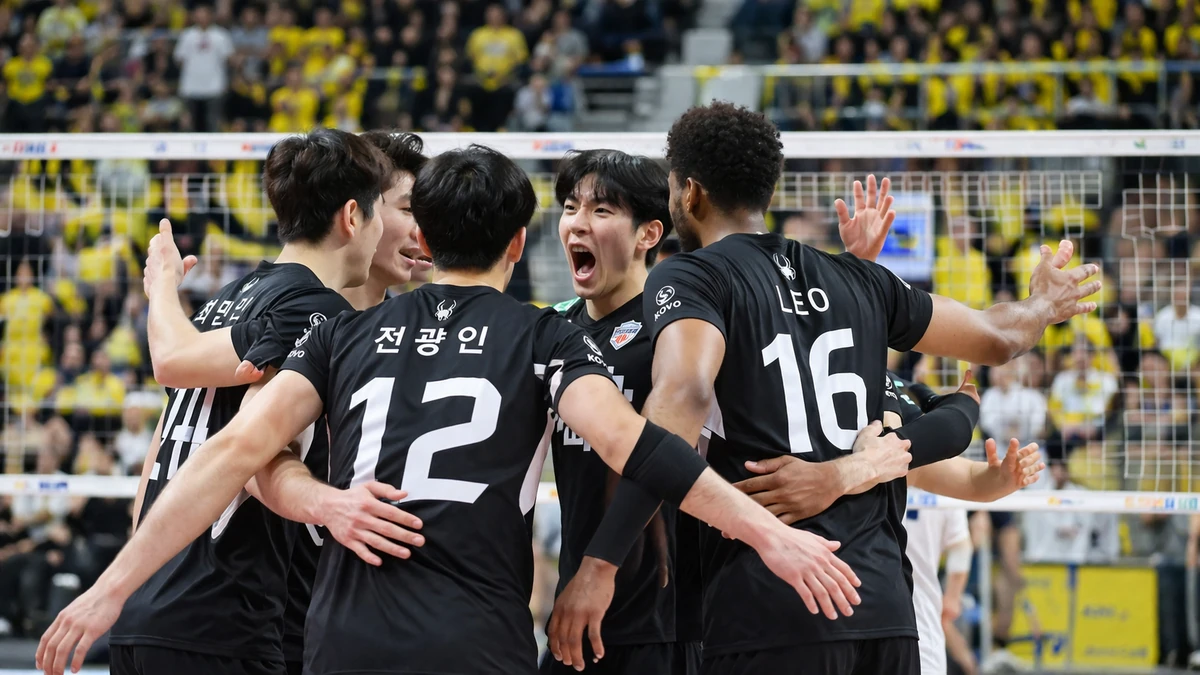
A finals series that suddenly feels alive again
For two matches, South Korea’s men’s volleyball championship series looked as if it might be headed for a quick and decisive finish. Hyundai Capital, one of the country’s best-known professional volleyball clubs, had fallen into an 0-2 hole, the sort of deficit that can make a short postseason series feel less like a contest than a countdown. Then came the response: a first win, a fresh pulse of momentum and, just as important, a reminder that championship series often turn not only on talent, but on emotion, perception and the ability to steady a team when everything around it feels loud.
That is where this series now stands. Hyundai Capital’s victory did more than keep its title hopes alive. It changed the conversation. What had been shaping up as a one-sided coronation has instead become a drama about resilience, officiating and the psychology of a team trying to climb back into a championship fight. In the aftermath, star players Heo Su-bong and Leo said, with a bravado that was impossible to miss, that they are “specialists in reverse sweeps” — essentially saying they believe they can lose the first two games and still win the series. Their coach, Philippe Blain, offered a more measured note, apologizing for previous remarks and saying he would refrain from letting emotion drive his public comments.
To American sports fans, the outline will sound familiar even if the setting does not. Think of a team in the NBA playoffs or Stanley Cup postseason finally stopping the bleeding after two losses, then emerging from the locker room not just with a win, but with a new message: this series is not over, and neither is the public argument around it. That is what Hyundai Capital has achieved. One victory does not erase the damage of two earlier defeats, but it can interrupt the emotional rhythm of a series. In volleyball, where confidence and tempo matter almost point by point, that interruption can be powerful.
And this was not a quiet reset. The match was followed by controversy over officiating, renewed scrutiny of how the league manages big-stage pressure and a debate over how much one disputed decision can shape a result without fully defining it. In that sense, Hyundai Capital’s first win became more than a box-score event. It became a pivot point — for the team’s mood, for the way fans are framing the series and for a league that now has to show that its championship showcase can handle both intensity and criticism.
That combination is what makes the next phase of this series especially compelling. Hyundai Capital has created a reason to believe. But belief, in postseason volleyball, is only the beginning.
Why one win matters so much in volleyball
Volleyball can be deceptive to casual American readers because, unlike football or baseball, it does not always lend itself to simple, familiar momentum markers. There is no clock to bleed and no pitcher to chase early. Instead, the sport is built around rhythm: serve pressure, serve receive, the setter’s choices, the confidence of outside hitters and the emotional chain reaction that can begin with a single point. That is why a team down 0-2 in a championship series is in such a delicate position. It is not just trailing in wins. It is at risk of being dragged into a mental script in which every bad bounce feels preordained.
Hyundai Capital’s first victory mattered because it disrupted that script. In practical terms, it cut into the deficit. In psychological terms, it gave the team and its supporters evidence that the series can still be bent in a different direction. That distinction matters. Coaches and players often talk about “proof” in the postseason — proof that a tactical change works, proof that a matchup can be managed, proof that the opponent is not untouchable. Hyundai Capital now has that proof, however limited. It has shown it can win under pressure and force the other side to confront a new reality: the easy sweep never came.
Championship rounds in Korean volleyball carry a concentrated intensity because the margins are so small and the spotlight, relative to the sport’s normal routine, becomes much brighter. South Korea’s V-League does not command the global attention of the NBA or English Premier League, but domestically, the finals serve as a major showcase for the league’s quality and commercial appeal. When a series tightens, interest rises quickly. Fans begin parsing substitutions, replay reviews and even body language on the bench. One win can therefore do something important beyond the standings: it can reopen the imagination of the audience. Suddenly, viewers are no longer watching the end of a procession. They are watching a contest again.
That is likely the biggest immediate gain for Hyundai Capital. The club has not yet reversed the series. It has merely restored suspense. But in a playoff environment, suspense is currency. It affects the opponent’s calm, the home crowd’s energy and the pressure felt by players who may have thought they were one clean step from a trophy. If this sounds like the sort of intangible that television analysts overstate, consider how often championship teams in any sport describe turning points not in terms of dramatic speeches, but in terms of getting one game that changed the feeling in the room. That is the opening Hyundai Capital has created for itself.
The officiating controversy and the larger question of trust
If the victory gave the series new energy, the officiating dispute gave it friction. That controversy has become one of the central storylines around Hyundai Capital’s win, not because disputed calls automatically invalidate a result, but because in a championship setting every close decision becomes magnified. In volleyball especially, a single ruling can alter more than the score. It can change substitution choices, increase bench frustration and affect how aggressively a team serves or attacks the next few rallies. Fans do not merely remember the call itself. They remember what happened after it.
This is a dynamic American sports audiences know well. A controversial pass interference flag in the NFL, a disputed strike zone in October baseball or a replay review in March Madness can all take on lives of their own because the argument is not only whether the call was right. It is whether the moment changed the emotional temperature of the game. Korean volleyball is no different. In this series, the officiating issue has lingered because supporters, commentators and league observers are asking the same question fans everywhere ask after a contentious call: what did that moment set in motion?
There is an important distinction here. To acknowledge controversy is not to say the entire match was decided by officiating. Volleyball results are built from many layers — serving consistency, reception stability, efficiency on attack, blocking discipline and error control. Teams win because they perform across those layers, not because of one moment alone. Still, championship sports are shaped by perception as well as execution, and when a disputed decision lands in a tense match, perception can become part of the event itself. The call enters the story, and the story follows the series into the next game.
That raises a bigger issue for the league. Finals are not just about crowning a champion. They are a public test of organizational credibility. Leagues sell their postseason as the moment when quality, fairness and drama come together. If officiating becomes the main topic, even temporarily, the burden shifts to the league to show that its systems are clear, transparent and consistent. That means the mechanics of video review matter. The explanations offered by officials matter. The standards for bench protests and sideline conduct matter. The more a series stretches on, the more those institutional details become part of the league’s brand.
For Korean volleyball, this is not a trivial concern. The V-League has spent years building its audience in a crowded sports market where baseball and soccer draw significant attention and where global entertainment exports often overshadow domestic leagues. Its championship round is one of its best chances to present itself as polished and compelling to casual viewers. A controversy-laden series can still attract viewers — sometimes even more of them — but only if the competition itself continues to feel trustworthy. That is the delicate balance now facing the league.
Coach Philippe Blain’s apology and the role of leadership under stress
That context helps explain why Coach Philippe Blain’s public apology stood out. In the aftermath of a contentious stretch, Blain said he was sorry for his remarks and would avoid speaking in ways driven by emotion. In some sports cultures, especially in the United States, a coach’s refusal to back down is often celebrated as evidence of toughness. But there is another model of leadership, one that becomes particularly valuable in a playoff series: reducing noise so that a team can focus on the next tactical problem in front of it.
Blain’s apology does not necessarily signal softness. If anything, it suggests a recognition that words from the bench can either stabilize a team or scatter its attention. Coaches in volleyball are not only tacticians. They are emotional traffic controllers. They decide when to challenge, when to calm a star, when to push and when to protect a lineup from spiraling after a bad run of points. If the coach becomes consumed by the external argument — officiating, public criticism, bench-to-bench tension — the players often follow. In a championship series, that can be costly.
There are really two audiences for a coach’s public comments. The first is internal: the players and staff, who hear whether their leader wants to dwell on grievance or redirect energy toward execution. The second is external: referees, opponents, fans and media, all of whom interpret tone as strategy. By apologizing, Blain appeared to be telling both audiences the same thing. Internally, he was signaling that Hyundai Capital needs to spend less emotional energy on complaint and more on repeatable volleyball. Externally, he was indicating that he does not want the series to become defined by escalating rhetoric.
That may prove wise. Anger can be useful in short bursts, but postseason series are marathons disguised as sprints. A bench that stays emotionally overheated tends to make poorer decisions in the moments that require clarity: a video challenge request, a substitution at a fragile rotation, a timeout used either one rally too early or one rally too late. Those small decisions add up. In that sense, Blain’s apology may end up being less about public relations than about preserving the team’s operational sharpness.
There is also a cultural dimension worth noting for English-speaking readers. Korean professional sports, like many sports cultures, place real emphasis on public composure and responsibility in leadership roles. Coaches are expected to project control, especially on high-profile stages. That does not mean they cannot be fiery. It means that when controversy spills into the open, a public effort to restore order can carry weight. Blain’s comments fit that tradition. He was not surrendering the competitive edge. He was trying to move the battle back onto the court.
Heo Su-bong, Leo and the appeal of reverse-sweep confidence
If Blain’s tone was about restraint, the players’ tone was about defiance. Heo Su-bong and Leo saying they are “specialists in reverse sweeps” is exactly the kind of line that can electrify supporters and raise eyebrows at the same time. In plain American sports language, it is the equivalent of saying: count us out if you want, but we think we can still flip this entire thing. That kind of statement is part confidence, part self-motivation and part message to the other side that no one inside Hyundai Capital sees the series as slipping away.
It also reflects a basic truth of postseason competition. Teams facing elimination or near-elimination cannot afford passive language. The real danger is not only being down in games. It is allowing a sense of inevitability to take hold. Veteran players know this, and they often use public remarks to shape the emotional climate around the locker room. A bold quote can function almost like a team slogan. It gives teammates something to rally around and gives fans a phrase to carry into the next match.
Still, reverse sweeps are easier to sell than to execute. Anyone who follows playoff sports knows the appeal of the comeback narrative. Americans have seen it romanticized in everything from the Boston Red Sox erasing a 3-0 series deficit against the Yankees in 2004 to countless NCAA tournament runs that seemed improbable until they were no longer improbable at all. But those stories tend to flatten the mechanics behind them. Comebacks are not made of confidence alone. They are built from better serving, cleaner first contacts, more disciplined defense and steadier responses to pressure. Volleyball may be especially unforgiving in this regard because rhythm must be recreated every match.
For Hyundai Capital, that means Leo cannot simply be a rescue scorer and Heo cannot be only a symbolic leader. Their confidence has to be connected to systems that hold up over multiple matches. Leo, a proven offensive weapon, can calm a team in crisis by turning broken plays into points. But championship opponents adjust quickly, and heavy dependence on one finisher becomes harder to sustain as scouting sharpens and fatigue accumulates. Heo’s role is therefore equally important. He has to contribute not only with scoring but with emotional steadiness and with the kind of two-way presence that helps a team survive rough stretches instead of merely erupting for highlight moments.
Their comments also create a new pressure point. Bold predictions feel empowering when the next match starts well. They can feel burdensome if the team falls behind early. That makes the opening stages of the next contest crucial. If Hyundai Capital starts strong, the players’ words will sound prophetic. If it stumbles, those same quotes may be recast as overconfidence. That is the gamble of speaking boldly in public. It can change a team’s energy, but it also raises the stakes of the next performance.
What Hyundai Capital must actually change to keep the comeback going
The broader strategic challenge for a trailing team in a championship series is not simply to “play harder.” By the time a finals matchup reaches this stage, effort is assumed. The question is where meaningful adjustments can still be found without overhauling so much that the team loses its identity. That is Hyundai Capital’s task now.
In volleyball, the first place to look is usually the serve-and-receive battle. Serving pressure can distort an opponent’s offense before a set is even formed, while stable reception gives a setter the freedom to spread the attack and keep blockers guessing. If Hyundai Capital can continue to serve with purpose — not just forcefully, but intelligently — it can make the other side’s offense more predictable. That, in turn, improves block timing and back-row defensive reads. It is often a chain reaction rather than a single fix.
Error management is another key. Comeback teams often want dramatic swings, but postseason matches are frequently won by the side that trims its avoidable mistakes by a small but meaningful margin. A missed serve at a bad moment, a miscommunication in transition, a rushed attack into a set block — these are the details that decide tight sets. Hyundai Capital’s first win provided emotional lift, but if that lift is to become a real series turn, it needs to be translated into calmer execution rather than adrenaline alone.
There is also the matter of variability. Once an opponent has won two matches in a series, it has patterns it trusts. That means the trailing team must alter the picture just enough to create hesitation. In volleyball, these changes are often subtle: targeting a different receiver with the serve, changing the pace of a certain rotation, adjusting block responsibilities against a favored hitter or altering early-set play calls to establish different rhythms. Sweeping tactical revolutions are rare this late in a series. More often, coaches win by making selective disruptions that force the opponent to rethink what had felt comfortable.
Just as important, Hyundai Capital has to carry over its renewed confidence without letting the drama of the comeback story become a distraction. Reverse sweeps make for great television and irresistible headlines, but teams that actually pull them off usually do so through plain, repeatable work. They reduce errors by a handful. They survive one rotation that used to sink them. They respond better after a controversial review. They keep their composure when the crowd shifts or the officiating discussion flares again. That is what a comeback really looks like in volleyball: not one cinematic burst, but a sequence of disciplined corrections.
That is why this series now feels more interesting than it did a few days ago. Hyundai Capital’s win has reopened the tactical battle, reignited the psychological battle and intensified the conversation around officiating and leadership. The result is a finals matchup that now asks several questions at once. Was this merely a temporary reprieve, or the beginning of a genuine reversal? Can the league manage controversy without letting it overshadow the sport? Can Blain keep the emotional climate under control while his players channel belief into execution?
For American readers, the easiest way to understand the stakes is to think of a playoff series that suddenly stops being predictable. That shift is what fans crave, whether the sport is basketball, hockey or volleyball in South Korea. Hyundai Capital has not completed the comeback. It has only earned the right to try. But in championship sports, that right can be everything. One win can change a bracket. More often, it changes something less visible but just as important: the sense of what is possible. And right now, possibility is back in this series.
Comments
Post a Comment