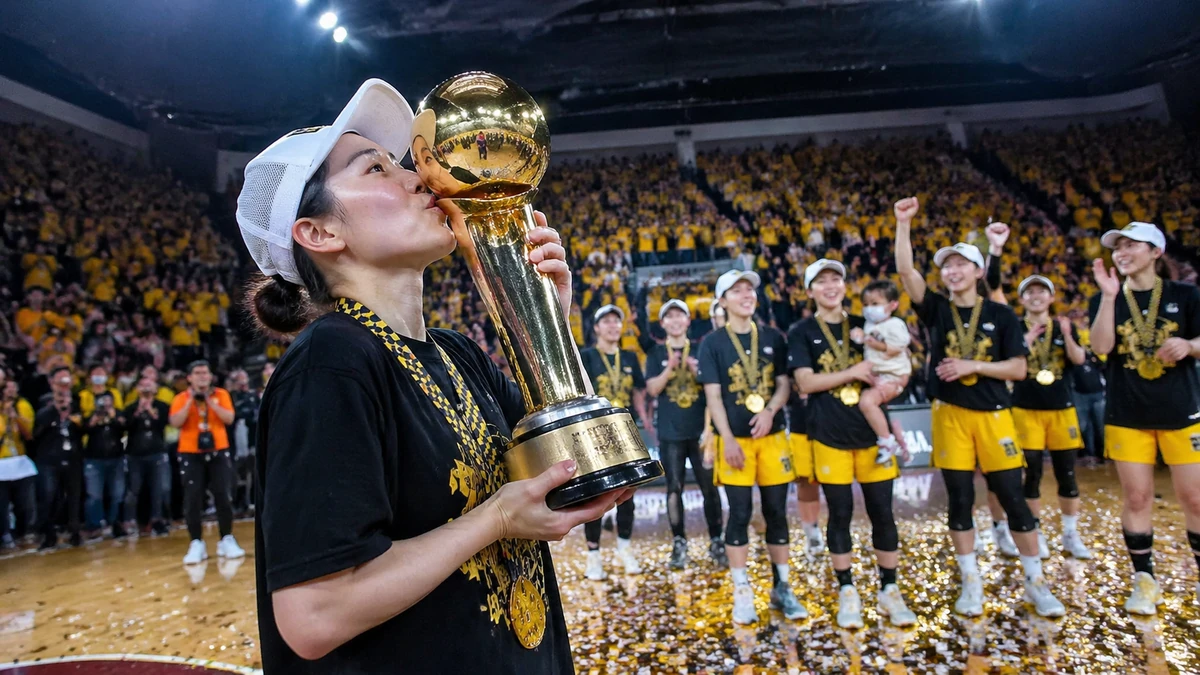
A championship story bigger than one trophy
In American sports, fans love a familiar arc: the rookie who once watched from the edge of the spotlight grows into the player who decides the biggest games. It is the kind of story that turns a championship from a result into a memory. In South Korea’s women’s professional basketball league, that story now belongs to Heo Ye-eun.
Heo, a 24-year-old guard for the Cheongju KB Stars, has emerged as the defining figure in the club’s return to the top of the Women’s Korean Basketball League, or WKBL. After experiencing a title run as the team’s youngest player during the 2021-22 season, she came back four years later not as a promising understudy, but as the floor leader and Finals MVP of a championship team. In Korea, the title often used for that role is “field commander,” a phrase that may sound dramatic to American ears but maps neatly onto a familiar basketball idea: the point guard who sees the whole game a beat ahead of everyone else.
That is what made this moment resonate beyond the box score. Heo’s rise was not framed simply as a hot streak, a timely scoring binge or a feel-good award handed out after a title celebration. Teammates and coaches described something more durable. They saw a player who reads the court, manages tempo, steadies the team in stressful moments and, just as important, lives the game with an intensity that earns trust over a long season.
For American readers less familiar with the landscape of Korean women’s basketball, the WKBL is a relatively compact league compared with the WNBA or major men’s leagues in the United States. That smaller scale often makes personality, team culture and continuity matter even more. A team’s identity can be shaped less by roster churn and more by how players grow into roles over several years. Heo’s story fits that pattern. Her development mirrors KB Stars’ own attempt to bridge one championship generation to the next.
And in a sports culture often drawn to gaudy scoring totals and viral highlights, her rise offers a reminder that winning teams are usually organized around something less flashy. In the biggest games, there is enormous value in the player who controls rhythm, recognizes danger before it arrives and makes everyone else function more cleanly. That player, for KB Stars, was Heo.
Why Heo’s rise matters in Korean basketball
On paper, Heo’s transformation can be summarized in a sentence: youngest player on a title team in 2021-22, centerpiece of another championship and Finals MVP in 2026. But in Korean basketball, and especially in women’s basketball, that shift carries extra weight because of how team hierarchies are understood.
South Korean sports culture still places strong emphasis on seniority and role definition. The youngest player on a roster is often referred to as the “maknae,” a Korean term that simply means the youngest member of a group but carries a broader social meaning. In practice, it can suggest lower status, a learning role and a duty to observe before commanding attention. The maknae is often expected to absorb the culture before shaping it.
That context makes Heo’s progression especially striking. She did not merely improve statistically or gain more playing time. She moved from the edge of a championship experience to the emotional and tactical center of one. For fans in the United States, an easy comparison might be a young guard who once played alongside veterans during a title run and later grows into the player who controls the Finals. It is not just that she was there for both championships. It is that her place in the story changed completely.
In the recent championship series, Heo was described not as someone filling minutes but as the guard who brought order to the floor. That distinction matters. Basketball’s glamour often belongs to the scorer who takes over in the closing minutes. But coaches and teammates know that title games frequently hinge on subtler choices: when to push pace, when to slow down, when to attack a weak matchup, when to settle a rattled teammate, when to keep a lead from becoming fragile. Those responsibilities often belong to the point guard, and they become more visible in a high-pressure series.
That is why the Finals MVP label feels so significant in her case. The award can sometimes go to the player with the most obvious offensive fireworks. Here, it stood for something closer to game governance. Heo’s value was tied to command, composure and continuity. She was the player organizing the connections between defense and offense, urgency and patience, system and improvisation.
Her emergence also says something about the league itself. Women’s basketball in South Korea has long produced star bigs and prolific shooters, but teams still need organizers, players who turn talent into a sustainable style. When a young guard becomes the unmistakable nerve center of a championship club, that can signal a healthy evolution not only for a team but also for the league’s competitive identity.
The kind of player teammates notice first
Some of the most revealing details about Heo’s season did not come through official statistics. They came through the way her teammates talked about her.
According to the reported interview, veteran teammates Kang I-seul and Park Ji-su emphasized not one signature move or one technical skill, but her relationship with basketball itself. Kang said it seemed as if basketball was the only thing in Heo’s life. Park described her as someone deeply immersed in the sport, a player whose love for the game was obvious to anyone around her.
In an American locker room, comments like that might be interpreted as cliché praise. In reality, players often reserve their strongest endorsements for precisely this kind of testimony. Teammates see the details outsiders do not: how a player handles repetition, how quickly she resets after a bad possession, how she reacts when a practice drill is not going well, whether she watches extra film, whether she asks the right questions, whether her competitiveness sharpens the room or drains it.
That is the substance beneath phrases like “she lives basketball.” It is not merely about obsession in the romantic, highlight-reel sense. It is about reliability. It means the player’s daily habits align with the demands of winning. It means the player is still attentive after fatigue sets in, still curious after success arrives, still accountable when mistakes happen in public.
That kind of approval matters even more in a team sport where trust is cumulative. Coaches can assign roles, but teammates decide whom they truly believe in when a game gets tense. A point guard, perhaps more than any other position, depends on that trust. She touches the ball, calls actions, dictates pace and asks others to follow her read of the game. If the locker room does not buy in, the system eventually frays.
Heo appears to have earned that belief not through volume or self-promotion, but through consistency. That makes her rise especially compelling in the current sports media environment, where fame is often measured by visibility first. There is a quieter kind of star power in being the player teammates trust most when everything speeds up. Korean coverage of Heo’s championship has leaned into that idea, presenting her MVP not as a surprise flourish but as the visible reward for a long accumulation of invisible work.
For American audiences accustomed to hearing veteran NBA and WNBA players talk about “hoopers” — the people who are always in the gym, always thinking the game — this portrait will sound familiar. The details are Korean, but the credibility is universal.
How a point guard can shape a title without dominating headlines
One of the most useful ways to understand Heo’s championship impact is to think about the difference between starring in a game and controlling it. Those are not always the same thing.
American sports coverage often gravitates toward points, especially in postseason settings. It is easy to understand why. Big scoring performances are legible, dramatic and easy to package. But coaches have always known that a championship series can tilt because of someone whose contribution is more structural. The player who manages spacing, dictates tempo and prevents a bad stretch from turning into a collapse can be every bit as valuable as the player who puts up the biggest number.
That is where Heo’s role became central. She was praised for reading the court, changing the flow of games and setting the team’s speed. Those descriptions point to a guard whose influence extended across possessions, not just through isolated highlights. If one wants an American reference point, think of the point guard who may not lead every night in scoring but consistently decides what kind of game is being played. Is it fast or patient? Chaotic or controlled? Reactive or intentional? Those questions often determine postseason outcomes.
Under pressure, the value of that role only increases. When defenses tighten and every possession carries more emotional weight, teams need someone who can keep the offense coherent. A point guard in those moments is expected to be the team’s hands, feet and brain at once. She must attack without rushing, calm others without becoming passive and make hard decisions before the defense fully reveals itself.
That seems to be why Heo’s MVP case resonated so strongly. Her stardom was not presented as spectacle. It was presented as stewardship. She embodied the order of a championship team. In other words, she was not simply the player producing winning plays. She was the player making winning basketball possible over the course of a series.
There is also something culturally notable in how that role is being celebrated. Korean sports media, much like American media, can be drawn to marquee names and decisive moments. But there remains deep appreciation in basketball circles for players who represent discipline and orchestration. Heo’s MVP is compelling precisely because it validates a form of excellence that can be harder to dramatize. It says that the engine room deserves the spotlight, too.
For a women’s league seeking wider recognition, that matters. Stars do not all have to fit the same template. A league becomes richer when it can elevate not only dominant scorers and towering centers, but also cerebral guards whose greatest skill is making the entire game make sense.
The locker room message that helped define KB Stars
Heo’s rise did not happen in a vacuum, and neither did the championship. One of the more revealing details to emerge from the team’s interviews involved a phrase written on the locker room board: “We can win. Why not?”
That line, shared by teammate Kang I-seul, became a kind of touchstone for the team during moments when its momentum wavered. In an American context, locker room slogans can sound corny when repeated after a victory, but they can also serve a real function. Across sports, teams use short phrases to compress belief into something repeatable. The best ones are not magical spells. They are reminders of identity.
The significance of “Why not?” lies in its modesty. It does not guarantee success. It pushes back against doubt. When a team falls behind a rival in the standings, loses form or starts to question whether a title is realistic, the first battle is often against hesitation. Why not us? Why not now? Why not this group? Those are familiar questions in every sports culture because they speak to the emotional side of competition that statistics alone cannot solve.
In the reported account, the phrase gained strength as players kept returning to it and as the team slowly saw evidence on the floor that it was still capable of winning the whole thing. That process matters. Confidence in sports is rarely a single surge. More often, it is repetition: of language, of habits, of possessions, of recovered composure after setbacks. A championship culture is usually built through that repetition.
Heo’s development looks even more meaningful when placed inside that environment. She was not portrayed as a solo phenomenon bursting out independently from the rest of the team. She grew within a collective culture of belief and accountability. Her brilliance, in that sense, was relational. It became more visible because the group around her trusted her, challenged her and moved in the same direction.
This is one reason championship stories often land so well with audiences. Fans may come for the star, but they stay for the ecosystem around that star. The language on the board, the habits in practice, the teammates’ testimony, the emotional rebound after midseason doubts — all of those pieces make a title feel earned rather than accidental. In KB Stars’ case, they also help explain why Heo’s MVP has been embraced not as a random culmination, but as the clearest face of a shared project.
Why this resonates beyond South Korea
For readers in the United States, it may be tempting to see this as a niche story from a foreign league. But the emotional logic of it is instantly recognizable.
Sports, at their best, travel well. The uniforms, league structures and media ecosystems change, but the core themes do not. A young player grows inside a winning program. Years later, she becomes the player her team leans on most. Veterans publicly affirm that her greatest quality is not flash but devotion. The team rallies around a simple belief when its season starts to wobble. A championship follows. That story would make sense in Indianapolis, Storrs, Los Angeles or any city where basketball matters.
It also arrives at a moment when women’s basketball, globally, is receiving more sustained mainstream attention. In the United States, that conversation has been shaped by surging interest in the WNBA, major college stars and broader debates about investment, visibility and audience growth. South Korea’s women’s league exists in a different market, but it faces some of the same questions: How do you build long-term fan attachment? What kinds of stars move casual audiences? What stories endure beyond a single game?
Heo offers one answer. Fans are drawn to skill, but they stay attached to narrative. The image of the former youngest player becoming the championship’s central force is easy to grasp and easy to remember. It is the kind of progression sports fans instinctively admire because it reflects both patience and payoff.
There is another layer here, too. In many leagues, especially women’s leagues that fight for attention against bigger commercial rivals, credibility is built not only by celebrity but also by authenticity. A player described by teammates as someone wholly devoted to basketball carries a kind of moral authority. She represents the seriousness of the league itself. Her success becomes evidence that the competition matters, that the work is deep and that the stars are not manufactured by marketing alone.
That may be why Heo’s public remarks about wanting to help grow women’s basketball in Korea have landed with particular force. Rather than treating the title as a private achievement, she has tied it to something larger — the health and future of the sport. American audiences have seen similar moments before, when a breakout athlete becomes not just a winner but a messenger for her league. It is one of the most powerful transitions in sports culture because it turns a personal ascent into a public invitation.
The new face of a league, and what comes next
Every league benefits when a championship creates not just a victor, but a face. This season, South Korean women’s basketball appears to have found one in Heo.
She is young enough to represent the future, accomplished enough to command immediate attention and grounded enough to be credible when she talks about the sport beyond herself. The details of her story make her accessible: once the maknae, now the MVP; once learning what a title looked like from the margins, now directing one from the middle of the floor. The basketball details make her persuasive: a guard who organizes rather than merely entertains, who makes pressure look manageable, who wins the trust of teammates by treating the game as a craft rather than a stage.
That combination gives women’s basketball in Korea something valuable. Not every star must be a cultural phenomenon on the scale of a global pop icon. Sometimes what a league needs is a player who gives fans a clear reason to invest week after week: because she is excellent, because her growth feels real and because her team’s success reflects more than one hot month.
For American readers, there is also a broader Korean Wave angle worth noting. Much of the world’s attention toward South Korea still flows through entertainment — K-pop, Korean dramas, film and beauty culture, to name the most obvious examples. Sports stories like this one expand that picture. They show a different side of Korean public life, one where local leagues, regional pride and team-centered narratives still carry real social energy. Cheongju, a city south of Seoul, is not exported globally the way Seoul’s entertainment machine is, but its basketball team can still produce a story with universal pull.
In that sense, Heo’s championship is both local and translatable. It belongs deeply to Korean basketball culture, with its emphasis on collective trust, role evolution and earned hierarchy. But it also speaks in a language any serious sports fan understands. Talent matters. Timing matters. But love of the game — proven daily, not proclaimed once — is often what separates a good player from the one who can hold a championship team together.
That is why Heo Ye-eun’s rise feels larger than a single award. Finals MVP is the headline. The deeper story is the making of a leader, the reaffirmation of team culture and the arrival of a player who now seems positioned to shape the next chapter of women’s basketball in South Korea. Four years after seeing the summit as the youngest player in the room, she returned as the one guiding everyone else there.
Comments
Post a Comment