
A new kind of arms race in cancer research
For years, the public story of cancer drug development has been easy to grasp: A company finds a promising molecule, pushes it into trials and hopes it becomes the next breakthrough therapy. Investors rally around a lead candidate. Executives pitch a marquee asset. Patients and doctors wait to see whether the science holds up.
But at the American Association for Cancer Research annual meeting in San Diego this spring, a different story came into focus — one that says the real competition in oncology is no longer centered on a single experimental drug. It is increasingly about building a research platform that can produce better drug candidates, identify the right patients faster and cut the odds of failure before a therapy ever reaches a late-stage trial.
That shift was especially visible in the presence of South Korean pharmaceutical and biotech companies at AACR 2026, one of the world’s most influential cancer research gatherings. Korean firms arrived not merely to showcase one or two headline assets, but to present a broader model of how cancer medicines may be discovered and refined in the next decade: by combining multiple technologies, layering large-scale biological data and using artificial intelligence to sharpen decision-making from the earliest stages of research.
Among the companies drawing attention was Hanmi Pharmaceutical, which disclosed nine research presentations, the largest number among Korean drugmakers at the meeting. In another era, the headline might simply have been that a Korean company showed a deep oncology pipeline on a global stage. But the more important development was what those presentations suggested about the direction of the field. The message was less about a single “star” molecule and more about a system: a platform that integrates different therapeutic approaches, narrows down the most promising targets and makes drug development more precise.
That may sound technical, but the implications are not abstract. For patients, platform-based research could affect how quickly weak candidates are weeded out, how accurately drugs are matched to tumor biology and how soon therapies with a better chance of working move forward. For the industry, it reflects a hard truth that researchers in the United States, Europe and Asia are all confronting: Cancer is too biologically complex for any one technology to solve on its own.
In that sense, what happened at AACR was about more than Korea’s growing visibility in biotech. It was a snapshot of how cancer drug development itself is changing.
Why “platform” matters more than a single drug candidate
In plain English, a platform strategy means a company is no longer betting its future on one drug mechanism alone. Instead, it tries to combine several scientific tools and therapeutic formats in a repeatable framework — one that can generate multiple candidates, test them against different tumor types and adapt when biology proves more complicated than expected.
That is a significant departure from the classic biotech narrative familiar to many American readers, where a company rises or falls on a lead asset. Wall Street still rewards clear stories built around a standout candidate, and regulators still approve individual drugs, not platforms. But behind the scenes, the industry has been moving toward a more diversified approach because the old model is brutally inefficient. Cancer drug development is expensive, slow and full of failure points. A therapy that looks promising in the lab often disappoints in humans. A tumor target that seems obvious may turn out to matter only in a narrow slice of patients. A drug that shrinks tumors may have unacceptable toxicity or may stop working once resistance emerges.
Platform thinking is one response to those realities. Instead of asking only, “Do we have a good drug?” companies are increasingly asking, “Do we have a better way to find the right drug, for the right patient, at the right time?” That means combining target discovery, biomarker analysis, drug design and patient-selection strategies rather than treating them as separate tasks.
It also reflects lessons from the past two decades of oncology. Precision medicine, a term Americans often associate with targeted therapies such as EGFR inhibitors for lung cancer or HER2 drugs for breast cancer, has already shown that matching treatment to biology can dramatically improve outcomes for some patients. But the next frontier is harder. Many cancers are genetically messy, evolve over time and respond differently depending on the surrounding tumor microenvironment — the ecosystem of immune cells, blood vessels and signaling pathways around a tumor. A single elegant mechanism often is not enough.
That is why researchers now talk more about “modalities,” a term increasingly common in drug development. A modality is essentially the format of treatment — whether a therapy is a small molecule, antibody, mRNA treatment, cell therapy or something else. What AACR 2026 highlighted is that the competition is shifting from who owns one modality to who can combine modalities most effectively.
The technologies behind the shift, explained for a broader audience
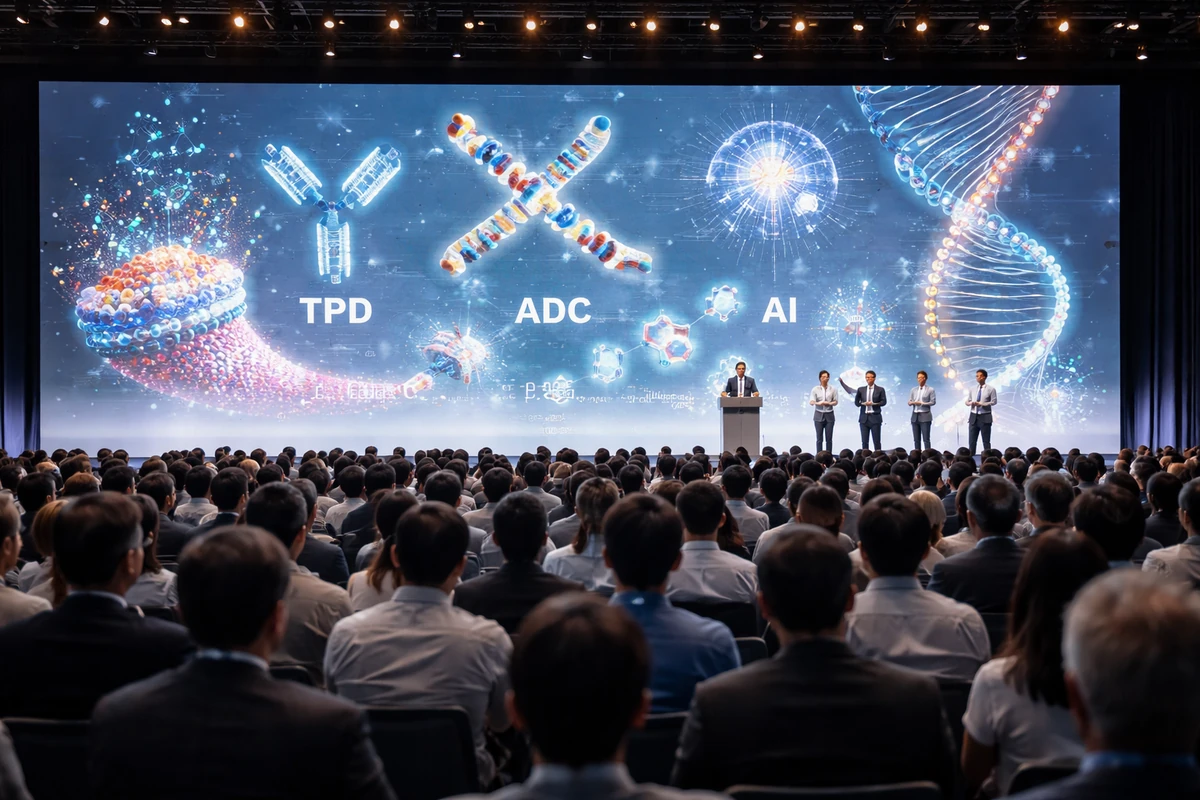
The Korean presentations at AACR underscored several technologies now driving this transition: targeted protein degradation, mRNA, antibody-drug conjugates and bispecific antibodies. Those labels can sound like insider jargon, but each represents a distinct way of attacking cancer — and each comes with strengths and limitations.
Targeted protein degradation, often shortened to TPD, is designed to do more than block a harmful protein. Instead, it aims to tag that protein for destruction by the cell’s own waste-disposal machinery. For non-scientists, a useful analogy is the difference between putting tape over a broken light switch and removing the faulty wiring altogether. Traditional drugs often inhibit protein activity; degraders seek to eliminate the problem protein itself. That approach has generated enormous excitement because many cancer-driving proteins have been difficult to target with standard drugs. But it is still a technically challenging area, and not every protein can be degraded safely or effectively.
mRNA technology, which became widely familiar to Americans during the COVID-19 pandemic through vaccines from Pfizer-BioNTech and Moderna, allows cells to produce a specified protein based on genetic instructions delivered into the body. In oncology, researchers are exploring mRNA for vaccines, immune activation and other therapeutic uses. Its appeal lies partly in design flexibility: Once a platform works, it can potentially be adapted for different targets faster than conventional drug formats. Still, mRNA therapies face their own hurdles, including delivery, durability and consistency of response.
Antibody-drug conjugates, or ADCs, are already one of the hottest areas in cancer medicine. An ADC combines an antibody that homes in on a tumor-related target with a potent cell-killing payload. Think of it as a guided missile concept in drug form: The antibody is the targeting system, and the payload is the warhead. Several ADCs are already approved in the United States and have changed treatment standards in breast cancer and other diseases. But they are not magic bullets. Success depends on choosing the right target, engineering a stable linker and managing toxicity when some of the payload affects healthy cells.
Bispecific antibodies are engineered to bind two different targets at once. In some cases, they bring immune cells into closer contact with cancer cells, essentially helping the immune system find and attack the tumor. In other cases, they may shut down two signaling pathways simultaneously. That flexibility makes them attractive, especially in cancers where one target alone is not enough. Yet bispecifics, too, can be difficult to optimize, particularly when balancing potency with side effects.
The larger point is that none of these technologies is a universal answer. Each offers a tool, not a cure-all. What companies such as Hanmi are now emphasizing is the ability to choose among them, combine them and build a more predictive process around them. In other words, the competitive edge may lie less in possessing a fashionable technology than in knowing when and how to deploy it.
Why AACR presentations matter beyond publicity
To outsiders, large medical meetings can look like elaborate trade shows for science — part conference, part networking event, part public relations exercise. There is some truth to that. Companies do use AACR, the American Society of Clinical Oncology annual meeting and similar gatherings to signal momentum, court partners and attract investor attention.
But in oncology, those meetings are also where research narratives are tested in public. Scientists, physicians, competing companies and potential collaborators all scrutinize the same data. They ask whether a proposed target is biologically meaningful, whether preclinical evidence is convincing and whether a company’s patient-selection strategy makes sense. A flashy claim can quickly run into skepticism if the evidence is thin.
That is why the quantity of presentations matters less than the quality of the scientific questions being asked and answered. Hanmi’s R&D leadership said the company typically makes about 50 presentations a year at global scientific meetings to gauge competitiveness, identify problems and track research trends. That framing is telling. The goal is not just visibility. It is validation — or, just as importantly, early correction.
In the United States, where biotech investors are accustomed to parsing conference abstracts for clues about a company’s future, this process is familiar. But for Korean pharmaceutical companies, the shift is especially notable because it reflects broader maturation. A decade ago, headlines about Korean biotech often focused on whether a company had signed a licensing deal or entered clinical trials. Now the conversation is increasingly about data quality, translational strategy and whether a Korean firm can speak the scientific language of global oncology on equal footing.
That matters because modern cancer drug development is global by necessity. Clinical trials are multinational. Licensing partnerships cross borders. Regulators compare data against international standards. If a company cannot withstand scrutiny at a meeting like AACR, it is unlikely to thrive in late-stage development or global commercialization. In that sense, international conferences function as an unofficial checkpoint before the much harder battles of clinical proof and regulatory approval.
For patients, this type of public vetting has real value. Oncology programs consume enormous amounts of money and time. The sooner weak ideas are challenged, the better the odds that resources are redirected toward more viable approaches. There is no guarantee that high-profile conference data will translate into approved medicines. In fact, much of it will not. But these meetings help shape which programs move forward and how they are redesigned.
AI and “omics” are changing how researchers decide what to build
Another central theme from AACR 2026 was the pairing of artificial intelligence with “omics” data — a catchall term for large-scale biological datasets such as genomics, transcriptomics and proteomics. In simpler terms, researchers are trying to read cancer in far greater detail and then use computing tools to detect patterns human analysts might miss.
This is more than a buzzword exercise. Cancer is not one disease, and often not even one disease within a single organ. Two patients with lung cancer may have entirely different mutations, immune profiles and responses to treatment. Even within one patient, tumors can evolve under treatment pressure. That means drug development is no longer just about finding a target in the abstract. It is about identifying which target matters in which biological context, and which patients are most likely to benefit.
Omics technologies help generate that map. Genomics can reveal DNA mutations. Transcriptomics looks at RNA activity, showing which genes are turned on or off. Proteomics tracks the proteins doing much of the functional work inside cells. Together, those layers can offer a richer picture of how a tumor operates, how it resists therapy and where vulnerabilities may lie.
AI enters because the volume and complexity of such data can overwhelm conventional analysis. Machine-learning tools can help classify tumors, predict biomarkers, identify patient subgroups and model how different therapeutic approaches might perform. In an ideal setup, this means fewer blind guesses and more evidence-guided prioritization before a company spends years and hundreds of millions of dollars chasing the wrong candidate.
American readers have heard versions of this promise before. AI is now pitched in nearly every corner of medicine, from radiology to hospital operations to drug discovery. Skepticism is warranted. AI does not eliminate the need for careful biology, rigorous trials or clinical judgment. A powerful algorithm cannot rescue a drug with unacceptable toxicity. Nor can it substitute for randomized evidence showing that patients actually live longer or feel better.
Still, in oncology research, AI’s practical value may be less about discovering miracle drugs overnight and more about reducing avoidable failure. If a company can use data tools to identify the wrong patient population early, detect a resistance pathway before a trial collapses or design a smarter biomarker strategy, that alone can be transformative. It can shorten timelines, reduce wasted capital and, eventually, improve the odds that truly useful therapies make it to the clinic.
In the Korean context, that is especially important because it suggests local companies are trying to compete not just on manufacturing strength or licensing execution, but on research design itself. The goal is to become companies that define the scientific question, not just companies that advance someone else’s answer.
Korea’s biotech rise is real, but patients are still a long way from the finish line
There is a temptation, whenever a national industry gains prominence at a prestigious international meeting, to treat visibility as victory. Korea’s biotech sector has earned a larger seat at the table, and not by accident. It benefits from a highly educated scientific workforce, strong hospital infrastructure, an increasingly sophisticated startup ecosystem and years of investment aimed at moving beyond the country’s earlier reputation as primarily a manufacturing powerhouse.
Recent signs of progress have fed that narrative. Separate Korean reporting has noted that Korean-developed drugs account for a meaningful share of rare-disease therapies receiving U.S. Food and Drug Administration orphan-drug designation, a marker often used to gauge innovation in hard-to-treat conditions. In oncology, Korean companies are also increasingly participating in global deals, multicenter trials and advanced biologics research.
But for all the excitement, there is a wide gap between a strong AACR showing and a tangible patient benefit. Every step from preclinical promise to real-world use is difficult. First come early human studies, which must establish safety, dosing and preliminary evidence of activity. Then larger trials must demonstrate efficacy against relevant standards of care. After that come regulatory review, manufacturing scale-up, pricing negotiations and reimbursement questions.
That final stage is especially important in cancer care. In the United States, patients are painfully familiar with the fact that breakthrough therapies can carry staggering price tags and insurance hurdles. Korea has a very different health care system, with national health insurance playing a much larger role, but it faces the same core question: Can innovation reach patients in an affordable and timely way? A scientifically elegant drug is not enough if coverage decisions lag or if hospitals cannot integrate it efficiently into treatment pathways.
In other words, greater industrial prestige does not automatically translate into greater public health value. A company can impress peers in San Diego and still spend years trying to prove clinical relevance. A platform can generate multiple candidates and still fail to produce an approved medicine. That is not a sign of fraud or weakness; it is simply the brutal math of oncology research.
For journalists covering this sector, the challenge is to resist both cynicism and hype. Korea’s biotech rise is genuine, and the strategic shift on display at AACR deserves attention. But so does the reality that cancer drug development remains one of the most unforgiving enterprises in modern science.
What American readers should take away from Korea’s showing at AACR
For an American audience, the biggest takeaway is not merely that Korean companies are becoming more visible. It is that the strategic logic now emerging in Korea mirrors a broader transition in global oncology — one that U.S. biotech and pharmaceutical companies are also navigating.
The old blockbuster model, in which a company rallies around one candidate and hopes for a clean march to approval, is giving way to something more modular, data-heavy and interconnected. The winners may be the companies best able to pair biology with engineering, target discovery with patient stratification and drug format with computational insight. That does not mean the single great molecule no longer matters. It does. But it increasingly matters as the output of a system rather than as the product of intuition alone.
There is also a geopolitical dimension. Americans have long thought of South Korea through a handful of familiar lenses: as a U.S. ally, as a major technology exporter, as the home of K-pop, K-dramas and Korean films that have reshaped global culture. In recent years, “K-wave” or “Hallyu,” the term used to describe Korea’s global cultural influence, has expanded far beyond entertainment. What AACR suggests is that Korea is also trying to build a knowledge brand in biotechnology — a form of soft power rooted not in music or television, but in scientific credibility.
That does not mean Korea is about to overtake the United States in oncology innovation. America still dominates much of the biotech ecosystem, from venture financing to academic research infrastructure to the scale of its pharmaceutical industry. But the balance of participation is changing. More countries are no longer content to serve as manufacturing bases, regional trial sites or junior partners. They want to help set the direction of the science itself.
In practical terms, that could mean more Korean-origin assets entering global licensing deals, more joint development programs with U.S. firms and more Korean data shaping treatment conversations worldwide. It could also mean more competition in areas such as ADCs, mRNA-based oncology and biomarker-driven therapeutics. For American companies and investors, Korea’s rise is not just a regional curiosity. It is part of the broader globalization of advanced drug research.
And for patients, the healthiest way to read the moment is with guarded optimism. A platform strategy will not cure cancer. AACR abstracts will not save lives on their own. But a smarter, more integrated approach to drug development can improve the odds that better therapies emerge, and that they reach the right patients sooner.
The bigger story is not Korean science alone, but Korean strategy
What stood out in San Diego was not simply that Korean researchers were present, or even that they were prolific. It was that they appeared increasingly fluent in the strategic language now defining oncology’s future. The center of gravity is moving from isolated assets toward ecosystems of discovery. The key question is no longer just whether a company has one compelling mechanism, but whether it has a disciplined way to match targets, modalities, biomarkers and patient populations.
That is a more demanding model. It requires money, data infrastructure, cross-functional teams and a willingness to abandon weak candidates early. It also requires scientific humility — the recognition that cancer is too adaptive and too heterogeneous for simplistic solutions. In that regard, the platform turn is not a sign that the industry has solved oncology. It is a sign that the industry better understands how hard the problem really is.
Korea’s presence at AACR 2026 suggests its biotech sector wants to compete on those terms. That is notable in itself. The country’s pharmaceutical industry was once often viewed abroad as playing catch-up to the U.S., Europe and Japan. Increasingly, it is trying to position itself not just as a fast follower, but as a contributor to the architecture of next-generation drug discovery.
Whether that ambition leads to durable success will depend on what happens after the conference lights dim: the rigor of the preclinical work, the design of the trials, the discipline of the partnerships and the patience to translate scientific complexity into real treatments. Those are the measures that ultimately matter.
But AACR 2026 offered a clear sign of where the race is heading. In cancer drug development, the age of the lone contender is giving way to the age of the platform. And South Korea, at least judging by its showing in San Diego, intends to be part of that next chapter.


0 Comments