Doosan Bears set KBO record with 14 straight error-free games, and a 19-year-old infielder is at the heart of it
A defensive milestone that means more than a box score note
In the United States, baseball milestones that grab the widest attention usually come with obvious drama: a no-hitter, a walk-off home run, a long hitting streak, a 100-mph fastball. But in South Korea’s top professional league, the Korea Baseball Organization, or KBO, one of the most striking stories of the young season is built on something quieter and, in many ways, harder to sustain: not making mistakes.
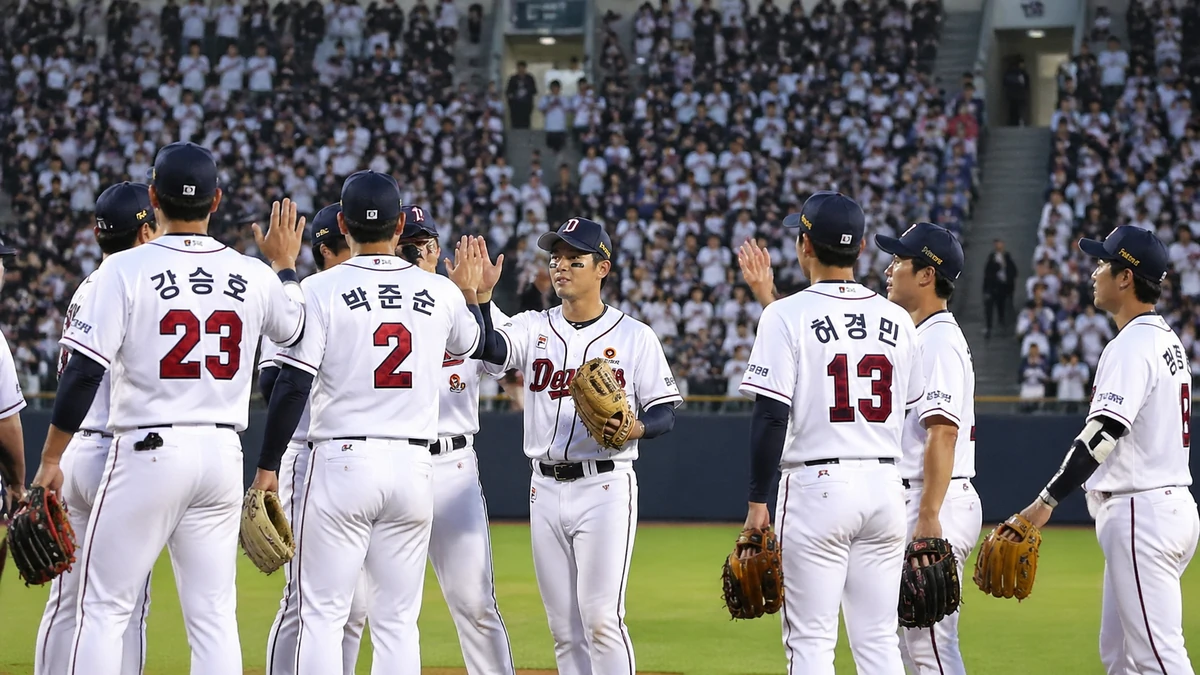
The Doosan Bears, one of Seoul’s most established clubs, defeated the Samsung Lions 8-5 on April 30 at Jamsil Baseball Stadium and in the process set a new KBO record with 14 consecutive games without committing an error. The streak dates to an April 15 game against the SSG Landers in Incheon, and it broke the previous KBO record of 13 straight error-free games set by Samsung in 2002.
That kind of record can sound almost modest to casual American readers. After all, an error is a statistical judgment, and there are nights in baseball when a team simply is not tested very much. But over two full weeks of regular-season play, a clean defensive run like this is not a fluke. It reflects repeated precision: fielders getting good jumps, infielders completing routine plays under pressure, outfielders cutting off balls cleanly, catchers handling the running game and pitchers doing their part on bunts and comebackers.
In a sport where one misplayed grounder can open an inning and flip a result, Doosan’s streak says something larger about the team it is trying to be in 2026. This is not simply a lucky stretch. It is a statement about concentration, structure and trust across all nine defensive positions.
And at the center of the story is a player young enough that many American fans would expect him to be a college freshman: 19-year-old second baseman Park Joon-soon, a second-year infielder whose emergence has given the Bears both production and a new narrative. On a team record built by collective discipline, he has become one of its clearest symbols.
Why an error-free streak carries real weight in Korean baseball
To understand why this record has drawn such attention in South Korea, it helps to understand the texture of KBO baseball. American fans who know the league often associate it with passionate crowds, loud cheering sections, bat flips and offense-friendly games. Those images are not wrong. The KBO is a league with distinct atmosphere and emotional intensity, and it often embraces a more demonstrative style than Major League Baseball does.
But that reputation can obscure an important reality: KBO games can turn quickly on defense. In a league where contact is frequent, pressure can be relentless. A single error does not always show up as an obvious disaster in the scorebook, but it can change pitch counts, extend innings, alter bullpen usage and force a team to chase the game in less visible ways. Over a long season, clean fielding becomes not just a virtue but a competitive identity.
That is why Doosan’s 14-game streak matters beyond trivia. It is not just that the Bears avoided a glaring miscue on one nationally notable night. It is that for more than a dozen games, no official scorer found a play severe enough to charge as an error anywhere on the roster. In a sport built on repetition, that consistency is the story.
The record it broke had stood for nearly a quarter-century. Samsung’s 13-game streak in 2002 lasted from mid-July into early August, and over time it became one of those oddly durable league marks that survive generations of players. Plenty of good teams had come and gone since then. Many had strong pitching. Many played crisp defense. None had pushed past 13 clean games.
So when Doosan surpassed that standard, it did more than add a footnote to league history. It crossed a threshold that had quietly become part of KBO lore. In baseball, age gives records gravity. The longer a mark survives, the more it begins to represent not only the excellence of the team that set it, but the difficulty of the act itself.
Park Joon-soon, 19, gives the record a face
Every team record is collective, but fans tend to gravitate toward a figure who helps make the abstract feel human. For Doosan, that player is Park Joon-soon.
Park is a 19-year-old second baseman in only his second season, which in American terms makes his rise especially notable. It is one thing for a young prospect to flash upside in spring training or fill in occasionally. It is another to become the regular at a middle-infield position, the part of the diamond where split-second decisions can expose every weakness in footwork, hands and internal clock.
Second base is one of baseball’s most demanding jobs, even if it is not always the most glamorous. The position sits at the center of traffic. Double plays run through it. Ground-ball rhythm runs through it. Communication with the shortstop, first baseman and pitcher runs through it. A young player can have tools and still struggle there because the position asks for calm as much as athleticism.
By that standard, Park’s rapid ascent is one of the most encouraging developments for Doosan. He has gone from prospect to reliable everyday presence, and in doing so he has given the Bears something teams in every league covet: a young regular who already looks like part of the present, not merely a promise for the future.
Korean coverage has highlighted Park’s line that “it’s fun to go to the ballpark,” a remark that may sound simple but carries some resonance in a country where team sports culture often places heavy emphasis on discipline, repetition and responsibility. In that sense, the comment does not suggest a lack of seriousness. It suggests freedom within structure, the kind of mindset coaches love when it is backed by steady performance.
For fans, it is also easy to see why Park’s presence has become emotionally important. In professional sports, supporters are often most attached not just to winning, but to witnessing growth in real time. A veteran star can command respect. A teenager becoming indispensable can reshape how a fan base imagines the future. Park’s emergence makes the Doosan story feel less like a temporary hot streak and more like the beginning of a new chapter.
What the Bears’ streak says about team defense
An error-free streak is sometimes misunderstood as a passive achievement, as if a team simply avoided calamity. In reality, the best defensive stretches are active. They require constant decision-making. A clean scorebook is the visible outcome of dozens of invisible right choices.
That is especially true for a team like Doosan, which did not stumble into this record while playing low-event baseball. Over 14 games, a defense has to navigate hard-hit balls, awkward hops, relay throws, cutoff alignments, backup responsibilities and the basic mental strain of knowing that any one lapse can end the run. The longer a streak goes, the more pressure attaches to routine plays. Players know the record is there. So do fans. The challenge is to keep fielding as if nothing has changed.
That is one reason the Bears’ 8-5 win over Samsung on April 30 felt significant beyond the statistic itself. Doosan did allow runs. This was not a shutout and not a flawless night in the broader sense. But the club did not give away extra outs or create unnecessary chaos with sloppy fielding. That distinction matters. Good defensive teams are not defined by never facing trouble. They are defined by not multiplying it.
In baseball language Americans know well, defense can help a pitcher stay on script. A cleanly fielded game means fewer extra pitches, fewer long innings and fewer moments where a staff has to get four or five outs instead of three. It also changes the emotional feel of a dugout. When a team trusts its defense, pitchers attack more confidently, infielders play with shorter memories and managers have more freedom with bullpen choices.
For Doosan, then, the streak is not only about avoiding a blemish in the newspaper line score. It is about building a style of baseball that can travel over the long arc of a season. Home runs come in bursts. Defensive reliability tends to age better. Teams that keep innings under control usually keep themselves in games even when the offense cools off.
There is also a basic collective element worth stressing. Unlike many records that can be attached mostly to one player, an error-free run belongs to everyone. Infielders, outfielders, catcher, pitcher — all have to hold up their part. That is why these records often feel especially satisfying to fans. They suggest not just talent, but cohesion.
Jamsil, Seoul and the stage of Korean baseball
The setting matters, too. Jamsil Baseball Stadium, in southeastern Seoul, is one of the landmarks of Korean sports, a place woven into the everyday rhythms of the city’s baseball life. It is the shared home of the Doosan Bears and the LG Twins, a setup that can be surprising to American readers used to teams controlling their own parks. In Seoul, where land is scarce and sports geography works differently, shared spaces often carry layered identities.
Jamsil is not just a venue. It is one of the cultural centers of the KBO season, where games can feel as much like public gathering as sporting event. Korean baseball fandom is famously organized and musical, with cheer songs, coordinated chants and a level of participation that can feel closer to college football or European soccer than to a quiet midweek MLB game. For visitors from the United States, one of the first surprises is how communal the experience is.
That atmosphere gave Doosan’s record extra resonance. Had the Bears set the mark in a loss, it still would have counted, but the emotional impact would have been diminished. Instead, they paired the record with an 8-5 victory over Samsung, which allowed the night to unfold not as a statistical aside but as a full celebration. The crowd got both a win and a piece of league history.
Moments like that matter in Seoul sports culture because records are not treated as isolated numbers. They become part of a live, shared event. Fans do not merely read about them later. They experience the suspense of each ground ball, each throw across the diamond, each inning that keeps the streak alive. By the end of the game, the achievement belongs not only to the players but to the people who watched it develop in real time.
That dynamic is especially powerful in Korean baseball, where fan attachment often extends beyond individual stars to the daily habits of following a club. In the United States, local baseball loyalties can be inherited through generations and measured in summer evenings on the couch. In South Korea, the emotional rhythms are different in some ways but recognizable in others: the team becomes part of family life, social life and city identity. A record built on steady competence can inspire just as much pride as one built on spectacle.
Breaking an old record, without overstating what comes next
One of the temptations after a moment like this is to rush into big declarations. Is Doosan now the clear favorite? Is this the defining team of the season? Does a streak in April and early May forecast what the standings will look like in the fall?
The careful answer is no, or at least not yet. Baseball, whether in the KBO or MLB, punishes certainty. A strong two weeks can announce a team’s strengths, but it cannot settle a six-month race. Injuries happen. Bullpens wear down. Hitters slump. Defensive form can regress as quickly as it sharpens. It would be premature to treat this streak as proof of a championship path.
At the same time, it would be a mistake to dismiss it as an early-season curiosity. April is when many teams are still sorting out lineups, roles and timing. The fact that Doosan already looks so polished defensively is meaningful precisely because the season is still young. It suggests that the team has established habits that are difficult to fake. Clean defense is not usually an accident of timing. It is a sign of preparation.
And there is symbolic power in surpassing a benchmark that had stood since 2002. That year belongs to another era of Korean baseball, before some current fans were even old enough to follow the league. When a modern team breaks a record from that period, it bridges generations. Older fans remember the original mark. Younger fans get a new point of reference. The game’s history feels continuous.
For Doosan, the achievement also lands at a useful moment in the season’s storytelling. Every club wants a reason for fans to believe early, something that feels sturdier than a random hot week at the plate. Defense provides that kind of reason. It is not flashy, but it travels well and tends to earn the respect of players and coaches inside the sport.
A familiar baseball lesson, told in a distinctly Korean way
For American audiences, perhaps the easiest way to frame Doosan’s streak is through a lesson baseball teaches over and over: there are nights when the game rewards flash, and there are seasons when it rewards discipline. The teams that last usually need both, but discipline is what allows talent to matter consistently.
That is what makes the Bears’ record compelling beyond South Korea. This is not just a KBO story for KBO fans. It is a baseball story in the broadest sense — about how a team builds trust, how a young player matures into responsibility and how the smallest plays can shape the biggest impressions.
Park Joon-soon’s rise gives the story an especially durable hook. At 19, he is not merely participating in a successful run; he is helping define it from one of the game’s most demanding positions. In the language of American sports, he looks less like a novelty and more like a foundational piece. Fans respond to that because it makes today’s achievement feel connected to tomorrow’s possibilities.
There is also something appealingly old-fashioned about the way this record has been received. In an era when so much sports conversation is driven by velocity, launch angle and star power, an error-free streak reminds people that precision still has narrative power. It tells fans that the game can still be won through details, through competence repeated so often it begins to feel like character.
That may be why this moment has resonated so strongly in Seoul. The Bears did not just beat Samsung. They embodied a form of baseball that supporters like to believe can endure. They stayed steady. They protected outs. They let skill and concentration accumulate into history.
Records built on defense do not always travel as loudly across oceans as home-run chases do. But they should. Because if baseball is, at heart, a sport about avoiding failure often enough to create success, then what Doosan has done over these 14 games is not minor at all. It is one of the cleanest expressions of team quality the game offers.
And on one spring night at Jamsil, with a 19-year-old infielder helping lead the way, that quality became history.
Comments
Post a Comment