A cast change that means more than a new face
One of South Korea’s most durable variety shows is making a notable change to its formula, and for viewers who follow Korean entertainment — especially the ever-expanding Korean Wave — it is the kind of shift that can alter the feel of an entire franchise.
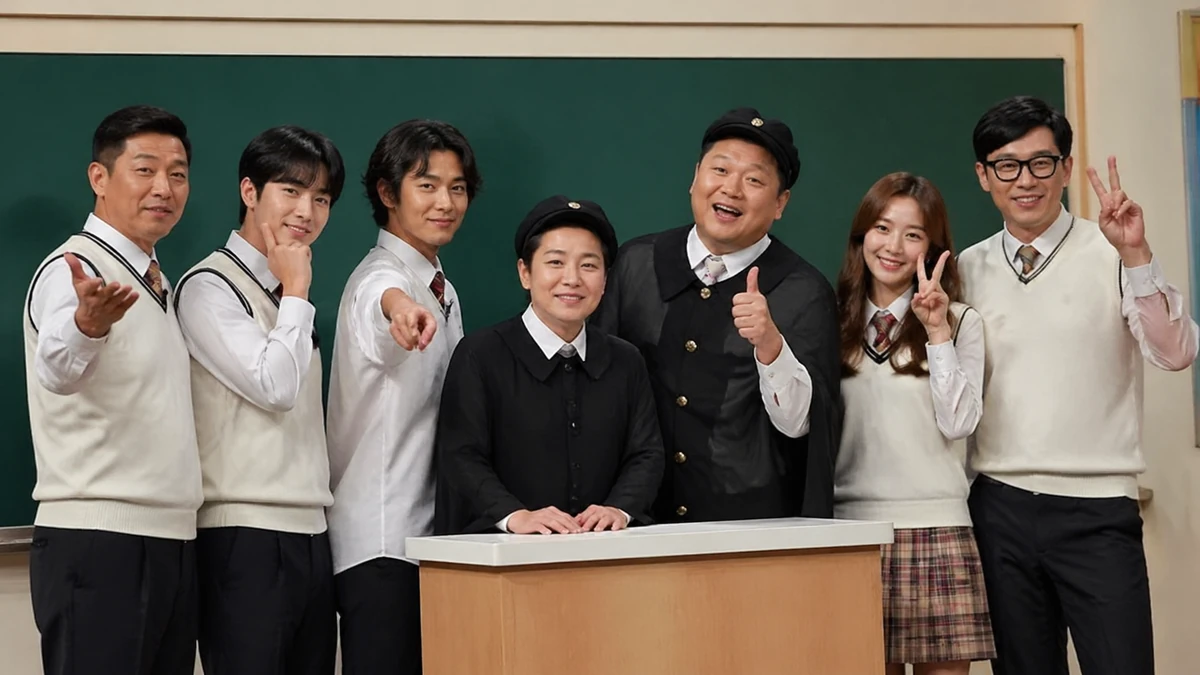
JTBC said comedian Kim Shin-young has been selected as a regular cast member on “Knowing Bros,” the long-running variety program also known to many international viewers by its Korean title, “Ask Us Anything.” Her appointment makes her the first female fixed cast member in the show’s history since its debut in December 2015. The announcement came alongside news that Kim Hee-chul, a member of the veteran K-pop group Super Junior and one of the show’s best-known personalities, will temporarily step away because of scheduling demands, including tour commitments, and the need to manage his health and condition.
On paper, this may sound like a routine programming update — one entertainer joins, another takes a break. In Korean variety television, however, cast changes are rarely just administrative. They can reshape the rhythm of the jokes, the hierarchy of who drives the conversation, and the chemistry that loyal viewers have come to expect over years of weekly viewing. On a show like “Knowing Bros,” where much of the appeal comes from banter, improvisation and the cast’s ability to riff off one another in real time, a single new regular can change not only the mood of an episode but the identity of the program itself.
That is why Kim’s arrival is drawing attention beyond fan circles. It speaks to a larger question that faces aging entertainment brands everywhere, whether in South Korea or the United States: How does a hit show stay familiar enough to comfort longtime viewers while changing enough to avoid going stale? American audiences have seen versions of that problem play out on legacy late-night shows, “Saturday Night Live,” panel programs and reality competition series. The cast is the engine, but once an engine runs the same way for too long, even successful formats can begin to show wear.
For “Knowing Bros,” Kim Shin-young’s addition looks less like a minor substitution and more like a deliberate recalibration.
What ‘Knowing Bros’ is, and why its chemistry matters
For American readers who do not regularly watch Korean variety television, “Knowing Bros” occupies a space that may be easiest to understand as a hybrid of celebrity talk show, improv panel and character-driven ensemble comedy. The program typically stages its cast as mischievous “school brothers” in a classroom setting, with guest stars — often actors, singers, athletes or other public figures — entering as new classmates. That setup gives the show a loose but reliable framework for games, teasing, confessions and ad-libbed exchanges.
Korean variety shows often depend less on formal interviewing than on what Korean viewers call “talk flavor” — the texture and timing of how cast members bounce off one another. The humor is built not just on punch lines, but on recurring character roles, inside jokes, mock rivalries and the quick ability to heighten someone else’s story. A cast member who knows when to interrupt, when to escalate and when to hand the spotlight back can be as important as a host in a traditional American studio format.
“Knowing Bros” has survived for nearly a decade in part because it established a recognizable conversational ecosystem. Its members developed reliable personas: the shameless teaser, the sarcastic commentator, the quick-witted mediator, the overconfident exaggerator. Fans tune in not only for celebrity guests but for how those guests are folded into a machine that has been refined over hundreds of episodes. In that sense, the show resembles other ensemble-driven institutions where the format matters less than the familiar rhythm of the people inside it.
That can be a strength and a vulnerability. The strength is obvious: viewers feel they know the cast, and the program becomes a weekly ritual. The vulnerability is that repetition can harden into predictability. Once a character structure is too well established, episodes may still work, but surprises become harder to create. Producers then face a difficult balance. Overhaul the formula too aggressively, and you risk alienating the core audience. Change nothing, and viewers may start to feel they are watching variations of the same conversation.
Kim Shin-young’s appointment suggests the producers believe the answer lies not in blowing up the format, but in adjusting its internal energy.
Why Kim Shin-young is a particularly strategic choice
Kim is not arriving as an unknown quantity or a risky experiment. That matters. According to the show’s own history, she has already appeared on “Knowing Bros” five times as a guest, giving both viewers and producers a test run of how her comedic instincts fit the existing ensemble. In television terms, that lowers the risk considerably. Rather than asking the audience to embrace a totally unfamiliar presence, the show is promoting someone who has already demonstrated she can operate effectively inside its rules.
Kim Shin-young is widely known in South Korea as a comedian, broadcaster and entertainer with sharp timing, a direct style and a talent for energizing a room quickly. Guest appearances are one thing; becoming a permanent cast member is another. But in many ways, her past appearances offered the strongest possible audition. She showed she could raise the pace of a segment, draw reactions from established cast members and assert a clear comic identity without derailing the larger flow.
That skill is especially valuable on a guest-driven show. Because “Knowing Bros” features different visitors each episode, the fixed cast has two jobs at once: it must maintain the show’s familiar tone and also create enough space for new guests to shine. The people at the center have to know how to open a conversation, redirect a flat moment, puncture a rehearsed anecdote and turn a guest’s public image into something playful or revealing. Kim’s reputation suggests she can do that efficiently.
JTBC said it expects her “sense and wit” to bring a fresh change to the program. That may sound like a standard network welcome, but it carries a specific implication. The language points to renewal rather than simple continuity. Producers are not merely saying Kim can keep the seat warm. They are signaling that the show needs fresh circulation without abandoning its identity.
In the American television landscape, there are clear parallels. When a long-running ensemble brings in a new cast member who already understands the house style — think of a frequent guest host elevated to regular status, or a recurring sketch performer promoted into the main lineup — the goal is usually not reinvention for its own sake. It is to produce enough friction to generate new comedy while preserving the audience’s attachment to the brand. Kim appears to be that kind of choice: stabilizing and disruptive at the same time.
The significance of the first female permanent cast member
The biggest symbolic element of the announcement is simple and impossible to miss: Kim Shin-young is the first female regular cast member in the history of “Knowing Bros.” In a show that has run since 2015 with a male-centered fixed lineup, that alone marks a meaningful turning point.
It would be too simplistic to say that adding one woman automatically transforms a show’s sensibility. Television does not work that neatly, and comedy certainly does not. What changes a program is not gender in the abstract, but what a performer brings in terms of pace, perspective, status within the group and the kinds of responses they invite from everyone else. Still, representation inside a cast matters because it affects the baseline assumptions around who gets to lead, interrupt, challenge and reset the scene.
Korean variety television has often relied on male ensemble chemistry, especially in long-running formats built around talk and teasing. Female entertainers have, of course, played central roles across the industry, but they have often appeared as guests, rotating panelists or anchors in different kinds of formats rather than as permanent members in male-dominated comedic teams. That pattern has never been absolute, but it has been common enough that Kim’s addition stands out as more than a routine booking decision.
For global viewers, including Americans who have discovered Korean entertainment through Netflix dramas, K-pop and streaming-era variety clips, this offers an interesting snapshot of an industry adjusting from within. Korean variety has long been one of the country’s most exportable cultural products, but it can also be one of its most tradition-bound. Shows thrive on familiar dynamics, and those dynamics can become rigid over time. Adding the first female fixed member to such a well-established ensemble signals at least a willingness to test how far the format can stretch without breaking.
That matters symbolically even if the show remains recognizably itself. Sometimes the significance of a cast decision is not that it rewrites the rules overnight, but that it acknowledges the old rules no longer need to be treated as permanent. In that sense, Kim’s arrival may become a small but memorable marker in the evolution of mainstream Korean entertainment: not a revolution, but a correction in the grammar of who occupies the center of the joke.
Kim Hee-chul’s temporary exit creates a real opening
The timing of Kim Shin-young’s arrival is inseparable from Kim Hee-chul’s temporary departure. Kim Hee-chul has been one of the most recognizable faces on “Knowing Bros” for roughly a decade, bringing the kind of personality that veteran viewers associate with the show’s identity. As a member of Super Junior — one of K-pop’s foundational second-generation groups — he carries his own fan base, his own media history and a very specific on-screen persona shaped by years in music, television and celebrity culture.
His break from the show, attributed to health management and an upcoming tour schedule, leaves more than an empty chair. It removes one of the conversation’s established axes. On ensemble shows, every regular member functions like part of a rhythm section. Some drive the tempo. Some provide the setup. Some create chaos at strategic moments. If one of those musicians steps away, the entire arrangement changes, even if only temporarily.
That is why this moment can be read less as a crisis than as an opportunity for controlled reinvention. Long-running programs often resist change until they are forced into it by scheduling conflicts, contract shifts or audience fatigue. Here, the unavoidable absence of a central personality gives producers a chance to experiment with a new balance. Instead of simply plugging in a replacement who mimics the existing dynamic, they have opted to introduce a different kind of energy source.
That is an important distinction. Kim Shin-young is not being positioned as a one-to-one substitute for Kim Hee-chul. She is not there to impersonate his role in the group’s ecosystem. The smarter interpretation is that the show is trying to build a new center of gravity, at least for the period in which his absence is felt most strongly. That allows viewers to focus less on what is missing and more on what is being created.
For fans, that may ultimately be the more productive lens. Rather than asking whether the show can be the same without Kim Hee-chul for a while, the more interesting question is whether it can become newly compelling because it is not trying to be exactly the same.
How long-running variety shows survive in Korea and beyond
The broader significance of this move extends beyond one cast announcement. It speaks to how long-running entertainment formats stay alive in fiercely competitive media markets. In South Korea, that challenge is particularly acute. Variety shows compete not only with one another but with streaming platforms, short-form video, idol content, drama series and a global audience whose attention is fragmented across languages and platforms.
The central problem is familiar to anyone who watches American television. Legacy franchises endure by mastering a paradox: they must preserve enough continuity to remain recognizable while introducing enough novelty to justify continued attention. Too much change can read as desperation. Too little can feel like creative drift. The best producers understand that audiences do not always need a new format. Often, they need the old format to breathe differently.
That appears to be what JTBC is trying here. “Knowing Bros” is not scrapping its classroom concept. It is not relaunching under a new title. It is not pretending the past decade never happened. Instead, it is using casting as the tool of renewal. And it has chosen someone who already understands the show’s operating system.
That matters because the hardest thing for a long-running comedy format to manage is the speed of change. If change comes too abruptly, loyal viewers recoil. If it arrives too slowly, the show’s energy leaks away before anyone formally acknowledges the problem. Promoting a performer who has already proven compatible with the cast is a measured way of controlling that speed. It allows the program to feel different immediately while remaining legible to the people who built the audience in the first place.
This is also a revealing case study in the Korean entertainment industry’s larger transition. The industry still depends heavily on established names, proven chemistry and reliable personalities. At the same time, it has to respond to evolving viewer expectations, both domestic and international, about diversity of perspective, freshness of interaction and the ability to surprise. The path forward, at least in this case, is not to discard the familiar stage but to rewrite the dialogue performed on it.
What fans are really waiting to see
In the end, viewers are not likely to judge this decision based on symbolism alone, however meaningful the symbolism may be. Fans of variety television are famously sensitive to chemistry. They will be watching for something more difficult to manufacture than headlines: whether Kim Shin-young changes the show’s “breathing.” In practical terms, that means whether she can disrupt old rhythms in a way that feels lively rather than forced, and whether the rest of the cast responds by revealing new sides of themselves.
That is the key point. A new regular member does not matter because she is new. She matters if her presence triggers different reactions from everybody else. The best ensemble comedians do not merely occupy space; they reshape the space around them. They challenge stale habits, expose overused bits and generate fresh combinations that make veteran performers feel less automatic. Kim’s track record as a guest suggests she may be particularly strong at that kind of catalytic comedy.
If that happens, the benefits could be layered. For longtime viewers in South Korea, it could restore an element of unpredictability to a beloved show. For newer international viewers, including English-speaking audiences discovering Korean variety through clips and streaming platforms, it could provide a clearer entry point into a format that sometimes depends heavily on established relationships. A cast member who can both unsettle the old hierarchy and translate the show’s energy into something immediately legible is valuable in any market.
Ultimately, this story is about more than who entered and who stepped aside. It is about a show that debuted in late 2015 confronting the natural wear that comes with longevity. It is about a temporary absence from one of its signature personalities. It is about the promotion of a comedian already tested through five guest appearances. And it is about the symbolic and practical significance of installing the first female permanent cast member in a program built for years around male regulars.
For observers of the Korean Wave, those details add up to something larger than casting news. They offer a window into how Korean television institutions evolve: cautiously, strategically and often through performance chemistry rather than dramatic formal reinvention. “Knowing Bros” is betting that one person can change the grammar of the room without changing the room itself. That is a subtle gamble, but in variety television, subtle gambles are often the ones that matter most.
Whether the move pays off will not be decided by the announcement. It will be decided in the pauses between jokes, the speed of the comebacks, the way old cast members adjust to a new center of energy and the degree to which viewers feel that a familiar show has found fresh air. For a long-running Korean variety franchise trying to remain relevant in a crowded entertainment landscape, that may be exactly the right test.
Comments
Post a Comment