When waiting becomes a product
For generations, one of the unwritten rules of public life in many countries has been simple: You wait your turn. That is especially true in places where demand spills out onto sidewalks — popular brunch spots in New York, barbecue joints in Texas, ramen counters in Tokyo. The line itself is often treated as a kind of social contract, a visible sign that everyone, at least for that moment, is subject to the same order. In Japan, where orderly queuing is often seen not just as a habit but as a deeply ingrained part of everyday public etiquette, that assumption is now being tested in a new and highly visible way.
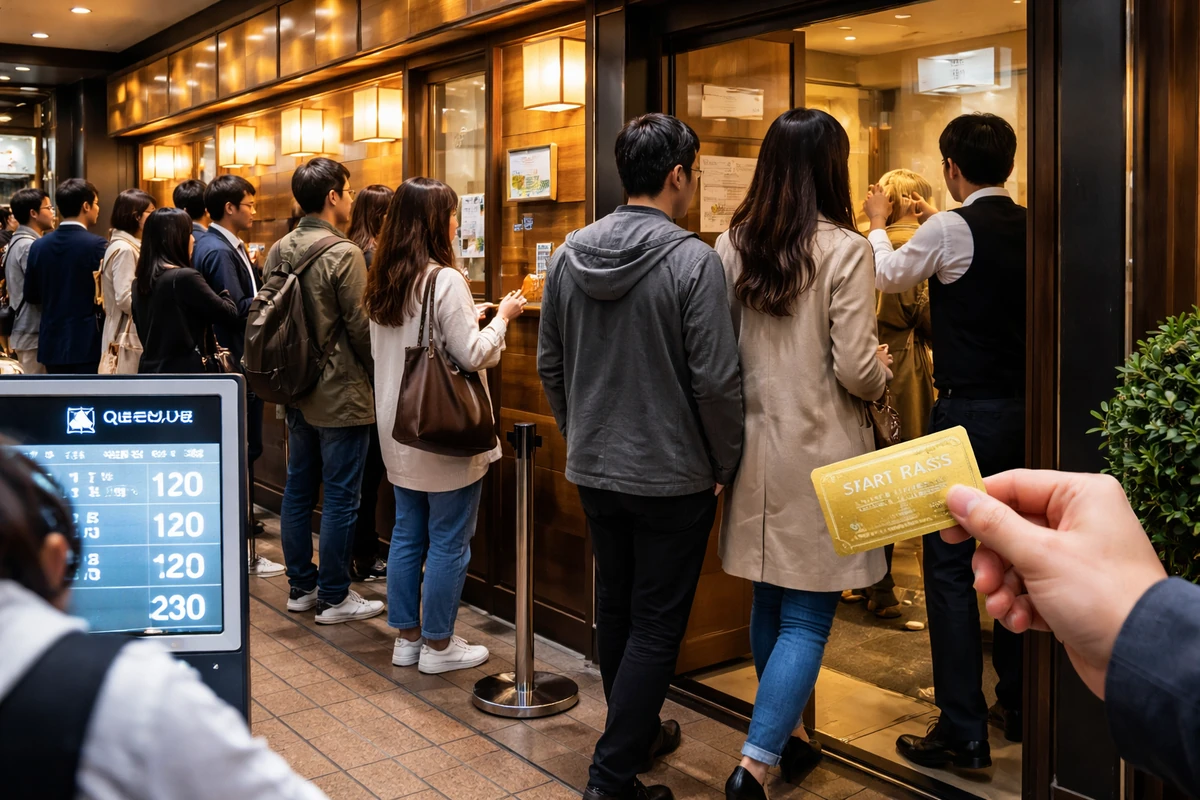
According to a report by Nikkei on April 12, a growing number of popular restaurants in Tokyo, Osaka and Kyoto have begun offering paid “fast-pass” entry, allowing customers who pay an extra fee to be seated sooner. About 80 restaurants were said to be using the system. In one Kyoto soba restaurant, called Den, fast-pass sales reportedly reached 419,000 yen in November of last year. The most expensive single fast-pass sold for 8,000 yen — about six times the restaurant’s average customer spending, according to the report.
Those figures matter because they suggest this is no longer just a quirky add-on or a niche experiment. What is being sold is not better food, a larger portion or a more luxurious dining room. It is time — or more precisely, relief from waiting. In an era when consumers already pay for faster shipping, priority boarding and premium access to digital services, Japan’s restaurant industry is turning one of the oldest parts of urban life, the line, into something that can be priced, packaged and sold.
From theme parks to noodle shops
The idea of paying to move ahead is hardly new. Americans know it from airports, stadiums, amusement parks and subscription services that offer members early access. Disney’s line-skipping systems have trained families to think of time-saving as part of the cost of a day out. Airlines have spent years turning boarding order into a hierarchy, with clearer lanes for those willing or able to spend more. What is striking in Japan’s case is not the concept itself, but where it is showing up: not at a one-time mega-event, but at everyday restaurants.
That shift changes how people experience the policy. In a theme park or at an airport, premium access is often baked into a much larger, explicitly tiered environment. Restaurants feel different. They are more intimate, more ordinary and more visible. If one diner enters before another because of a paid fast-pass, the distinction is immediate and public. Someone is not just receiving a luxury perk behind the scenes; someone else is still standing outside, watching the privilege take effect in real time.
That visibility is part of why the issue has touched a nerve. A restaurant line is not just a mechanism for managing overflow. It is also a small civic ritual. People can see who arrived first, who is next and whether the rules seem fair. Once that line is split into a standard queue and a paid priority queue, the meaning changes. The experience becomes less about waiting for a table and more about how a business assigns value to access. In that sense, Japan’s restaurant fast-pass system is not merely a new convenience product. It is a new way of organizing scarcity.
Why Japan is fertile ground for the idea
Japan’s restaurant culture helps explain why this model is taking hold there now. In major cities such as Tokyo, Osaka and Kyoto, long lines are often part of the reputation of a destination restaurant. A crowded sidewalk can function as advertising. It signals that the food is worth the wait, that the place has a following and that social proof is accumulating in plain sight. In that environment, the line is both a problem and an asset: bad for customer comfort, useful for brand prestige.
The Nikkei report said the fast-pass service was launched in the fall of 2023 by a Japanese IT company called Suisui. Early on, some restaurants reportedly used a flat fee of 500 yen, but that created a situation in which both regular lines and fast-pass lines formed at the same time. The company then developed a pricing model that changes according to six variables, suggesting the system is evolving beyond a simple surcharge and toward a more dynamic way of managing demand. In other words, this is not just a host stand making ad hoc exceptions. It is a technology-driven attempt to price congestion itself.
There are also practical business reasons restaurants may find the system attractive. Reservations can reduce uncertainty, but they also create risks, including no-shows. Fully reservation-only models can shut out walk-in customers, including tourists and spontaneous local diners. But if a restaurant relies entirely on in-person waiting, turnover becomes harder to predict and customer frustration can mount. A paid fast-pass offers a middle path: keep the energy and visibility of a line, while carving out a monetized lane for people most eager to avoid it.
The real controversy: not just price, but visible inequality
At first glance, the debate may sound like a routine dispute over premium pricing. But the criticism surrounding restaurant fast-passes in Japan goes deeper than whether the extra fee is too high. The more fundamental question is whether businesses should be allowed to reorder entry itself in a setting where fairness has traditionally been expressed through first-come, first-served waiting. People may accept paying more for a better seat on a plane or a private room at a restaurant. Paying more to be moved ahead of others seeking the same meal feels different.
That difference has to do with what Americans might call “the optics” of inequality. It is one thing for hierarchy to exist in a hidden or abstract form, such as an algorithm prioritizing some deliveries over others. It is another for the hierarchy to be enacted at the front door in full view of everyone present. When a fast-pass customer walks in ahead of people who have already been waiting, the issue becomes emotional as well as economic. The person who paid sees convenience; the person left outside may see humiliation, resentment or a rule that has been privatized.
The report noted that some operators appear to understand that risk. Fast-pass users are reportedly capped at no more than 10% of total entrants at some participating restaurants. That is an important detail. It suggests the system’s backers recognize there is a threshold beyond which consumer tolerance may break down. This is not a product that can expand infinitely without consequences. It depends on delicate management: enough priority access to generate revenue and appeal to time-conscious diners, but not so much that the ordinary line comes to feel like second-class status.
Tourism, packed schedules and the monetization of convenience
Another reason the idea may be spreading in Japan is the changing composition of customers in major tourist cities. Kyoto, in particular, has become a symbol of the pressures that heavy tourism can place on local infrastructure, from transit and sidewalks to neighborhood eateries. For travelers on tight schedules, long waits carry a real opportunity cost. Missing one meal can disrupt an entire day’s itinerary. A tourist trying to fit temples, museums, train transfers and dinner into a single day may be more willing than a local regular to pay to save an hour.
That logic will sound familiar to American readers who have watched convenience become one of the defining currencies of modern consumer life. App-based delivery, expedited checkout, airport lounge memberships and premium credit card perks all rest on the same promise: reduce friction for a fee. What Japan’s restaurant fast-pass system does is extend that logic into one of the most ordinary parts of travel and daily life. It tells customers that even the uncertainty of a line can be managed if they are willing to pay enough.
There is an irony here. Restaurant culture in Japan is often admired abroad for its democratic aspects: modest shops serving exceptional food, neighborhood counters where craftsmanship matters more than spectacle, and deeply rooted etiquette that emphasizes respect for shared space. Yet the same culinary culture is increasingly embedded in global tourism, digital platforms and scarcity marketing. As a result, the meal itself remains the same, but access to that meal begins to fracture. The line is no longer simply where demand gathers; it becomes another place where wealth and urgency can be converted into advantage.
A broader question about time in unequal societies
Seen narrowly, Japan’s fast-pass restaurant trend is about hospitality operations. Seen more broadly, it reflects a much larger shift in how affluent societies value time. The wealthy have always been able to buy convenience, from private cars to household help to concierge services. What is changing is the range of spaces in which that logic is normalized. More and more, the default experience is delay, while the upgraded experience is speed. That turns waiting from a shared inconvenience into a marker of who can and cannot pay to escape it.
In that sense, the Japanese debate resonates far beyond Japan. In the United States, many people have grown accustomed to a two-tiered consumer system, whether in healthcare navigation, airport screening, event ticket access or same-day delivery. The social effect is subtle but powerful. Over time, citizens stop asking whether some forms of access should remain equal and instead ask only how much faster access should cost. Japan’s restaurant experiment brings that tension into unusually sharp focus because it unfolds in a setting that is public, mundane and easy to understand. Everyone knows what a line means. Everyone can recognize when its meaning changes.
That is why this story matters. It is not just about a bowl of soba in Kyoto or a tech company finding a new revenue stream. It is about whether everyday fairness is being quietly redefined in one purchase at a time. Supporters can reasonably argue that people already pay for convenience in countless ways and that restaurants need flexible tools to manage demand. Critics can just as reasonably argue that once businesses openly sell priority in basic public-facing situations, they erode a small but meaningful sense of equality. Japan’s restaurant fast-pass system does not settle that argument. But it does make it impossible to ignore.
What comes next for restaurants and customers
The future of the model will likely depend on whether restaurants can persuade customers that paid priority is a convenience option rather than a betrayal of the queue itself. If the service remains limited, transparently priced and confined to a small share of guests, it may gradually become accepted as just another premium feature in an industry already transformed by apps, platforms and fluctuating tourist demand. If it expands too aggressively, however, backlash may grow — especially in a culture where orderly lines still carry moral weight as well as practical function.
For restaurant owners, the temptation is obvious. Seats at a hot restaurant are scarce, and scarcity is monetizable. The same economic logic that drives surge pricing in ride-hailing or premium seating at concerts can be applied to a dinner rush. But restaurants are not just machines for allocating inventory. They are also social spaces where status, courtesy and atmosphere matter. A system that maximizes revenue while making ordinary guests feel publicly devalued may prove less sustainable than the numbers initially suggest.
For customers, the spread of fast-passes poses a more personal question: What kind of consumer culture are people willing to accept? Most diners will occasionally pay more to save time when the circumstances feel worth it. But every new pay-to-skip system also nudges society toward a world where patience is for those who cannot afford alternatives. Japan’s current debate is a reminder that even something as mundane as a restaurant line can reveal a great deal about fairness, class and the future of everyday public life.
Comments
Post a Comment