South Korea’s Streaming Battle Is Moving From Binge-Watching to Live Events — and That Could Reshape K-pop, TV and Fan Culture
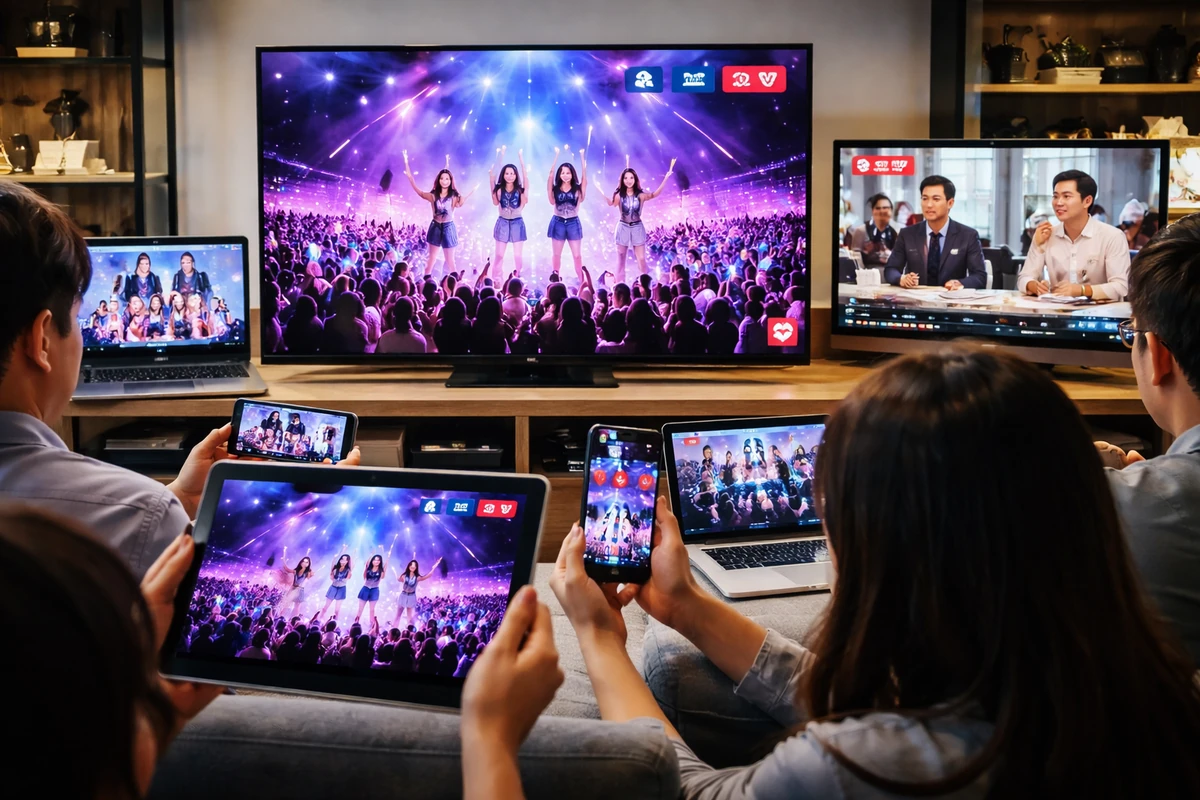
From on-demand libraries to must-see-now events
For years, the streaming wars in South Korea looked familiar to anyone following media in the United States: Platforms competed to lock up hit series, invest in originals and persuade audiences that the next binge-worthy drama or variety show lived behind their paywall. In that sense, the Korean market resembled the battles among Netflix, Disney+, Hulu and others in the U.S., where success often seemed to depend on who had the deepest catalog and the most talked-about scripted series.
But the center of gravity is shifting. South Korea’s media and entertainment business is increasingly focused not just on what viewers can watch, but on what they feel they need to watch right now. Online video platforms, often called OTT services, and IPTV operators are leaning harder into live entertainment, including concerts, fan events, sports and real-time variety programming. The strategic question is no longer simply who owns the strongest library of on-demand content. It is who can create the kind of cultural moment that pulls viewers to a screen at the same hour and keeps them there.
That may sound like a return to old-fashioned television, and in some ways it is. Before streaming, U.S. audiences also gathered around live events that felt bigger than entertainment itself: the Super Bowl halftime show, the Oscars, a season finale everyone discussed the next morning, or a surprise album release paired with a live special. South Korea’s platforms are now trying to package that same urgency for a digital era shaped by fandom, mobile viewing and global social media. The difference is that in Korea, where K-pop fandoms are highly organized and entertainment companies are deeply integrated across music, TV and digital commerce, the business implications may be even more dramatic.
The pivot reflects a maturing streaming market. Once subscriber growth slows, platforms need reasons for people to keep paying every month. Live programming solves a problem that huge on-demand libraries no longer can: It creates scarcity. If a fan believes a comeback stage, a concert, a sports match or a cast event matters most in the moment, the platform hosting it becomes more than an app. It becomes the place where the event happened.
Why live programming matters more in South Korea
The Korean entertainment industry has long been built around a tight relationship between stars and fans. While American pop culture certainly has superfans, K-pop fandom tends to be more structured and participatory, with fans organizing streaming campaigns, buying merchandise in coordinated waves, attending in-person events and treating each release as a collective project. In that environment, live content has special value. It does not just deliver a performance. It offers synchronized emotional experience — a chance for fans in Seoul, Los Angeles, Bangkok and São Paulo to feel they are reacting together.
That matters because K-pop and Korean celebrity culture are not purely about passive consumption. A new single, a comeback showcase, a fan meeting or a behind-the-scenes livestream can all function as part of one continuous relationship between artist and audience. A comeback, in Korean entertainment terms, does not simply mean an artist returning after a long absence. It refers to the promotional cycle around a new release, often involving teaser videos, live appearances, fan interaction and a coordinated rollout across platforms. For a streaming company, securing one piece of that cycle can bring not just viewers but loyalty.
The same dynamic applies beyond music. Variety programming — a major pillar of Korean entertainment — often relies on personality, spontaneity and audience chatter. Sports, meanwhile, remain one of the most reliable sources of real-time viewing in any country. Add fan events, exclusive interviews and live specials, and the distinction between content distribution and event hosting starts to fade. A platform is no longer just a warehouse for episodes. It becomes a venue.
That helps explain why live competition has intensified at a time when Korean and global services are all spending heavily on originals. Netflix and Disney+ continue to expand their Korean investments, while local services such as TVING, Wavve and Coupang Play have pushed into their own exclusive programming, entertainment formats and sports rights. The next stage of that competition is not just about owning intellectual property. It is about owning moments — the scenes, reveals and reactions that spread fastest online and are hardest to replicate once the first wave passes.
The fandom economy is changing platform strategy
In South Korea, entertainment companies and platforms have learned that fandom is not a side effect of content. It is an economic engine. A successful live event can drive subscriptions, merchandise sales, repeat viewing, travel and tourism, online clips, sponsorship value and social media traction all at once. For American readers, one way to think about it is as a hybrid of a Taylor Swift stadium show, Comic-Con fan culture and the always-on digital engagement of major sports leagues. The content itself matters, but so does the community built around attending, reacting and commemorating it.
That is especially evident in the orbit around BTS, the global K-pop group whose impact has extended far beyond music charts. Large-scale BTS-related events have shown how online attention can spill into physical travel and tourism. Even locations tied to past album photography or iconic imagery have become destinations for international visitors. In other words, a live stream is not just a stream. It can be the first touchpoint in a wider chain of spending and participation that stretches from digital viewing to airline tickets, hotel bookings and local retail.
For platforms, this makes live entertainment unusually attractive. A scripted drama may help define a brand over months or years, but a major live event can generate immediate spikes in attention and subscriber activity. It also creates a sense of urgency that algorithms alone cannot manufacture. Recommendation systems are excellent at telling people what to watch next. They are less effective at producing the fear of missing out that keeps audiences logging in at a specific time.
There is also a cultural dimension. Korean fandom often places high value on presence — being there, even virtually, when something important happens. That helps explain why clips and replays are not perfect substitutes for the original moment. The archive still matters, but the first live experience carries status and emotional weight. In a crowded media environment, that can be the difference between a platform users browse and one they feel they belong to.
OTT and IPTV are approaching the same screen with different strengths
The companies involved in this competition are not all built the same way. OTT platforms, the streaming services audiences access over the internet, have generally been associated with mobile viewing, personalized recommendations and younger consumers who move fluidly between phones, tablets and connected TVs. IPTV, by contrast, refers to television services delivered over internet protocol networks, often through telecom companies and set-top boxes. For U.S. readers, IPTV occupies some of the territory that cable, fiber TV and bundled broadband-TV services have historically covered, though the Korean market has its own structure and players.
That difference matters because live entertainment is experienced differently depending on the screen. A concert clip on a smartphone can feel immediate and intimate. A live performance on a big television in the living room can feel communal and immersive. Korean IPTV providers already have advantages in the home: stable delivery, established billing relationships, family-oriented viewing habits and integration with larger telecom bundles. That gives them a strong base from which to market live entertainment as an event best experienced on the biggest screen in the house.
OTT services, however, retain strengths of their own. They are more naturally tied to individual accounts, app-based engagement, notifications, clips, chat-like fan activity and rapid integration with social trends. For a younger fan following multiple artists or programs, the phone remains the command center. That means OTT companies can position themselves as the fastest route to the live moment, while IPTV can present itself as the premium in-home destination once that moment arrives.
Increasingly, though, the distinction is blurring. Many consumers do not care whether a service originated as IPTV or OTT. They care whether it is easy to access, works reliably and has the event they want. That convergence is forcing all sides to behave more similarly. OTT platforms are rediscovering the importance of scheduling, promotion and event programming — disciplines that traditional broadcasters mastered long ago. IPTV operators, meanwhile, are adopting more app-like interfaces and content strategies. The result is a hybrid market where everyone wants the flexibility of streaming and the appointment-viewing power of old television.
What this means for producers, artists and entertainment companies
The live turn is likely to reshape not just distribution, but how Korean entertainment is planned and produced. In the past, a drama, movie or variety season might have been judged mainly on its quality, cast and long-tail viewing potential. Now, producers and agencies must also think about whether a project can be expanded into live extensions: a premiere event, a cast appearance, a behind-the-scenes broadcast, a fan activation or a real-time interactive component. Those features are not always central to the story itself, but they can be central to the platform strategy around it.
That changes the value of intellectual property. A series or artist is no longer assessed solely by how many hours of viewing it can generate on demand. It is also assessed by whether it can produce a burst of collective attention at a specific time, fuel short-form clips afterward and sustain replay value once the live window closes. In other words, a title becomes part of a cycle: live viewing, social sharing, media coverage, fan-driven recirculation and then on-demand rewatching. The most valuable properties are the ones that work at every stage.
For talent agencies and artists, platform choice becomes more consequential. Signing with a platform that offers global reach, strong live-event production and active fan engagement tools may be more attractive than simply selling distribution rights to the highest bidder. In K-pop especially, where artists often rely on carefully orchestrated release calendars, the platform partner can influence the scale of a launch, the visibility of a comeback and the intensity of fan response. A release is no longer just a song drop or a music video upload. It can be a package that includes live showcases, interviews, fan-facing content and post-event clips designed for worldwide circulation.
Production budgets may evolve as well. Live programming requires technical infrastructure, rights management, real-time coordination and contingency planning that differ from standard on-demand content. But it can also open multiple revenue paths. A single event may support sponsorship, premium access, upgrades, advertising inventory, merchandise integration and downstream VOD viewing. In an industry where content spending is rising and competition is ruthless, that broader revenue mix becomes hard to ignore.
Why the shift echoes broader changes in American media
There is a reason this story should resonate beyond South Korea. American media companies are also rediscovering the value of liveness. Streaming platforms in the U.S. have moved into sports, awards shows, stand-up specials and other programming that feels different when watched as it unfolds. Even companies built on the promise of watch-anytime convenience have learned that live events can command attention in ways deep libraries cannot. South Korea’s market may be farther along in linking that strategy to fandom-driven entertainment, but the underlying logic is familiar.
The Korean case is distinctive because it sits at the intersection of several global trends at once: the rise of K-pop and Korean dramas as export powerhouses, the maturation of subscription streaming, the continuing value of telecom distribution and the transformation of fans into highly networked communities. In the U.S., audiences might compare this to what happens when sports streaming, music fandom and franchise entertainment overlap. But in South Korea, those relationships are often tighter, faster and more commercially integrated.
That makes the country an important indicator of where entertainment may be headed elsewhere. If live fan-centered programming proves to be a durable advantage in Korea, expect more platforms in other markets to experiment with similar models: exclusives built around release moments, fan interaction layered into premium subscriptions, more aggressive bundling of live and on-demand rights and a heavier emphasis on turning content into experiences. The future of streaming may end up looking less like an infinite library and more like a calendar of events.
That does not mean on-demand viewing is going away. Binge-watching, catch-up viewing and personalized recommendation systems remain core to the business. But the balance is changing. Platforms increasingly need both the long tail and the headline moment — both the archive and the event. For Korean companies, the race is already underway.
A new phase of the Korean Wave
The broader significance is that the Korean Wave, or Hallyu — the global popularity of South Korean pop culture — is entering a new commercial phase. Over the last two decades, Hallyu has often been discussed in terms of exports: dramas sold abroad, K-pop albums topping charts, Korean films winning awards and beauty or food trends spreading internationally. Now the question is less about whether Korean content can travel and more about which platforms can capture the live global audience that comes with it.
That is a different kind of competition. It is not just about distribution territory, subtitle quality or catalog depth. It is about designing shared time. A fan in Chicago or London who tunes in live to a Korean concert, fan event or entertainment special is participating in a media model that collapses distance. Geography matters less; timing matters more. That is a powerful proposition for platforms that want to serve not only domestic households but also a worldwide audience that experiences Korean entertainment as part of everyday life.
In practical terms, the winners in this new phase will likely be the platforms that combine technical reliability, intuitive access, strong event programming and a deep understanding of fan behavior. They will need the production discipline of television networks, the product instincts of tech companies and the community awareness of entertainment agencies. Few companies do all of those things well. But in South Korea, where media, telecom and entertainment have long been tightly intertwined, the push to build that model is already visible.
The shift from VOD-centered competition to live-event competition does not erase the old streaming playbook. It expands it. Libraries still matter. Hit dramas still matter. But in an era when every service claims to have premium content, the real advantage may come from something more basic and more difficult to manufacture: giving audiences a reason to show up together. In South Korea, that is becoming the next big fight in entertainment — and a revealing one for the rest of the world to watch.
Comments
Post a Comment