A BTS event that turns Seoul into part of the show
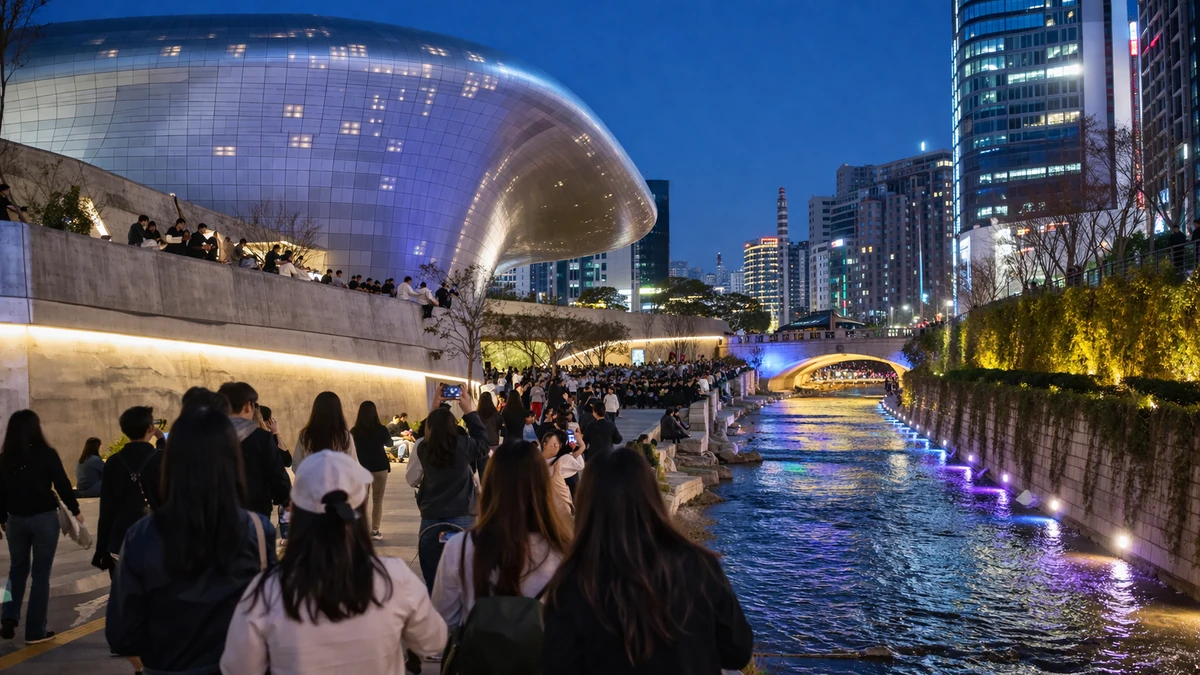
In South Korea, it is no longer enough for a major K-pop act to live only on a stage, a streaming platform or a billboard. Increasingly, the fan experience spills into the city itself — into plazas, walking paths, light installations and the ordinary routes people take after work or on vacation. That shift was on display in Seoul on April 6, 2026, when a BTS-themed fan space called “ARMY Madang” opened at Dongdaemun Design Plaza, better known as DDP, while nearby Cheonggyecheon, a restored urban stream that cuts through downtown Seoul, added nighttime lighting that extended the experience into the evening.
On paper, those may sound like two separate developments: a fan activation at one landmark and decorative lighting at another. In practice, they point to something bigger happening in Korean pop culture and city branding. Seoul is increasingly treating fandom not as a niche subculture tucked inside concert halls or merchandise shops, but as a form of public life that can shape how people move through urban space. For BTS fans — collectively known as ARMY — that means the experience of supporting the group is no longer confined to buying albums, watching videos or attending a stadium show. It also means visiting the right places, taking part in a shared atmosphere and making memories in settings that become inseparable from the artist itself.
For American readers, one useful comparison might be the way major sports cities turn game day into an all-day civic ritual. Think of how Wrigleyville in Chicago, the area around Fenway Park in Boston or the blocks surrounding Madison Square Garden in New York become part of the event, not just a route to it. The difference in Seoul is that this model is being adapted for pop fandom — and particularly for K-pop fandom, which has developed into one of the world’s most organized, digitally savvy and internationally mobile fan cultures.
The symbolism of pairing DDP and Cheonggyecheon matters. DDP is one of Seoul’s most recognizable contemporary landmarks, a sweeping metallic complex designed by the late architect Zaha Hadid that hosts exhibitions, fashion events and public programming. Cheonggyecheon, by contrast, is one of the city’s best-known public walking corridors, a stream restored in the 2000s after decades under concrete and elevated roadway. One site represents design, spectacle and programmed culture. The other represents movement, accessibility and public space. Put them together, and the message is clear: BTS fandom is being staged not just as an attraction to visit, but as a route to inhabit.
Why this matters beyond K-pop fans
It would be easy to dismiss a BTS-themed plaza and a lit-up stream as a fan-service story, relevant mainly to the group’s enormous global following. But that would miss the broader significance. What is unfolding in Seoul is part of a larger transformation in how entertainment, tourism and municipal identity overlap. Pop culture events increasingly function as city-making tools. They draw visitors, shape social media imagery and create the kind of highly shareable urban scenes that travel far beyond local news coverage.
That matters especially in the case of BTS, a group whose cultural reach extends well beyond music charts. Over the past decade, BTS has become one of South Korea’s most internationally recognizable exports, helping drive interest in Korean language study, Korean tourism, Korean food and Korean beauty products. In the United States, their success helped normalize K-pop in the mainstream, pushing it from a niche online interest into televised awards shows, major-label partnerships and sold-out stadium tours. For many international fans, BTS was not just an introduction to a band, but an introduction to South Korea itself.
That is why the choice of venue carries outsized weight. An event tied to BTS at a convention center or private indoor venue would still attract attention. But an event tied to BTS at a landmark like DDP, and then linked to a public nighttime walking experience along Cheonggyecheon, sends a different signal. It suggests the city is not merely hosting a fan event. It is weaving fan culture into the urban fabric.
There is also a strategic logic here that American cities would recognize. Tourism officials everywhere are looking for reasons to persuade travelers not only to come, but to stay longer, spend more and post more. A one-hour exhibit can draw a visitor. A walkable, photogenic, multi-stop experience that stretches from afternoon into night can anchor an entire evening — or an entire trip. In that sense, “ARMY Madang” is not just an installation. It is part of a broader effort to turn fan attention into urban dwell time.
From merchandise tables to “experience consumption”
The Korean entertainment industry has a term for the trend this event represents, even if it is not always expressed the same way in English: experience-centered consumption. The idea is simple but powerful. Fans no longer consume culture only by purchasing products. They consume it by inhabiting environments, documenting themselves within them and attaching emotional meaning to the spaces where those encounters happen.
That is hardly unique to South Korea. American consumers have seen versions of it in immersive museum pop-ups, branded festivals, movie-themed attractions and traveling installations built for Instagram as much as for in-person enjoyment. But K-pop has proved especially well suited to this model because of how fandom already operates. Fans are highly networked. They organize travel. They document obsessively. They exchange information quickly. And they understand participation as something active rather than passive.
That is particularly true of BTS ARMY, one of the most influential fan communities in the world. ARMY is not simply a fan club in the old sense of the term. It is a decentralized global network capable of driving online trends, coordinating charitable campaigns, translating content, supporting releases across time zones and rapidly turning an on-site event into a digital narrative through photos, videos and first-person accounts. In practical terms, that means a physical installation in Seoul does not stay local for long. Within hours, it can become global content.
That feedback loop is one reason offline experiences tied to BTS remain potent even in an era of constant digital access. Fans can stream songs at home and watch archived performances from anywhere. But being physically present in a place associated with the group offers something streaming cannot: a sense of collective participation and emotional temperature. Standing in a public space with other fans, following a route that has been deliberately designed around a shared cultural object, changes the experience from private consumption to communal memory.
That is a lesson companies across the entertainment world have been chasing. The streaming age made culture more available than ever, but also more diffuse. Physical spaces reintroduce scarcity, occasion and embodiment. They make a fandom feel tangible again.
Why DDP and Cheonggyecheon are especially telling choices
To understand why this pairing matters, it helps to know what these places mean in Seoul. DDP is not just another event hall. It is one of the city’s flagship cultural sites, a futuristic structure in the Dongdaemun district that has become a staple of tourism photography and a hub for exhibitions, design fairs and fashion programming. It is visually dramatic, centrally located and already loaded with symbolic capital. Hosting “ARMY Madang” there elevates the BTS experience beyond retail or promotion. It signals prestige, visibility and civic recognition.
Cheonggyecheon plays a different role. The stream is one of Seoul’s most successful urban renewal projects, a once-buried waterway transformed into a pedestrian-friendly corridor in the city center. For locals, it is a place to walk, meet and cool off. For tourists, it is an easy and intuitive entry point into downtown Seoul. In American terms, it is not exactly the High Line in New York, nor the San Antonio River Walk, nor Millennium Park in Chicago, but it shares something with each: it is public, highly recognizable and easy for first-time visitors to navigate.
By adding night lighting to Cheonggyecheon in conjunction with the BTS-related programming at DDP, organizers effectively broadened the timeline of the event. This was no longer just something to see in a designated indoor window. It became something to move through across part of the city and into the evening. That matters because nighttime is when urban branding often becomes most photogenic and most emotionally resonant. Cities know this instinctively. Skylines, bridges and river walks are illuminated for a reason. They encourage lingering.
The practical effect is also important. A fan who comes to DDP for a BTS experience may then walk to Cheonggyecheon, take photos, stop for dinner, browse nearby shops and spend more time in the district than they otherwise would have. In tourism terms, that is the difference between a single destination and an itinerary. In emotional terms, it is the difference between seeing something and inhabiting a mood.
The economic promise — and the limits of the hype
There is little doubt that BTS-linked events can generate economic activity. DDP and the surrounding Dongdaemun area already attract substantial foot traffic, including international visitors. Add one of the world’s most recognizable pop acts to the mix, and the likelihood rises that nearby hotels, cafes, restaurants, convenience stores and transit routes will benefit from increased traffic and longer stays.
Still, it is worth being cautious about exaggerated claims. A single day or short-run activation does not automatically transform a city’s economy. The economic impact of fan events is often diffuse, hard to isolate and unevenly distributed. Not every visitor spends heavily. Not every crowd turns into sustained tourism. And not every high-profile activation becomes a repeatable model.
What events like this can do, however, is create a stronger reason to visit Seoul at a specific moment and a stronger memory once visitors leave. That matters because tourism often runs on motive as much as logistics. People travel when they feel they have a compelling reason to go now, not later. BTS has the rare ability to provide that urgency. For an international fan deciding whether to book a trip, a city-linked event can turn Seoul from a vague someday destination into an immediate plan.
That is also where the city’s long-term opportunity lies. If officials and organizers can pair fan-centered attractions with multilingual signage, transit guidance, local business partnerships and reliable crowd management, they can turn a one-off pop culture moment into part of a more durable tourism ecosystem. In other words, the real value may not come from one activation alone, but from whether Seoul can repeatedly convert music fandom into a navigable, welcoming and memorable urban experience.
That formula is difficult to replicate precisely because BTS is unusual. The group’s symbolic power, international fan mobility and cultural prestige are not easily transferable to every artist. What works for BTS will not necessarily work for the average idol group, no matter how popular. The scale of attention matters. So does timing. So does location. Seoul can leverage the city’s global recognizability in ways that smaller municipalities or less internationally known artists cannot. That makes this event more a special case than an industry template.
The operational test: not just spectacle, but management
If all of this sounds promising, there is also a less glamorous side to the story: logistics. Public fan events rise or fall not just on visual appeal, but on operational discipline. That is especially true when they take place in spaces that remain open to the general public. DDP and Cheonggyecheon are not closed campuses for fans only. They are shared civic spaces used by residents, tourists, workers and passersby who may have little interest in BTS at all.
That creates a familiar urban challenge. How do you generate excitement without producing dysfunction? Crowd flow, line management, safety staffing, wayfinding, sanitation and transit access are not side issues. They are central to whether the event feels welcoming or chaotic. In fact, for high-demand fandom events, operational execution often matters more than the visual concept itself. Fans today are sophisticated consumers. They do not judge an event solely by its branding. They assess how long they had to wait, whether the site was easy to navigate, whether the experience felt distinctive, whether amenities were sufficient and whether the event respected their time.
For international fans, those issues become even more consequential. A traveler arriving in a foreign city may be willing to tolerate some inconvenience, but confusion can quickly sour what was supposed to be a meaningful pilgrimage. That is why multilingual guidance matters so much. Clear maps, online pre-visit information, transit instructions, crowd alerts and location-specific details are not luxuries. They are part of the product. Seoul’s reputation as a K-pop destination depends not just on the glamour of its content, but on the usability of its infrastructure.
There is also a public-interest dimension that should not be overlooked. Events built around a superstar can energize public spaces, but they also risk overwhelming them. Residents still need to move through the city. Public walkways still need to function. The best version of a city-scale K-pop event is one that satisfies fans while minimizing disruption for everyone else. That balance — between cultural excitement and civic openness — is one of the key tests of whether fandom can coexist productively with public space.
What this says about BTS, Seoul and the future of fan culture
At its core, this story is about more than one group and more than one day in Seoul. It is about a broader shift in what cultural power looks like. For years, music industry success was measured mostly through album sales, chart rankings and concert grosses. Those metrics still matter. But in the BTS era, they no longer tell the whole story. Cultural power now also includes the ability to shape travel, alter city imagery and turn physical space into part of the emotional architecture of fandom.
BTS is uniquely positioned to do that. The group’s global profile means almost any public-facing activation tied to its name can attract attention well beyond South Korea. But the Seoul setting matters just as much. This kind of event works because it draws on the city’s own symbolism — its design landmarks, its walkable public spaces, its sophisticated transit system and its status as both the center of South Korea’s entertainment industry and a global destination in its own right.
If there is a lesson here for the K-pop industry, it may be a simple one: fans may come for the artist, but they often remember the place. The song starts the attachment. The city helps cement the memory. That does not mean every artist needs a branded urban trail or a landmark activation. It does mean the industry is increasingly aware that fandom is spatial as well as emotional. People do not just want to hear the music. They want to stand somewhere that makes the music feel lived.
For American audiences, that may be one of the most revealing aspects of the Korean Wave as it continues to evolve. Hallyu — the term often used to describe the global spread of Korean popular culture — is no longer just about exported content. It is about exported curiosity that eventually loops back to place. Fans who first encounter Korean culture through a playlist or a social media clip often wind up wanting to visit the neighborhoods, landmarks and public spaces associated with that feeling. Seoul has become adept at meeting that desire.
The open question now is whether these city-scaled fan experiences can become more consistent, more inclusive and more sustainable. Can they serve global fans without alienating residents? Can they encourage tourism without becoming shallow photo ops? Can they deliver enough substance, comfort and originality to satisfy a fandom that is enthusiastic but also increasingly discerning?
Those are the issues worth watching next. The debut of “ARMY Madang” at DDP and the nighttime illumination of Cheonggyecheon suggest a clear direction: K-pop fandom is expanding from entertainment content into urban content. The next phase will depend on whether organizers can match that ambition with careful design, strong operations and a sense of public balance. If they can, Seoul may continue to set the standard for what it means when a pop phenomenon stops being just a performance — and becomes part of a city’s lived experience.
Comments
Post a Comment