Kim Min-jae stands at the center of Bayern Munich’s early title clincher, signaling a new phase for South Korean soccer
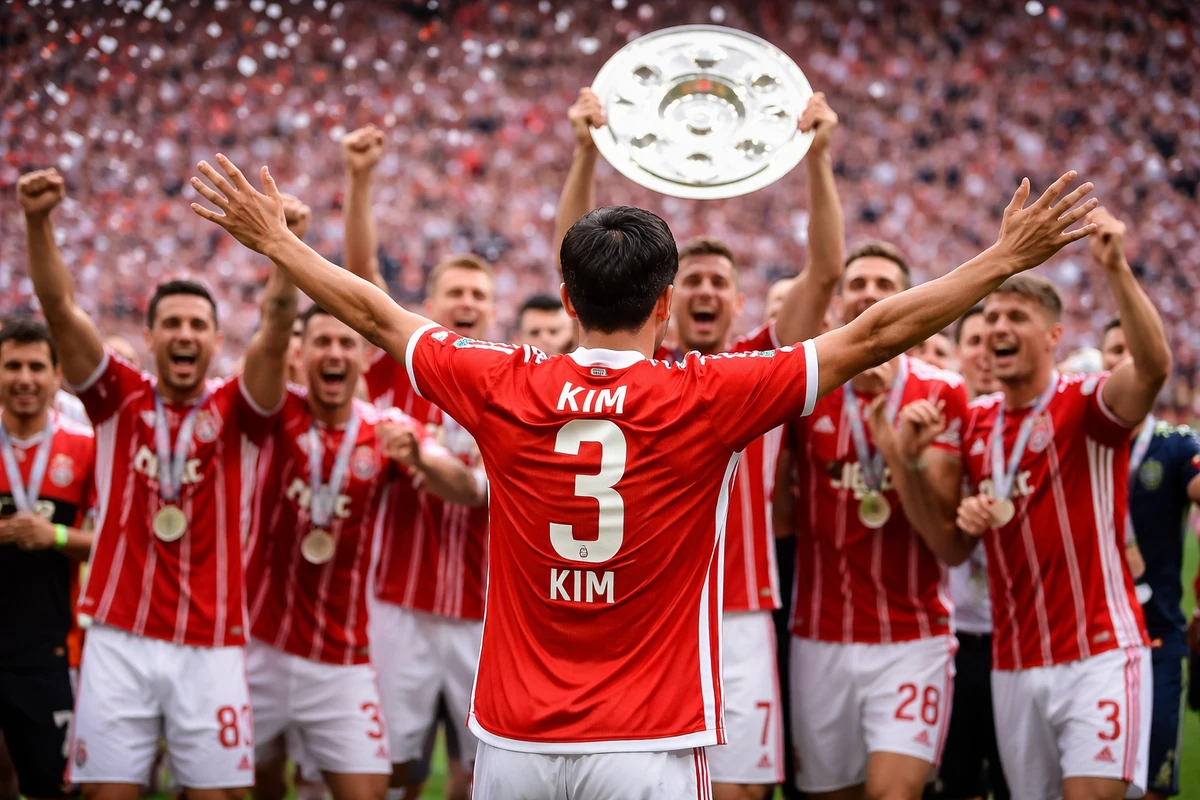
A title night that meant more than another Bayern trophy
Bayern Munich winning the Bundesliga is not, by itself, a shocking development to most soccer fans. For Americans who follow European soccer the way they follow the Yankees, Lakers or Chiefs, Bayern occupies that kind of cultural space in Germany: a giant club expected to contend for trophies every season, and often expected to win them. But the latest title-clinching result carried a significance that went beyond another medal added to the club museum. At the center of the story was Kim Min-jae, the South Korean center back who played the full match as Bayern sealed the championship in front of its home fans.
According to a Korean media report published April 20, Bayern beat Stuttgart 4-2 at Allianz Arena in Munich to reach 79 points, opening a 15-point gap over second-place Borussia Dortmund. With four league matches left, that margin made Bayern’s second straight Bundesliga title mathematically secure. The headline in Germany was the championship. The headline in South Korea, and increasingly for global audiences, was that Kim was not a ceremonial part of the moment. He was on the field from start to finish in the game that locked it up.
That detail matters because defenders rarely own the spotlight the way goal scorers do. Casual fans tend to remember the player who scores the winner, not the center back who keeps a match from tilting into chaos. Yet in a championship-deciding game, especially one played under the pressure of a home crowd expecting a coronation, a full 90 minutes from a central defender says something important. It says the coaching staff trusted him with the most delicate assignment in the sport: preserving structure when the stakes are highest.
Why a full match from a center back carries so much weight
For readers more familiar with American football or basketball than with the tactical language of soccer, the center back’s role can be thought of as a hybrid of a quarterback of the back line and the last line of emergency response. A top central defender is responsible not only for stopping attacks, but also for organizing teammates, reading danger before it becomes obvious, and beginning possession in a controlled way. If a striker is judged by whether he finishes, a center back is judged by whether the whole team feels secure around him.
That is why Kim’s full-game involvement in the title-clinching win stands out. In championship settings, coaches often become conservative with personnel, leaning heavily on players they trust to manage emotion as much as tactics. It is one thing to start an ordinary league game in the middle of winter. It is another to be asked to hold together the defense on the night a title is within reach, with a stadium ready to celebrate and an opponent eager to spoil the party. Kim was not on the bench waiting for a cameo. He was in the spine of the team.
The Korean report makes clear only a few core facts: Kim started at center back, played the full match, and Bayern won both the game and the title. But those facts are enough to support a deeper conclusion. In a club like Bayern, where expectations are unforgiving and where “good enough” often is not good enough, meaningful minutes are a form of institutional trust. For a defender, they may be the clearest form of trust there is.
How Bayern’s comeback showed the anatomy of a champion
The 4-2 victory over Stuttgart also offered a useful snapshot of why Bayern was able to finish the job early. The score line matters not just because Bayern won, but because it won by coming from behind. Championship-clinching matches can tighten teams up. A club that knows a draw is enough may begin playing not to lose. Players start calculating instead of imposing themselves. Possession becomes cautious, and the crowd’s nerves can spread onto the field. That is how favorites sometimes turn a celebration into a slog.
Bayern, at least on this night, did the opposite. Falling behind and still scoring four goals suggested a team that could absorb pressure without becoming timid. For American readers, it is the difference between a No. 1 seed that gets rattled in a playoff opener and one that gets punched early, settles down and reasserts control by leaning into its strengths. The comeback format of the win mattered because it implied that Bayern did not back into the title through calendar math alone. It played through tension and still looked like the stronger side.
The early clinch matters, too. Securing a league crown with four matches remaining is the statistical signature of a season controlled over the long haul rather than won by late luck. A 15-point gap at this stage does not describe a photo finish. It describes separation. Bayern’s title, as presented in the Korean report, was not a matter of waiting for another team to slip. It was a demonstration that over months of competition, Bayern remained the standard in German soccer. Kim’s role in that story is notable because he contributed in the area that often sustains dominance over time: defensive stability.
What this means in South Korea, where the symbolism is bigger than one medal
In South Korea, Kim’s achievement lands differently than it might in Europe, because it fits into a broader national sports story. South Korean athletes competing abroad are often evaluated not only as individuals but as markers of how far the country has come in a given sport. American readers have seen similar dynamics when a player becomes a symbol of a larger breakthrough, whether that is Yao Ming in the NBA, Shohei Ohtani in Major League Baseball, or golfers who expand what seems possible for the next generation. Kim occupies some of that space in Korean soccer.
The Korean report described this Bundesliga title as the third major league championship of Kim’s European career. The number matters because it signals a shift in the way South Korean success in Europe is discussed. In earlier eras, the benchmark was simply making a roster, earning playing time, or surviving the grind of adaptation abroad. Now, at least for elite players, the question is not whether they can stay in Europe, but whether they can become indispensable for clubs that expect to win. That is a meaningful change in ambition.
There is also something particularly resonant about Kim doing this as a central defender. South Korean stars known broadly in the United States have often been attacking players, most notably Son Heung-min, whose goals translate easily across language barriers and highlight packages. Defending is subtler. It depends on positioning, repetition, anticipation and trust. A South Korean player becoming central to one of Europe’s biggest clubs from that position sends a different message: Korean soccer talent is not limited to speed, effort or flair. It can anchor a title-winning defense at the highest level.
Explaining Kim Min-jae’s place in the Korean sporting imagination
To understand why this story resonates so strongly in South Korea, it helps to understand how national-team players are viewed there. The men’s national team remains one of the country’s most visible athletic institutions, and players who succeed in Europe are often seen as carrying lessons back to the national setup. A center back who logs major minutes for an elite European club does more than enhance his own resume. He becomes a reference point for how the national team can defend, build out of the back and handle pressure on the biggest stages.
That is especially important because defenders tend to shape a team’s personality in ways that are not obvious in box scores. When coaches and teammates know a central defender has experienced title races, European nights and hostile away crowds, the whole team can play with a little more conviction. In American sports language, this is part tactical value and part locker-room gravity. The Korean report alludes to that larger significance by framing Kim not as a passenger on a strong team, but as part of the team’s real power structure.
For younger South Korean players, the symbolism may be just as important as the silverware. International careers are shaped by what previous generations make imaginable. If one Korean player thrives at a giant European club as an attacker, that opens one kind of door. If another becomes a trusted center back on a title-winning team, it opens another. Kim’s success broadens the template. It tells aspiring players in Korea that the route to the top of Europe does not have to be glamorous to be historic.
The pressure of playing for Bayern is different from merely playing in Europe
Not all European success is equal. There is a profound difference between starring for a respectable club and holding a major role for a team where anything short of trophies is treated as failure. Bayern belongs in the latter category. For American readers, think of the difference between being a productive player for a midmarket playoff team and being a starter for a franchise whose season is judged almost entirely by whether it wins the championship. The scrutiny is harsher, the margin for error is thinner, and every performance is interpreted through the lens of expectation.
That context sharpens the meaning of Kim’s title. Defenders at a club like Bayern are measured by consistency over months, not by one heroic night. A single mistake can become the defining image of a match; ten quiet, correct decisions may pass with little attention. This is one reason center backs at elite clubs are often among the most scrutinized players in the sport. When the team dominates possession and territory, they may have fewer obvious defensive actions, but the ones they do face are often high consequence. Concentration becomes a skill in itself.
So when Kim starts and finishes the match that mathematically seals the championship, the moment functions as more than a line in a game log. It is evidence that he remained part of Bayern’s trusted structure at a decisive point in the season. That does not mean every week was perfect, nor does it need to. It means that when the title was there to be secured, Bayern’s coaching staff saw him as one of the players to guide the team through the pressure rather than watch from the sideline.
The season’s story is not over, which raises the stakes even more
The Korean report notes that Bayern’s season still carries the possibility of something bigger. League success may settle one argument, but it can also intensify the next one. Once a club of Bayern’s stature has secured domestic control, attention shifts quickly to whether it can turn a strong season into a historically memorable one. The report points to Bayern’s continued involvement in the German Cup semifinals and the UEFA Champions League semifinals, framing the run-in as a test of whether a title team can become something more ambitious.
That is where Kim’s role could become even more important. Knockout competitions are often less forgiving than league play. A title race stretched over months allows room to recover from a bad afternoon. A semifinal does not. Defenders, in particular, live closer to the edge in those environments. One lapse in concentration, one misread cross, one poorly timed step and an entire season can turn. If Kim continues to be a trusted starter in those matches, the meaning of this Bundesliga title may look even larger in retrospect: not as the endpoint of a good season, but as part of a larger campaign that tested Bayern’s nerve on multiple fronts.
For South Korean soccer, that possibility matters because it would place one of its most important players in the middle of the highest-pressure games club soccer can offer. Even if the season ends with only the league title, the current moment still tells an important story. Kim Min-jae was on the field, for all 90 minutes, when one of the world’s biggest clubs closed the door on another Bundesliga race. In a sport where defenders rarely get the headline, that alone says a great deal.
Why American readers should care about this story
For many Americans, the Korean Wave is still most commonly associated with K-pop, Korean film, prestige television and beauty brands. But South Korea’s global profile is also being shaped through sports, where success often reaches audiences who may never seek out a subtitled drama or a foreign-language news report. Kim’s role at Bayern is part of that broader pattern. He is a visible reminder that South Korea’s cultural export story includes elite athletes operating not at the margins of global leagues, but at their center.
There is also a broader sports lesson here about how international reputations are built. They are not built only by star turns and viral moments. Often they are built by reliability in institutions that demand excellence every week. That is what makes Kim’s title-clinching performance worth noticing. He was not simply present for a celebration. He was entrusted with responsibility in the exact kind of match where responsibility is hardest to carry.
And that may be the most enduring takeaway from Bayern’s championship night. The score, the standings and the trophy tell one story. Kim Min-jae playing the full match tells another. It is the story of a South Korean defender who has moved beyond novelty or symbolic representation and into something sturdier: being counted on by one of the most demanding clubs in world soccer when a title is there to be won.
Comments
Post a Comment