
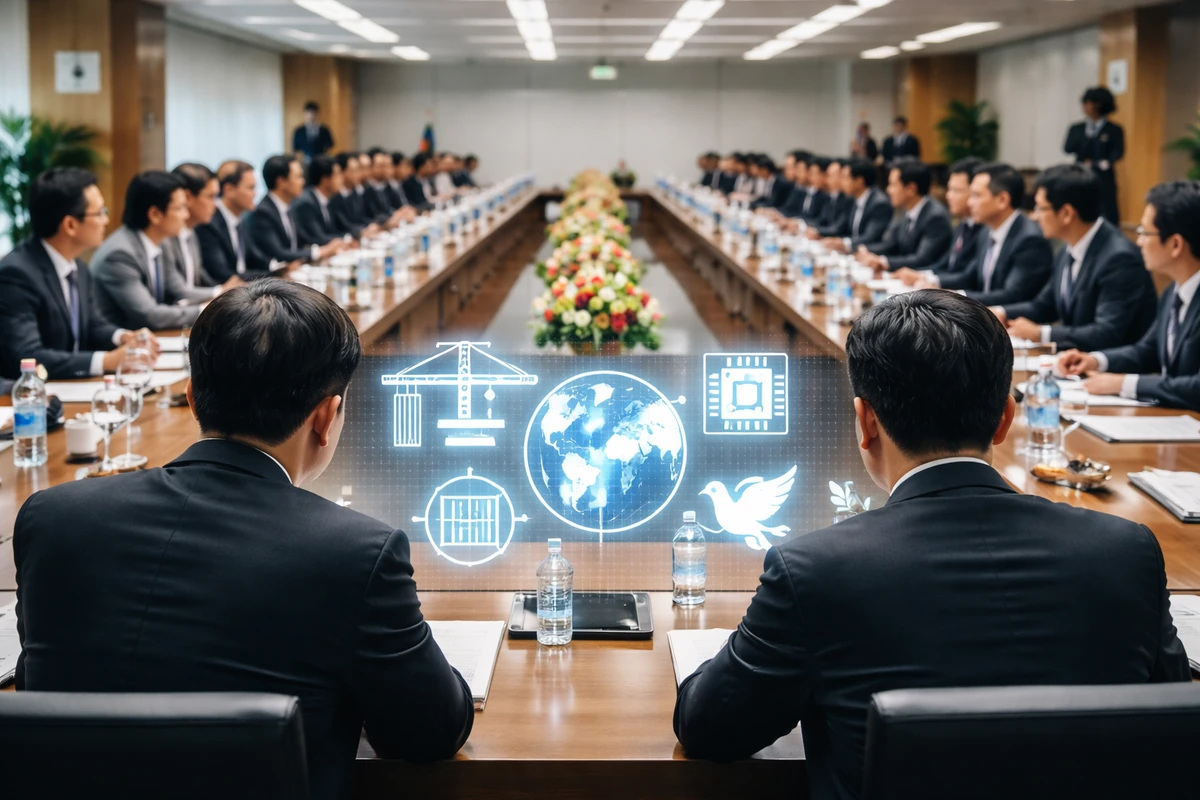
A diplomatic trip with a domestic political message
When South Korean President Lee Jae-myung arrived in New Delhi on April 19, 2026, local time, he did more than deliver the usual talking points about friendship and cooperation. Speaking at a dinner meeting with members of the Korean diaspora in India, Lee said relations between South Korea and India have a “very high possibility” of developing on “a completely different level” from the past. In the language of summit diplomacy, those kinds of phrases are common enough. Leaders everywhere talk about “new eras,” “upgraded partnerships” and “historic turning points.” But in this case, the substance around Lee’s remarks suggests something broader: a reordering of political priorities that reaches far beyond a standard overseas visit.
What stood out in the presidential message was not ceremonial warmth or symbolic outreach. It was the way Lee’s office reportedly bundled together a set of issues that are often treated separately: supply-chain instability, the global economic downturn and peace on the Korean Peninsula. That matters because in South Korean politics, foreign trips have often been consumed as short-lived events — a chance to generate images of statesmanship, dominate a news cycle at home or temporarily shift attention from domestic problems. Lee’s India stop, at least in the way it was framed, pointed in a different direction. It suggested he wants diplomacy to serve as a tool for economic security, and economic security to serve as a pillar of political stability at home.
For American readers, the closest comparison may be the way U.S. presidents in recent years have talked about semiconductors, critical minerals and energy security not just as trade issues, but as matters of national resilience. In Washington, the old line between foreign policy and economic policy has eroded. Seoul appears to be making a similar adjustment. That is especially significant for South Korea, a trade-dependent economy that imports much of its energy and raw materials and sits in one of the world’s most volatile geopolitical neighborhoods.
Lee’s remarks in India, then, were not simply about bilateral goodwill. They were a signal about how his administration sees the world: unstable, structurally risky and increasingly defined by whether countries can keep factories running, prices stable and strategic vulnerabilities under control. If that diagnosis is correct, India is not merely a friendly partner. It becomes part of a larger survival strategy.
Why India, and why now?
One of the most striking details in the summary of Lee’s remarks is where he began. He did not start by celebrating India’s culture, market size or status as the world’s most populous country, though all of those are familiar themes in official visits. Instead, he reportedly framed India through the aftershocks of war in the Middle East, arguing that supply-chain instability and global economic crisis have become permanent features of international life rather than temporary shocks.
That framing is revealing. It suggests the administration is looking at world affairs less through the lens of values diplomacy or symbolic alignment and more through the lens of material risk: energy flows, access to raw materials, manufacturing capacity and the durability of logistics networks. In practical terms, that means New Delhi is being cast not simply as an export market, but as a strategic hedge.
That logic is easy to understand in the South Korean context. South Korea is one of the world’s most export-oriented advanced economies, but it remains heavily dependent on imported fuel, industrial inputs and maritime trade routes. Any prolonged disruption in the Middle East — whether through energy markets, shipping lanes or secondary financial effects — carries direct consequences for inflation, industrial output and consumer confidence in Seoul. Those consequences do not stay in the realm of diplomacy for long. They show up in electricity costs, factory planning, jobs and kitchen-table economics.
That is where India enters the picture. For years, India has been described by foreign governments and multinational companies as an alternative manufacturing hub, a giant consumer market and a key player in efforts to diversify production away from overconcentrated supply chains. Lee’s reported description of India as a core country leading global production and supply chains fits squarely within that international trend. But his emphasis appears to go beyond the standard “India opportunity” narrative familiar to business forums and investor presentations. The point, in this telling, is not just growth. It is risk distribution.
That difference is politically important. Governments often sell overseas engagement in terms of opportunity — more exports, more investment, more access to fast-growing markets. Lee’s rhetoric, at least as summarized, sounds more like the language of resilience. Instead of promising only expansion, it speaks to a more anxious era in which governments are judged by whether they can help their societies absorb shocks. For voters, that may be more persuasive than the abstract promise of future gains. Stability is tangible. It affects grocery bills, employment and the general sense of whether life feels manageable.
In that sense, the timing makes political sense. When the international environment grows more uncertain, leaders often try to show they are not merely reacting to events but redesigning the national playbook around them. A visit to India allows Lee to do that while tying a foreign-policy initiative directly to domestic concerns that voters can recognize in their daily lives.
From diplomacy to economic security
There is a phrase increasingly used in Washington, Brussels and Asian capitals alike: economic security. It captures a world in which trade, industry, technology and national defense are no longer neatly separate domains. A semiconductor plant is not just a business asset; it is strategic infrastructure. Access to lithium, natural gas or rare earths is not simply a pricing issue; it shapes national power. Shipping bottlenecks are no longer mere headaches for corporate procurement teams. They are political problems that can topple approval ratings if shortages or inflation spiral.
Lee’s India message seems to fit squarely within that framework. By foregrounding energy, raw materials, manufacturing bases and supply-chain restructuring, he appears to be using the language of industrial policy while standing on a diplomatic stage. That is a noteworthy shift in tone. Traditional summit rhetoric often stays at a high level — friendship, cooperation, mutual prosperity. The summary of Lee’s remarks suggests a more concrete vocabulary, one rooted in the mechanics of how an economy survives disruption.
For South Korea, this is more than a matter of style. It reflects structural reality. The country is a manufacturing powerhouse in sectors ranging from semiconductors and autos to batteries and shipbuilding, but its strengths depend on access to imported resources and predictable trade routes. In an era marked by war, great-power rivalry and climate-related disruptions, that dependence creates vulnerabilities that no government can ignore. If earlier generations of South Korean leaders could afford to treat diplomacy and industry as adjacent but separate realms, that is much harder now.
Seen that way, Lee’s reported statement that India is South Korea’s “most important strategic partner” is not just a compliment to a host country. It is a message about how his administration intends to define strategic partnership itself. The term no longer refers only to military ties or broad geopolitical alignment. It increasingly includes the question of who can help stabilize supply chains, secure inputs, expand production networks and lessen exposure to external shocks.
That does not automatically mean dramatic policy breakthroughs are imminent. The hard part comes after the speeches: negotiating deals, coordinating ministries, aligning budgets, winning legislative support and persuading businesses to commit real capital. Political leaders frequently announce strategic visions that later bog down in bureaucracy or market realities. Still, agenda-setting matters. Before governments can build institutions around economic security, they have to define it as a central task. Lee’s India trip appears designed to do exactly that.
There is also a communications dimension here. By introducing these ideas early in the trip, Lee effectively sets the standard by which the visit should be judged. Rather than inviting the public to evaluate success only through headline-grabbing investment numbers or ceremonial agreements, he is asking them to think in terms of resilience: whether ties with India can make South Korea less vulnerable to global turbulence. That is a subtler metric, but potentially a more consequential one.
The political risk of promising a “completely different level”
Even so, the wording matters. When a president says bilateral ties could move to “a completely different level,” expectations rise immediately. In politics, rhetoric is never free. It creates a benchmark against which critics, supporters and markets alike will later measure performance. The more sweeping the promise, the harder it becomes to explain incremental results.
That is one reason Lee’s phrasing carries domestic political weight. It signals confidence, but it also enlarges responsibility. If the visit yields meaningful follow-up in trade, energy, logistics, industrial cooperation or long-term supply-chain planning, the phrase may later be remembered as an early marker of strategic leadership. If results prove thin or diffuse, opponents could portray it as overpromising dressed up as diplomacy.
Still, there is an important distinction in how this message was delivered. Lee does not appear to have preemptively boasted about a specific investment figure or a major signed agreement before outcomes were clear. Instead, the emphasis was on redefining the relationship itself — moving South Korea and India into a new strategic frame. That makes the message less about immediate spectacle and more about structure. Politically, that can be a smart move. Structural arguments are harder to disprove overnight, even if they remain difficult to implement.
It also suggests Lee may be trying to break with a familiar pattern in South Korean politics, where overseas trips are often judged as isolated events rather than integrated parts of governance. By treating diplomacy as a framework for domestic resilience, he is implicitly arguing that the real significance of a summit does not end when Air Force One — or its South Korean equivalent — lands back home. It begins there, in the policy machinery that follows.
That puts pressure not just on the presidency but on the entire governing system. If India policy is now tied to supply-chain security, then ministries responsible for trade, industry, energy, transportation and foreign affairs all need to move in concert. So do lawmakers, regulators and major firms. In other words, the trip raises the bar for the South Korean state itself. Grand strategy cannot remain rhetorical if it is to survive contact with political reality.
For observers of Asian politics, that may be the most interesting element of all. The question is not whether Lee can deliver a memorable line abroad. It is whether he can translate a broad strategic thesis into administrative follow-through at home. That is where many governments stumble.
A literary reference and the return of peace language
The other noteworthy element in the summary was more unexpected: Lee’s invocation of the novel “The Square” by Choi In-hun, a landmark work in modern Korean literature. For readers outside Korea, some context helps. Published in 1960, “The Square” is widely taught and discussed in South Korea as a powerful meditation on division, ideology and the human cost of the Korean Peninsula’s split between North and South. Referencing it in a diplomatic setting is not a casual flourish. It carries emotional and political resonance.
According to the summary, Lee said the mention of India made him think of “The Square,” explaining that the novel includes stories of people living through the tragedy of national division and passing through third countries. He then said that the reality of South and North Koreans living together in India shows a possible future for peace on the Korean Peninsula. That is a notable choice of imagery. Rather than invoking peace through formal slogans, treaty language or direct calls for negotiation, he reportedly used a scene of coexistence in a third-country setting.
That softer framing may be deliberate. In South Korea, discussion of North Korea is politically charged and often exhausting for the public. Debates can quickly harden into a binary between hawks and doves, deterrence and engagement, realism and idealism. By using a literary reference and diaspora experience, Lee seems to have chosen a less confrontational register. He spoke not in the vocabulary of summit declarations but in the vocabulary of lived reality — people from a divided nation sharing space abroad.
For American readers, there is no perfect equivalent, but imagine a U.S. president referencing a classic American novel or historical image to recast a polarized political issue in more human terms. The point would not be to announce a policy reversal on the spot, but to change the emotional texture of the conversation. That appears to be part of what Lee was doing.
At the same time, it would be premature to read too much into a single remark. The summary itself cautions against declaring a full policy turn based on comments at a diaspora event. That is a sensible warning. South Korea’s North Korea policy is shaped by military realities, alliance commitments, domestic politics and the behavior of Pyongyang itself. One literary metaphor in New Delhi does not override those constraints. But it can offer clues about tone, emphasis and the kinds of narratives a president wants to revive.
In that sense, the comment matters. Political direction often appears first not in major doctrine speeches but in smaller choices of language. If Lee is trying to reintroduce peace discourse into South Korean public life, doing so through a scene of ordinary coexistence rather than ideological confrontation is significant. It suggests an effort to make the subject feel less abstract, less polarizing and more rooted in everyday human possibility.
Why a diaspora event matters
The setting of the remarks is also worth attention. Lee spoke not at a formal summit podium or during a joint statement with Indian officials, but at a dinner meeting with ethnic Koreans living abroad. That kind of event occupies a distinctive place in Korean presidential travel. It is less rigid than treaty language, less choreographed than state ceremony and often more personal in tone. Leaders can test themes there, blend emotional appeal with political signaling and address audiences at home indirectly through a supposedly informal setting.
That makes diaspora gatherings useful stages for a president trying to broaden the meaning of a trip. In this case, the format allowed Lee to connect strategic partnership, supply-chain insecurity and peace rhetoric in one setting without sounding like he was unveiling a formal doctrine. The language can be warmer, more anecdotal and less boxed in by diplomatic protocol. But it still travels — through media coverage, political interpretation and domestic debate.
There is a long tradition of political leaders using overseas Korean communities as both an audience and a mirror. These communities embody South Korea’s global reach, but they also provide a venue where national identity, economic ambition and geopolitical anxiety can be discussed together. For a president, that makes them an ideal audience for signaling how foreign policy should be understood back home.
That may explain the layered nature of Lee’s remarks. On the surface, he was speaking to compatriots abroad about South Korea’s ties with India. At another level, he was speaking to domestic audiences in South Korea about what should count as successful leadership in an unstable world. The message was that foreign policy should no longer be judged only by prestige or symbolism, but by whether it supports resilience, growth and a less fragile national future.
That kind of indirect communication is hardly unique to Korea. American presidents do something similar when they frame overseas trips around jobs, gas prices, factory investment or supply chains back home. What feels different here is the degree to which Lee appears to be folding peace on the Korean Peninsula into the same conversation as economic security. That gives the message an unusual breadth. It says, in effect, that diplomacy is not one policy area among many. It is a hinge connecting security, economic survival and social stability.
What to watch after the trip
The most important test will come after the headlines fade. If Lee’s India trip was indeed an attempt to reset the agenda, the real measure will be whether the administration can convert rhetoric into policy architecture. That means concrete follow-up across multiple fronts: trade arrangements, industrial cooperation, energy planning, logistics coordination, private-sector participation and perhaps expanded people-to-people ties as well.
It also means managing public expectations carefully. Strategic partnerships are rarely transformed overnight, no matter how emphatic the language used at the outset. The relationship between South Korea and India has long been discussed in terms of untapped potential. Turning that potential into durable results requires persistence, bureaucratic discipline and sustained political attention — all of which are harder than crafting a compelling message on foreign soil.
Still, even at this early stage, the framing alone is telling. Lee did not appear to present India simply as a diplomatic destination or a market to be courted. He presented it as part of a broader answer to a world shaped by war, uncertainty and interdependence. That is a different kind of foreign-policy argument from the one South Koreans have often heard in the past. It is less about grandeur than about endurance.
Whether that approach succeeds is impossible to know yet. But the trip has already clarified something important about Lee’s political instincts. He seems intent on collapsing old boundaries — between foreign policy and domestic politics, between diplomacy and industrial policy, between security and economics, and even between strategic calculation and the symbolic language of peace. In a period when many democracies are trying to redefine what national security means in everyday life, that is a consequential move.
For American readers, the broader lesson is familiar. In an era of fragile supply chains, inflation shocks and geopolitical conflict, diplomacy no longer lives only in embassies and summit halls. It lives in ports, factories, energy contracts and grocery prices. South Korea, one of the world’s most globally exposed economies, may now be making that reality the centerpiece of statecraft. Lee’s India trip suggests that in Seoul, at least, the age of treating foreign policy as a photo opportunity is giving way to something more structural — and more politically demanding.
That does not guarantee success. But it does change the terms of the debate. The question is no longer simply whether a presidential trip produced good optics. It is whether the visit marked the beginning of a durable strategy for weathering a harsher world. On that question, Lee has set an ambitious standard for himself. The next chapter will be written not in New Delhi, but in the policy decisions that follow back home in South Korea.




0 Comments