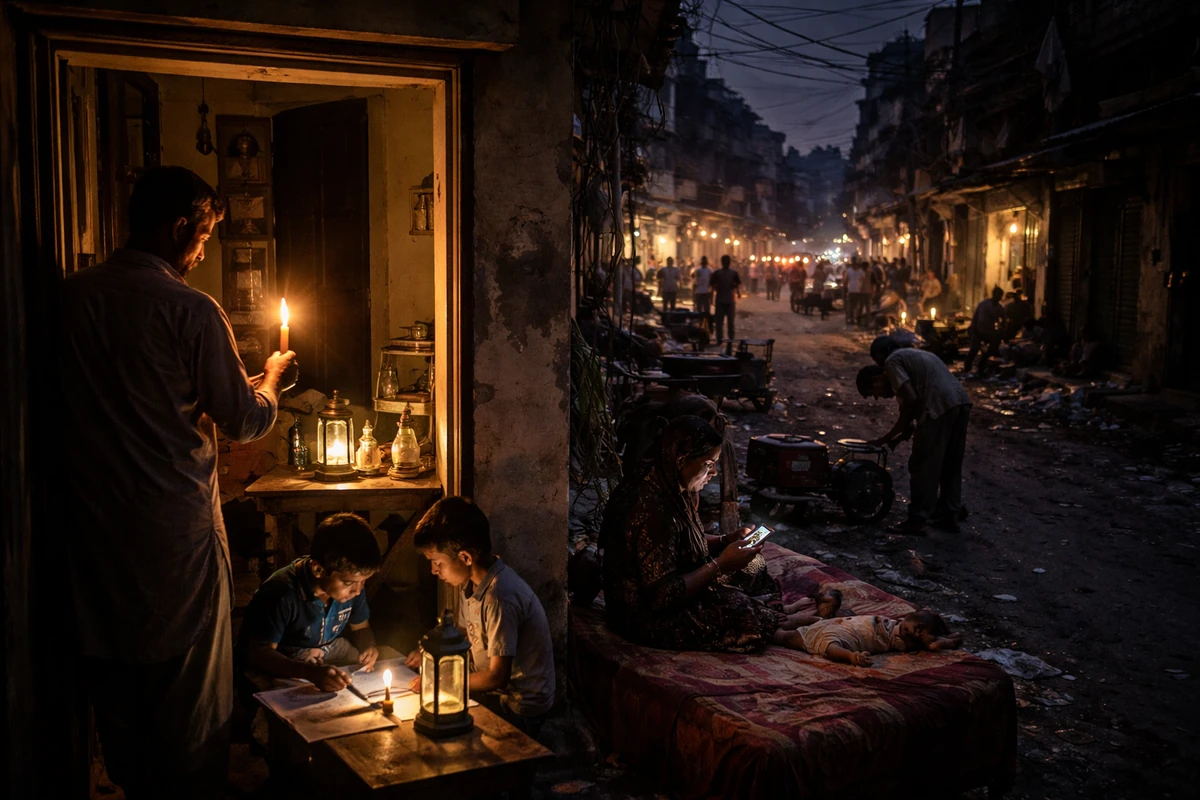
A national power crisis moves from inconvenience to emergency
Pakistan is facing the kind of electricity crisis that turns ordinary routines into a daily struggle. Across parts of the country, residents and businesses are enduring outages that stretch well beyond the brief rolling blackouts many people in the United States might associate with heat waves or storm damage. In some areas, the power has been unavailable for more than half the day, a level of disruption that affects nearly every part of modern life at once: keeping food cold, pumping water, charging phones, running factories and maintaining cell service.
The immediate trigger is a shortage of liquefied natural gas, or LNG, a supercooled form of natural gas that can be shipped by tanker and turned back into usable fuel at import terminals. Pakistan depends heavily on gas-fired power generation, so when LNG supplies are interrupted, the effect can travel quickly through the power system. It is not just a story about one technical failure or one city going dark. It is a story about what happens when a country’s invisible infrastructure, the systems people rely on without thinking much about them, no longer has enough slack to absorb a shock.
That reality is playing out in homes and workplaces alike. Reports from Lahore, Pakistan’s second-largest city, describe residents living through repeated outages day after day. A single household dealing with a dark apartment, a dead fan and a warming refrigerator might sound like a local hardship. But the larger problem is that the same shortage is hitting homes, industrial production lines and telecommunications networks at the same time. That convergence is what makes this episode more than an energy story. It is a national stress test.
For American readers, one way to understand the scale is to imagine a prolonged grid emergency that does not end after the weather clears. Think less of a two-hour outage after a thunderstorm and more of the cascading disruption seen in major disasters, when power, communication and commerce start to fail together. Pakistan’s current crisis offers a stark reminder that electricity is not simply another utility bill. It is the foundation beneath almost everything else.
The timing also adds an uncomfortable contrast. Pakistan has recently drawn attention for its role as a diplomatic intermediary in talks tied to tensions involving the United States and Iran. But while its profile abroad may be rising, the crisis at home underscores a very different reality: a country can gain strategic relevance on the world stage and still find its domestic stability tested by something as basic as fuel for power plants.
Why an LNG shortage can mean hours of darkness
To many Americans, the term LNG may sound technical or remote, something discussed in energy markets, policy hearings or global shipping reports. In Pakistan right now, it has become a kitchen-table issue. That is because LNG is deeply connected to how the country makes electricity. When gas imports stumble, the power sector feels it almost immediately.
Electric grids need balance. Utilities have to match supply and demand in real time, not just over weeks or months. In a system with strong backup capacity, diversified fuel sources and healthy reserves, one disruption can sometimes be managed without widespread pain. But in a more fragile system, losing a major fuel input can create shortages that spread fast. The result is not just a dip in supply. It can mean sustained outages, voltage instability and increasingly difficult choices about who gets electricity and when.
Pakistan’s current predicament suggests that its energy system has lost much of its cushion. LNG is not a fuel you simply pull from the ground and send directly to a plant. It has to be purchased, transported, unloaded, stored, regasified and delivered through an intricate chain. A problem at any stage, shipping, procurement, financing, terminal operations or distribution, can create a bottleneck. If power plants are built to run on gas but do not have reliable access to fuel, their installed capacity matters less than it appears on paper.
That helps explain why this crisis has been so severe. Reports of outages lasting more than half the day suggest not a minor management hiccup but a system under heavy strain. In practical terms, it means households cannot assume that a blackout will be brief enough to wait out. It means hospitals, offices, schools and telecom providers must think not in minutes but in extended survival windows, relying on batteries, backup generators or improvised workarounds until those backups run out too.
There is also a broader lesson here about energy security. In Washington policy circles, energy security often gets framed as a question of geopolitics, shipping lanes or commodity prices. Those issues matter. But at street level, energy security means whether the fan stays on during a punishing hot night, whether a neighborhood water pump keeps working and whether a parent can call a child after dark. Pakistan’s blackouts are showing how quickly an abstract supply problem turns into a social one.
Factories feel the damage first and count it fastest
When electricity becomes unreliable, the economic costs usually show up in industry before they are fully visible elsewhere. Households experience discomfort, disruption and anxiety. Factories experience measurable losses almost immediately. Machines stop mid-process. Materials spoil. Orders are delayed. Workers are left idle. Restarting production can take additional time, especially in facilities that need stable temperatures, pressure levels or quality controls before operations can resume.
That is why even an eight-hour outage is not just eight lost hours. In manufacturing, it can wipe out an entire shift and create knock-on losses long after the power returns. Equipment may need inspection. Assembly lines must be recalibrated. Suppliers and trucking schedules may have to be reset. Export commitments can slip. For companies already operating on thin margins, frequent disruptions can turn a difficult month into a crippling one.
Pakistani business groups have warned that repeated outages are already taking a toll on industrial activity, including manufacturing. For a country where textile production and other export-oriented industries play a major economic role, unreliable electricity is more than an operational headache. It becomes a competitiveness problem. Foreign buyers may tolerate some delays, but repeated uncertainty can push orders elsewhere. Investors weighing where to expand production rarely see unstable power supply as a manageable inconvenience. They see risk.
Americans have seen smaller versions of this dynamic when supply chains seize up after natural disasters or port slowdowns. The difference in Pakistan is that the vulnerability sits inside the daily functioning of the power system itself. If outages become routine, the cost of doing business rises across the board. Companies that can afford generators or private backup power may keep going, but at a higher expense. Smaller firms often cannot. That deepens inequality within the economy, rewarding those with their own safety nets and punishing those without them.
There is also a psychological cost. Businesses can plan around high taxes, complex regulations or tough competition if the rules are at least predictable. Electricity shortages undermine predictability. A factory manager who does not know whether the next day will bring two hours of power or 12 cannot organize labor, inventory or delivery schedules with confidence. Over time, that uncertainty changes how companies hire, invest and grow. It is one reason power instability can haunt an economy long after the immediate crisis eases.
When cell towers go dark, the outage becomes a systemwide breakdown
One of the most revealing parts of Pakistan’s current emergency is the threat to mobile phone service. In an earlier era, a power outage mostly meant darkness, heat and inconvenience. In a smartphone economy, it threatens connection itself. Cell towers can keep running on backup batteries for only so long. If blackouts stretch past that window, the communication network begins to fray.
That matters because modern daily life is built on the assumption of constant connectivity. In the United States, people use phones for maps, banking alerts, rideshares, work messages, telehealth visits and emergency notifications. Pakistan is no different in the basic structure, even if the apps and local services vary. Mobile networks carry everything from family contact and business coordination to digital payments, deliveries, school notices and medical appointments. When the network goes down, the problem is no longer just a lack of electricity. It becomes a loss of social and economic coordination.
A major Pakistani telecom provider has warned that if outages continue for eight hours or more, backup batteries at cell sites could be depleted, opening the door to service interruptions. That is a striking warning because it shows how tightly interlocked infrastructure has become. Power and communications are often treated as separate sectors on paper. In real life, one increasingly depends on the other. If the grid fails long enough, the phone in your hand may still have battery life, but it turns into something close to a flashlight and camera rather than a communications device.
This kind of failure has broad consequences. People cannot easily check on relatives. Small businesses cannot confirm orders. Drivers cannot navigate or receive ride requests. Delivery workers lose contact with customers. Hospitals and public agencies may struggle to send updates. Governments trying to manage public frustration face an ugly paradox: the longer the power crisis lasts, the harder it becomes to communicate clearly with the public about what is happening.
That is one reason prolonged blackouts can intensify fear far beyond the immediate discomfort of heat or darkness. Information itself becomes scarce. Rumors spread more easily when official updates are harder to access. A resident who cannot charge a phone or reach a relative may reasonably assume the situation is worse than it is. In that sense, a power shortage can evolve into a crisis of trust and public confidence. Once power and communications start failing together, the disruption stops looking temporary and starts feeling systemic.
The burden falls hardest on ordinary households
For families, the most visible part of an electricity shortage is often the simplest. Fans stop. Air conditioners shut off. Refrigerators warm up. Water pumps fail. Elevators stall. Phones become precious because each percentage point of battery life has to be rationed. People begin to organize life around whatever backup tools they can afford: power banks, rechargeable lamps, small generators and phone flashlights.
That image, households leaning on improvised or temporary fixes, says something important about the crisis. It suggests not just a short-term disruption but a society adapting to the expectation of continued instability. In many countries, generator culture becomes its own marker of unequal resilience. Wealthier households and businesses can buy a degree of independence from the grid. Poorer families cannot. They absorb the outage directly, sweating through the heat, watching food spoil faster and spending more time and money just to maintain a basic routine.
For readers in the U.S., it may help to think of the difference between preparing for a storm and living inside a prolonged infrastructure shortage. Americans in hurricane-prone states may keep flashlights, bottled water and battery packs on hand for emergencies. But that preparation is usually tied to an event expected to pass. In Pakistan, when outages become an enduring feature of life, stopgap measures start replacing normal service rather than bridging a temporary gap. That is a far heavier burden.
The consequences ripple outward. Children may have difficulty studying after dark. Working adults lose the ability to rely on home internet or charged devices. Refrigerated food and medicine become less secure. Small neighborhood shops that depend on cooling or electronic payments face extra losses. Even basic domestic rhythms, cooking, bathing, sleeping, commuting, begin to bend around the unpredictable return of electricity.
And because power is so closely linked to water, sanitation and communication, the pain is rarely isolated. An outage can mean no fan, but it can also mean no running water in upper floors of an apartment building, no ability to recharge a phone needed for work and no reliable way to receive notices about when service might be restored. That stacking effect is what turns inconvenience into fragility. It reveals how many layers of ordinary life depend on a steady current running through walls people barely notice until the current stops.
Diplomatic relevance abroad, vulnerability at home
The crisis also highlights a tension that is common in international affairs but rarely seen this clearly. Pakistan has recently attracted attention as a diplomatic actor, particularly because of its role in mediation tied to U.S.-Iran tensions. That kind of engagement can raise a country’s profile and reinforce its importance in regional politics. Yet the same nation can be wrestling with severe weaknesses at home, in this case an energy system vulnerable enough that a fuel disruption can throw major cities and industries into prolonged distress.
That gap is more than symbolic. International influence can bring prestige, leverage and opportunities. But the durability of a state’s influence often rests on whether it can deliver basic stability to its own population. A country trying to shape events abroad while struggling to keep the lights on at home faces hard questions about capacity and priorities. Diplomacy may elevate a government’s standing, but electricity shortages tend to dominate the public mood in a far more immediate way.
There is a deeper point as well. For many Americans, foreign policy and domestic life can feel like separate conversations. Pakistan’s current experience shows how thin that line can be. Shifts in regional politics, tensions in energy markets and disruptions in fuel supply chains do not remain confined to diplomatic briefings. They show up in blacked-out homes, silent production lines and phones that cannot connect. Geopolitics arrives at the dinner table, sometimes literally in the dark.
That is why this is not just Pakistan’s problem. It is also a case study in the fragility of global interdependence. Countries that rely on imported fuel live with the reality that international shocks can become domestic crises quickly. For lower- and middle-income countries, especially those with aging infrastructure or limited fiscal space, the margin for error can be very small. When fuel becomes harder to secure, the effects are not merely financial. They are physical, visible and immediate.
The real test is resilience, not just short-term relief
In the near term, Pakistan’s most urgent task is straightforward: reduce outage hours, protect key services and prevent a power shortage from becoming a wider communications and industrial collapse. But the larger lesson of this episode points beyond emergency management. The issue is not only whether the country can secure more LNG in the coming days or weeks. It is whether its energy system can become resilient enough to withstand future shocks without pushing millions of people into crisis mode.
Resilience in this context means several things at once. It means fuel procurement that is less exposed to a single point of failure. It means backup generation and reserve margins that can cushion sudden disruptions. It means transmission and distribution systems capable of managing stress more effectively. It means planning that treats telecommunications, hospitals, water systems and industry as linked infrastructure, not separate silos. And it means recognizing that energy policy is inseparable from economic stability and public trust.
None of that is easy, especially in a country facing fiscal constraints, political pressures and rising demand. But crises like this make the costs of underinvestment painfully clear. People can live without many conveniences. They cannot function for long without reliable electricity. Once the grid becomes uncertain, every other promise of modernization, digital access, industrial growth, government responsiveness, starts to look contingent.
Pakistan’s blackouts have laid bare something fundamental: the most important parts of modern life are often the least visible until they break. Electricity is one of those systems. When it works, it disappears into the background. When it fails, it exposes how much of daily life, economic activity and state capacity depends on a steady supply of power. In Pakistan today, that exposure is happening in real time, in darkened homes, stalled factories and cell towers counting down the life left in their batteries.
For outsiders, it is tempting to view such a crisis as a technical matter, a fuel shortage to be solved by contracts and logistics. Those things matter, but they are not the whole story. The deeper story is about vulnerability. It is about how quickly everyday routines can unravel when a nation’s foundational systems lose their ability to absorb shocks. Pakistan’s current emergency is a warning, not just for one country but for any society whose essential infrastructure is running closer to the edge than it realizes.
Comments
Post a Comment