
Beyond the campaign trail, Seoul is thinking about supply chains
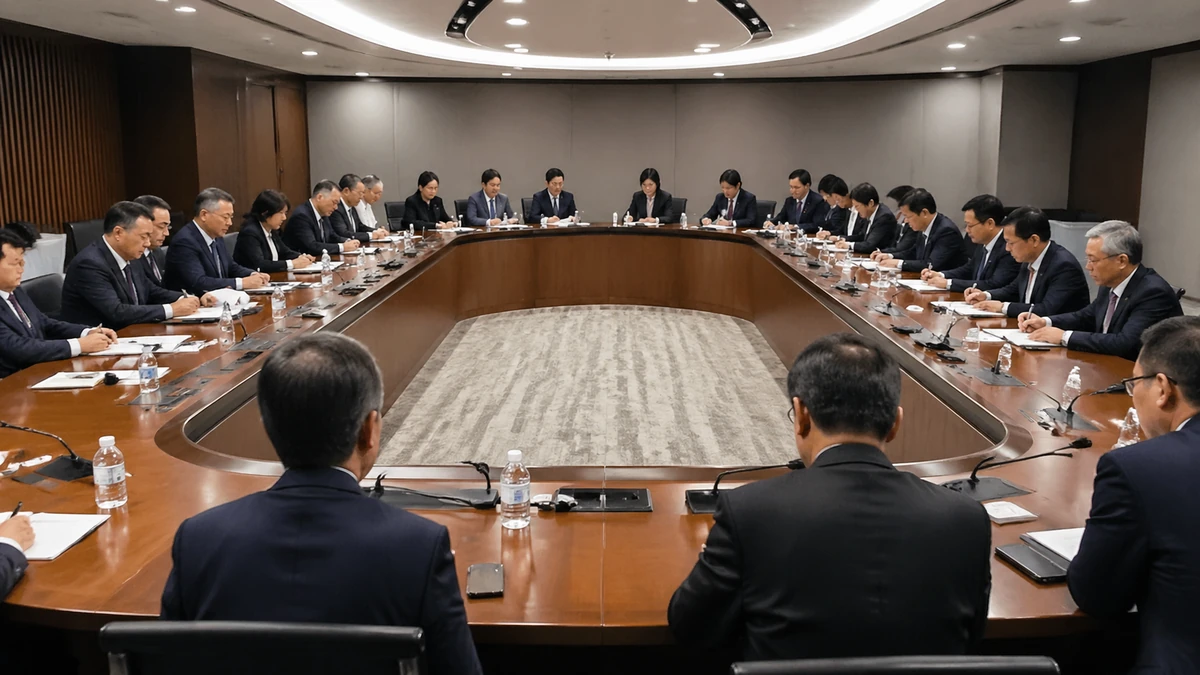
On a day when much of South Korea’s domestic political coverage was focused on the familiar machinery of democracy — party nominations, local election jockeying and the tactical choreography of primaries — the country’s foreign policy establishment was sending a different signal. The Ministry of Foreign Affairs convened a roundtable with the Korean Association of Middle East Studies to examine geopolitical instability in the Middle East and to explore what officials called future-oriented opportunities for cooperation between South Korea and the region.
That might sound, at first glance, like the sort of technocratic meeting that rarely escapes the government conference room. But in the language South Korean officials used, and in the way they framed the conversation, the event pointed to a broader strategic shift. Seoul is not treating turmoil in the Middle East as a distant crisis to be monitored from afar. It is increasingly describing that instability as a direct economic security issue for South Korea itself — one tied to energy flows, industrial resilience, advanced technology partnerships and the ability of a trade-dependent nation to keep its economy running through global shocks.
For American readers, one comparison might help. In Washington, officials in recent years have begun using the phrase “economic security is national security” to describe everything from semiconductor production to rare earth minerals to shipping vulnerabilities in the Red Sea. South Korea, a U.S. ally whose economy depends heavily on imports of energy and exports of manufactured goods, is now speaking in a similar register. The country is effectively arguing that events in the Middle East are not just foreign affairs topics. They are questions of statecraft that reach into domestic prosperity, industrial planning and national resilience.
The significance of the meeting lies not only in the fact that it happened, but in how it was described. By pairing “diagnosing the Middle East’s geopolitical crisis” with “seeking future-oriented cooperation opportunities,” South Korea’s Foreign Ministry made clear that it sees the region through two lenses at once: as a source of immediate vulnerability and as a long-term strategic partner. That dual framing matters. It suggests Seoul does not want to limit its Middle East policy to emergency management. It wants to build a sturdier architecture for cooperation before the next crisis arrives.
That approach reflects a reality that has become increasingly familiar to governments around the world. A war, maritime disruption or regional escalation thousands of miles away can quickly ripple into everyday life at home, affecting fuel prices, shipping costs, factory inputs and investor confidence. South Korea’s diplomats appear to be saying that the era when Middle East instability could be treated as someone else’s regional problem is over.
Why the Middle East matters so much to South Korea
For Americans, South Korea is often understood through a few dominant reference points: its military standoff with North Korea, its world-leading technology companies, and the global spread of Korean pop culture, from K-pop to Oscar-winning films and prestige television. But beneath that public image sits a structural reality: South Korea is one of the world’s most trade-dependent advanced economies, and it lacks the domestic energy resources needed to fuel that economy on its own.
That helps explain why the Middle East carries outsize importance in Korean strategic thinking. The region has long been central to South Korea’s energy supply, particularly in oil and gas. While the Korean summary of the meeting did not list detailed figures, the ministry’s emphasis on upgrading energy cooperation left little ambiguity about the stakes. For Seoul, energy ties with the Middle East are not an abstract diplomatic concern. They are bound up with the foundations of industrial production, transportation, household costs and export competitiveness.
To an American audience, this is somewhat analogous to how U.S. policymakers think about the Strait of Hormuz, the Suez Canal or major shipping lanes in the Indo-Pacific. Even when a country is not geographically close to a conflict, it can be economically exposed to it. South Korea’s vulnerability is especially acute because its economic model depends on reliably importing raw materials and energy, transforming them through advanced manufacturing, and selling finished goods to the world. Any major disruption in that chain can have outsized effects.
That is why the Foreign Ministry’s language around “supply chain stability” deserves attention. In the years since the COVID-19 pandemic, the war in Ukraine and shipping disruptions linked to conflict in the broader Middle East, “supply chains” have moved from business pages into the center of national policy debates. Once a term mostly used by logistics executives, it is now part of the vocabulary of presidents, foreign ministers and defense planners. In South Korea, as in the United States, supply chains are no longer treated merely as commercial arrangements. They are viewed as strategic systems that can either strengthen or expose the nation.
The Korean government’s concern is not simply that instability could raise energy prices. It is that repeated external shocks can reveal deeper weaknesses in how the country is connected to the world. If too much depends on a small number of routes, suppliers or partners, then every flare-up becomes a potential domestic problem. That is the backdrop for Seoul’s push to think more systematically about resilience.
From crisis response to resilience planning
One of the most telling remarks at the roundtable came from Jeong Hye-hye, a deputy minister-level official at the Foreign Ministry, who said the current war had reaffirmed that a supply chain crisis in the Middle East could develop into an economic security crisis for South Korea. The key word there is “reaffirmed.” It suggests that Seoul is not identifying a brand-new threat. Rather, it is acknowledging that an existing vulnerability has once again been exposed by events on the ground.
That distinction is important. Governments often react to international crises in one of two ways. The first is reactive: scramble after the disruption begins, work to contain the damage and hope markets stabilize. The second is structural: use the shock as evidence that underlying systems need redesign. South Korea’s messaging points to the second approach. Officials are signaling that they want to move beyond emergency response toward what might be called resilience planning — building relationships and institutions that are better able to absorb shocks in the first place.
In practical terms, that means broadening the policy conversation. The ministry’s framing did not stop with energy. It also highlighted supply chain stabilization and expanded cooperation in emerging and advanced sectors. That broadening is notable because it shows Seoul trying to update an older view of the Middle East as simply a source of hydrocarbons. The newer view is more layered. It treats the region as a set of strategic partners in an era when economic security spans energy, manufacturing, technology and infrastructure.
For American readers, this may sound similar to the way U.S. officials now discuss partnerships with Gulf states not only in terms of oil but also investment, artificial intelligence, critical minerals, clean energy and logistics. South Korea appears to be making a comparable adjustment. It is not abandoning traditional energy diplomacy. Rather, it is trying to build on it — using longstanding ties as the basis for more diversified, future-facing cooperation.
This is also where the policy language becomes political in the broadest sense of the word. In many democracies, politics is often equated with elections, campaigns and legislation. But high-level decisions about which risks to prioritize, which regions to cultivate and which industries to shield are equally political. They reveal how a state defines its interests and how it intends to navigate a volatile world. By elevating Middle East instability to a central economic security issue, South Korea is making a choice about what deserves sustained government attention.
A distinctly Korean way of translating global crisis into policy
The South Korean response also reflects something specific about the country’s governing style. In Seoul, foreign policy is often shaped through a blend of state coordination, private-sector input and academic expertise. That helps explain the format of the meeting, which brought together government, business-facing perspectives and scholars in a public-private-academic roundtable. The structure itself was part of the message.
In Korean, the phrase often used for this kind of arrangement is “min-gwan-hak,” shorthand for cooperation among the private sector, government and academia. To American ears, that might sound bureaucratic. In South Korea, however, it signals a practical recognition that major strategic challenges cannot be solved by ministries alone. Businesses feel supply chain stress in real time. Scholars often have deeper regional knowledge than generalist policymakers. Government holds the tools of diplomacy and coordination. Bringing those actors to the same table indicates an effort to treat the problem as systemic rather than siloed.
That matters because Middle East policy is not just about what happens in embassies or at summits. It touches shipping firms, refiners, manufacturers, insurers, construction companies and technology investors. South Korea has decades of experience in the region through energy imports, major infrastructure projects and labor-intensive development deals that helped fuel Korean economic growth in earlier eras. But the ministry’s latest framing implies those older linkages are no longer sufficient on their own. Seoul wants a more sophisticated model suited to a period of overlapping wars, great-power competition and supply chain weaponization.
There is another distinctly Korean dimension here as well: the habit of translating external crises into administrative language that can guide policy. Rather than making the Middle East discussion primarily about ideological alignment or sweeping moral rhetoric, the ministry appears to be processing it through the terms “economic security,” “supply chain stability” and “cooperation structure.” That may sound dry, but it is revealing. It shows a government trying to discipline uncertainty into a framework it can manage.
That approach does not mean South Korea is indifferent to the human or political dimensions of conflict. It means its officials are trying to define the issue in a way that matches Korean national interests. In other words, Seoul is speaking in what might be called a Korean policy dialect: not centered first on battlefield narratives, but on how regional upheaval travels through tanker routes, import dependence, export industries and long-term strategic planning.
More than an economic story, this is a political one
At first glance, the roundtable could be mistaken for an economic policy event. It dealt with energy, logistics and industrial cooperation, and it did not announce a dramatic new doctrine or a headline-grabbing diplomatic breakthrough. But that would undersell its significance. In reality, this is a political story because it reveals what the South Korean state now considers part of its core governing agenda.
In the United States, the merger of foreign policy and economic policy has become increasingly visible. The White House talks about “friend-shoring.” Congress debates semiconductor subsidies through a national security lens. Trade, once treated as a mostly commercial domain, is now discussed in relation to strategic rivalry and resilience. South Korea is operating in a comparable environment. It is a U.S. ally, but also a middle power with its own exposure to global volatility and its own need to balance diplomacy, industry and security.
What makes the Korean case especially interesting is the contrast between the day’s domestic headlines and the substance of the Foreign Ministry meeting. Local political news in South Korea can be as tactical and personality-driven as anywhere else: candidate endorsements, factional alignments, nomination battles and election messaging. Yet while those stories dominate attention, the machinery of state continues operating on another level, dealing with risks that do not wait for campaign calendars.
That is one of the deeper lessons of the roundtable. A country’s politics are not limited to its elections. They also include quieter decisions about where to deploy diplomatic energy, how to hedge against global disruptions and what kinds of international partnerships to prioritize. By choosing to spotlight the Middle East as an economic security challenge, Seoul is asserting that the issue belongs not on the margins of policymaking, but near its center.
This also suggests a widening definition of what “security” means in South Korea. Traditionally, for obvious historical reasons, security in the Korean context has often been dominated by questions involving North Korea, the U.S. alliance and military deterrence. Those concerns remain fundamental. But they now coexist with a broader understanding: that a modern industrial state can be threatened not only by missiles and armies, but by chokepoints, shortages, energy shocks and prolonged global instability. The roundtable did not erase traditional security concerns. It added another layer to them.
What Seoul may be signaling to Washington and other partners
Although the meeting was primarily about South Korea’s own strategic calculus, it also carries implications for allies and partners, especially the United States. Washington has encouraged its allies to think more holistically about economic resilience, strategic dependencies and the vulnerabilities embedded in global supply networks. South Korea’s latest messaging suggests it is doing exactly that, but with an eye toward its own geographic and industrial realities.
For American policymakers, that could be a welcome development. The U.S.-South Korea alliance has expanded far beyond its original military foundation. It now includes technology cooperation, supply chain dialogues, industrial policy coordination and joint thinking about regional stability. If Seoul is elevating the Middle East as an economic security issue, that creates another area where allied consultations may deepen — whether through energy planning, maritime security, investment coordination or joint approaches to critical industries.
At the same time, South Korea’s framing underscores that allies do not experience global risk in identical ways. The United States has different energy resources, different market size and different logistical buffers. South Korea’s vulnerabilities are sharper in some respects because of its heavier dependence on imported energy and its tightly integrated export economy. That means Seoul’s urgency is not simply derivative of Washington’s agenda. It comes from the hard arithmetic of its own national exposure.
The roundtable may also be read more broadly by Middle Eastern partners themselves. By linking crisis diagnosis with future-oriented cooperation, South Korea is sending a diplomatic message that the region is not valuable to Seoul only when oil prices are stable or shipping lanes are calm. Instead, the message is that long-term ties should be strengthened precisely because volatility is becoming a more permanent feature of international affairs. For countries in the Gulf and elsewhere in the region, that kind of language can signal seriousness: South Korea wants to be seen not just as a buyer, but as a sustained strategic partner.
The bigger picture: a middle power adapting to a more dangerous world
Stepping back, the real significance of the meeting may be that it captures how a country like South Korea is adapting to the fractured global landscape of the 2020s. This is a period in which supply chains have become geopolitical terrain, regional wars generate global economic consequences and governments are trying to future-proof their economies without retreating from international trade. For a middle power that prospers through openness, that is a delicate balancing act.
South Korea cannot insulate itself from the world. Its prosperity depends on engagement. But it can try to make that engagement more resilient. That is the logic running through the Foreign Ministry’s discussion: maintain ties, deepen them where useful, diversify cooperation, and build structures that are less likely to break under pressure. In essence, Seoul is not choosing between globalization and security. It is trying to redesign globalization in a way that better serves security.
That effort is still taking shape. The roundtable did not produce a splashy policy announcement, nor did it lay out a fully detailed blueprint for action. But in some ways that restraint is part of what makes it noteworthy. The gathering was less about declaring victory than about defining the problem correctly. And in government, especially on complex international issues, that can be one of the most consequential steps.
For outsiders watching South Korea, the event offers a useful reminder. The country’s politics are not only about partisan drama at home or military tensions on the peninsula. They are also about how an advanced democracy, deeply embedded in global commerce, responds when the map of international risk changes. Right now, Seoul appears to be concluding that the Middle East belongs much higher on that map than many may have assumed.
In that sense, the ministry’s roundtable was more than a seminar. It was a marker of strategic intent. South Korea is telling its businesses, scholars, partners and citizens that upheaval in the Middle East is not a distant headline. It is part of the operating environment of the Korean state. And the proper response, in Seoul’s view, is not panic or passivity, but a more deliberate blend of diplomacy, economic planning and long-range cooperation.
That may not have the immediate drama of an election showdown or a breaking crisis alert. But as governments in Washington, Seoul and elsewhere have learned, some of the most important political decisions happen long before the next emergency hits. They happen when officials decide which risks to take seriously, which partnerships to strengthen and which vulnerabilities can no longer be left to chance. South Korea’s latest move suggests that, for Seoul, the Middle East now falls squarely into that category.


0 Comments