
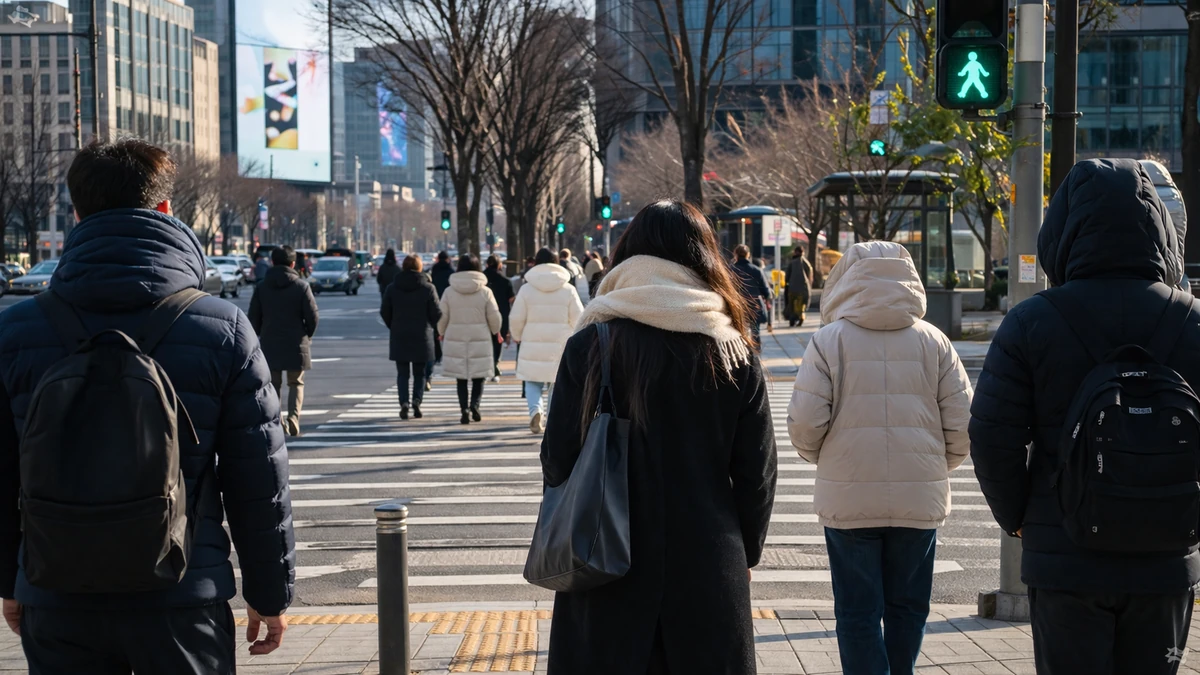
A spring morning that felt more like winter
SEOUL — In much of South Korea, early April is supposed to feel like a seasonal exhale. Heavy parkas are typically pushed to the back of the closet, cherry blossom forecasts dominate local headlines and families begin planning weekends outdoors. But on April 7, that spring rhythm was interrupted by a sharp chill that sent many commuters back outside in thick coats, gloves and layered clothing.
Morning temperatures in parts of the country dropped to around 32 degrees Fahrenheit, or 0 degrees Celsius, according to South Korean weather reporting summarized by local media. In some higher-elevation areas of Gangwon Province, east of Seoul and known for colder mountain weather, temperatures fell below freezing. Hyangnobong, a mountain peak near the eastern border region, recorded minus 5.5 degrees Celsius, or about 22 degrees Fahrenheit.
The numbers alone do not describe the full disruption. This was not a once-in-a-generation blizzard or a polar vortex on the scale Americans might associate with Chicago, Minneapolis or upstate New York. South Korea did not wake up to a full-scale winter emergency. What made the day notable was the whiplash: a cold morning requiring winter-style protection, followed by midday conditions that could feel comparatively mild in the sun. In southern regions including Daegu and North Gyeongsang Province, daytime highs were forecast to reach only the low- to mid-50s Fahrenheit, cooler than many residents would expect for this point in spring but warm enough to create a striking contrast with the start of the day.
For Americans, the closest comparison might be one of those deceptive April days in the Northeast or Midwest when the daffodils are already up, baseball season has started, and yet the morning commute still feels like late February. The problem is not simply that it is cold. It is that the body, the wardrobe and the daily routine have already mentally moved on to another season.
In Korea, that sensation has a familiar name: “kkotsaem chuui,” often translated as a late cold snap that arrives just as flowers begin to bloom. The phrase carries more than a meteorological meaning. It evokes the idea that spring has arrived, only to be briefly “teased” or pushed back by one last round of chill. It is a recurring feature of Korean springtime, and on April 7 it returned in a way that affected commuters, students, outdoor workers, older adults and farmers alike.
Why the real story is volatility, not just cold
The central issue in South Korea’s latest cold snap is less the absolute low temperature than the instability it represents. Seasonal transition periods are always messy, but large swings between morning and afternoon temperatures can create outsized stress on everyday life. A forecast that says the high will reach double digits Celsius can sound manageable on paper. In practice, however, the coldest hours are often the ones that matter most: the school run, the walk to a subway station, the start of a construction shift, or the predawn deliveries that keep cities running.
That is especially true in South Korea, where daily life is highly structured around mass transit, dense urban commuting and early work schedules. In Seoul and other major cities, many people spend part of their morning outdoors walking between apartment complexes, bus stops and subway entrances. Students often travel to school on foot or by public transportation. Delivery drivers, sanitation workers, market vendors and construction crews begin long before the warmest part of the day arrives. When the air is near freezing at those hours, the discomfort is immediate, even if the afternoon later softens.
Weather volatility can also make planning harder than a straightforward cold day would. A winter day calls for winter clothes; the decision is simple. A spring day that begins near freezing and ends with bright sun requires layers, extra bags and a small amount of guesswork. Parents must decide how to dress children who may be cold on the way to school and overheated by recess. Office workers have to prepare for both an icy platform and a heated indoor environment. Schools may have to adjust ventilation, heating and outdoor activities to account for the swing. The inconvenience sounds minor until multiplied across millions of people.
In that sense, this kind of cold snap acts like a stress test for everyday systems. It does not topple society, but it exposes where routines are least flexible. It reveals how much daily comfort depends on accurate timing, appropriate clothing and the ability to adapt quickly. Those who have stable indoor jobs and easy access to transportation can usually manage. Those whose work or health leaves them directly exposed to the elements face the greatest burden.
The Korean summary of the day’s weather emphasized this point clearly: the bigger risk was not simply “cold,” but “variability.” That is a useful distinction for readers outside Korea as well. Around the world, many people think of weather danger only in terms of extremes — a hurricane, a record heat wave, a major snowstorm. But even modest shifts can matter if they arrive at the wrong moment, after people have lowered their guard and adjusted their habits for a new season.
Commuters, students and outdoor workers feel it first
The first people to absorb the impact of a spring cold snap are often those with the least control over their exposure. In South Korea, morning commuters waiting for public transit can feel colder than the thermometer suggests, especially when wind cuts through open platforms or bus stops. A short outdoor walk can feel punishing when someone is dressed for April but standing in temperatures hovering around freezing.
Students are another obvious pressure point. In the United States, parents know the spring clothing dilemma well: send a child out in a winter coat and they may come home sweaty; send them in a hoodie and they may shiver at the bus stop. In Korea, where school routines are tightly scheduled and many children commute on foot or by transit, the same tension becomes especially visible on mornings like this one. Layering becomes less a style choice than the only practical strategy.
Schools also face smaller but real operational decisions. Teachers and administrators must think about whether classrooms are too cool in the morning, how long windows should remain open for ventilation, and whether outdoor physical education classes or playground time should be modified. None of this is dramatic enough to become national crisis news, but it is precisely the kind of low-level disruption that shapes how people experience a weather event.
Outdoor workers encounter sharper risks. Construction crews, logistics staff, street cleaners, open-air market sellers and delivery riders often begin work before sunrise or shortly after. Spring cold snaps can catch them in a vulnerable window because winter gear may already have been packed away or work routines may have shifted to warmer-season assumptions. Gloves, wind-resistant outerwear, warm drinks and timed breaks suddenly become relevant again.
That matters in Korea’s urban economy, where fast delivery and round-the-clock convenience are deeply woven into daily life. Whether it is a dawn wholesale market, a courier on a scooter or a vendor setting up before the morning rush, the workers who sustain everyday convenience often meet the weather before everyone else does. A brief cold spell may not shut those systems down, but it can make work harder, slower and less safe.
It is also worth noting how subtle weather shifts affect mood and perception. People tend to tolerate January cold because it fits the season. April cold feels like a betrayal. That mismatch between expectation and reality can make even ordinary discomfort feel sharper. In Korea, where spring is closely associated with flower viewing, campus festivals and the visible return of street life, a cold morning lands not just on the skin but on the social calendar.
The health risks are modest for some, serious for others
For most healthy adults, a brief cold spell in April is more nuisance than medical emergency. But public health experts in Korea have long warned that wide temperature swings can place added strain on the respiratory and cardiovascular systems, particularly for older adults and people with chronic illnesses.
Cold morning air can irritate the bronchial tubes, making it harder for people with asthma or chronic lung disease to breathe comfortably. Abrupt changes in temperature may also contribute to fluctuations in blood pressure, an especially relevant concern for older adults and those with heart conditions. Infants and very young children, whose bodies regulate temperature differently from adults, can also be more sensitive to sudden chill.
This is where timing matters. Someone who assumes winter is over may increase outdoor activity, restart early-morning exercise or spend longer hours outside without fully accounting for the day’s low temperature. A sunrise walk, a morning jog or early physical labor can all be healthy habits under the right conditions. But when near-freezing air meets a body that has not fully adapted, the strain can be greater than expected.
Another problem is the cycle created by large daily temperature gaps. People leave home underdressed for the cold, become active as the weather warms, perspire and then face cooler conditions again later in the day. That repeated shift — cold, warm, cold — can intensify fatigue and leave people feeling run down. While the idea of “catching a cold” from weather alone is medically simplistic, exposure patterns like these can weaken comfort, worsen symptoms and increase vulnerability, especially among those already at risk.
Indoor conditions matter, too. By April, many households reduce heating use, assuming the worst of winter has passed. But if early-morning indoor temperatures drop too low, sleep quality and morning well-being can suffer, particularly for seniors living alone or in older housing. Korean health guidance in these situations tends to emphasize simple measures rather than elaborate interventions: dress in layers, stay hydrated, avoid overexertion outdoors at dawn, and carefully manage medications and body temperature if you have chronic health concerns.
For American readers, this may sound familiar. In the United States, health departments routinely issue winter advisories for older adults, unhoused residents and people with heart or lung disease. What is different in Korea is how compressed and abrupt the seasonal shift can feel. When cherry blossoms are already appearing and the broader culture has mentally moved into spring, a colder-than-expected morning can be easy to dismiss. That is exactly why officials and health experts caution against complacency.
Farmers and local businesses have reason to watch the forecast closely
The consequences of spring cold in South Korea extend well beyond urban inconvenience. April is a sensitive period for agriculture, particularly for fruit growers and greenhouse farmers. Young shoots, flower buds and crops in early growth stages can be vulnerable to cold injury if temperatures fall suddenly.
That risk is especially important in regions with orchards producing apples, pears and peaches, all crops that can be damaged by low temperatures around the blooming period. A single cold morning does not guarantee severe agricultural loss, and not every region or crop is affected equally. But even the possibility of frost or chill damage can force farmers into additional labor and expense. They may need to monitor fields before dawn, operate frost-protection fans, deploy coverings or take other protective measures to reduce risk.
In the United States, growers in states such as Michigan, Washington and Georgia are familiar with this same anxiety. A warm spell can push fruit trees to bud early, and then one badly timed freeze can threaten a season’s yield. Korea’s agricultural communities face a similar calculus. When the weather swings suddenly in April, the concern is not abstract climate chatter; it is the practical question of whether the year’s crop quality and volume will hold.
Local economies can also feel subtler effects. Cold mornings and unstable spring weather may suppress outdoor spending, shorten visits to parks or cherry blossom sites and reduce traffic at cafes with patios or businesses that depend on seasonal foot traffic. Korea’s spring flower season is an important social and commercial moment, with festivals, local tourism and neighborhood retail activity often rising in tandem. If the weather turns cold and erratic, people may still go out, but they may stay for less time and spend differently.
At the same time, certain businesses can see a temporary bump. Convenience stores may sell more hot drinks, disposable hand warmers or transitional clothing items. Seasonal apparel sales can briefly tilt back toward jackets and vests. These are small shifts, not economic shocks, but they illustrate a broader truth: volatile spring weather changes consumer behavior even when it does not rise to the level of disaster.
That distinction is important. Much of modern weather coverage focuses on catastrophic events. Yet the economy is also shaped by countless smaller disruptions that alter labor, planning and spending by degrees. A cold snap like this one is not likely to move national indicators. It does, however, ripple through household budgets, work schedules and rural decision-making in ways that are widely felt.
Not a disaster, but a test of social preparedness
South Korea’s April 7 cold snap does not fit the classic definition of a national emergency. It was not the kind of extreme weather event that overwhelms infrastructure or triggers sweeping evacuation warnings. Still, the fact that it falls short of disaster does not mean it should be treated as trivial.
Seasonal instability tends to hit the most vulnerable first. Older adults living alone, unhoused people, low-wage outdoor workers, children commuting early and people managing chronic disease all face a narrower margin for error. For them, “just one cold morning” can translate into real risk, especially if heating has been reduced, winter clothing has been set aside or support systems are slow to respond.
The Korean summary pointed to an important policy lesson: the challenge is often less about inventing new systems than about activating existing ones quickly and precisely. Local governments, schools and welfare agencies can respond to abrupt weather changes by checking on elderly residents, expanding overnight protection for those without stable housing, advising parents and students on appropriate clothing, and adjusting operations at outdoor facilities. These are not dramatic measures. They are practical ones, and they matter most when the weather event itself seems too small to command sustained attention.
This is an issue many American cities would recognize. A cold snap in April rarely gets the same urgency as a January freeze, even though public behavior may be less cautious. The psychology is straightforward: people expect winter danger in winter. They do not expect it once the trees have started blooming. That gap between seasonal expectation and actual exposure is where preventable problems often arise.
It also helps explain why Korea’s concept of “kkotsaem chuui” resonates so strongly. The term captures not only a weather pattern but a cultural warning: spring has arrived, but do not trust it completely. For readers unfamiliar with Korea, the phrase offers a window into how weather is experienced socially, not just measured scientifically. It reflects the lived reality that seasonal change is rarely neat, and that communities develop language to describe those recurring moments of instability.
In a broader sense, this kind of event underscores why resilience is not just about surviving extremes. It is also about responding intelligently to fluctuations that are common, disruptive and easy to underestimate. A society that manages those smaller shocks well is usually better positioned for the larger ones.
The number to watch now is the overnight low
If there is one practical takeaway from South Korea’s early-April cold spell, it is this: in spring, the low temperature may matter more than the high. Many people glance first at the afternoon forecast and assume that a double-digit Celsius high means a light jacket day. But the hours that shape work, school and health routines often occur much closer to the overnight low.
That is particularly true in Korea, where morning activity begins early and where regional differences can be pronounced. Conditions in a mountainous part of Gangwon can differ significantly from those along the southern coast or in inland southeastern cities. A national weather headline may say “spring chill,” but the practical impact depends on where a person lives, when they travel and how long they will be outdoors.
As the country moves deeper into April, the message from this cold snap is not that spring has failed to arrive. It is that spring weather remains unstable, and that stability should not be assumed just because the calendar has advanced. Residents who check the day’s minimum temperature, watch local hourly forecasts and dress for a wider range of conditions will be better prepared than those relying on a sunny afternoon high.
For many Koreans, that is a familiar lesson wrapped in a familiar phrase. For outsiders, it is a useful reminder that weather stories are often really stories about how a society organizes daily life, protects vulnerable people and interprets the gap between expectation and reality. On April 7, South Korea did not face a meteorological catastrophe. What it faced instead was something quieter and, in its own way, revealing: a brief return of cold that showed how much modern life still depends on the details of the forecast.
Spring has arrived in South Korea, but it has not fully settled in. And on mornings like this one, that distinction can make all the difference.


0 Comments