South Korea’s Housing Market Is Flashing a Warning Sign Americans Might Miss: The Trouble Starts at Move-In
A softer signal than prices, but a sharper warning
When Americans follow housing markets, the headline indicators are familiar: home prices, mortgage rates, building permits and sales. In South Korea, those numbers matter, too. But one of the clearest warning lights now blinking in the country’s property market comes from a metric that would sound obscure to many U.S. readers: the apartment move-in outlook index.
In April, that index fell to 69.3, according to the Housing Industry Research Institute, a Korean industry think tank. That may not sound dramatic on its own, but the number carries real weight in Korea’s housing system. The index uses 100 as the dividing line. A reading above 100 means more respondents expect move-ins to proceed smoothly than expect trouble. A reading below 100 means pessimism outweighs optimism. At 69.3, the signal is not simply that sentiment has worsened. It suggests stress is building at the very last stage of the housing pipeline, when buyers must come up with final payments, builders need cash to be collected, and lenders reassess risk.
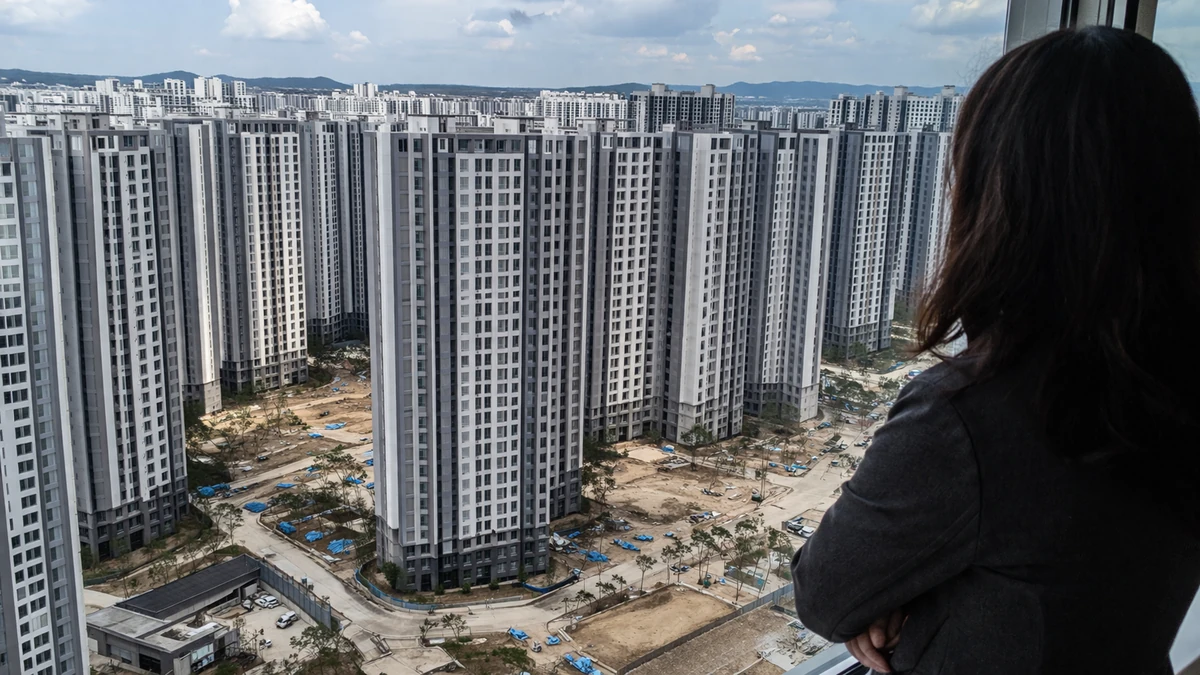
That matters because housing pain often does not fully show up when units are first marketed or even when contracts are signed. It becomes visible when construction is complete and people are supposed to actually move in. That is the moment when financing plans meet reality. For households, that can mean selling an old home, securing a tenant, converting construction-stage loans into long-term mortgages and paying large remaining balances. For developers, it means whether expected cash finally arrives. For banks, it means whether a project that looked viable on paper can really be repaid.
In the U.S., the closest comparison might be a condo market where presales looked strong two years ago, only for buyers to reach closing and discover that interest rates are higher, lending standards are tighter and rental demand is weaker than expected. The Korean version is more structurally intense because of the country’s unique housing finance practices and its heavy reliance on apartment development. That helps explain why this drop below 70, the first such break in 15 months, is being read by market watchers as more than a passing mood swing.
The deeper story is this: South Korea’s real estate market is showing strain not first in headline price charts, but in the ability of homes to be absorbed when they are finished. In practical terms, that means the market’s weakest link may no longer be sales hype or construction starts. It may be the far less glamorous question of whether buyers, tenants, developers and banks can all make the math work at the handoff stage.
Why move-in matters so much in South Korea
To understand why this indicator is significant, it helps to understand how Korean apartments are often bought and financed. Many units are sold well before completion, sometimes years in advance. Buyers typically pay a contract deposit, then a series of interim payments during construction, and finally a large balance when the building is finished and residents are expected to move in. During the sales phase, optimism can be driven by expectations of rising prices, a desirable school district or a strong location near a subway line.
But move-in is where all those expectations must be converted into cash. A household may have counted on selling its current apartment to finance the new one. It may also have planned to use a tenant’s deposit to bridge the gap. In South Korea, that tenant-deposit system is known as jeonse, a distinctive arrangement in which renters put down a very large lump-sum deposit instead of paying the kind of monthly rent Americans are used to. Landlords then use that deposit as working capital and return it at the end of the lease. For years, jeonse has been one of the key gears in the country’s housing machine, especially for homeowners trying to manage leverage.
That system works only when demand is there and deposits can be raised at expected levels. If a landlord cannot find a tenant, or can only find one willing to pay a much smaller deposit, the financing plan begins to wobble. If the existing home does not sell quickly, that creates another hole. If the bank tightens standards for the final mortgage, the gap gets larger still. What looked manageable when the apartment was first sold can become difficult by the time the keys are ready.
That is why the move-in outlook index is less like a consumer confidence survey and more like a stress gauge for the final mile of the housing supply chain. It captures the point where end-user demand, financing conditions and project-level cash flow collide. A weak reading suggests not only that households feel uneasy, but that developers may struggle to collect balances and lenders may become more cautious on new deals. In other words, trouble at move-in can ripple backward into future supply.
This is also why the headline can be misleading if one looks only at isolated signs of recovery. A few neighborhoods may see more transactions or modest rebounds in asking prices. But that does not necessarily mean finished units are easy to absorb. In a market where apartments are sold years before completion, a lot can change between presale and move-in. Rates rise. Loan rules change. Population trends shift. Employers cut jobs. Local rental demand softens. The gap between the market conditions of 2024, 2025 or 2026 and the assumptions made at the time of sale becomes the source of risk.
The triple squeeze: final payments, home sales and tenant demand
Korean analysts often describe the current move-in challenge as a three-way pressure point: final payment burdens, delays in selling existing homes and weaker demand from tenants. That combination is especially dangerous because each problem can amplify the others.
Start with the final payment, the large balance due when construction is complete. Even in healthy markets, that is the moment when households need their financing arranged with precision. But if banks are stricter than expected, or if interest costs are materially higher than when the buyer first signed, that last payment becomes harder to meet. A buyer who once expected a relatively easy loan conversion may suddenly need much more cash up front.
Now add the second problem: selling the old home. Many owner-occupiers in Korea are not speculators in the caricatured sense of a house-flipper. They are families trying to trade up, downsize or relocate. Much like an American family relying on the sale of a suburban home to close on a new one, they often need proceeds from the existing property to make the move possible. If that sale stalls, the household can be left carrying two homes temporarily, along with taxes, interest costs and uncertainty.
The third pressure point is tenant demand, particularly through the jeonse market. In many areas, buyers have historically counted on placing a tenant in the new unit and using that tenant’s large deposit to help cover the final balance. But where local demand is weak, the math breaks down. In parts of the country with slower population growth or concentrated new supply, finding a tenant may take longer or require accepting a lower deposit than anticipated.
For Americans, it may help to think of a new condo owner who expected to either sell quickly or rent the unit at a premium, only to find a glut of similar units hitting the market at the same time. Suddenly there are too many keys and not enough occupants. In Korea, because so much depends on that final settlement and on rental deposits, the financial consequences can arrive faster and more forcefully.
This is why a drop in the move-in outlook matters more than it might first appear. It points to a cash-flow problem, not just a confidence problem. Households face rising carrying costs. Builders face slower collection of balances. Financial institutions face a higher probability that projected repayment schedules will slip. The result can be a feedback loop: a weaker move-in environment makes lenders more cautious, and tighter lending makes move-ins even harder.
Why the pain is worse outside Seoul
If there is one point Korean housing analysts keep stressing, it is that national numbers can hide sharp regional divides. And in this case, the divide between the Seoul metropolitan area and many provincial cities is central to the story.
Seoul, one of the densest and most expensive metropolitan areas in the world, still benefits from powerful structural demand. It is the center of politics, finance, culture and high-paying jobs. Even when transactions slow, there is often a deep pool of would-be buyers and renters waiting for the right opportunity. Parts of the greater capital region have a similar buffer. That does not make them immune to stress, but it gives them more capacity to absorb new housing supply over time.
Many smaller cities and regional markets do not have that cushion. They may be dealing with population decline, weaker local industry, youth outmigration to Seoul and bursts of concentrated apartment supply delivered in a short period. In those places, the issue is often not whether homes were marketed effectively, but whether the local market can absorb completed units at all.
That is a subtle but crucial distinction. The problem is not simply unsold inventory in the usual sense. A project may have posted decent sales numbers during the presale stage. Yet when the building is finished, a meaningful share of buyers may struggle to complete the transaction, move in or place a tenant. The market’s absorption capacity, not just its selling ability, becomes the key variable.
For U.S. readers, there is a parallel in the difference between Manhattan and a smaller metro that overbuilt luxury apartments just as in-migration cooled. Prices alone do not tell the whole story. A region with abundant demand can digest temporary oversupply. A region with limited job growth and fewer new households can be overwhelmed by even a few large projects arriving at once.
That is one reason criticism is mounting in South Korea that national real estate policy is often designed around the politics and overheating risks of Seoul, while the provinces face a different challenge entirely. Measures aimed at restraining speculative excess or enforcing broad financial discipline may be appropriate for hot markets. But in weaker regional markets, the more immediate risks are lack of demand, tighter liquidity and the inability of completed projects to clear. Applying the same policy lens everywhere can produce very different outcomes.
The local consequences can be severe. A cluster of new apartment complexes opening around the same time in a midsize city can saturate the rental market and depress prices. That in turn makes it harder for current homeowners to sell their old units, harder for new buyers to raise cash and harder for developers to collect final balances. What begins as a move-in problem can quickly morph into price adjustments, late payments and growing inventories of completed but unoccupied homes.
When real estate and finance stop moving together
Another concept now shaping the debate in South Korea is what some Korean business commentators describe as a “decoupling” between real estate and finance. In plain English, that means the old assumption that money would continue flowing into housing projects, especially once units were sold, no longer holds as reliably as it once did.
During earlier housing cycles, a project with decent presales could often expect financing to remain available through later stages. Today, lenders are far more selective. They are scrutinizing regions, project viability and repayment prospects with greater care. In one sense, that is what regulators and risk managers are supposed to do after years of debt-fueled real estate expansion. But it also creates friction at the exact moment when projects and households need the most certainty.
That friction is especially visible at move-in. Buyers discover that loan ceilings are lower or approval standards have changed. Developers find that refinancing terms, bridge loans or project-financing extensions are more conservative than expected. In South Korea, project financing, or PF, is a major mechanism used to fund development. When analysts warn about PF stress, they are talking about whether the broader structure backing construction and repayment can still function smoothly if move-ins slow and cash recovery is delayed.
There is a phrase in Korea’s property market that sums up the current tension: apartments were sold at yesterday’s prices, but move-ins are paid for with today’s financing conditions. That time lag is at the heart of the problem. A buyer who signed a contract two or three years ago did so in a different financial environment. If rates, underwriting standards and local rental demand have all deteriorated since then, the original plan may no longer be realistic.
Importantly, the issue is not just the price of money. It is also access to money. Market watchers increasingly say that in weaker regional projects, the question is not whether borrowing costs are 50 basis points higher or lower. It is whether credit is available on workable terms at all. That distinction matters. A household or builder can sometimes manage a somewhat higher rate. It is much harder to manage a sudden refusal, a lower loan limit or a sharply more conservative appraisal.
Once that pattern takes hold, the market can reinforce its own pessimism. Low move-in expectations make banks more cautious. More cautious banks make move-ins harder. That, in turn, worsens the outlook for new projects and future housing supply. It is the kind of negative loop policymakers fear because it can spread from a handful of stressed developments into a broader freeze in market activity.
The second-round shock for builders and families
The move-in slowdown is not just an abstract market concern. It carries concrete consequences for construction companies, subcontractors and ordinary households.
Smaller and midsize builders are especially exposed. Large developers with strong brand names and deeper balance sheets often have more tools to buy time. They can offer discounts, marketing incentives or financing support to encourage occupancy. They may be able to absorb delayed collections longer than their weaker competitors. Smaller firms usually have less room to maneuver. If final payments come in late, debt-servicing pressure rises quickly. That can force delays in new projects, strain payments to subcontractors and further tighten the construction ecosystem.
This is where a localized move-in issue can become an industry-wide concern. Construction does not operate in isolation. General contractors rely on networks of suppliers, labor firms, equipment companies and specialized subcontractors. If cash flow slows at the developer level, the effects can travel down the chain. South Korea has already experienced periods when concerns around real estate financing spread into broader worries about nonbank lenders and corporate credit. That history helps explain the sensitivity around even seemingly technical indicators.
For households, the first shock is often not the moving truck bill but the financing bill. Families may face interim loan interest, final mortgage costs, expenses from still holding an old home and even temporary housing costs if schedules slip. If a tenant is not found on time or an old home does not sell, the household may be forced to lean on more expensive forms of credit. In a country where housing has long been central to middle-class wealth, that kind of squeeze can quickly become politically charged.
The emotional cost should not be understated either. Buying a newly built apartment in South Korea is often tied to long-term family planning, school choices and social status. Apartments are not just housing units; they are a core social and financial asset in modern Korean life. Delayed or troubled move-ins can therefore feel like more than a financial inconvenience. They can disrupt carefully staged plans about children’s education, commutes and retirement.
For American readers, imagine a household that has sold itself on the classic promise of a new home: better schools, more space, a fresh start. Now imagine that right before closing, the financing gets shaky, the old house won’t sell and the hoped-for rental fallback disappears. That is the kind of stress now being captured, in Korean terms, by a move-in outlook sitting well below 100.
What policymakers and markets will watch next
The most immediate question is whether the weak April reading is an early tremor or the start of a more persistent deterioration. Markets will be watching several things closely: whether regional move-ins become more delayed, whether completed-but-unoccupied inventory rises, whether tenant-deposit markets weaken further and whether lenders continue tightening for provincial projects.
Policymakers, meanwhile, face an awkward balancing act familiar to many governments after real estate booms. They do not want to encourage reckless leverage or revive speculative excess. But they also do not want a move-in bottleneck to trigger avoidable damage to sound households, viable projects and regional construction networks. That is particularly difficult in South Korea because the needs of Seoul and the needs of the provinces are not the same.
One likely debate will be whether more region-specific policy is needed. National rules designed for the capital area may not fit local markets where the problem is less runaway demand than weak absorption and thin liquidity. Another debate will center on whether support should target households, developers, lenders or some combination of all three. Each choice carries risks. Ease too much and critics will say the government is backstopping a troubled property market. Do too little and officials risk allowing cash-flow stress to spread unnecessarily.
There is also a larger structural issue in view. South Korea’s housing model has long relied on a finely tuned sequence of presales, staged payments, tenant deposits and credit flows. That model can work efficiently when population patterns, rates and financing norms are relatively stable. It becomes more fragile when those conditions shift quickly. The current move-in outlook suggests the last step in that sequence is under strain.
For outsiders, the figure 69.3 may look like just another survey number. In South Korea, it is better read as a warning from the market’s pressure point. Prices can be sticky. Transaction volumes can send mixed messages. Sales offices can project confidence. But when finished homes become harder to occupy and harder to finance, the market is telling a more serious story.
That story is not simply that South Korean real estate is weak. It is that the burden is showing up where housing systems are most vulnerable: at the moment promises become payments. In that sense, the move-in outlook may be one of the clearest clues yet that the country’s property slowdown is less about headline prices than about whether the machinery connecting families, builders and banks is still functioning smoothly. And once that machinery begins to grind, the effects rarely stay confined to one building or one city for long.
Comments
Post a Comment