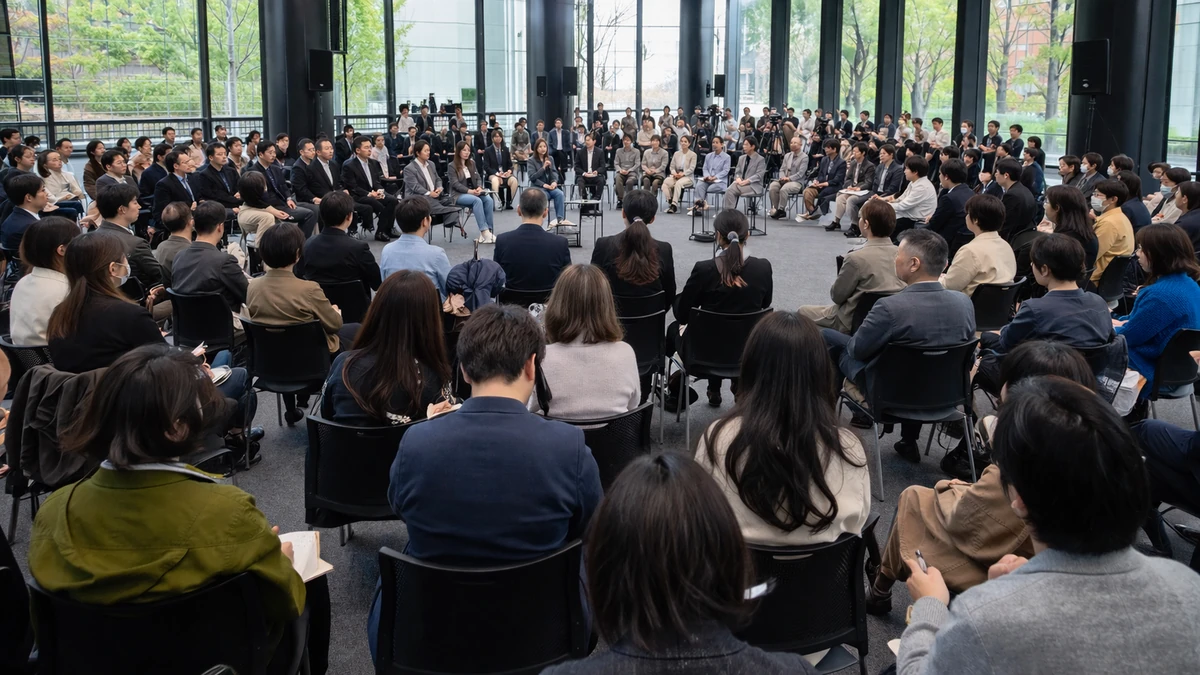
A listening tour with unusually high stakes
South Korea’s presidential office says it wants to do more than listen. That, at least, is the promise behind a new citizen-participation program called “Open Mic,” unveiled April 9 by the Presidential Committee on National Cohesion, an advisory body attached to President Lee Jae-myung’s administration.
On paper, the idea sounds familiar to American readers: invite ordinary people to speak directly to government, gather complaints and ideas from the field, and feed them into policy decisions. In Washington, it might resemble a hybrid of a White House listening session, a town hall and an interagency task force. In South Korea, however, the stakes are arguably higher. The country’s problem is not a lack of opportunities for citizens to speak. It is a growing public belief that speaking rarely changes anything.
That gap between participation and results is what makes this initiative politically significant. In a country of more than 51 million people, with sharp regional divides, a rapidly aging population and an intensely competitive political culture, “we’re listening” is no longer enough. South Korea entered what officials call a “super-aged society” when the share of people 65 and older crossed 20% of the population, a milestone that carries major consequences for health care, pensions, labor supply and local economies. At the same time, the Seoul metropolitan area continues to dominate jobs, wealth and educational opportunity, leaving many provincial cities struggling with population loss and economic decline.
Against that backdrop, the administration’s pledge to connect “voices from the field” to actual policy is less a feel-good civic exercise than an early test of how Lee plans to govern. If the program produces measurable changes in budgets, regulations, agency guidance or legislation, it could help restore confidence in government at a moment of deep social strain. If it becomes another symbolic forum with no visible follow-through, it may reinforce one of the most corrosive ideas in South Korean politics today: that public participation is mostly political theater.
The timing adds to the significance. South Korea is roughly 50 days away from local elections on June 3, races that often turn less on ideology than on everyday concerns such as transportation, housing, welfare, schools and regional development. By emphasizing “integration” and “the field” rather than partisan confrontation, the presidential office appears to be trying to broaden its appeal beyond core supporters and into the middle — the practical voters who may not be deeply loyal to any party but do care whether government can solve problems.
That is a smart political instinct. But it is also a demanding one. Listening is easy to stage. Building a credible system that turns citizen testimony into state action is much harder.
Why direct citizen contact has become central in Korean politics
Citizen participation is hardly new in South Korea. Over the past decade, governments of different stripes have expanded ways for people to be heard: online petitions, public hearings, opinion surveys, deliberative panels and digital complaint systems. South Korea is one of the world’s most wired democracies, and its citizens are highly engaged, highly informed and highly willing to mobilize. Yet many Koreans say politics feels more distant, not less.
The reason is not especially mysterious. Participation has often functioned as a tool to legitimize decisions, not to reshape them. People can submit comments, sign petitions and appear at events, but the odds that those actions will reorder the state’s priorities have often seemed low. To many citizens, the system asks for input without sharing power.
That frustration has become more acute because South Korea’s social structure has changed so quickly. A generation ago, national politics could still be conducted through relatively broad slogans about growth, security and democracy. Today, the country’s interests are more fragmented. Young adults worry about impossible housing costs, unstable jobs and delayed family formation. Older voters focus on pensions, medical care and long-term care. Small-business owners face fierce competition and thin margins. Workers in logistics, delivery and platform-based jobs confront grueling conditions in sectors that grew quickly but remain unevenly regulated. Rural areas struggle with depopulation. Parents in some regions worry about shrinking schools; in others, they worry about test pressure and access to elite education.
These are not abstract tensions. They are conflicts over who gets what, who waits, who pays and who is left behind. In that environment, governments cannot rely on a single national message aimed at an “average citizen” who increasingly does not exist. They need more granular information from specific communities, sectors and age groups, and they need a way to show that the information matters.
That is where “Open Mic” could matter. In the best-case scenario, it would not simply create another venue for grievances. It would create a pipeline: citizens raise issues; the presidential advisory body classifies them; relevant ministries review them; timelines are published; and decisions, even partial ones, are explained in plain language. In other words, the event itself would be less important than the administrative machinery that follows it.
For a presidential system, that kind of policy trust can be as valuable as legislative muscle. Even when a president lacks easy support for major laws, governments can still move through regulations, budget allocations, ministry coordination and administrative guidance. The challenge is legitimacy. Direct engagement with citizens can provide that legitimacy only if people can trace a line from complaint to response.
The promise and limits of a presidential advisory committee
The body behind this initiative, the Presidential Committee on National Cohesion, occupies a familiar but tricky place in Korean governance. As a presidential advisory committee, it has some clear strengths. It can span issues that do not fit neatly into one ministry. It can convene agencies that might otherwise work in silos. And because it is linked to the president, its recommendations can carry political weight if the presidential office chooses to back them.
That matters in a country where many of the hardest social disputes cross bureaucratic lines. Labor concerns can overlap with welfare and transport policy. Elder care touches health, local government and fiscal planning. Regional decline involves education, infrastructure, housing, business incentives and demographic policy all at once. A body focused on “national cohesion” is, in theory, well placed to see the whole picture.
But advisory committees also face obvious constraints. They typically do not control the budget. They do not write laws on their own. They do not directly execute policy. If a citizen says a bus route leaves older residents stranded, the solution may involve transit planning, local subsidies, central-local cost sharing and regulatory adjustments. If a young person says there is no reason to remain in a regional city, the answer may require housing support, job creation, higher education policy and quality-of-life investment. Those are not things an advisory committee can deliver by issuing a report.
This is where many well-intentioned participation exercises have stalled in the past. Social conflict appears at the local level, but solutions are expressed in the language of institutions: appropriations, regulations, interagency authority and legislative compromise. A single sentence from a citizen can imply months of work across ministries and local governments.
That means the success or failure of “Open Mic” will not depend on how many people speak or how many events are held. It will depend on whether there is a visible tracking system afterward. What was submitted? Which concerns were accepted for formal review? Which ministry was assigned responsibility? When is a response due? Was a budget request made? Was a rule changed? Was the issue judged impossible, and if so, why?
For American readers, think of the difference between a candidate’s town hall and a functioning casework system run by a skilled congressional office. One generates empathy. The other solves problems. South Korea’s new program needs to become the latter if it hopes to earn trust.
What “national integration” really means in South Korea
The Korean phrase often translated as “national integration” can sound lofty, even vague, to English-speaking audiences. In practice, it is less about everyone agreeing and more about managing conflict in a society where multiple divides overlap: region, generation, class, ideology and occupation. South Korea’s political culture is famously intense, but the friction is not simply partisan. It is structural.
Take pensions. Younger Koreans worry they will pay into a system that may be financially strained when they retire. Older Koreans depend on existing benefits and fear retrenchment. Consider health care and elder care, both under pressure as the population ages. Or regional university restructuring, where preserving local institutions can clash with demographic reality. Or transportation and energy subsidies, where one group’s relief is another group’s fiscal burden. These are not disputes that disappear under a banner of unity.
In that sense, integration is a technical problem as much as a moral one. It requires government to explain how losses and gains will be distributed, who will be compensated, over what timetable and according to which principles. If officials use the language of unity merely to package painful trade-offs, they risk making distrust worse.
South Korea has experienced that pattern before. In recent years, governments and political parties have often been adept at fighting public-opinion battles but less effective at designing transitions for groups that would bear the costs of reform. Yet social acceptance is not the same thing as approval in a poll. A policy backed by a national majority can still generate fierce local resistance if the burden falls heavily on a specific community. The reverse is also true: a policy with mixed national support can become manageable if officials provide clear compensation, sequencing and transparency.
This is one reason the new “Open Mic” effort could be useful, if done seriously. It could function as an early-warning system for conflict. Problems such as shrinking school enrollments, inadequate rural bus service, labor conditions in logistics and delivery, shortages of foreign workers, gaps in child care and uneven access to medical services often become expensive only after they are ignored for too long. A presidentially linked body that surfaces those signals early and pushes ministries to respond could reduce the odds of a small grievance turning into a national fight.
But if those same complaints disappear into a black box, the opposite will happen. Citizens will conclude that their role is to provide emotional scenery for official messaging. In a country already fatigued by political polarization, that cynicism would be damaging.
The electoral calculation before June’s local races
It would be naive to separate this initiative entirely from electoral politics. South Korea’s local elections are not just municipal contests; they are also read as a national barometer of political mood. Governors, mayors and local council members are elected on issues that touch daily life, but their results can shape narratives about national momentum, party strength and the president’s governing capacity.
That makes the administration’s language notable. At a moment when both major parties are consumed by nominations, regional strongholds and future power alignments, the presidential office is foregrounding terms such as “integration” and “the field.” That choice suggests an attempt to expand support beyond highly mobilized partisan bases and toward moderates and unaffiliated voters — the people often described in Korea as voters without firm party attachment.
These voters matter because local elections are often won not by the loudest ideological camp but by whichever side seems more competent on practical concerns. Public transit, redevelopment, child care, welfare access, neighborhood infrastructure and local economic vitality frequently carry more weight than grand national narratives. A central government that can present itself as attentive, flexible and problem-solving may help allied local candidates, even indirectly.
There is also a tonal benefit. By emphasizing listening rather than confrontation, the administration can soften the image of national politics at a time when many voters are weary of permanent conflict. That matters, particularly for middle-of-the-road voters who are not deeply invested in party identity and tend to reward perceived competence over rhetoric.
Still, this is where the initiative faces its greatest political risk. Moderate voters are often less impressed by symbolism than by delivery. A government that brands itself as listening but cannot show evidence of action may end up looking more performative, not less. The opposition will almost certainly attack the program as a publicity exercise, and it will have precedent on its side: many citizen-participation efforts in Korea have generated headlines without lasting policy changes.
Yet the opposition has constraints as well. If it dismisses direct civic engagement too aggressively, it risks sounding indifferent to local concerns at precisely the moment voters are focused on practical issues. The coming weeks, then, are likely to feature a subtle contest: Can the governing side institutionalize “integration” in a way that looks real, and can the opposition criticize the effort while offering a more convincing model of citizen input?
Three tests that will determine whether this works
If the Lee administration wants “Open Mic” to become more than a slogan, three conditions appear essential.
First, it needs transparent data. Citizen listening may sound emotional and personal, but good governance requires classification, measurement and disclosure. The public should be able to see what kinds of issues are being raised, from which regions and by which demographic groups. Are transportation complaints concentrated in rural counties with older populations? Are housing concerns clustering around Seoul’s outer suburbs? Are child care or school consolidation issues emerging in depopulating areas? Without that level of organized information, listening sessions remain anecdotal.
Second, the program needs hard links to ministries and local governments. Every major complaint should have a designated institutional pathway. Some issues may belong with the Ministry of Health and Welfare, others with Land, Infrastructure and Transport, Education, Interior and Safety or the finance authorities. Some will require coordination with governors, mayors and county leaders. If “Open Mic” cannot force or at least strongly incentivize bureaucratic follow-up, it will remain detached from the machinery that actually makes policy.
Third, it needs timelines. Citizens do not expect every grievance to be solved quickly, especially in a country where major reforms can run into budget limits, legal hurdles and local resistance. But they do expect acknowledgment, status updates and explanations. A simple dashboard showing what has been received, what is under review, what has been acted on and what has been rejected would do more for trust than another round of carefully staged meetings. Administrative trust is built not only through empathy but through speed, clarity and visible processing.
For South Korea, this kind of system could be especially valuable because so many of its emerging problems are unevenly distributed. The needs of older residents in a shrinking rural county differ sharply from those of young renters in the Seoul area. One-size-fits-all politics is increasingly ineffective. A responsive state needs a better way to detect pressure points early and tailor responses accordingly.
The real question, then, is whether the administration sees “Open Mic” as a governing instrument or as a communications strategy. If it is the former, the program could help modernize how the Korean state interacts with an aging, fragmented and demanding society. If it is the latter, it will likely be absorbed into the long list of participation mechanisms that expanded the appearance of access without increasing the reality of influence.
A broader test for Korean democracy
In the end, the significance of this moment reaches beyond one advisory committee or one administration. South Korea is a vibrant democracy with high civic participation, a sophisticated media environment and a public that pays close attention to politics. But like many democracies, including the United States, it is struggling with a deeper problem: the erosion of confidence that institutions can translate public input into fair, competent action.
That is why the launch of a program like “Open Mic” deserves attention. It speaks to a broader democratic dilemma familiar far beyond Korea. Governments have learned how to collect feedback. They are much less skilled at proving that feedback changes outcomes. The gap between those two things is where cynicism grows.
For American readers, the parallels are easy to recognize. Town halls, online petitions, federal comment periods and public hearings all promise a voice. The public’s frustration often begins when that voice seems disconnected from decisions already made. South Korea’s current experiment is, in that sense, not merely a Korean story. It is part of a larger global search for ways to reconnect democratic participation with administrative results.
Whether President Lee’s government can do that remains uncertain. The social conflicts facing South Korea are too complex to be dissolved by branding or by a series of well-publicized meetings. An aging population, regional inequality, youth insecurity and growing policy fragmentation all demand more than empathetic rhetoric. They require a state capable of showing its work: what it heard, what it chose, what it changed and why.
If “Open Mic” becomes a mechanism for that kind of accountability, it could strengthen not just the administration’s standing before local elections, but the credibility of government itself. If it does not, the lesson will be equally clear. In modern democracies, listening is no longer the hard part. Acting in a way people can see and verify is.
Comments
Post a Comment