South Korea’s prime minister puts ER bottlenecks at the center of politics, signaling a broader emergency care overhaul
Why this issue matters in South Korea
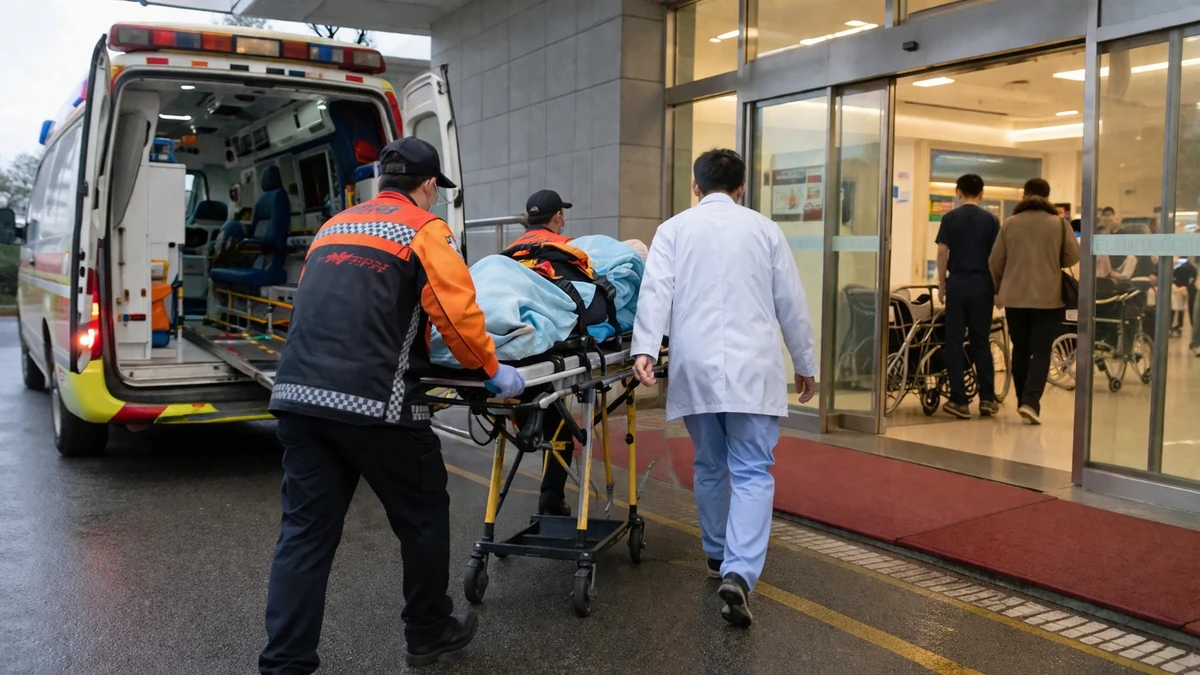
South Korean Prime Minister Kim Min-seok has elevated a long-frustrating problem in the country’s medical system into a clear national political issue: the repeated failure to quickly place emergency patients in hospital care. In South Korea, the problem is commonly described with the phrase “emergency room spinning,” shorthand for cases in which ambulances call multiple hospitals before finding one willing or able to accept a patient. The image is vivid and troubling: a patient in crisis effectively circling the system while time slips away.
Speaking during a visit Thursday to emergency-response facilities in North Jeolla Province, Kim argued that the root of the problem is not a lack of dedication by doctors, nurses or paramedics. Instead, he pointed to “institutional limits” and “infrastructure limits,” according to South Korea’s Yonhap News Agency. That distinction matters. In practical terms, it shifts the debate away from blaming individual hospitals or frontline workers and toward a discussion of policy design, communications systems, transport capacity and how the government organizes emergency medicine.
For American readers, the closest comparison may be a familiar debate over ambulance diversion, rural hospital strain and ER overcrowding in the United States. But South Korea’s case has its own political and cultural contours. The country has a highly centralized state, a dense hospital network in major metro areas and a public expectation that government can intervene quickly when systems fail. When a sitting prime minister publicly says the problem is structural, not personal, that is more than a site visit soundbite. It is a signal that emergency care may be moving back to the top tier of the government’s domestic agenda.
A visit designed to show the whole chain of emergency care
Kim’s schedule in North Jeolla was notable not just for what he said, but for where he went. Yonhap reported that he visited the Jeonbuk 119 Emergency Control Center, then Jeonbuk National University Hospital and Wonkwang University Hospital. In South Korea, “119” is the emergency number for fire and ambulance services, roughly equivalent to 911 in the United States. By starting at the dispatch and transport level before moving to hospitals, Kim underscored a central point: emergency care is not just an ER problem. It is a chain that begins with triage, dispatch and communication long before a patient reaches a hospital door.
That sequencing carries policy meaning. Politicians often visit hospitals after a controversy because hospitals are where public anxiety is most visible. Kim instead appears to have framed the challenge as a systems problem spanning multiple stages: emergency call management, ambulance routing, hospital intake and even air transport. That is important because one of the easiest ways for governments to mishandle health crises is to treat them as isolated failures inside a single institution. His itinerary suggested the opposite view — that even a well-run hospital can struggle if the surrounding transport and coordination network is fragmented.
According to Yonhap, Kim was briefed on a pilot project in the region designed to improve emergency patient transport. He said that if the current system simply worked as intended, many cases of hospitals refusing or failing to accept emergency patients could be resolved systemically. That is a striking formulation. It suggests the government may see at least part of the crisis not as proof that the entire model is broken, but as evidence that existing mechanisms are not operating consistently or efficiently enough. In Washington terms, this sounds less like a call for a brand-new federal program than a blunt acknowledgment that the current one is failing in execution.
From blaming hospitals to naming structural limits
Kim’s most politically significant move may have been linguistic. He explicitly prefaced his criticism by recognizing the devotion and effort of medical personnel before naming structural constraints as the real problem. That kind of framing is not accidental, especially in South Korea, where disputes involving doctors, hospitals and the government can quickly become politically combustible. By acknowledging clinicians first, Kim avoided turning frontline workers into scapegoats. By then emphasizing institutions and infrastructure, he redirected accountability toward the state and the design of the system itself.
That rhetorical shift matters because public policy usually follows the story a government tells about cause. If the failure is described as individual negligence, the policy response tends to center on punishment, discipline or naming and shaming. If the failure is described as structural, the response is more likely to involve investment, administrative redesign, new incentives and coordination across agencies. Kim’s choice of words therefore amounts to an early framing battle over what kind of political problem emergency care has become. He is not saying South Korea has too few committed medical workers. He is saying committed workers are being asked to function inside a system that does not reliably connect its pieces.
There is also a larger political logic here. South Korea’s governments are often judged by their ability to manage visible, everyday breakdowns, from housing prices to transportation disruptions to public safety scares. Emergency medical access belongs in that category because it cuts across class and region in a particularly visceral way. Nearly everyone can imagine needing an ambulance. Nearly everyone can imagine the fear of hearing that no hospital can take a patient right away. By naming the issue as a matter of state capacity, Kim is effectively telling the public: this is not a one-off hospital failure; this is a government problem, and government is now on notice to fix it.
The reforms now under discussion
The most concrete policy clues from Kim’s trip came from the requests raised on site. Yonhap reported that officials and medical personnel discussed integrating emergency room hotlines, expanding support for dedicated medical helicopters and improving the evaluation metrics used to assess emergency departments. Those three ideas point to three very different layers of reform: communication, transportation and incentives. Taken together, they suggest that South Korea’s emergency care bottlenecks are not caused by one simple shortage, but by friction at multiple stages of the process.
The hotline issue may sound technical, but in emergency care, communication architecture can determine life-or-death timing. If ambulance crews, dispatchers and hospitals rely on fragmented channels to figure out who has capacity, who has the right specialists and who can take a patient immediately, delays become almost inevitable. Americans might think of this in terms of the digital backbone behind hospital bed management or ambulance diversion alerts. An integrated emergency line, if designed well, could reduce the back-and-forth that leaves patients effectively stalled in transit while providers try to identify an accepting facility.
The helicopter question speaks to geography and unequal access. South Korea is smaller than the United States, but access is not uniform, and not every emergency is best handled by road transport. Dedicated medical helicopters, often referred to as doctor helicopters or doctor helis in parts of Asia, are intended to speed treatment for critically ill patients and connect regions to higher-level care. Kim reportedly visited a helicopter landing area and encouraged related personnel, a sign that aviation infrastructure is being treated not as a symbolic add-on but as part of the emergency network. The final issue, evaluation metrics, may be the least dramatic but is often the most consequential. What a government measures shapes what hospitals prioritize. If the metrics do not properly account for emergency readiness, acceptance capacity or coordination burdens, hospitals may face incentives that do not match the public need.
What American readers should understand about the Korean context
To an American audience, South Korea’s emergency-care debate can sound familiar on the surface but different in how politics works underneath. South Korea has universal health coverage and a strong central government presence in health policy, even though private hospitals and university hospitals play major roles in care delivery. That means a prime minister’s public comments can function as a strong directional signal to ministries, regional authorities and major medical institutions. In the U.S., where health care authority is split among federal agencies, states, insurers, hospital systems and private providers, a similar statement might draw headlines but not necessarily trigger a unified response. In South Korea, there is greater expectation that top-level political attention can be translated into administrative action.
There is also the matter of public trust and public pressure. South Koreans are used to fast service in many parts of daily life, from digital banking to public transit. When a critical service like emergency medicine appears slow, fragmented or inconsistent, frustration can be especially intense. The phrase used to describe ER rerouting resonates because it captures a sense of bureaucratic absurdity inside a country otherwise known for efficiency. Americans may think of it as a hospital version of being put on hold and bounced from department to department — except here the stakes are measured in minutes, trauma and survival.
Another key cultural point is how frontline sacrifice is discussed in Korean public life. Officials often emphasize the dedication of workers before criticizing systems, partly out of respect for professional hierarchy and partly to avoid inflaming sectoral conflict. Kim’s comments fit that pattern, but they also went beyond ritual praise. He did not stop at commending medical staff. He used that acknowledgment as a platform to say, in effect, that heroism cannot compensate forever for flawed infrastructure. That is a message many Americans would recognize from debates over teachers, nurses, first responders and air traffic controllers: praise is not a substitute for a functioning system.
The politics behind the language
There is a reason political analysts in Seoul are likely to pay close attention to what might otherwise seem like a routine field inspection. Politics often telegraphs major priorities through language before budgets and legislation arrive. Kim’s phrasing suggested a government preparing the public for a more assertive intervention in emergency medicine. Even without a detailed policy package yet on the table, the message itself carries weight. Once the prime minister says the core problem is structural, the political burden shifts. Future failures become harder to write off as isolated incidents or local mismanagement.
At the same time, the available facts still require caution. Based on the reported summary of Kim’s visit, it is clear that he identified institutional and infrastructure shortcomings, reviewed a regional pilot project and heard specific proposals involving hotlines, helicopters and evaluation standards. What is not yet clear is how far the government will go, how quickly it will move or whether these discussions will lead to nationwide reform, budget increases or changes in law and regulation. Good reporting requires that distinction. The visit marks a signal flare, not a completed overhaul.
Still, signals matter in politics because they organize expectations. Bureaucracies tend to move when leaders define a problem in a way that assigns responsibility upward. Hospitals, local officials and emergency coordinators are now on notice that the prime minister sees this not as a narrow medical issue but as a test of governance. If the administration follows through, South Korea may be entering a phase in which emergency medicine is treated less as a specialized health-sector challenge and more as core public infrastructure, alongside transit, fire response and disaster preparedness.
What comes next for South Korea’s emergency system
The immediate takeaway from Kim’s visit is not that South Korea has solved its emergency-room bottlenecks, but that it may finally be discussing them in more realistic terms. Patients in crisis do not experience the system one agency at a time. They experience it as a single promise: that someone will answer, someone will know where to send them and a hospital will be ready when they arrive. If any link fails, the whole system feels broken. Kim’s remarks acknowledged that truth by focusing on the continuity between dispatch, transport, intake and treatment.
That framing could pave the way for a more serious overhaul of emergency-care management, especially if officials use it to align technology, staffing, transport and hospital incentives. The regional pilot project in North Jeolla may become important evidence in that discussion. If authorities can show that better coordination alone reduces cases of hospitals turning away emergency patients, they will have a compelling argument for scaling reforms nationwide. If the results are mixed, the government may face pressure to go further, including deeper infrastructure investments and a broader redesign of how emergency capacity is measured and funded.
For now, the political significance is clear even if the policy details remain in formation. A prime minister went into the field, looked at dispatch, hospitals and air transport in one day, and publicly said the country’s emergency-care failures stem from system limits rather than a lack of commitment by medical workers. In any democracy, that is a consequential shift in official language. In South Korea, where public expectations for competent administration are high and medical access is a deeply sensitive issue, it may mark the beginning of a new push to rebuild confidence in the emergency-care system before the next ambulance has to keep driving in search of a door that will open.
Comments
Post a Comment