
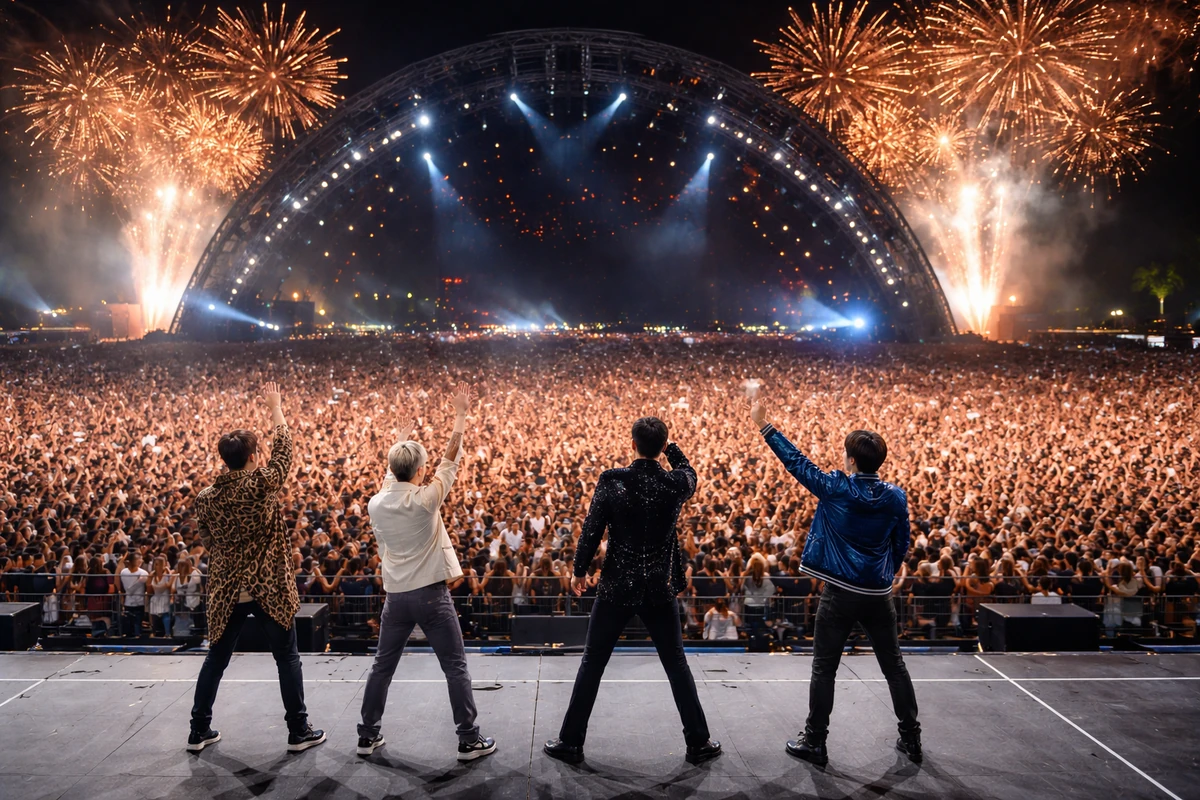
A K-pop landmark chose an American stage for its next chapter
For many American music fans, Coachella is where stars test their relevance in real time. It is part festival, part industry showcase, part social-media proving ground. So when BigBang, one of the most influential groups in K-pop history, used the festival stage in Indio, California, to announce a new album and a world tour tied to the group’s 20th anniversary, the message landed as something bigger than a reunion teaser.
According to the announcement made during the group’s April 19 performance, BigBang has completed preparations for a new album and plans to launch a world tour in August. On paper, that is straightforward entertainment news: a veteran act is releasing music and going back on the road. In context, though, it is one of the most significant comeback stories in K-pop this year, because it folds together three timelines that each carry unusual weight: a 20th anniversary, a return to large-scale concerts after about nine years, and a plan to re-enter the global touring circuit from one of the most visible stages in American pop culture.
That last part matters. BigBang could have made this announcement through a slick video, a press conference in Seoul or a traditional teaser campaign designed primarily for the Korean market. Instead, the group chose Coachella, where the audience is international, the press attention is immediate and the symbolism is unmistakable. This was not framed as a sentimental gift to longtime fans in South Korea alone. It was positioned as a statement to the wider music industry: BigBang does not want to be remembered only as an important K-pop act from the past. It wants to be active in the present.
For American readers who may know K-pop mainly through newer generations of groups, BigBang occupies a place somewhat like a bridge figure in pop history. The group was not the first Korean idol act, but it helped define what a globally minded, self-styled, trendsetting K-pop group could look and sound like. Long before K-pop became a routine part of the American mainstream music conversation, BigBang helped build the aesthetic and commercial vocabulary that later acts expanded.
That is why this announcement is not merely about a comeback. It is about whether one of K-pop’s foundational names can turn legacy into current momentum on the world stage.
Why BigBang still carries unusual weight in K-pop history
To understand why this return has become such a major story, it helps to understand BigBang’s place in Korean pop culture. Debuting in 2006, the group emerged during a period when K-pop was growing rapidly across Asia but had not yet become a normalized presence in the United States. In South Korea, idol groups were already a major industry force, but BigBang stood out for a style that felt looser, more self-fashioned and more deeply tied to youth culture than many of its peers.
The group’s members built strong individual identities while still functioning as a team, a balance that would become central to later K-pop success stories. Their music blended pop hooks with hip-hop, dance, electronic music and R&B in a way that made them feel less like a manufactured act following a rigid template and more like artists helping shape the template itself. Their fashion, stage design and music videos also had an oversized impact, influencing not just fans but younger performers and the broader entertainment business in Korea.
For U.S. readers, one rough comparison might be to the way an act can be both commercially huge and culturally catalytic at the same time. BigBang was not just a hitmaking group; it was a reference point. When people in Korea talk about second-generation K-pop, meaning the era that helped prepare the genre for global breakout, BigBang is almost always part of the conversation.
That history, however, is precisely what makes a return complicated. In pop music, legacy can be an asset, but it can also be a trap. It is one thing to be celebrated in documentaries, anniversary playlists and online fan tributes. It is another to show that your name still creates urgency in a market defined by speed, youth and constant turnover. K-pop, perhaps more than most pop industries, is built around accelerated generational change. New groups debut constantly. Fan communities reorganize quickly. Attention is fierce, and relevance has to be continually renewed.
That is the tension BigBang’s Coachella announcement addressed head-on. Rather than inviting the public to revisit old songs and old memories only, the group emphasized a new album and a new tour. In other words, it did not ask to be treated as a museum piece. It asked to be treated as an active act with unfinished business.
The power of saying “restart” in public
At the center of the announcement was a simple word: restart. Onstage, G-Dragon said BigBang had reached its 20th anniversary, called it a restart and said the group would continue. In entertainment reporting, it is easy to reduce those moments to promotional language. But in this case, the wording mattered, because it was not just about releasing a schedule. It was about defining the meaning of the group’s return.
In the years since BigBang’s peak period as a full group, public discussion around the act has often contained two competing ideas. One is that BigBang is a defining K-pop group whose influence remains undeniable. The other is that after a long gap and major changes in the industry, it is fair to ask whether the name still functions as a present-tense force rather than simply a legacy brand. The Coachella statement was designed to answer that second question without sounding defensive. The group did not make its case through retrospective praise. It made its case by presenting new work and a concrete touring plan.
That distinction is crucial. In music, the difference between a comeback and a memorial can be surprisingly small. Anniversary projects often lean heavily on nostalgia: remastered catalog releases, retrospective content, one-off fan events and sentimental tributes to a group’s history. There is nothing wrong with that. In fact, such projects can be deeply meaningful, especially in fandom cultures where shared memory is part of the experience. But BigBang’s announcement suggested a different priority. The emotional appeal was there, especially in remarks thanking fans who had stayed with the group over two decades, yet the central message was not “remember us.” It was “we are moving again.”
Daesung’s comments reinforced that tone. By describing the Coachella moment as a special night and thanking supporters who had allowed the group to keep singing for 20 years, he placed the return in relational terms, not purely commercial ones. In Korean pop culture, fandom is not just a passive audience category. It is often understood as an ongoing bond, one shaped by time, loyalty, ritual and shared milestones. For readers unfamiliar with that dynamic, think of it as a highly organized, emotionally invested fan culture that often plays a visible role in an artist’s public life. A comeback, then, is not just the release of new content. It is also a reopening of that relationship.
That is part of what made Coachella such an effective setting. The announcement happened not in a sealed media environment but inside a live event, where performance and proclamation blurred together. The comeback became part of the show, and the show became a trailer for what comes next.
Why Coachella was the perfect place to make the announcement
To American readers, Coachella may register as a desert festival known for celebrity sightings, Instagram aesthetics and eclectic lineups. In the global music business, though, it also functions as a prestige platform. For K-pop acts in particular, appearing there has become a signal that an artist belongs in the broader international pop conversation, not just in a niche category of “foreign” or “regional” success.
That is why BigBang’s decision to reveal its plans there was so strategic. In recent years, K-pop’s presence at Coachella has become part of a larger push for global validation, especially in the U.S. market. The festival offers something no standard comeback rollout can fully replicate: a widely understood stage of consequence. If an artist announces something at Coachella, the implication is that the news is meant for the world, not just for a domestic fan base.
For BigBang, that choice also fits the group’s own history. This is a group whose identity was long tied to the international expansion of K-pop. It was among the names that helped make overseas ambition feel central, not optional, to the industry. Launching a 20th-anniversary project from a global festival, rather than from a purely Korean commemorative setting, aligns with that legacy. It says the most truthful way to present BigBang’s return is not as a homecoming alone but as a renewed bid for global relevance.
There is also a more practical calculation at work. Veteran groups do not face the same challenge as rookies. New acts must introduce themselves; established acts must prove they still create an event. In a crowded market, the key question is not simply whether people remember the name. It is whether the name still commands attention now. By tying its announcement to a major live performance in one of the world’s most closely watched music environments, BigBang effectively turned that question into part of the answer.
Coachella amplified the stakes, but it also amplified the confidence behind the move. Rather than cautiously testing the waters in a smaller venue or a controlled PR rollout, BigBang chose a setting associated with scrutiny and scale. The subtext was clear: if there is going to be a restart, it should begin in a place that immediately measures whether the world is paying attention.
This is not just an anniversary project. It is a test of present-day relevance
One reason this story has grown beyond fan-service territory is that BigBang’s 20th-anniversary project appears designed around new activity, not merely commemoration. The Korean summary of the announcement emphasizes that the album preparations are finished and that the world tour is set to begin in August. That framing matters. In the current K-pop business, longevity is not proven by old hits alone. It is proven by whether an act can still deliver new music and new performances that feel meaningful in the present market.
The difference may sound subtle, but it is foundational. Plenty of veteran artists can still generate headlines by reminding audiences of what they once meant. Fewer can convert that attention into momentum for new material. For BigBang, the most important part of this comeback is not the anniversary branding itself. It is the suggestion that the group is willing to let new songs and a new stage production carry the burden of proof.
The planned world tour is especially significant because live performance is where a group’s narrative becomes real again. An album can announce a return, but a tour sustains it city after city, audience after audience. In K-pop, where choreography, staging, visual identity and fan interaction are often as important as the songs, touring serves as a particularly powerful engine of reactivation. It transforms a comeback from a headline into an ongoing public event.
And in BigBang’s case, the nearly nine-year gap since a concert of this scale raises the stakes even further. Long absences can create anticipation, but they can also create distance. The audience changes. The market changes. Listening habits change. Fans who grew up with an artist may now be older, with different routines, different spending patterns and different relationships to fandom itself. At the same time, younger listeners may know BigBang more as a name cited by other artists than as a group they experienced in real time.
That generational split is one of the most interesting business questions attached to this return. Can a veteran K-pop act mobilize longtime fans while also persuading newer global listeners that its comeback is not just historically important but musically urgent? If BigBang can, it may offer the industry a new model for how legacy groups age in a genre often defined by perpetual debut.
What BigBang’s return says about the future of K-pop’s older generations
There is a broader industry angle here that extends well beyond one group. K-pop has become remarkably efficient at launching new acts, building fandom ecosystems and exporting polished content across digital platforms. What it has been less consistent at proving is how groups can remain durable over the long term, especially after military service, hiatuses, solo careers and shifts in public taste complicate the traditional idol lifecycle.
That is why BigBang’s comeback carries implications for the business as a whole. It raises a basic question: Can a K-pop group from an earlier generation be reactivated not just as a nostalgia property, but as a viable contemporary force with new commercial and cultural leverage? If the answer is yes, that could influence how entertainment companies think about catalog, touring, fan retention and multigenerational audience building.
In the United States, older artists often rely on touring as a durable revenue stream, with classic-rock acts, pop veterans and legacy performers filling arenas and amphitheaters for decades. K-pop has not always followed that exact pattern, in part because the idol system emphasizes tightly managed life cycles and rapid replacement by newer acts. But as the genre matures globally, it may need to build more sustainable long-tail models. BigBang’s re-emergence arrives right at that point of transition.
There is also an audience question embedded in this story. The fans who supported BigBang in its early years are not the same demographic as teenage fans discovering the latest fourth- or fifth-generation groups. They may have more disposable income, but less time. Their relationship to fandom may be less intense day to day, yet more emotionally rooted because it spans a much longer period. If they respond strongly to a 20th-anniversary album and world tour, it would suggest that K-pop’s mature fan base is an underappreciated economic force.
More broadly, the comeback highlights how legacy itself can function as a present asset. In pop music, history often becomes valuable only after it is safely sealed off. BigBang appears to be attempting something harder: converting history into current action. Coachella was not a backdrop for nostalgia alone. It was a way of telling the market that legacy can still be activated in real time.
In the end, everything comes down to the new music
As dramatic as the Coachella announcement was, the true measure of this comeback will not be the symbolism. It will be the songs. That is true for any returning act, but especially for a group with BigBang’s stature. The 20th-anniversary framing can draw headlines. The world tour can create anticipation. But only new music can answer the central artistic question: Can BigBang make a compelling case for itself in today’s sonic landscape, rather than in yesterday’s memory?
For now, details about the album’s concept, track list and sound remain undisclosed. That leaves room for speculation, but it also keeps attention focused where it belongs. If the record leans too heavily on past formulas, critics may see it as a nostalgia exercise dressed up as a restart. If it reinvents too aggressively, longtime fans may question whether the group has drifted too far from what made it distinct. The challenge is familiar to many veteran artists, but in K-pop it can be even sharper because audience expectations around identity, performance and brand coherence are so intense.
Still, there is an advantage in the way BigBang has framed the return. By saying the album is ready, not merely in development, the group made this comeback feel concrete rather than aspirational. It shifted the story from rumor and sentiment into the realm of deliverables. That alone separates this announcement from the kind of vague reunion talk that often circulates around legacy acts without leading anywhere substantial.
For American and other English-speaking readers, the easiest way to understand the significance of this moment is to see it as the convergence of music history and market strategy. A hugely influential K-pop group chose one of America’s most visible festival stages to say that its story is still unfolding. It backed that message with a completed album and a global tour timeline. It did so at a moment when K-pop’s future increasingly depends not just on discovering the next sensation, but on figuring out how its foundational acts can remain alive in the culture.
Whether BigBang fully succeeds will depend on the quality of the music and the strength of the performances to come. But as an announcement, this was expertly designed. It answered doubts about inactivity with a plan. It answered questions about relevance with a platform. And it turned what could have been framed as a 20th-anniversary tribute into something much more ambitious: a bid to make BigBang matter again, now, in public, on a global stage.
That is why the news feels bigger than a standard comeback. Not because anniversaries are rare, and not because nostalgia is powerful, but because BigBang used a milestone to argue for continuity instead of closure. In a fast-moving pop industry that often treats age as obsolescence, that is a bold claim. Coachella was the opening statement. The album and the world tour will determine whether it becomes a lasting one.




0 Comments