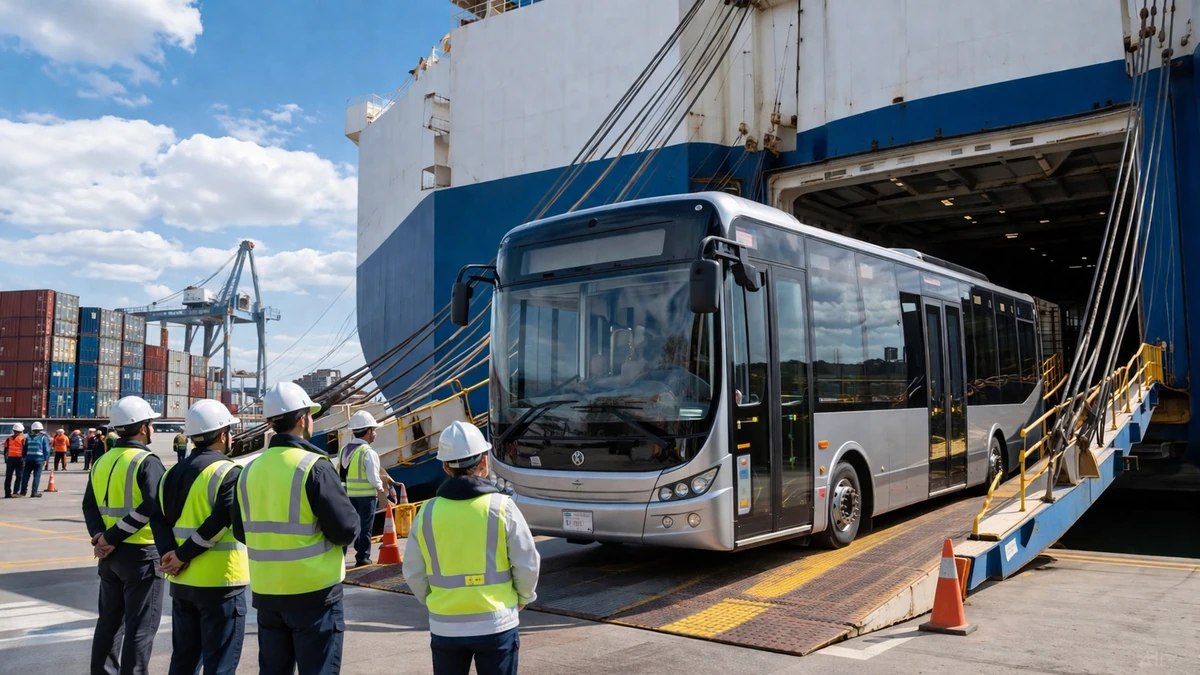
A cross-border alliance aimed at a fast-changing market
In the global race to electrify transportation, the spotlight often falls on passenger cars: Teslas on California highways, Chinese EV brands expanding into Europe, or Detroit automakers trying to catch up in a market transformed by batteries and software. But for many cities across Asia and the Pacific, the more immediate battleground is not the family sedan. It is the bus.
That is what makes the emerging partnership between Japan’s Mitsubishi Fuso and Taiwan’s Foxconn worth watching. According to a report from South Korea’s Yonhap News Agency citing developments announced April 6, the two companies are pursuing plans to export electric buses to Australia and Southeast Asia. On its face, that may sound like another routine corporate tie-up in a crowded EV industry. In reality, it reflects a broader shift in how electric commercial vehicles may be designed, built and sold across Asia.
Mitsubishi Fuso brings the traditional strengths of a commercial vehicle manufacturer: engineering, safety certification, long experience in fleet operations, and sales and service networks built around trucks and buses rather than consumer marketing. Foxconn, best known to many Americans as the Taiwanese electronics manufacturing giant that assembles devices for major tech brands including Apple, brings a very different set of capabilities. Its strengths lie in large-scale manufacturing management, electronics supply chains, platform development and procurement efficiency — skills that have become increasingly central in the EV era.
That combination matters because electric vehicles, especially buses, are not simply old products with batteries swapped in for diesel engines. They sit at the intersection of mechanical engineering, battery management, power electronics, software and logistics. In other words, the companies that succeed may not always be the ones that do everything themselves. They may be the ones that find the right industrial partnerships.
The planned focus on Australia and Southeast Asia also says a great deal about where the commercial EV market is moving. These are regions where public transportation policy, urban air quality concerns and fleet economics can push electrification faster than the consumer car market. In many cities, the key buyers are not individual households deciding whether to buy an EV. They are transit agencies, municipal governments and private fleet operators trying to cut fuel costs, reduce maintenance expenses and meet emissions goals.
For American readers, there is a familiar parallel here. In the United States, school bus electrification and municipal fleet procurement often move on a different timetable than private EV adoption. Once a city or state aligns incentives, charging plans and procurement rules, fleet purchases can scale relatively quickly. The same logic is increasingly at work in parts of Australia and Southeast Asia.
Why Australia and Southeast Asia make sense
The choice of target markets is not random. Australia and Southeast Asia differ sharply in income levels, infrastructure readiness and regulatory systems, but both offer practical reasons for electric bus makers to look beyond their home markets.
Australia, in many respects, is the more institutionally predictable of the two. Major cities there have set clearer targets for cleaner public transportation, and buses are often purchased through large tenders by public agencies or contracted operators. That makes the market attractive to manufacturers that can meet safety, certification and maintenance requirements. Winning a contract in that kind of environment is different from trying to persuade thousands of individual car buyers one by one. It is closer to competing for a city transit procurement deal in the United States or Canada: if a manufacturer can prove reliability, support capacity and regulatory compliance, it has a path to relatively stable business.
Southeast Asia presents a different calculation. The region is not a single market but a patchwork of countries at very different stages of development. Singapore, Indonesia, Thailand, Vietnam, the Philippines and Malaysia all have distinct policy frameworks, transit systems and infrastructure gaps. Yet many of their largest cities face the same pressures: chronic traffic congestion, worsening air pollution, rising fuel costs and growing pressure to modernize transportation systems.
In tourist-heavy cities, cleaner public transit also has symbolic value. Electric buses can become part of a broader urban branding strategy, much as bike-share systems or pedestrianized downtown zones have in American and European cities. For local governments hoping to signal that they are modern, livable and internationally competitive, zero-emission buses are not just transportation assets. They are civic statements.
There is also a straightforward operational argument. Buses tend to run fixed or highly predictable routes. Their daily mileage, downtime and charging windows can be modeled more easily than those of many private vehicles. That makes it simpler for transit operators to calculate total cost of ownership, a concept that has become central in EV procurement. Even if an electric bus costs more upfront than a diesel model, lower fuel and maintenance costs over time can make the math attractive, especially when diesel prices are volatile.
For manufacturers, that predictability is gold. It means they can target customers whose purchasing decisions are driven less by brand image and more by hard operational economics. In the passenger car market, a consumer might choose a vehicle because of styling, habit or emotion. In the bus market, the decision often comes down to uptime, serviceability, delivery schedules and lifecycle cost. That is a very different contest.
By pursuing both Australia and Southeast Asia, Mitsubishi Fuso and Foxconn may also be trying to balance two kinds of opportunity. Australia offers a rules-based market where winning contracts can validate technology and build credibility. Southeast Asia offers larger long-term growth potential, even if it comes with more regulatory fragmentation. Together, the two regions could form a useful export portfolio: one market for trust and proof, another for scale.
What each company brings to the table
The partnership itself reflects a deeper restructuring of industrial power in Asia. For decades, the auto business was dominated by companies that tightly controlled most of the process, from vehicle development to branding to final assembly. That model still matters, but the EV transition is changing the balance of power.
Mitsubishi Fuso, long associated with commercial vehicles, represents a legacy manufacturing tradition that emphasizes durability, safety and real-world fleet performance. In commercial transport, those qualities are not abstractions. A bus that breaks down disrupts commuter schedules, strains operators and can quickly damage a manufacturer’s reputation with public agencies. Reliability is often valued more than flashy features.
Foxconn represents another side of the new industrial economy. In the United States, the company is often discussed through the lens of consumer electronics and its complicated history of global manufacturing. But its broader value proposition is this: Foxconn knows how to orchestrate vast supplier networks, manage electronics-heavy production and compress manufacturing costs at scale. Those are increasingly valuable abilities in electric vehicles, where battery systems, semiconductors, control units and software integration matter as much as traditional metal-bending.
That does not mean Foxconn automatically becomes an automaker in the conventional sense. The company’s ambitions in EVs have drawn attention for years, but branding and manufacturing a successful consumer vehicle remain very different challenges. Commercial vehicles may offer a more practical entry point. In buses, the customer base is narrower, procurement is more institutional, and product evaluation often centers on functionality rather than consumer identity.
That is where a company like Mitsubishi Fuso can complement Foxconn. One side understands commercial vehicle development, homologation, field service and fleet relationships. The other can potentially lower production costs, speed up supply chain coordination and support a more electronics-centered vehicle architecture. If that division of labor works, it could become a model for how Asian companies compete in electric commercial vehicles without each company having to master every piece of the value chain on its own.
It also reflects a broader geopolitical and industrial reality. Japan remains a manufacturing powerhouse, but in the EV transition it has faced pressure from both the rapid rise of Chinese producers and the scale of American industrial policy efforts. Taiwan, meanwhile, holds extraordinary leverage in semiconductors and electronics manufacturing but has less influence in globally recognized auto brands. A partnership between a Japanese commercial vehicle maker and a Taiwanese electronics giant is, in that sense, a practical effort to combine complementary strengths while reducing mutual weaknesses.
The bigger story: EV competition is shifting from brands to supply chains
The most important takeaway may be that electric commercial vehicle competition is no longer just about whose badge is on the front of the bus. It is increasingly about which industrial network can deliver a vehicle that is affordable, durable, serviceable and available on time.
That sounds dry, but it is central to how the EV market is maturing. In the early stages of electric mobility, companies often competed on headline claims: range, charging speed, design, hype. In public transit, those things matter, but they are not enough. Operators want predictable uptime, parts availability, maintenance support, software updates and battery performance that holds up over years of use. They want vehicles that fit local charging infrastructure and route conditions. They want data systems that help manage fleets, not just dashboards that look futuristic.
This is why the Mitsubishi Fuso-Foxconn effort deserves more attention than a typical export story. It hints at a commercial structure in which the traditional automaker no longer insists on controlling every layer. Instead, vehicle design, platform management, sourcing and production can be divided among specialized partners.
Americans have seen a version of this logic in other sectors. The smartphone in your pocket may carry one brand name, rely on chips from multiple countries, use software built elsewhere and be assembled by a contract manufacturer. Cars are not phones, and buses are even more demanding in safety and durability. But the organizing principle — modular specialization across borders — is becoming harder to ignore.
The commercial vehicle sector may be especially suited to this approach. Unlike passenger cars, buses are sold in relatively lower volumes, often through fleet contracts, and evaluated with a heavy emphasis on operational outcomes. If a distributed manufacturing model can lower costs without sacrificing reliability, it could gain traction faster in buses than in private consumer vehicles, where brand loyalty and design identity still carry enormous weight.
Still, this is a possibility, not a certainty. Export plans do not automatically become contracts, and contracts do not automatically produce long-term market share. Much depends on whether the partners can align product quality, pricing, local support, battery sourcing and charging compatibility. Transit agencies do not buy PowerPoint slides. They buy systems that have to work every day.
The China factor hanging over every electric bus deal
No serious discussion of electric buses can ignore China. Chinese manufacturers have already built strong positions in battery supply chains, EV production and cost competitiveness. In many international markets, Chinese electric buses arrived early and gained operating experience before rivals had fully organized their strategies.
That matters because commercial fleet purchasing is cumulative. Once a city or operator gains familiarity with one supplier’s technology, maintenance routines and charging systems, switching becomes more complicated. Early entrants enjoy more than first-sales advantage. They can accumulate data, service relationships and trust.
So any Japanese-Taiwanese initiative in electric buses is unfolding in a market where Chinese companies have already set a high bar on price and scale. In some cases, they also have the backing of vertically integrated supply chains, especially in batteries. That lets them control costs and shorten timelines in ways competitors may struggle to match.
For Mitsubishi Fuso and Foxconn, the clearest counterargument is likely to be reliability plus operational value. Japanese industrial brands still carry strong reputations in many markets for quality, safety and durability. In public transit, those traits can matter more than sticker price alone. If the two companies can show that their buses offer lower downtime, easier servicing, dependable parts support and competitive lifecycle costs, they may persuade buyers that paying more upfront makes financial sense over the long run.
Foxconn’s role could be critical here. If it can help narrow the cost gap through procurement and manufacturing efficiencies, the partnership may be able to position itself between premium-priced legacy offerings and lower-cost Chinese competitors. That middle ground could be attractive to transit agencies that want credible technology without betting entirely on the cheapest option.
But there are obvious risks. In electric vehicles, software updates, battery management systems and cost reduction cycles move quickly. Chinese firms have extensive real-world experience, manufacturing scale and the ability to iterate rapidly. If the Mitsubishi Fuso-Foxconn partnership remains limited to a shallow assembly arrangement rather than a genuinely integrated strategy, it could find itself squeezed on both price and speed.
In that sense, the emerging electric bus contest in Asia may be taking shape along three broad lines: China’s vertically integrated model, a collaborative Japan-Taiwan division-of-labor model, and country-specific local procurement models that favor domestic assembly or tailored solutions. The winners will likely vary by market, policy environment and financing structure.
Why this matters beyond Japan, Taiwan and the bus sector
The story also has implications far beyond the companies involved. South Korean businesses, for example, are likely to watch closely. Australia and Southeast Asia are important markets not just for finished vehicles, but also for batteries, components and charging infrastructure. If a Japan-Taiwan partnership proves it can compete effectively, other Asian manufacturers may have to rethink not only product strategy but also business structure.
That is a crucial point. The next phase of EV competition may not be won solely by the company with the best battery chemistry or the strongest legacy brand. It may be won by firms that can build flexible, cross-border industrial coalitions and then tailor them to public policy, local regulation and fleet economics.
In practical terms, success in electric buses requires more than shipping vehicles overseas. It requires after-sales service, spare parts logistics, charging coordination, technician training, data management and a clear understanding of local procurement rules. These are operational ecosystems, not one-time export transactions. A company can have a sophisticated bus and still fail if it cannot support the fleet once it is deployed.
That is why caution is warranted in interpreting the current announcement. What has been reported so far indicates that Mitsubishi Fuso and Foxconn are pursuing exports to Australia and Southeast Asia. It does not mean that large-scale contracts are already in hand, production volumes are finalized, or market success is guaranteed. Electric bus deployment often unfolds slowly. Certification, regulatory review, pilot programs, financing and local partnerships can stretch timelines significantly.
Even so, the strategic direction is unmistakable. This is not just a story about two companies hoping to sell buses abroad. It is a window into how Asia’s industrial powers are adapting to an era in which the boundaries between automaking, electronics and supply chain management are increasingly blurred.
For American readers, there is a broader lesson. Much of the public conversation around EVs in the United States still revolves around consumer choice: range anxiety, charging stations, tax credits and the culture war around electric cars. But around the world, some of the most consequential changes may be happening in less glamorous corners of transportation — municipal buses, logistics fleets, delivery vehicles and other workhorse segments where economics and policy matter more than branding.
If Mitsubishi Fuso and Foxconn can turn this export push into a workable model, they may help show that the future of transportation manufacturing belongs not only to giant vertically integrated national champions, but also to carefully assembled alliances that span industries and borders. And if they cannot, that failure will be just as instructive, underscoring how difficult it is to challenge entrenched competitors in a market where scale, software and service all count at once.
Either way, the move is a reminder that the battle over clean transportation is no longer confined to the showroom floor. It is playing out in city procurement offices, industrial parks, charging depots and supply chain negotiations across the Asia-Pacific region. Electric buses may not command the cultural cachet of sleek passenger EVs, but they could end up telling us far more about who is actually winning the next phase of the mobility transition.
Comments
Post a Comment