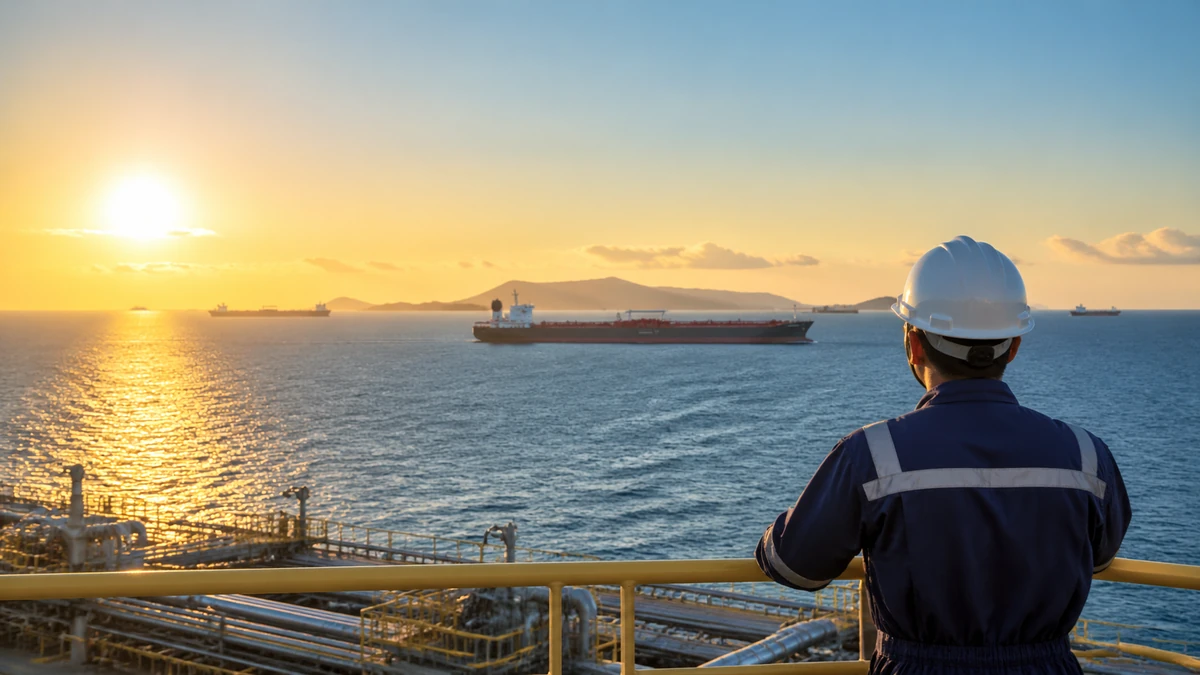
A Middle East oil shake-up lands on South Korea’s doorstep
When Americans think about oil shocks, many still picture long gas lines in the 1970s, a spike in prices after the Gulf War, or the way every jump at the pump can ripple through family budgets and airline tickets. In South Korea, the connection is even more immediate. The country imports nearly all of the crude oil it uses, and that oil is not just about what drivers pay to fill up. It is woven into the cost of making semiconductors, shipping cars, producing petrochemicals and powering one of the world’s most export-dependent industrial economies.
That is why a decision by the United Arab Emirates to leave OPEC and OPEC+ as of May 1 is drawing such intense attention in Seoul. On its face, the move may sound like an inside-baseball dispute among oil-producing states. But for South Korea, it raises a practical and urgent question: Will this help ease crude supply strains tied to the broader Middle East crisis, or will it add another layer of uncertainty to a market already rattled by war and shipping risk?
The short answer is that it could do both. South Korean refiners and market watchers see a possible upside if the UAE, one of the region’s major producers, begins pumping more oil outside the production discipline traditionally associated with OPEC. More barrels on the world market could put downward pressure on prices over time and give importers like South Korea more room to breathe.
But there is an equally important caveat. Oil does not help South Korea simply because it exists underground or even because it is produced. It has to move safely through some of the world’s most sensitive maritime chokepoints, above all the Strait of Hormuz, the narrow waterway between the Persian Gulf and the Gulf of Oman through which a large share of the world’s seaborne crude passes. If that route remains threatened by regional conflict, then more production on paper may not translate into immediate relief in practice.
That tension — between a potential increase in supply and a continued threat to transportation — is what makes the UAE move such an important story. For South Korea, this is not an abstract geopolitical development. It is a live test of how vulnerable a modern industrial economy remains to the political and military fault lines of the Middle East.
What OPEC and OPEC+ mean — and why a UAE exit matters
For readers less familiar with the alphabet soup of global oil governance, OPEC is the Organization of the Petroleum Exporting Countries, a bloc of oil-producing nations that has long tried to influence world prices by coordinating output. OPEC+ is the broader coalition that includes OPEC members plus other major producers, most notably Russia. Together, these groups have functioned as a kind of oil-management system, imperfect but influential, signaling to traders and consuming countries whether production will be tightened or loosened.
In American terms, imagine a group of the world’s biggest agricultural exporters meeting regularly and collectively deciding how much wheat or corn to release into the market. That would not control every price movement, but it would matter enormously for food costs, trade flows and financial expectations. OPEC has played a similar role in oil, except with much higher geopolitical stakes.
The UAE is not a fringe player. It is one of the larger producers in the group and an influential Gulf state with deep financial resources, an ambitious development strategy and a growing appetite for strategic independence. Its decision to leave therefore carries more weight than the departure of a smaller producer might. It also lands as Saudi Arabia, the de facto leader of OPEC, seeks to preserve the cartel’s ability to shape the market.
For years, the UAE has balanced close cooperation with Saudi Arabia against its own national goals. It has invested heavily in expanding energy capacity and has signaled that it does not want those investments constrained indefinitely by collective production ceilings. In that sense, its withdrawal can be read not simply as a diplomatic snub, but as a declaration that it wants more freedom to pursue market share and long-term economic strategy.
That matters because the strength of OPEC has never rested solely on how many barrels its members possess. It also depends on the credibility of coordination. Once a major producer steps away, the market begins asking whether others will follow, whether discipline inside the bloc will weaken and whether oil prices will increasingly be driven by competition among individual states rather than negotiated restraint.
For South Korea, which buys rather than sells oil, that shift is not automatically good or bad. More competition among producers can mean cheaper crude. But a weaker coordinating structure can also mean wilder swings, greater political signaling and a less predictable pricing environment. For a country whose manufacturers thrive on stable input costs, volatility itself can be a serious problem.
Why South Korea is especially exposed to the Gulf
South Korea’s economy helps explain why this news is getting such close scrutiny there. The country is one of the world’s leading exporters of semiconductors, autos, batteries, ships and petrochemical products. Those sectors depend on reliable energy, both directly and indirectly. Crude oil feeds refining and chemical production; fuel costs shape shipping expenses; energy prices influence factory overhead, inflation and ultimately the competitiveness of Korean goods in global markets.
That differs somewhat from the United States, which has become a major oil and gas producer and therefore has more internal buffers than it once did. Americans certainly feel the effect of oil price spikes, especially at the gasoline pump, but the U.S. energy picture is more diversified and domestically grounded than South Korea’s. Seoul does not have that luxury. It is a highly advanced economy with relatively limited natural resources, making it particularly sensitive to disruptions abroad.
That dependence is one reason South Korea has spent decades building sophisticated refining capacity and close trade ties with Middle Eastern suppliers. The country’s refiners are among the most technologically advanced in the world, and they have long relied on Gulf crude as a key input. When the Middle East is stable, that system can function efficiently. When the region is under military or political stress, South Korea feels it quickly.
The issue is broader than refinery margins. If crude prices rise or deliveries become uncertain, transportation companies face higher costs, manufacturers reassess pricing, and households can eventually see the effects in everything from utility bills to consumer goods. In a country where export performance is closely watched as a national barometer, energy instability can have implications far beyond the oil sector.
That is why the UAE’s move is being read in Seoul through two lenses at once. One is hopeful: if the UAE raises output, additional supply could help soften global prices and make procurement easier. The other is cautious: if the break weakens the old rules without improving shipping safety, then South Korea may get more market noise without meaningful short-term relief.
The Strait of Hormuz problem: More oil is not the same as secure oil
This is where geography becomes destiny. The Strait of Hormuz is one of the world’s most strategically important waterways, a narrow maritime passage through which a significant portion of Gulf oil exports must travel. When tensions rise there, the impact extends far beyond the Middle East. Insurance costs can jump. Shipping schedules can be disrupted. Tanker operators may demand higher premiums or reroute where possible. Traders then price in the risk that physical supply could be delayed or interrupted.
For American readers, the closest analogy may be the way a blockage in a critical logistics corridor can snarl supply chains thousands of miles away, as the Suez Canal incident did for container shipping. But oil chokepoints carry an extra charge because they affect not only delivery times but also global benchmark prices, investor sentiment and national energy security calculations.
That is why South Korean analysts are warning that the UAE’s exit may have only limited immediate benefits. Even if Abu Dhabi wants to produce more, and even if the world believes those additional barrels are coming, tanker traffic remains vulnerable so long as regional tensions stay elevated. In other words, the market can welcome the promise of supply while still fearing the route it must travel.
The broader conflict involving Iran, Israel and the United States makes that concern particularly acute. Any threat, real or perceived, to freedom of navigation in or around the Strait of Hormuz can rapidly overshadow otherwise bullish supply news. A market that thinks more oil may be available six months from now can still panic over what might happen next week if shipping is interrupted.
For South Korea, that creates a difficult planning environment. Refiners and importers are not just trying to predict the price of crude; they are also weighing transport risk, timing risk and geopolitical risk. Those variables do not always move together. A producer can signal expansion while shipping conditions deteriorate. That is one reason the country’s industry is treating the UAE development as a mixed signal rather than a simple win.
The distinction is crucial. Economists often talk about supply as if it were a single number, but from the perspective of an importing nation, supply has at least two dimensions: how much oil is produced, and how reliably it can be delivered. The first may improve if the UAE breaks from group restrictions. The second may remain fragile if the Gulf stays on edge.
The UAE’s strategy is about more than diplomacy
To understand why the UAE is taking this step, it helps to look at how the country sees itself. Over the past two decades, the Emirates have worked to brand themselves as more than an oil state. Dubai became a global hub for finance, tourism and logistics, while Abu Dhabi used sovereign wealth and infrastructure investment to project economic clout well beyond the Gulf. Yet oil revenue remains foundational, and the government has also invested in expanding its energy production capacity.
From that standpoint, leaving OPEC and OPEC+ can be understood as a business decision as much as a geopolitical one. If the UAE believes the energy market is changing, that long-term demand uncertainty is growing and that it has the capacity to produce more now, it may conclude that capturing market share sooner makes more sense than remaining tightly bound by coordinated limits.
That strategy is familiar in other industries. Companies sometimes decide that in a changing market, volume and flexibility matter more than preserving older cooperative arrangements. The risk, of course, is that if too many players think the same way, the result can be a price war that hurts everyone. In oil, the stakes are even higher because state budgets, diplomatic relationships and regional security all enter the equation.
There is also a longer-term energy transition backdrop. Even major oil producers know that the global energy conversation is shifting, whether because of climate policy, electric vehicles or changing investor behavior. That does not mean oil is going away soon; far from it. But it does mean some producers may be asking whether they should monetize reserves more aggressively while demand remains strong.
Seen through that lens, the UAE’s decision is not only about frustration with cartel management. It may also reflect a calculation that a more flexible and nationally controlled oil strategy better serves its future. For consumers like South Korea, that could eventually mean more crude on offer. But it also points toward a world in which major producers act more independently, making the oil market more fragmented and potentially more volatile.
What this could mean for oil prices, Korean industry and global supply chains
In the near term, the most likely outcome is not a dramatic overnight transformation but a more complicated market. Traders will try to assess whether the UAE actually increases output, how other producers respond and whether OPEC retains enough cohesion to influence prices effectively. That process alone can create uncertainty, and uncertainty tends to show up in pricing.
If the UAE materially boosts production and others feel pressure to defend market share, oil prices could come under downward pressure over the medium term. For South Korea, that would be welcome news. Lower crude prices can ease the burden on refiners, reduce costs for petrochemical producers and offer some relief to transportation firms. Those benefits could eventually filter through to broader inflation and export competitiveness.
But there is no guarantee the result will be a clean, sustained drop. If maritime insecurity persists, or if conflict escalates in ways that threaten facilities or shipping, then the geopolitical premium attached to oil could remain high even amid expectations of more production. In practical terms, South Korea could face a market where prices are pulled downward by supply optimism and upward by conflict risk at the same time.
That matters not just for Seoul but for the global economy. South Korea is often a useful bellwether because it sits at the center of multiple supply chains. When energy costs squeeze Korean industry, the effects can surface in prices and production schedules for goods sold around the world, including electronics, auto parts and industrial materials. A disruption there does not stay local for long.
In that sense, the story is bigger than oil. It is about how a political decision in the Gulf can alter cost calculations in East Asia and, by extension, affect consumers in North America and Europe. Americans may not follow the daily procurement concerns of Korean refiners, but they do understand what happens when energy shocks work their way into shipping rates, airline costs, inflation reports and the prices of globally traded goods.
That is why the UAE’s break with OPEC deserves attention beyond specialist energy circles. It comes at the intersection of war risk, industrial planning and the old but still potent truth that oil markets are governed not only by geology and economics, but by politics and geography.
The bigger lesson: The old oil order is fraying
The most important takeaway may be that the world is seeing the limits of older energy arrangements at the same time that it still depends heavily on them. OPEC and OPEC+ were built around the idea that major producers, acting together, could moderate market swings and preserve collective leverage. That system never eliminated conflict or volatility, but it offered a framework the market knew how to read.
A UAE departure suggests that framework is under stress. If leading producers begin prioritizing national flexibility over cartel cohesion, the market may become less orderly and more reactive to short-term political moves. That does not automatically mean permanently higher prices or permanently lower ones. It means the path between cause and effect may become harder to predict.
For South Korea, this is an uncomfortable but familiar reality. The country has spent decades mastering the art of prospering despite resource scarcity, turning imported energy and raw materials into advanced manufactured exports. What the current moment underscores is that even the most sophisticated importers remain exposed when the structure of the market itself begins to shift.
For American readers, South Korea’s response offers a revealing window into the modern global economy. Here is a close U.S. ally, technologically advanced and deeply integrated into world trade, parsing a Gulf oil decision not as distant foreign news but as a direct input into factory economics, shipping strategy and inflation management. That is globalization in its clearest form: a policy announcement in Abu Dhabi can shape business decisions in Seoul and eventually touch prices and supply chains far beyond Asia.
The UAE’s exit may yet create opportunities for buyers if more crude reaches the market. But the headline for now is less about immediate relief than about simultaneous possibility and risk. South Korea sees the chance of expanded supply. It also sees that the roads — or more accurately, the sea lanes — through which that supply must travel remain precarious.
In other words, the world may be getting more oil freedom and less oil order at the same time. For import-dependent economies like South Korea, that is not a simple bargain. It is a warning that even when supply appears to be improving, stability can still be in short supply.
Comments
Post a Comment