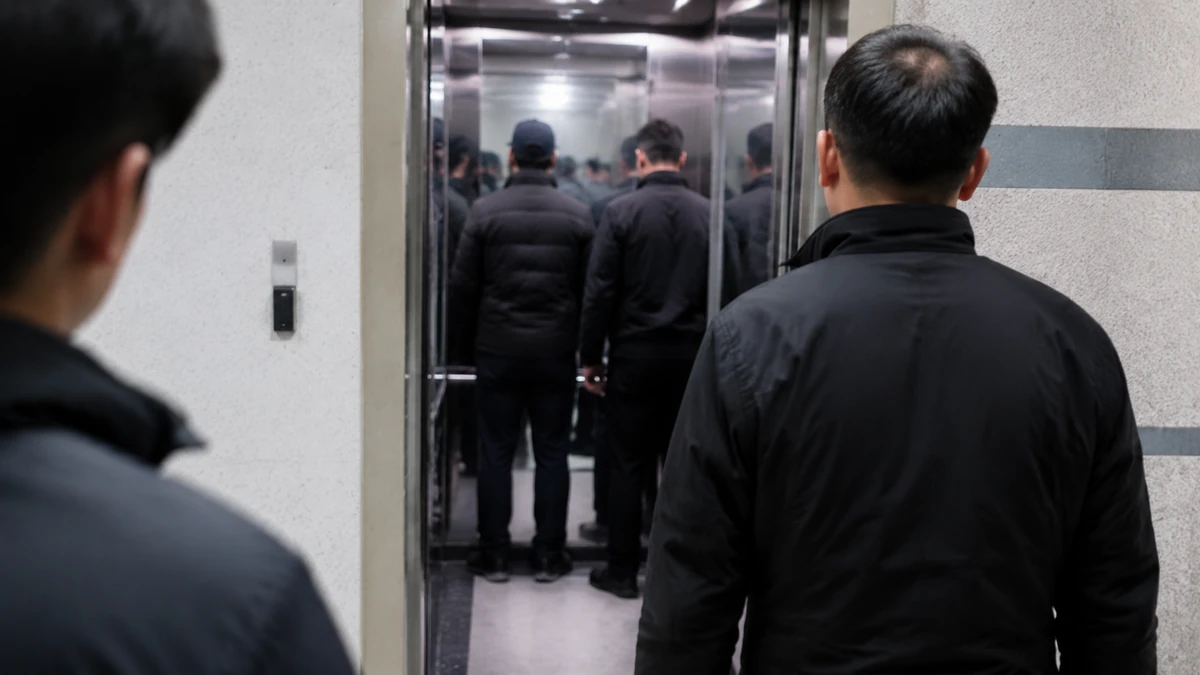
A killing in one of the most ordinary places imaginable
A fatal stabbing inside an apartment elevator in the South Korean city of Daegu has drawn national attention not only because of the violence itself, but because of where it happened: in one of the most routine, familiar spaces of urban life.
Police in Daegu said a man in his 20s was taken into custody on suspicion of killing a neighbor in his 50s inside an elevator at an apartment building in the city’s western district at about 10:40 a.m. on the 9th. Authorities said the suspect and the victim lived in the same building, with the victim residing on a higher floor. The suspect was detained near the first-floor elevator area after an apartment official reported the incident, according to police.
At this stage, the confirmed facts are narrow but stark. Investigators say the two men encountered each other in the elevator and that the attack happened there. Police are still questioning the suspect. Officials have not publicly described a motive, the nature of the men’s prior relationship beyond being neighbors, whether there had been any earlier disputes, or how the weapon was obtained or prepared.
That relative lack of detail has not prevented the case from resonating across South Korea. If anything, the limited facts have made the core reality more jarring: a man was killed not in a back alley, bar district or remote roadside, but in a shared residential space used every day by ordinary people going to work, taking out trash, receiving packages or walking children to school.
For American readers, a rough comparison might be violence breaking out in the hallway of a large condo tower, in the elevator bank of a New York high-rise or in the enclosed common areas of a densely populated apartment complex where residents constantly cross paths. The horror lies partly in the violation of expectation. Elevators are not intimate places, but they are deeply familiar ones. They are small capsules of routine, part of the background machinery of city living. When violence erupts there, it unsettles a broader sense of everyday safety.
Why the setting matters so much in South Korea
To understand why this case has struck such a nerve, it helps to understand the role apartments play in South Korean life. In the United States, apartment living is common in many cities, but homeownership ideals have historically been tied to detached houses, yards and suburbia. In South Korea, by contrast, the apartment is not a secondary or transitional housing form. It is the dominant landscape of urban middle-class life.
Across major Korean cities, apartment towers shape neighborhoods, school zones, commuting patterns and even social identity. Many complexes operate almost like self-contained residential ecosystems, with security desks, management offices, parking structures, controlled entry points and shared amenities. These developments are not simply buildings. They are a central piece of how city life is organized.
That helps explain why a crime in an apartment elevator carries a cultural and emotional weight beyond the immediate victims. Shared spaces inside Korean apartment complexes are where private life and public life overlap most directly. Residents may know little about one another personally, yet they repeatedly occupy the same hallways, parking garages, sidewalks and elevators. Neighbors can remain strangers while still being a constant presence in one another’s daily routines.
In that sense, the case in Daegu touches on a tension familiar in many modern cities: proximity without intimacy. People live stacked above, below and beside one another, sharing walls and infrastructure while maintaining separate lives. The arrangement is efficient and, for many, convenient. But it also means that accidental encounters are frequent, and when something goes wrong, it can go wrong in a space that feels both public and intensely personal.
The elevator, especially, is a powerful symbol of that closeness. It is enclosed, unavoidable and transient. You press a button, step inside and share a few seconds or minutes with whoever happens to be there. In high-rise living, it is one of the few places where neighbors regularly come face to face with no real option to opt out. That is part of why this case has produced such unease. It suggests that even the briefest, most mundane contact point can become dangerous.
The early response and the role of apartment management
Police said the suspect was arrested at the scene after an apartment official alerted authorities. That sequence — report, dispatch, detention — appears to have unfolded quickly, with no lengthy manhunt or public search. In practical terms, that suggests the emergency response in the immediate aftermath was relatively swift.
It also highlights an aspect of Korean residential life that may be less familiar to some American readers: apartment management offices and building staff often play an active role in day-to-day problem solving and emergency response. Depending on the size and type of complex, staff may handle security monitoring, maintenance, visitor access, resident complaints and general oversight of common areas. In many places, they are the first institutional point of contact when something goes wrong.
That does not mean such buildings operate like police outposts, and it would be premature to draw broader conclusions from a single case. But it does help explain why an apartment official, rather than a passerby or family member, was reportedly the person who notified police. In a Korean apartment complex, management structures can function as an important layer between residents and public emergency services.
For now, the significance of the quick arrest is limited. It establishes that authorities were able to secure a suspect rapidly. It does not answer the larger questions that tend to shape public understanding of violent crime: whether the attack was planned, whether it grew out of an ongoing conflict, whether there were warning signs and whether others in the building had any awareness of tensions beforehand. Those questions remain unanswered based on the publicly available information.
That distinction matters. In the earliest hours of a violent case, speed can easily outpace certainty. The most responsible reporting often sounds less dramatic than rumor because it sticks to what is known. Here, what is known is that a man has been detained on suspicion of murder, that the victim was his upstairs neighbor and that the attack allegedly happened inside an apartment elevator in broad daylight.
What is not known may be just as important
The case has prompted understandable speculation, especially in a country where disputes among apartment neighbors can sometimes become public flashpoints. South Korea has had repeated national debates over noise between floors, known in Korean as “inter-floor noise,” a phrase that often refers to the sounds of footsteps, children running or furniture moving in multiunit housing. Such disputes have at times led to bitter complaints, legal arguments and intense social debate about the strains of dense living.
But there is an important line between context and assumption. Police have not said that this killing was connected to any floor-noise dispute, personal grudge or longstanding feud. They have not publicly described the suspect’s state of mind, whether the encounter was spontaneous or premeditated, or whether the men had an established history of conflict. At this point, attaching a familiar social narrative to the case would risk outrunning the facts.
That caution is especially important in a story like this one because the outline is so simple and the implications feel so large. When confirmed information is sparse, people often fill the gaps with what seems plausible. That instinct is human, but it can distort public understanding, unfairly affect families and neighbors, and create misinformation long before investigators finish their work.
There is also the matter of privacy and identification. South Korean crime coverage, like crime reporting elsewhere, can quickly become entangled with online rumor, amateur detective work and the circulation of unverified claims. In cases involving residential communities, that problem can be magnified because neighbors, building staff and local social media networks may all become involved. Responsible reporting requires restraint, particularly when many core details remain under investigation.
For American audiences used to wall-to-wall true-crime framing, the temptation might be to jump immediately to motive and psychological backstory. But at this stage, the more revealing story may be structural rather than personal: how a single act of violence can rattle confidence in the spaces people rely on most, even before the fuller narrative is known.
A broader unease about safety in shared urban spaces
The Daegu case stands out because it was not a traffic collision, fire or weather emergency — the kinds of public safety stories that often dominate local headlines. On the same day in South Korea, other safety incidents were also reported, including a restaurant fire in Seoul that prompted dozens of people to evacuate and a multi-vehicle crash on an expressway in North Chungcheong Province that left several people with minor injuries. Those incidents fit a more familiar public-safety pattern: dangerous events that demand rapid response, medical care and damage control.
The Daegu killing is different. It is being treated as an alleged intentional act of interpersonal violence, not an accident or disaster. That difference matters in how the public processes risk. Accidents, even frightening ones, are often seen as hazards to be managed. Violent crime, especially when it appears deliberate, strikes more directly at assumptions about trust, predictability and personal security.
When that crime happens inside a shared residential building, the psychological effect can be even sharper. People may start to reassess ordinary routines: taking the elevator alone, opening doors to strangers, confronting a neighbor, or assuming that daytime hours and populated buildings provide protection. In a large apartment complex, hundreds of residents may pass through the same physical environment while imagining it differently after an incident like this.
That does not mean the case should be used to portray Korean apartment life as uniquely dangerous. South Korea remains, by many international measures, a relatively safe country with lower violent crime rates than many Americans might expect from consuming global news. But safety is not only statistical. It is also experiential. A single violent event can alter how safe a place feels, particularly when it occurs in a setting people cannot easily avoid.
For readers outside Korea, this is one reason the story resonates beyond local crime coverage. High-density urban living is becoming more common in cities across the world. More people are living in vertical communities, relying on shared systems, common entryways and close-quarters encounters with neighbors they may barely know. The Daegu case raises a universal question: what happens to a community’s sense of normalcy when violence enters the most ordinary spaces of daily life?
The challenge of covering a case without fueling panic
Incidents like this also test the balance between public interest and public alarm. The details are inherently shocking: a daytime elevator attack, neighbors living in the same building, a death in a place associated with routine. Those facts make the case newsworthy. They also create the conditions for oversimplification, sensationalism and fear that spreads faster than evidence.
That is why the current limits of the case matter so much. Police have confirmed a detention, a homicide allegation, the basic ages of the two men, the location and the time. Beyond that, many of the most consequential elements remain unclear. News consumers may want immediate explanations, but in early-stage crime reporting, patience is often part of accuracy.
In the United States, audiences have seen how quickly incomplete stories can harden into conventional wisdom. A few early assumptions can set the tone for national discussion, only to collapse under later scrutiny. South Korea faces a similar challenge in the age of rapid digital distribution, neighborhood chat groups and highly reactive online commentary. In that environment, even accurate reporting can be swept into a broader cycle of inference and amplification.
There is another reason caution matters: the victims of rumor are often wider than the victim of the crime. Family members, neighbors, building staff and entire communities can become subject to suspicion or unwanted exposure. In a residential setting, where people continue living with the aftermath in the same hallways and elevators, the social cost of misinformation can be unusually high.
None of that diminishes the gravity of the crime. If anything, it underscores it. A fatal attack inside a residential elevator is already serious enough without narrative embellishment. The most responsible response — by police, journalists and the public — is to establish what happened, how it happened and whether there were relevant warning signs, while resisting the urge to force a meaning onto facts that are still emerging.
What this case says about modern life in South Korea
South Korea’s global image is often shaped abroad by its cultural exports: K-pop, Oscar-winning films, hit streaming dramas, beauty brands and cutting-edge consumer technology. But beneath that polished international profile is an intensely urban, highly structured society where everyday life depends on systems working smoothly — transit systems, school systems, delivery systems and, crucially, housing systems. Apartment complexes are one of the places where all those systems intersect.
That is part of why a crime like this one lands so forcefully. It is not just a story about one suspect and one victim. It is also a story about the fragility of social trust in places designed for efficiency and repetition. Residents of tower apartments depend on countless small acts of mutual predictability: that doors lock, elevators function, common areas remain orderly and encounters with neighbors remain civil or neutral. Those assumptions are rarely spoken aloud because they are built into the rhythm of daily life.
When one of those assumptions breaks in spectacular fashion, the effect can be broader than a single criminal investigation. It can unsettle how people think about shared space itself. In South Korea, where so much of urban existence is organized through common residential infrastructure, that kind of rupture may feel especially intimate.
At the same time, it would be a mistake to turn the case into a sweeping verdict on Korean society. One crime, even a deeply disturbing one, cannot bear that weight. What it can do is expose a pressure point — the uneasy boundary between collective living and individual isolation, between familiarity and anonymity, between daily routine and sudden violence.
That tension is not uniquely Korean. Americans know versions of it from condominium disputes, apartment shootings, domestic incidents spilling into common areas and the uneasy etiquette of sharing tight urban space with strangers. What gives the Daegu case its distinct local resonance is the centrality of apartment life in South Korea and the symbolic power of the elevator as a site of unavoidable proximity.
The next phase of the investigation
The Daegu West Police Station said the suspect is being questioned. As the investigation proceeds, authorities will likely work to reconstruct the encounter, examine the relationship between the two men, review any available surveillance footage, establish the source and handling of the weapon, and determine whether the attack was impulsive or planned. Those steps are standard in a homicide investigation, but the results have not yet been made public.
Until more is known, the social meaning of the case will likely continue to rest on the facts already established: a resident in his 20s was arrested on suspicion of killing a resident in his 50s, they lived in the same apartment building, and the attack allegedly took place in an elevator in the middle of the day.
Sometimes that is enough to explain why a story matters. In a country built increasingly upward, where millions of people move through shared residential spaces every day, an elevator is more than a machine. It is a passage through ordinary life. When that passage becomes a crime scene, the shock radiates far beyond one building in Daegu.
For now, the unanswered questions remain the most important ones. But the known facts already tell a larger story about urban vulnerability, the pressures of close-quarters living and the way a single violent act can puncture the sense of security people attach to the most ordinary corners of home.
Comments
Post a Comment