A Swimmer’s Death at a South Korean Community Pool Raises Familiar Questions About Safety in Everyday Public Spaces
A routine morning ends in tragedy
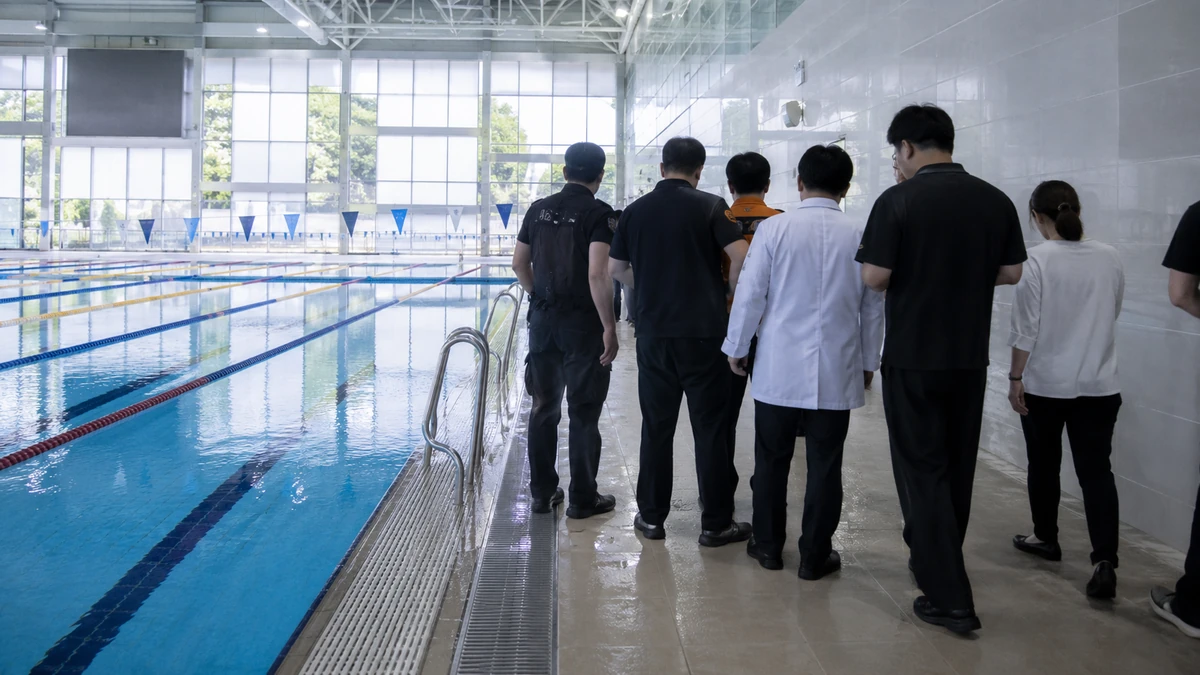
A man in his 70s died after losing consciousness while swimming at an indoor public pool in Cheongju, a city in central South Korea, in an incident that is reverberating beyond the details of a single emergency. According to South Korean authorities, the swimmer was found unresponsive in the water at the Gagyeong National Sports Center, a community athletic facility in Heungdeok District, at about 8:30 a.m. on Wednesday. Another pool user noticed the man, reported the emergency, and on-site safety personnel pulled him from the water. He received CPR and was taken to a nearby hospital, but later died.
The basic facts, as reported by Yonhap News Agency and local officials, are straightforward and stark. There has been no public indication yet of a broader cause beyond what was observed at the scene: a swimmer in distress, a rapid rescue, emergency treatment and a fatal outcome. Police and fire authorities are handling the case. At this stage, the available information does not support broader conclusions about whether a medical episode, accident or another factor triggered the emergency, and responsible reporting requires stopping there.
But even when the facts are limited, some events become larger social stories because of where they happen. This death did not occur at a construction site, on a highway or during a natural disaster. It happened in a place associated with health, routine and civic life: an indoor public swimming pool. In the United States, readers might think of a YMCA pool, a county recreation center or a city-run aquatic complex where retirees swim laps in the morning, parents bring children for lessons and residents use the facility as part of ordinary life. That is the social meaning of a place like the Gagyeong center in South Korea.
And that is why the incident has drawn attention. A sudden death in a daily-use public sports facility forces a community to confront a difficult question: How safe are the places people assume are safest precisely because they are so ordinary?
Why this is more than a local police brief
On paper, this could have remained a short item in the local news cycle. A person collapsed while exercising, emergency responders were called, and the person died. Newsrooms everywhere publish such briefs. Yet in South Korea, as in the United States, stories involving public facilities often carry a broader civic charge. They touch on public trust, institutional readiness and the social contract between residents and the local governments that provide shared spaces.
The phrase “National Sports Center” in the facility’s name can be misleading to English-language readers if taken literally. It does not mean an elite training site for Olympic athletes. In South Korea, facilities with names like this are often neighborhood-oriented public sports complexes built for everyday residents. They may include swimming pools, gyms, fitness rooms and multipurpose courts. They are part of what Korea calls “sports for all” infrastructure, closer in spirit to a municipal rec center than to a professional athletic venue.
That matters because the death occurred in a setting meant to promote public health. Swimming, in particular, is widely encouraged among older adults because it is often seen as lower impact than running or high-intensity gym exercise. The water reduces stress on joints, and the exercise can support cardiovascular health, mobility and rehabilitation. In both South Korea and the United States, that logic has made pools an especially popular part of senior fitness culture.
So when a person in his 70s dies while swimming in a public facility, the event lands with a different emotional force than an accident in a clearly high-risk environment. It interrupts a familiar idea: that the spaces people use to protect their health are, by design, buffered from sudden danger. The event also highlights a tension many aging societies now face. Governments encourage older adults to remain active, independent and socially engaged. But the systems surrounding those activities must be equipped for the reality that emergencies can happen quickly, even in well-managed settings.
The importance of seconds, observation and response
One of the most telling details in the South Korean reports is not only that the swimmer was rescued by a safety worker, but that another user first noticed something was wrong. That sequence is not unusual in aquatic emergencies. Drowning and near-drowning events often do not look dramatic. They can be quiet, fast and easy to miss, especially in indoor environments where multiple swimmers are moving at once and the visual field is busy.
In that sense, the incident underscores a simple reality well known to lifeguards, emergency physicians and public recreation managers: in water, recognition is often the decisive first step. The chain of response begins with someone seeing the problem. Then comes the intervention by trained staff, the call to emergency services, resuscitation efforts and transport to a hospital. If any link is delayed, the consequences can be severe.
South Korean officials have said the rescue and emergency treatment proceeded quickly. The man was pulled from the water, received CPR and was taken to a nearby hospital. That timeline suggests the basic emergency response system was activated without obvious delay. Yet the outcome remained fatal. That does not automatically indicate a breakdown in procedure. Sometimes even a prompt, appropriate response cannot reverse a medical crisis, especially when the person involved is older or when the triggering event is severe.
Still, tragedies like this inevitably prompt scrutiny of the broader system. How visible are swimmers to staff? How are lanes monitored during busy morning periods? Are staffing levels calibrated to actual use patterns rather than minimum formal requirements? How frequently are drills conducted for water rescues involving older adults? Is emergency equipment immediately accessible, and are the transitions from on-site rescue to fire department response to hospital care as seamless in practice as they are on paper?
These are not accusations. They are the questions communities ask after any public-facility emergency because that is how safety culture works. In the United States, similar questions arise after an incident at a school pool, a community center or a hotel aquatic area. Often the issue is not a single obvious failure but whether layers of protection were designed for real-world conditions. The same principle applies here.
An aging society and the public-health paradox
South Korea is one of the fastest-aging societies in the world, a demographic fact with implications far beyond pensions and health care budgets. It is reshaping transportation, housing, labor markets and the design of everyday public spaces. Sports and recreation facilities are part of that story. As more older adults use pools, gyms and walking tracks, questions of access and safety become inseparable.
The death in Cheongju highlights what might be called a public-health paradox. Policymakers, doctors and families want older adults to stay physically active for as long as possible. Regular exercise is linked to better heart health, stronger muscles, improved balance, lower risk of isolation and better overall quality of life. In South Korea, local governments have invested in community fitness infrastructure partly for that reason. The social message is clear: aging should not mean withdrawing from public life.
Yet the success of that policy creates new demands. If more seniors are encouraged to participate in aquatic exercise, fitness classes and rehabilitation programs, then facilities must be prepared for age-related emergencies that may occur without warning. That does not mean treating older users as fragile or excluding them from activity. It means designing public recreation around realistic human needs.
American readers will recognize the issue. Community pools across the United States offer senior water aerobics, arthritis-friendly movement classes and open swim hours aimed at older residents. These programs are celebrated precisely because they support healthy aging. But recreation managers also understand that an older user base may require sharper screening protocols, clearer communication about health risks, stronger staff training and closer attention to moments when a participant appears distressed or disoriented.
None of this implies that age alone explains what happened in Cheongju. It does, however, explain why the victim’s age matters in the public discussion. The incident is not only about one person. It is about how a society builds systems for ordinary activity in an era when more of its citizens are living longer, staying active longer and relying more heavily on public facilities to do so.
Community trust is part of the story
Cheongju, the capital of North Chungcheong province, is not Seoul, but it is a significant regional city with the mix of apartment neighborhoods, schools, commercial districts and public amenities that shape middle-class daily life in South Korea. Heungdeok District, where the pool is located, is part of that landscape. For local residents, the sports center is not an abstract institution. It is likely a place many know, have visited or pass by regularly.
That familiarity is why incidents like this can produce a shock disproportionate to the number of people directly involved. When something tragic happens in an unfamiliar or obviously dangerous setting, people tend to process it at a distance. When it happens in a place woven into their weekly routine, they ask whether it could happen to them, to a parent or to a neighbor. Morning swimmers who use similar facilities may now be wondering how closely staff watch the lanes. Families may be asking whether emergency plans are posted, rehearsed and visible. Older residents may feel uneasy returning to spaces that once signaled safety and wellness.
In public administration, trust is often discussed in terms of budgets, elections or policy outcomes. But trust also lives in mundane spaces: libraries, transit stops, playgrounds and sports centers. If residents believe those spaces are competently run, they tend to use them more and support them politically. If they lose confidence, usage can decline even without any formal change in service. That is why local governments often face pressure after seemingly isolated incidents to communicate clearly about what happened, what is known, what is not known and what reviews will follow.
In this case, careful communication is especially important. Because the confirmed facts remain limited, officials face a balancing act familiar to public institutions everywhere. They must avoid speculation while also showing that they take public anxiety seriously. Simply saying emergency procedures were followed may not satisfy residents who want reassurance about staffing, surveillance, training and equipment. At the same time, it would be irresponsible to imply negligence before investigators have established any such finding. The path forward usually lies in transparency: confirming the sequence of events, reviewing protocols and explaining what standards governed the facility at the time of the incident.
Everyday safety has become a central civic issue
There is a reason this story resonates beyond one pool in one South Korean city. Modern societies have become increasingly sensitive to safety not only in rare disasters but in the ordinary spaces that structure daily life. People expect bridges not to collapse, trains to run safely, air quality alerts to be issued promptly and public buildings to be ready for emergencies. In that broader civic framework, a fatal incident at a neighborhood sports facility fits naturally into the public conversation.
South Korea, like the United States, has spent years grappling with how institutions prepare for preventable harm. Large-scale disasters often dominate headlines and produce sweeping calls for reform. But smaller incidents in routine settings can be equally revealing because they test whether safety principles have truly filtered down into everyday operations. A city pool is not a high-profile symbol of national risk. It is a test of whether vigilance exists where citizens actually live their lives.
That is also why this incident speaks to a global audience. Americans know these debates well. When a death occurs at a local rec center, a school athletic program or a community pool, the news quickly expands beyond one victim and one timeline. Questions emerge about staff certification, emergency drills, facility design, older users’ health needs and whether best practices were followed. The problem is not unique to Korea. What differs is the local system, the terminology and the social context.
In South Korea, the idea of “everyday safety” has become more prominent in public discourse over the past decade. The term reflects a shift away from seeing safety solely as a matter for police, firefighters or disaster agencies. It includes the quality of supervision in child-care centers, the upkeep of neighborhood infrastructure, health alerts, workplace protections and the preparedness of civic facilities. By that standard, an indoor pool accident is not a niche sports story. It is part of a larger social debate about how deeply safety management extends into normal life.
What can be said now — and what cannot
At this stage, the most responsible conclusion is also the most restrained one. A man in his 70s lost consciousness while swimming at a public indoor pool in Cheongju, was rescued, received CPR and died after being transported to a hospital. Another patron first spotted the emergency, and on-site safety staff intervened immediately. That much is known. Beyond that, the cause of the collapse and any judgment about whether safety management was sufficient remain matters that would require official findings, medical information or investigative review that have not been publicly established in the reported summary.
Still, the incident deserves attention because it illuminates the stakes of ordinary public infrastructure. In many cities, especially aging ones, the future of public health will depend not only on hospitals and doctors but on whether people feel secure using the spaces designed for prevention: pools, walking paths, fitness centers and community programs. Those places cannot eliminate all risk. No public facility can guarantee that a sudden medical emergency will never happen. But communities reasonably expect those spaces to be designed, staffed and managed with that possibility in mind.
For Cheongju, the immediate human reality is grief. A routine swim ended in death, and family members, fellow patrons and staff are left with the emotional aftermath. For the broader public, the meaning of the event lies in a quieter but consequential reminder: safety is not only about spectacular catastrophes. It is also about the unnoticed systems in the background of ordinary mornings.
That may be the most important lesson to take from this story. The places people rely on for health and normalcy — whether in South Korea, the United States or anywhere else — are only as reassuring as the preparation behind them. When tragedy reaches into a calm, familiar setting, it exposes the hidden architecture of public trust. And once that trust is shaken, communities inevitably ask whether their everyday spaces are as ready as they need to be.
Comments
Post a Comment