South Korea’s 5-0 Rout in Utah Was More Than a Friendly. It Was a Preview of How Korean Soccer Travels.
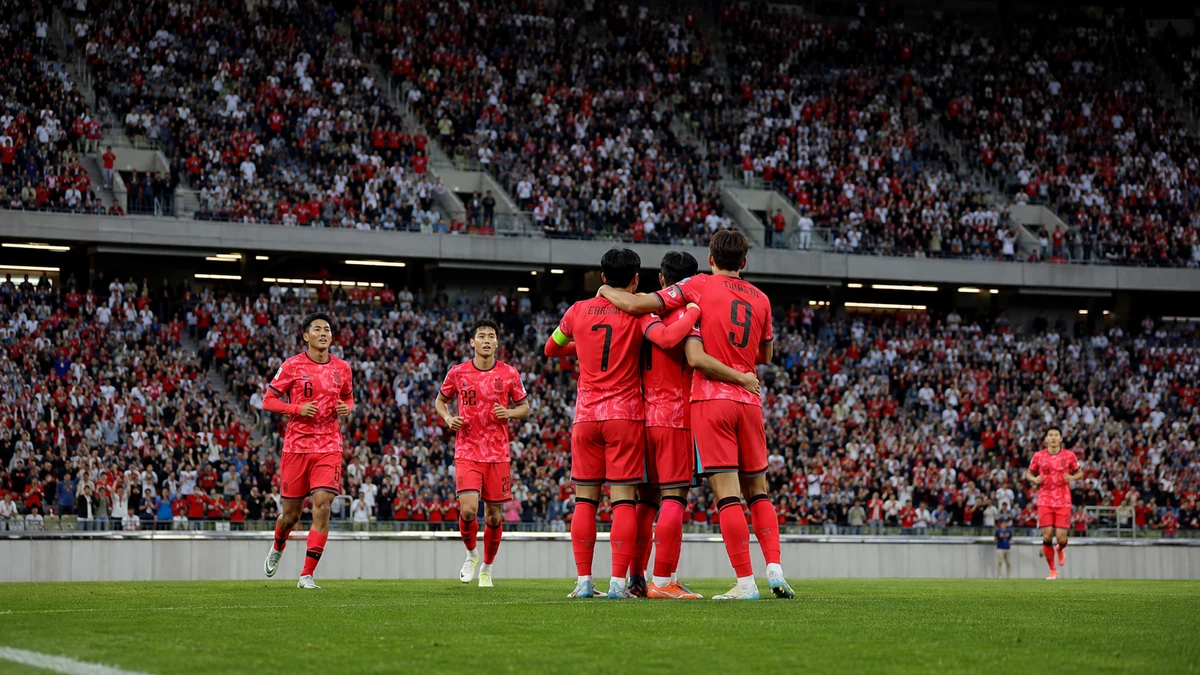
A five-goal night in Utah carried a bigger message
South Korea’s men’s national soccer team did more than overwhelm Trinidad and Tobago 5-0 in a friendly on U.S. soil this week. In a stadium in Provo, Utah, far from Seoul and still a long way from the opening whistle of the 2026 World Cup, the Korean team offered something close to a mission statement: Korean soccer is no longer a story contained within South Korea or even within Asia. It is now a global product, a diaspora event, and, increasingly, part of the sports conversation in North America.
The result itself was emphatic. Son Heung-min scored twice late in the first half, first finishing a low cross from Kim Moon-hwan in the 40th minute and then converting a penalty three minutes later. In the second half, Cho Gue-sung added two more goals, and Hwang Hee-chan scored from the penalty spot as South Korea turned a routine exhibition into a statement win. Friendlies, by definition, do not carry the stakes of a World Cup qualifier or knockout match. Coaches rotate players, opponents experiment, and intensity can vary. But a lopsided score line still tells a story, especially when a team looks organized, sharp and relentlessly purposeful from start to finish.
For American readers, the easiest comparison may be the way U.S. national team friendlies sometimes serve as more than tuneups. A game can become a test of identity, a chance to see whether a coach’s ideas are taking hold and whether a team’s stars can turn individual talent into a coherent style. That is what this looked like for South Korea under coach Hong Myung-bo. The score alone does not guarantee anything about the months ahead. But the performance showed how dangerous the Korean attack can be when its best-known names and supporting pieces are all moving in rhythm.
And the setting mattered. This was not just a Korean home game transplanted abroad. It was a glimpse of what international soccer increasingly looks like in the United States: national teams with global fan bases playing before immigrant communities, second-generation families and curious local spectators who may have first encountered Korea through K-pop, Korean dramas, Korean food or the Premier League. On this night, soccer became another way Korea explained itself to the world.
Son Heung-min remains the face of the team, and the numbers keep growing
No player embodies South Korea’s international profile more than Son. To many casual fans in the United States, he is already the most recognizable Korean soccer player ever, the kind of athlete whose appeal extends beyond hardcore followers of the sport. In Europe and North America, he has long functioned as both star forward and cultural ambassador, equally capable of making headlines for a clinical finish and of representing a broader Korean presence in global sports.
His two goals in Provo were the kind that remind viewers why he remains central to South Korea’s plans. The first was a clean striker’s finish, arriving at the right spot to turn Kim’s low service into the opening goal. The second, a penalty, may have been more straightforward technically, but together the goals changed the game. In a span of three minutes, tension vanished and control became unmistakably Korean. What had been a competitive first half suddenly became a showcase.
The significance went beyond one night’s efficiency. With those goals, Son moved to 55 and 56 international goals, bringing him within two of the 58 scored by Cha Bum-kun, the legendary former national team coach and still the top scorer in the history of the South Korean men’s team. For readers less familiar with Korean soccer history, Cha is a towering figure, something like a foundational bridge between generations. He was one of the first Korean players to build a major reputation in Europe, particularly in Germany, and for decades his record has represented an enduring benchmark.
That is part of what makes Son’s pursuit of the mark compelling. Record chases can sometimes feel manufactured, but this one carries genuine historical weight. It links two eras of Korean soccer’s outward expansion: Cha’s time, when Korean players earning major recognition abroad was still novel, and Son’s, when Korean talent in Europe is expected rather than surprising. If Son breaks the record, it will not simply be a personal milestone. It will symbolize the maturation of a soccer culture that has become increasingly comfortable on the world stage.
There is also a leadership dimension. Son is no longer just the electrifying attacker who can transform a game with pace and timing. He is now the captain, the reference point, the player younger teammates orbit around. In international soccer, stars often carry a double burden. They are asked to be match-winners while also giving shape to the team’s emotional identity. In Provo, Son looked every bit like that kind of player: decisive, composed and aware that the national team still runs through him even as others around him grow in influence.
South Korea’s attack looks deeper than one superstar
If Son’s brace set the tone, the rest of the night suggested that South Korea is not simply waiting for one famous player to rescue it. That may be the most encouraging takeaway for Hong and his staff. Cho scored twice in the second half, extending the margin and reinforcing the idea that South Korea’s frontline has both variety and depth. Hwang, meanwhile, added a penalty and helped underline that multiple players can finish chances and keep pressure on opponents.
That matters because modern international tournaments punish one-dimensional teams. At the World Cup level, opponents are too organized and too well-scouted for a team to rely only on one headline name. South Korea has known this lesson before. Even in successful eras, the national team’s global image has often become overly attached to one or two stars. Park Ji-sung once occupied that role for a previous generation. Son does now. But tournament success usually requires a broader ecosystem: runners who stretch back lines, midfielders who move the ball quickly, fullbacks who create width and supporting attackers who can punish defenses for focusing too heavily on the main threat.
That is what made the distribution of goals in Utah important. The attack did not end with Son’s first-half burst. It continued, expanded and changed shape. Cho’s second-half finishing illustrated the value of having a forward who can exploit space after the game has tilted. Hwang’s contribution showed that South Korea can maintain concentration and ruthlessness even when the outcome is effectively decided. A 5-0 score line is not just a measure of talent; it can also be evidence of discipline. Teams that lose focus with a lead often settle for 2-0 or 3-0. South Korea kept playing.
The source summary also points to a broader truth about how this team is built. Korean players are now spread across multiple overseas leagues, with Son listed at LAFC, Cho at Midtjylland and Hwang at Wolverhampton. Whether in Europe or North America, those club experiences matter. They expose players to different tactical systems, different tempos and different expectations. When they reconvene with the national team, they bring pieces of those football cultures with them. The result is a side that can look less like a team developed in one domestic environment and more like a coalition assembled from several competitive ecosystems.
For American audiences, that may sound familiar. The U.S. men’s national team has gone through its own evolution as more players moved to Europe and returned with a broader range of technical and tactical experience. South Korea’s situation is not identical, but the principle is similar. A national team increasingly shaped by foreign leagues tends to become more cosmopolitan in style and more resilient in big moments. Utah offered a snapshot of that trend.
The crowd in Provo told an important story about Korea abroad
One of the most revealing details from the match was not tactical at all. It was in the stands. According to the Korean report, the crowd was filled with Korean expatriate fans who celebrated every goal from Son, Cho and Hwang. That image matters. In the United States, where soccer crowds often reflect the country’s immigrant map as much as its domestic sports culture, the atmosphere around international friendlies can reveal how communities sustain identity across distance.
For readers who may not know the Korean term “gyopo,” often used to refer broadly to Koreans living overseas or members of the Korean diaspora, these fans represent an important part of modern Korea’s global footprint. They are not just spectators who happen to share an ancestry with the team. They are often central to how Korea appears abroad: through churches, student groups, restaurants, language schools, community organizations and family networks that keep emotional ties to the homeland active across generations.
That is why a match like this can carry a cultural charge beyond the final score. When the Korean national team plays in the United States, it is not only marketing itself to neutrals. It is reconnecting with communities that have helped carry Korean identity into American life. In a place like Utah, the sight of a heavily Korean-supporting crowd underscores how widely dispersed and deeply rooted those communities have become. It is a reminder that “global Korea” is not an abstract slogan. It is visible in stadium seats, in flags, in chants and in the emotional reactions of families who may follow Korea from thousands of miles away.
There is also a wider American context here. Over the past decade, many Americans have become more familiar with South Korea through culture rather than sports. K-pop groups fill arenas. Korean dramas draw streaming audiences. Korean films have won Oscars. Korean food, once niche in many parts of the country, is now a mainstream part of urban dining. Sports arrives differently. It can be more immediate and less explained. A goal does not require subtitles. A star player’s urgency, joy and frustration translate instantly.
In that sense, this match served as a bridge. It gave diaspora fans a home-away-from-home experience, while offering local American viewers another entry point into understanding contemporary Korea. For some, Son may be the gateway because they know him from club soccer. For others, the event itself may be the first time they see how strongly a Korean crowd can shape a stadium atmosphere outside Korea. Either way, the result is the same: South Korea’s national story abroad becomes more visible and more human.
Hong Myung-bo’s team is still being judged, but this was a useful checkpoint
Any honest assessment of South Korea under Hong should include perspective. The source material notes that his team has gone 5-1-3 across nine friendlies since the second half of last year. That is not the record of a team in crisis, but it is also not the profile of a finished contender. It suggests a side still defining itself, still experimenting and still trying to determine which combinations best suit the players available.
That is what makes a performance like this meaningful without making it definitive. Friendlies are often best read as snapshots rather than verdicts. They reveal tendencies. They show which relationships on the field look natural and which remain awkward. They show whether a coach’s preferred tempo can be sustained and whether a team can stay organized after momentum shifts. South Korea’s 5-0 win checked many of those boxes in positive ways. The attack was productive. The match management was clean. The emotional tone did not sag once the lead grew.
Hong, one of the most recognizable names in Korean soccer history, occupies an especially interesting place in this process. To older fans, he is not just a coach but a symbol of a prior era, remembered in part for his role in one of the national team’s most significant achievements. That history inevitably shapes how every result under him is interpreted. A strong performance is not merely a good evening at the office; it becomes evidence, fair or not, about whether a familiar figure can guide a new generation.
In Provo, the team gave him something useful: clarity. Coaches value not just winning but seeing the game unfold in the way they imagined. South Korea created a lead through a star attacker, widened it through secondary scorers and maintained enough structure to avoid turning the second half into a disjointed exhibition. That does not mean every issue has been solved. Better opponents will ask tougher questions. But it does mean the coaching staff has a stronger reference point for what this group can look like when the pieces align.
And because the 2026 World Cup will be staged across the United States, Mexico and Canada, there is a symbolic resonance in doing this in North America. No one serious would claim that a friendly in Utah predicts tournament outcomes. But there is still something psychologically useful about performing well on the continent where the next World Cup will unfold. For a team with global ambitions and a globe-spanning fan base, it is easier to imagine the future when the present already feels geographically familiar.
Why this mattered beyond soccer
International news about South Korea often reaches American audiences through a handful of well-established categories: tensions with North Korea, semiconductors and technology, global entertainment, trade and culture. Sports receives less consistent attention, but it can be just as revealing. Sometimes more so. A national team on tour offers a concentrated view of how a country is seen, how its citizens abroad gather and how its most internationally recognized figures carry national symbolism with them.
This match in Utah brought all of those threads together. It featured a captain chasing a historic scoring record. It showcased a roster shaped by experience in multiple foreign leagues. It unfolded before a crowd that reflected the Korean diaspora’s visibility in the United States. And it happened in a country that is steadily becoming one of the main stages for global soccer, whether through club exhibitions, Copa America, the expanded Club World Cup or the 2026 World Cup itself.
That is why reducing the night to “South Korea beats Trinidad and Tobago in a friendly” would miss the larger point. The score mattered, of course. A five-goal outburst is hard to ignore. But the game also worked as a piece of soft power, a demonstration that Korea’s global presence does not stop at music charts, movie awards or smartphone exports. It extends into the rhythms of international sport, where players serve as both athletes and symbols, and where diaspora communities help turn neutral venues into emotionally charged spaces.
There is an old tendency in American coverage to treat Asian countries as legible primarily through economics, security or pop culture. Soccer complicates that frame in productive ways. It shows movement, confidence and interaction. It reveals how identity travels. It reminds viewers that a national story can be told not only through diplomacy and entertainment but through the shared grammar of a game. A packed stand, a captain’s brace, a younger scorer adding insurance, a banner waving thousands of miles from home — all of it becomes a way of saying who belongs to the story and where that story can now be told.
In Provo, South Korea looked like a team preparing for a World Cup, but also like a country comfortable with being seen in motion. The 5-0 win over Trinidad and Tobago will not define its future on its own. Still, it offered a vivid image of the present: a Korean national team that can perform abroad, draw its people to it abroad and translate a sporting result abroad into a broader global narrative. For a country whose international identity has expanded so dramatically in the past two decades, that may be the most important takeaway of all.
Comments
Post a Comment