A station renovation that says more than it seems
In the United States, transit upgrades often become political shorthand for something bigger: whether a city is serious about accessibility, whether it expects people to use public transportation and whether it understands that the quality of daily life is shaped not only by flashy megaprojects but also by the small, repeated frictions of an ordinary commute. South Korea has its own version of that story, and this week it is playing out in Daegu, one of the country’s largest cities.
Daegu officials said they have completed a major renovation of Seomun Market Station on Line 3 of the city’s metro system and will fully reopen the station on Aug. 14. The project, reported by Yonhap News Agency, is not simply a cosmetic refresh. It is a practical redesign aimed at fixing a set of complaints familiar to riders in any big city: cramped interior space, awkward passenger flow, too much dependence on stairs and a vertical layout that made moving through the station harder than it needed to be.
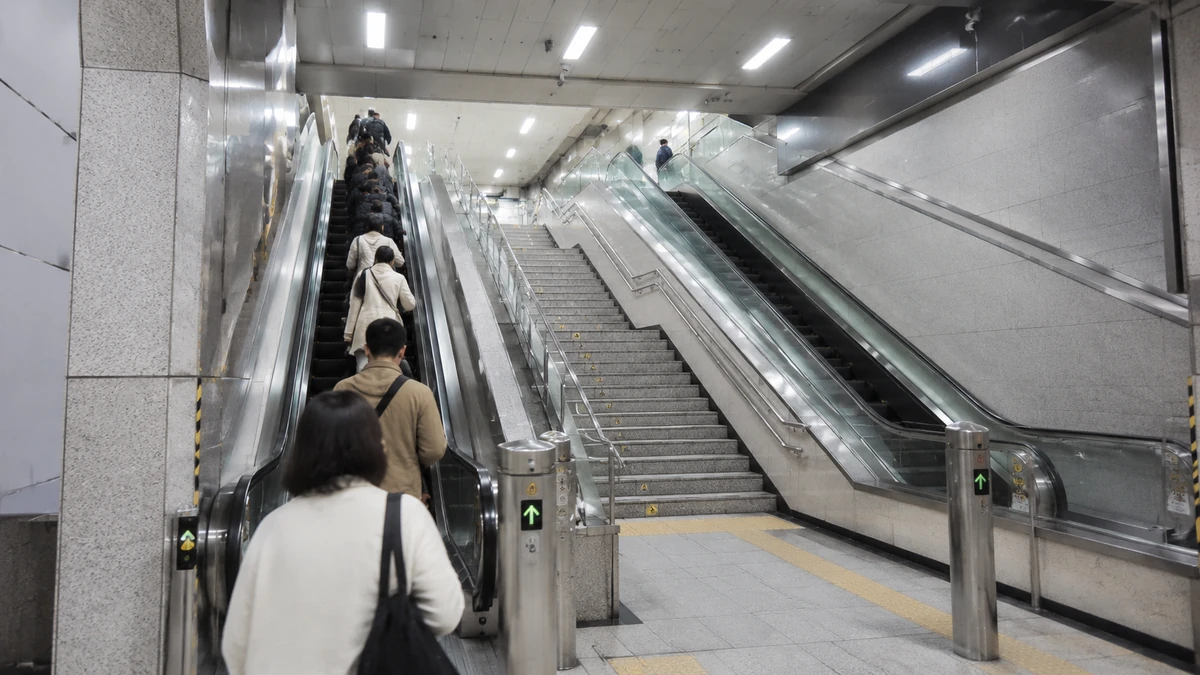
The city spent 10.1 billion won — roughly the kind of price tag Americans might associate with a serious but not headline-grabbing public works project — to expand the station and reorganize how people enter, exit and circulate inside it. Platform and concourse space increased from 190 square meters to 300 square meters. At three of the station’s exterior entrances, excluding one entrance reserved for emergency evacuation use, the city installed escalators running in both directions. That matters because the old arrangement included escalator service only in the upward direction, leaving riders to rely heavily on stone stairways when going down or navigating with bags, strollers or limited mobility.
On paper, those changes may sound modest. In practice, they can transform how a place feels. And at a station named for one of Korea’s best-known traditional markets, that matters well beyond the fare gate.
Why Seomun Market matters in the first place
To understand why this station upgrade has drawn attention, it helps to understand Seomun Market itself. For American readers, think of it less as a supermarket and more as a cross between a historic public market, a wholesale district and a neighborhood institution — a little like what Faneuil Hall Marketplace in Boston once represented culturally, or what Reading Terminal Market does in Philadelphia, but on a far more everyday basis for local life.
Traditional markets in South Korea are not quaint side attractions preserved only for tourists. They remain active commercial centers where residents buy clothing, household items, street food, produce and gifts, and where visitors can get a snapshot of a city outside the polished surfaces of department stores and high-rise malls. Seomun Market, in particular, is one of Daegu’s signature destinations, with deep roots in the region’s commercial history. It is the sort of place where commuting, shopping, eating and sightseeing all overlap.
That makes the nearby station more than a transportation node. It is, in effect, a front door. If the route into a market district feels cramped, confusing or physically taxing, that experience colors how people remember the city itself. Anyone who has hauled shopping bags up subway stairs in New York, navigated a crowded Metro station in Washington or tried to manage luggage in Chicago without a working escalator knows how quickly a simple trip can become exhausting. Transit design is not an abstraction. It is the difference between a place feeling welcoming and feeling like work.
In Daegu, the station’s shortcomings had become a recurring source of inconvenience. The concourse was narrow enough that congestion built up easily when riders gathered at the same time. The one-way escalator arrangement made the station more convenient in one direction than the other. And the entrance structure, centered largely on stone steps, created added difficulty for older adults, families with children, people carrying purchases and others whose movement through public space is not fast or frictionless.
South Korea’s urban transit networks are often admired abroad for their cleanliness, frequency and technological sophistication. But that reputation can obscure a simpler truth: even strong systems have weak links, and sometimes the most meaningful improvements happen not on glamorous new lines but at the bottleneck stations people use every day.
The real problem was not age, but flow
City officials framed the Seomun Market Station renovation as a response to long-standing inconvenience, and that phrase can undersell the issue. The problem was not just that the station was old or visually dated. It was that its design forced unnecessary slowdowns and bottlenecks into the passenger experience.
Anyone who studies transit systems, or simply uses them often, knows that space alone does not determine whether a station works well. Movement does. A narrow concourse means people stop more often, hesitate more often and bunch together more easily. Once that begins, staircases and escalators become choke points. When circulation is uneven — easy in one direction, cumbersome in the other — the station’s entire rhythm gets out of balance.
That pattern is particularly pronounced at destinations like market districts, where riders are more likely to be carrying bags, traveling in pairs or family groups, arriving from out of town or pausing to orient themselves before heading outside. A station serving an office district can sometimes function on routine and repetition; a station serving a market has to accommodate more varied behavior. People may stop to check directions, wait for companions or adjust what they are carrying. Small design flaws grow more noticeable in exactly those conditions.
So while the increase from 190 to 300 square meters is important, the deeper significance lies in what that extra room permits: fewer pinch points, clearer circulation and less forced waiting. In many public spaces, success is not dramatic. It shows up as the absence of irritation. Fewer abrupt pauses. Less crowding at the escalator entrance. Less decision-making under pressure. A little less fatigue before the day has really started.
That may sound mundane, but transit agencies around the world spend billions chasing precisely that kind of result. The difference in Daegu is that the city appears to be targeting a specific, recognizable set of pain points rather than promoting a generic promise of modernization.
Accessibility is not a niche issue
One of the most notable parts of the city’s explanation for the project was its emphasis on improving convenience for people with walking difficulties, a phrase commonly used in Korea to refer broadly to those whose mobility is limited by age, disability, injury or circumstance. In American urban planning language, the broader concept is familiar: universal design, or the idea that spaces should work for the widest possible range of people rather than only for the quick, able-bodied and unencumbered.
That matters because accessibility debates are often misunderstood as narrowly serving a small minority. In reality, design that helps those with the greatest difficulty often improves life for nearly everyone else. The same escalator that assists an older rider can also help a parent with a stroller, a traveler with luggage, a worker carrying supplies or a shopper headed home with multiple bags. Curb cuts in the United States became a classic example of this principle. Installed with wheelchair users in mind, they ended up benefiting delivery workers, cyclists, parents and countless others. Stations work the same way.
At Seomun Market Station, the old arrangement placed too much burden on stairs and offered escalator support primarily for only one direction of travel. That structure effectively assumed that most riders could adapt. But public infrastructure is at its best when people do not have to adapt so much. A city communicates its values through what it treats as normal. If a station is designed around the assumption that climbing steps with packages is simply part of the deal, that tells riders one thing. If it is redesigned so movement is easier and more predictable for more people, that tells them another.
There is also a cultural context worth explaining for readers outside Korea. South Korea is aging rapidly, and local governments are under growing pressure to make everyday urban life more navigable for older residents. At the same time, domestic tourism has expanded and regional cities like Daegu increasingly compete not just for business investment but for visitors, weekend travelers and cultural relevance. In that environment, improving access is not just a social welfare measure. It is part of how a city presents itself.
That is why the new two-way escalators are more important than they may first appear. They reduce the imbalance between ascending and descending movement, making the route through the station easier to understand and less physically punishing. In transportation terms, it is an operational fix. In civic terms, it is a statement that the right to move comfortably through public space should be shared more evenly.
A market is only as reachable as the path to it
When public officials talk about station upgrades, the discussion can easily stay trapped inside the station itself — square footage, equipment, entrances, exits. But stations do not exist for their own sake. They exist to connect people to the life around them. At Seomun Market Station, that means the renovation should be understood as part of the experience of reaching the market, not just passing through transit infrastructure.
That distinction matters because arrival shapes behavior. If getting to a destination feels cumbersome, people may visit less often, stay for less time or choose a different route altogether. If access feels smooth, the destination can seem psychologically closer even when the map has not changed. Urban economists and transportation planners have long noted that people respond not only to distance and time, but also to hassle. Hassle is real. It affects choices.
For a market district, hassle can be especially decisive. Markets invite browsing, impulse purchases and repeat visits. They are places where people frequently carry things back out with them. That means the trip home matters almost as much as the trip in. A rider willing to descend into the station empty-handed may think differently when leaving with food, textiles or gifts. A wider concourse and two-way escalator system do not merely save effort in the abstract; they directly improve the conditions under which commerce happens.
There is a tourism angle here as well. Korea’s travel appeal is often framed internationally through K-pop, Korean television dramas, beauty products and food. Those are real draws, but the practical experience of navigating a city determines whether tourism feels effortless or intimidating. For first-time visitors to Daegu — whether they are international tourists, domestic travelers from Seoul or families visiting relatives — the quality of a station near a major landmark affects first impressions in a way tourism campaigns cannot manufacture.
That is why small infrastructure news can resonate beyond the local metro map. It suggests that the city understands hospitality not only as branding but also as movement. A truly visitor-friendly city is not one that simply advertises attractions. It is one that makes them easier to reach, easier to leave and less tiring to incorporate into the rhythms of real life.
What this says about Korean cities now
There is a temptation, especially from abroad, to think of South Korean urban development in blockbuster terms: gleaming high-speed rail, futuristic airports, new apartment towers and digitally connected public services. Those stories are real, but they are incomplete. Just as in the United States, much of city government is about the less glamorous work of fixing interfaces between people and systems.
The Seomun Market Station project points to a broader shift in how Korean municipalities talk about public space. Rather than emphasizing development only as expansion, they increasingly talk about usability, convenience and inclusiveness. That may sound like standard bureaucratic language, but it reflects a meaningful change in priorities. A city does not have to build a new landmark to improve civic life. Sometimes it needs to redesign the bottlenecks embedded in existing places.
For Daegu, which has long balanced its industrial identity with efforts to attract tourism and cultural attention, this kind of project is also strategically sensible. Travelers do not assess a place solely by its headline attractions. They assess whether they can navigate it without stress. They notice whether the route from train to street feels intuitive. They remember whether carrying bags felt manageable or annoying. In that sense, transit upgrades serve as reputation management.
American readers may recognize parallels in debates over subway elevators in New York, station modernization in Los Angeles or bus rapid transit access improvements in cities trying to lure people out of cars. The details differ, but the underlying question is shared: What makes public infrastructure feel humane? Usually, the answer is not spectacle. It is reliability, legibility and a reduction in needless physical strain.
Daegu’s announcement also underscores something else: when a project is small enough to be legible, the public can often tell whether it delivered. Unlike abstract promises about future development, a wider station and more usable entrances become visible immediately. The city announced the completion on Aug. 13 and the full reopening on Aug. 14, leaving almost no gap between official statement and lived experience. Riders will know quickly whether the congestion feels lighter, whether the circulation works better and whether the station is easier to use when the market is busy.
Why a seemingly small transit story matters
The most important public infrastructure stories are not always the grandest ones. A concourse expansion and escalator installation may appear minor compared with the launch of a new rail line or the opening of a major terminal. But daily satisfaction in cities is often built from precisely these small structural changes. People experience government not only through policy documents and budgets, but through whether they can move through ordinary spaces without unnecessary difficulty.
In that sense, Seomun Market Station offers a useful case study in what good civic investment can look like. The city identified a specific cluster of problems — crowding, uneven escalator access and stair-heavy entrances — and spent public money not simply to freshen appearances but to change how the station works. The upgrade expands space, smooths circulation and lowers barriers for riders whose needs were not well served by the previous design.
That combination of practicality and symbolism is what makes the story worth attention. A market station is not glamorous. But it sits at the intersection of commuting, shopping, tourism, aging, accessibility and local identity. Improving it touches all of those issues at once. It makes the city more navigable for residents. It eases the trip for visitors. It potentially boosts the commercial vitality of the surrounding market. And it signals that public space should be designed around the real conditions of human movement, not the idealized behavior of the fastest pedestrians.
For English-speaking audiences who mostly encounter South Korea through entertainment exports or geopolitical headlines, this is a reminder that the country’s urban story is also told in its everyday infrastructure. The Korean Wave may have introduced global audiences to music, drama and food, but whether a city feels livable — and lovable — often depends on the plain mechanics of getting around.
Starting Aug. 14, riders heading to Seomun Market will encounter a station that is larger, more balanced in its vertical movement and, by design, less tiring to navigate. That may not sound like a revolution. Most meaningful civic improvements do not. They simply make ordinary life work a little better. In a city, that can be more than enough.
Comments
Post a Comment