At 40, Korean pop-opera tenor Lim Hyung-joo trades spectacle for intimacy in a small-theater recital
A milestone performance built around proximity, not scale
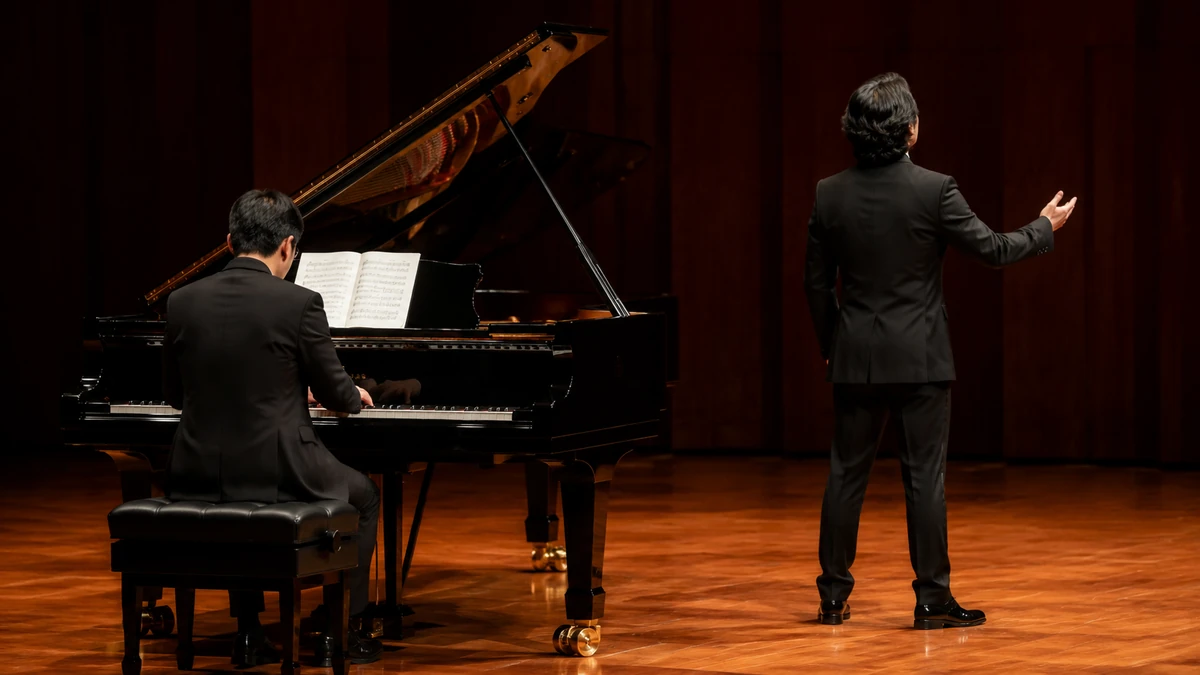
In an entertainment economy often defined by arena tours, giant LED screens and the global machinery of K-pop, South Korean tenor Lim Hyung-joo is marking a milestone in a very different way. The singer, one of the country’s best-known crossover vocalists, is set to hold a recital April 16 at 7:30 p.m. at the Garam Theater of Yongsan Art Hall in Seoul, using only piano accompaniment and the close quarters of a small venue to frame what amounts to a public artistic self-assessment.
The concert’s title, which translates roughly to “Welcoming My 40th Spring,” carries a layered meaning that may not be immediately obvious to American readers. In Korea, as in many cultures, spring is not only a season but a durable metaphor for renewal, beginnings and emotional transition. Pairing that image with a 40th birthday turns the event into something more than a birthday concert. It suggests a deliberate reset: a performer looking at midlife not as a nostalgic checkpoint, but as an opportunity to restate who he is musically, and why.
That matters because Lim’s career has long sat at the intersection of categories. He is widely described in Korea as a “popera” tenor, a term used in East Asia and parts of Europe for singers who blend classical vocal technique with the accessibility and emotional immediacy of pop. For U.S. audiences, the closest reference points might be artists such as Andrea Bocelli, Josh Groban or Sarah Brightman — performers who move between classical phrasing, mainstream repertoire and a concert style that invites broad audiences rather than only opera regulars. But in South Korea, where genre boundaries have become especially fluid in recent years, Lim’s place in the culture reflects something more specific: the way Korean performance has increasingly refused to keep classical prestige and popular appeal in separate boxes.
So while the recital was announced partly as a birthday celebration, the deeper story is the format itself. Turning 40 could have been marked with a larger gala, celebrity guests or a heavily branded commemorative event. Instead, Lim is choosing a small hall and a voice-and-piano structure that leaves very little room for distraction. In practical terms, that means listeners will hear the grain of the voice, the breath control, the phrasing and the interpretive choices with unusual clarity. In symbolic terms, it suggests a performer confident enough to set aside pageantry and let the fundamentals speak.
For American readers, it may help to think of the difference between a major pop star announcing a Las Vegas-style production and a veteran singer-songwriter booking a string of stripped-down theater dates with just a piano and a spotlight. The latter can sometimes say more about where an artist truly is. That appears to be the case here.
Why the encore matters
The April 16 performance is not being presented as an entirely new concept. Lim’s agency has described it as an encore to a well-received spring recital held last month at Youngsan Art Hall. That detail may sound routine, but it changes the meaning of the event in important ways.
Encore performances, in any market, generally imply that an initial show connected with audiences strongly enough to warrant another outing. On one level, this is a commercial signal: there was demand. On another, it is an artistic one: the program’s balance, pacing and emotional tone were compelling enough to revisit. Yet the Seoul recital is not merely a repeat booking. By attaching it to Lim’s 40th birthday and renaming it around the image of a “40th spring,” organizers are reframing the concert as both a continuation of prior momentum and a more personal statement.
That two-track framing — part proven program, part autobiographical marker — is especially interesting in the Korean context. Much of South Korea’s entertainment industry runs on constant novelty. Comebacks are packaged with new visual concepts, fresh promotional cycles and elaborate reinvention. In that environment, returning to a format that has already worked can seem almost conservative. But it can also read as a sign of confidence. Rather than chasing novelty for its own sake, Lim appears to be taking a program that audiences responded to and using it to deepen a narrative about maturity, continuity and artistic identity.
There is also something culturally resonant about linking a concert to a birthday in this way. In the United States, celebrity birthday events often function as lifestyle content or fan-service spectacle. In Korea, milestone birthdays can carry a more explicit sense of life-stage reflection, particularly when paired with formal artistic presentation. That does not make the event solemn. It does, however, create room for a more intentional reading: not “come celebrate me” so much as “come hear where I am now.”
The title reinforces that shift. “New spring” imagery was already present in the earlier recital. Extending that spring metaphor into Lim’s personal life gives the encore a stronger narrative arc. It becomes a way of saying that the season is not just outside the theater; it is inside the singer’s biography. For audiences, that can heighten both familiarity and anticipation. The repertoire may be rooted in a known program, but the frame around it has changed.
The significance of a piano-only recital
Perhaps the most revealing detail in the announcement is that pianist Cho Young-hoon will accompany Lim in a recital built around piano rather than a larger instrumental setup. To casual readers, that might sound like a production note. In classical and crossover performance, it is often the key to the evening’s entire aesthetic.
Big arrangements can flatter a voice. A fuller ensemble can add color, drama and momentum, and it can help bridge stylistic differences when a program moves from opera arias to pop ballads or musical theater. A piano recital, by contrast, is an exposed form. It asks more of the singer’s control and interpretive precision. Subtle shifts in tempo, articulation and dynamic contrast become more audible. So do any weaknesses.
That is why this format carries weight. According to the agency, this will be Lim’s first paid solo recital with piano accompaniment in roughly four years, since a July 2022 performance at Seoul Arts Center’s Inchoon Art Hall. In other words, this is not his default mode. It is a format he returns to selectively, which makes the return itself meaningful.
The phrase “paid recital” also matters more than it might in translation. It distinguishes the event from a free promotional showcase, a corporate-sponsored cultural program or a fan-centered celebration where music is only part of the draw. Ticket buyers are not simply being invited to honor a celebrity milestone; they are being asked to purchase a seat with the expectation of a serious musical experience. That places the performance in the marketplace as a professional artistic product, not merely a commemorative occasion.
For American readers, the analogy might be a Broadway star stepping away from a cast reunion or televised special and instead mounting a ticketed cabaret-style evening in a respected small venue, where the audience comes not for nostalgia alone but for vocal craft. That setting tends to attract a more concentrated kind of listening. It also reveals how an artist wants to be valued at that moment — by charisma and memory, yes, but also by technique and judgment.
In Lim’s case, the choice is especially resonant because his career has always involved balancing accessibility with formal training. A piano-only recital pulls that balance into sharper focus. The singer cannot rely on production to unify the program. He must do it through voice, interpretation and the relationship with the accompanist. That is a demanding artistic proposition, and precisely for that reason, it can be persuasive.
A set list that mirrors Korea’s genre-fluid music culture
Organizers say Lim’s program will span classical pieces, opera arias, pop, musical theater and original soundtracks from Korean television dramas. For readers outside Korea, that mix may seem unusually broad for a recital by a classically trained tenor. Inside South Korea’s performance culture, it makes near-perfect sense.
Korea’s arts ecosystem has spent years dissolving once-rigid lines between high culture and mass culture. K-dramas are not niche domestic products anymore; their soundtracks circulate globally, often achieving an emotional afterlife independent of the shows themselves. Musicals occupy an important middle ground in Korea as both prestige entertainment and robust commercial industry. And the term “crossover” is not treated as a side category so much as a viable mainstream lane for singers who can move between traditions.
That flexibility reflects broader changes in audience behavior. Korean listeners are often highly omnivorous. A fan who follows idol groups may also attend a musical. A viewer drawn in by a drama soundtrack may become curious about the singer’s classical background. A recital that includes opera and television OSTs is therefore not necessarily trying to please everyone indiscriminately; it is speaking the language of a market where audiences already move comfortably across formats.
For Americans, the nearest comparison may be the way film music, Broadway repertoire, standards and classical crossover can coexist in a single PBS concert special or a Lincoln Center-adjacent program without seeming incoherent — if the performer has the range to bind it together. The challenge, of course, is coherence. A program can become scattered if genre-hopping substitutes for interpretation. The success of a broad set list depends on whether the artist can make each piece sound like part of the same musical argument.
That appears to be one of the central tests of this recital. Lim is not simply showing that he can sing many things. He is presenting the idea that his voice and sensibility can hold those worlds together. The inclusion of K-drama OSTs is especially notable because it acknowledges a key reality of Korean soft power: for many global audiences, televised drama has been at least as important as K-pop in opening a window onto Korean culture. To place that repertoire alongside opera and classical material is, in a way, to map the modern Korean listening experience itself.
It also sends a message about what counts as seriousness in music. In some cultural settings, classical repertoire is treated as the measure of artistic legitimacy while popular repertoire is framed as outreach or compromise. Korea’s crossover scene often resists that hierarchy. A drama soundtrack can be emotionally formative; a pop ballad can demand real interpretive restraint; a musical number can function as a showcase of character and technique. Lim’s program seems built on that premise.
Why a small theater can say more than a big stage
The venue is another essential part of the story. Yongsan Art Hall’s Garam Theater is a small theater, not a cavernous concert hall. That distinction is not merely architectural. It shapes the entire social contract between performer and audience.
In a smaller space, physical distance collapses. Listeners can register facial expression, bodily tension and the moment-to-moment mechanics of vocal performance. Singers, in turn, receive more immediate feedback — not just applause, but the room’s concentration, its restlessness, its emotional response. There is less insulation on both sides.
That intimacy matters especially in a solo recital. A large venue can amplify scale and prestige, but it can also create emotional diffusion. A small theater asks the performer to generate connection without the help of grandeur. It rewards nuance. It makes sincerity easier to detect and overstatement harder to hide.
Seen that way, Lim’s decision to mark his 40th birthday in a small theater rather than leveraging the milestone into a bigger public spectacle reads as strategic as well as artistic. It suggests that he wants the evening’s central question to be not “How big is the celebration?” but “How directly can the music reach people?” In an era when so much celebrity culture is optimized for shareability — clips, visuals, branding moments — that is a notable inversion.
It also reflects an underappreciated side of South Korea’s entertainment world. International coverage often centers on industrial scale: stadium tours, chart performance, streaming numbers, synchronized fandoms. Those are real and important. But alongside them exists a durable performance culture that prizes live density, vocal discipline and genre specialization. Small halls, recital formats and musically focused programs remain meaningful parts of the ecosystem. Lim’s concert belongs to that tradition.
There is a quiet confidence in such programming. Instead of using the birthday occasion to enlarge the event outward, it concentrates inward. That concentration can itself be a statement of status. Established artists do not always need to prove size; sometimes they prove durability by showing they can still command attention in a room where nothing stands between voice and listener.
What Lim’s concert says about the Korean Wave beyond K-pop
For international readers, the bigger takeaway may be what this concert reveals about the Korean Wave, or Hallyu, at its current stage. In the United States, Hallyu is still often shorthand for idol groups, beauty products, binge-worthy dramas and the occasional Oscar-winning film. But Korean cultural influence is broader and more layered than that. It includes artists like Lim, whose careers are built not on dance-pop spectacle but on hybrid forms that connect classical technique, mainstream sensibility and local media culture.
That complexity is easy to miss if Korea is viewed only through its most exportable products. A singer performing opera arias and drama soundtracks in a small Seoul theater does not fit the default American image of Korean pop culture. Yet that is precisely why the recital is worth attention. It offers a more textured picture of how Korean entertainment actually functions at home: less as a single genre than as an interlocking network of forms, audiences and institutions.
Lim’s professional identity encapsulates that overlap. The label “popera tenor” may sound unusual to Americans, but it captures a longstanding reality in Asian and European markets where listeners have shown sustained appetite for singers who can make classical voice feel emotionally legible outside elite opera settings. In South Korea, that has been part of a larger democratization of listening habits. Audiences do not necessarily sort music according to the same prestige ladder that has historically shaped some Western criticism. Instead, they often ask whether a performance feels moving, polished and sincere across genre lines.
That sensibility helps explain why a recital like this can be both commercially viable and culturally meaningful. It is not a retreat from the mainstream so much as a reminder that Korea’s mainstream has multiple lanes. Just as K-drama has expanded global ideas of what television can travel, crossover artists expand assumptions about what Korean music looks and sounds like beyond idols and rap charts.
The timing also matters. Turning 40 is a symbolic threshold in many societies, and in the entertainment business it can invite questions about reinvention, longevity and relevance. In Korea, where public personas are intensely managed and youth culture carries enormous market value, age milestones can take on additional significance. Lim’s answer appears to be neither reinvention for shock value nor retreat into legacy branding. Instead, he is using the occasion to emphasize concentration, musicianship and continuity. That may be one of the more durable ways to age in public as an artist.
A recital as an argument about artistic identity
Ultimately, the Seoul concert matters not because it is a birthday event, but because it functions as an argument. It argues that an artist’s present tense can be clarified through form. It argues that smaller can be sharper. It argues that crossover is not dilution if the performer can unify the material. And it argues that in today’s Korean performance scene, seriousness and accessibility are not enemies.
Those ideas resonate beyond one singer or one night. Much of global entertainment is currently pulled between extremes: blockbuster scale on one end, hyper-personal niche identity on the other. Lim’s recital occupies a middle ground that many artists seek but few define clearly. It is professional without being grandiose, personal without becoming private, and marketable without surrendering its musical center.
The concert’s framing — a “40th spring,” an encore, a return to piano accompaniment, a small theater, a multi-genre program — creates a coherent picture of an artist revisiting fundamentals at a moment when he could easily have chosen bigger gestures. That coherence may be the point. In a media environment crowded with noise, consistency of intention can be its own kind of event.
For American audiences interested in Korean culture beyond the obvious flashpoints, Lim’s recital offers a useful lens. It shows how South Korean performance can translate life milestones into artistic statements, how genre boundaries are negotiated rather than obeyed, and how live music retains a distinct prestige even in one of the world’s most digitally sophisticated entertainment markets.
If the global Korean Wave has often been narrated through expansion — bigger tours, wider reach, broader influence — this concert tells a parallel story about concentration. One singer, one pianist, one small room, and a program meant to prove where the artist stands now. In its own quiet way, that may be as revealing about contemporary Korea as any headline-making chart feat or stadium spectacle.
Comments
Post a Comment