At Korea’s Baeksang Arts Awards, Two Veteran Actors Shared the Biggest Wins — and a Snapshot of Where Korean Entertainment Stands Now
A marquee night for Korea’s screen industry
South Korea’s Baeksang Arts Awards, one of the country’s most closely watched entertainment ceremonies, offered a clear reading this week of what audiences and industry insiders believe defined the past year in Korean popular culture: trusted actors, emotionally grounded storytelling and the continuing power of both theatrical film and television drama.
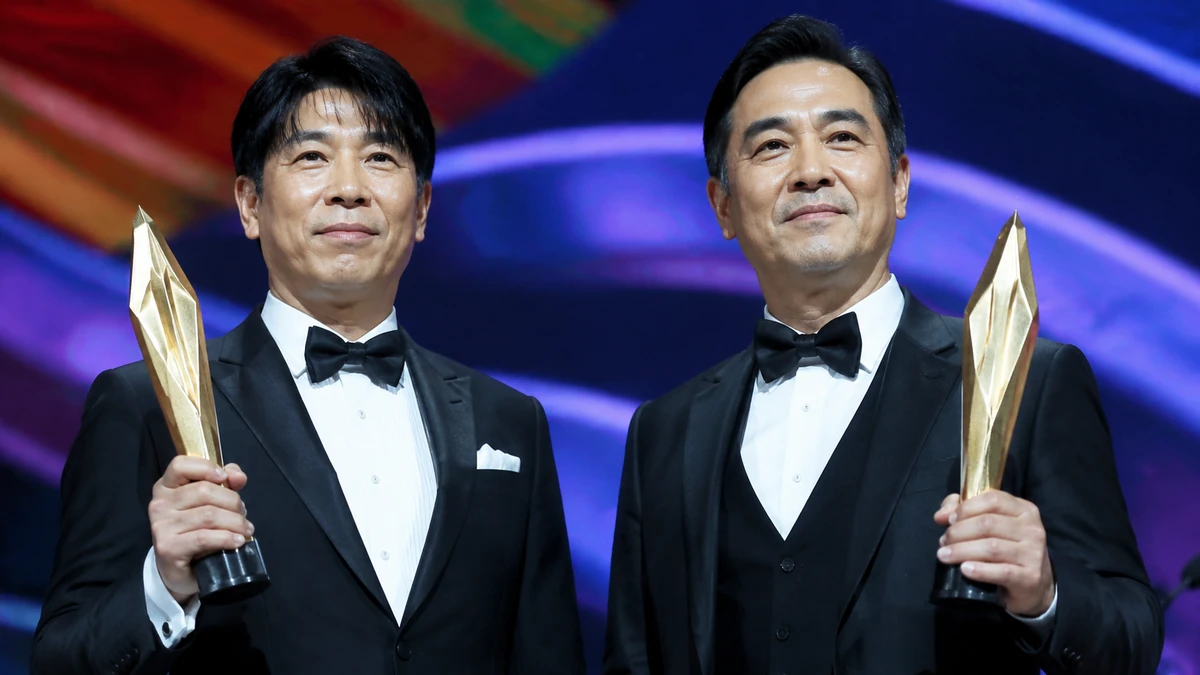
At the 62nd Baeksang ceremony, held Thursday at COEX in Seoul’s upscale Gangnam district, the top honor in the film category went to Yoo Hae-jin for his performance in the blockbuster movie “The Man Who Lives With the King,” while the grand prize for television went to Ryu Seung-ryong for the JTBC drama “The Story of Manager Kim, Who Works at a Major Company and Owns a Home in Seoul.”
For American readers, the easiest comparison is to imagine an awards show that carries some of the prestige of the Golden Globes, some of the industry-wide reach of the Screen Actors Guild Awards and some of the cultural centrality the Oscars once commanded when network television still gathered millions around a single event. The Baeksang Arts Awards are unusual in that they honor film and television together in one major ceremony, making them a useful barometer for what Korea is watching, discussing and emotionally investing in across platforms.
What happened onstage in Seoul was more than a routine trophies night. It was a statement about what kinds of performers endure in an industry often associated abroad with fast-moving trends, idol-driven fan culture and global streaming buzz. Yoo and Ryu are not overnight sensations. They are veteran actors with long careers, distinctive screen personas and the kind of public trust that builds slowly over decades. Their dual victories suggested that, at least this year, Korean entertainment’s biggest night belonged not to novelty but to depth, consistency and the long payoff of craft.
That matters because South Korea’s cultural exports are now followed far beyond their home market. To international audiences, K-dramas and Korean films can sometimes seem like a nonstop conveyor belt of fresh sensations. But inside Korea, reputation still matters. Industry memory matters. The relationship between actors and audiences matters. Baeksang highlighted that dynamic in a particularly vivid way.
Why Baeksang matters beyond the fan world
For viewers outside Korea, award shows can feel like insider rituals unless there is a hit title everyone already knows. But Baeksang serves a broader purpose. It functions as a kind of annual report on Korean screen culture, one that translates box-office success, TV popularity, acting ability and public goodwill into a single symbolic event. In other words, it tells you not just what sold, but what resonated.
That makes the ceremony especially important in a moment when Korean entertainment has become a global business. American audiences may come to Korean content through Netflix hits, festival favorites or social media clips, but Korean viewers often encounter those same performers through a much denser ecosystem: cable dramas, network shows, theatrical releases, variety programs, fan communities and years of accumulated familiarity. Baeksang stands near the center of that ecosystem.
The top honors this year reflected that layered reality. Yoo Hae-jin’s win recognized not only one performance but a film that combined critical respect with massive ticket sales. Ryu Seung-ryong’s prize recognized the enduring pull of a television lead performance in a country where weekly drama viewing still shapes public conversation in a way Americans might remember from the heyday of appointment television, before streaming fragmented the audience.
There is also a specifically Korean feature to the awards’ cultural role. In South Korea, the distinction between film and television talent has long been more fluid than in Hollywood’s older prestige hierarchy. Stars often move between big-screen roles, prestige cable dramas, mainstream network projects and streaming series. That means a ceremony honoring both sectors at once can capture the full strength of the industry, rather than forcing a false separation between “serious cinema” and “popular TV.”
Thursday’s winners underscored that point. The night did not present film and drama as rivals. It presented them as twin engines of the same cultural machine — one powered by the collective thrill of the theater, the other by the intimate pull of home viewing.
Yoo Hae-jin and the return of the movie theater event
If one title towered over the ceremony, it was “The Man Who Lives With the King.” The film took four awards, including the film grand prize, the Gucci Impact Award, a best new actor win for Park Ji-hoon and the Naver Popularity Award. That sweep suggested the rare kind of cultural reach studios dream about: commercial success, industry respect, breakout talent and visible fan enthusiasm all converging around one movie.
By the numbers alone, the film has become a phenomenon. According to the summary of the Korean reporting, it has drawn roughly 16.81 million admissions, placing it No. 2 among the highest-grossing theatrical releases in Korean box-office history by attendance. In the Korean market, admissions are often discussed as a headline statistic in a way that may feel unfamiliar to Americans used to domestic gross totals in dollars. But the meaning is easy to grasp: an enormous share of the country turned up at the multiplex.
That scale matters because theatergoing, in South Korea as in the United States, has faced post-pandemic uncertainty. Even when major movies return audiences to theaters, every local success carries an added symbolic weight. It is no longer just about whether one film was a hit; it is about whether the big-screen habit itself still has emotional force.
Yoo’s own acceptance remarks captured that sentiment. He thanked the approximately 17 million moviegoers who had come out for the film, and he reportedly said he was glad audiences seemed to remember “the taste of the theater.” It is the kind of phrase that does not translate neatly if treated too literally, but its meaning is unmistakable. He was talking about the sensory pleasure and communal feeling of moviegoing — the experience of leaving home, buying a ticket and sharing a story in a dark room with strangers.
That idea would sound familiar to anyone in the U.S. who watched “Top Gun: Maverick” or “Barbenheimer” become shorthand not just for successful releases but for the revival of the multiplex as a social ritual. In Korea, “The Man Who Lives With the King” appears to have played a similar role. Its success did not merely generate receipts. It helped restore confidence in the idea that a local movie can still become a must-see national event.
Yoo’s victory also fit his career arc. He has long been one of Korea’s most recognizable character actors, known for bringing warmth, wit and a lived-in authenticity to both comic and dramatic roles. In an American context, he occupies a space somewhat akin to those performers audiences instinctively trust — actors who may not always be marketed like glossy celebrities but whose presence signals quality, humanity and emotional credibility. A grand prize for Yoo, then, also reads as a vote for a certain kind of acting: textured, generous and rooted in observation rather than flash.
Ryu Seung-ryong and the staying power of Korean television drama
If Yoo’s win represented the theatrical side of Korea’s entertainment strength, Ryu Seung-ryong’s television grand prize underscored a parallel truth: Korean drama remains one of the country’s most powerful narrative forms, and star performances still drive that medium in a profound way.
The title of Ryu’s winning drama, “The Story of Manager Kim, Who Works at a Major Company and Owns a Home in Seoul,” may strike English-language readers as unusually long and hyper-specific. But that specificity is part of the point. Korean drama titles often carry clues about status, anxiety and social setting, and this one speaks directly to a cluster of concerns central to modern South Korean life: work at a major conglomerate, known locally as a chaebol-affiliated or big-company career track; the pressure of white-collar office culture; and housing in Seoul, one of the world’s most expensive and status-conscious urban real estate markets.
That social backdrop is worth pausing on for foreign readers. Homeownership in Seoul can function as a marker of class stability and generational success in ways that resonate with Americans living in cities where property prices have become a source of frustration and inequality. Likewise, the idea of “Manager Kim” evokes a familiar office hierarchy — the middle-class corporate employee carrying burdens from above and below, an archetype that can connect across borders even when the local details differ.
Ryu’s win suggests that the drama did more than mirror those pressures. It gave them a face and voice powerful enough to dominate the TV field. In Korean television, viewers often remember not just plot twists but the rhythm of a lead actor’s performance — the precise timing, the emotional restraint, the comic release, the way a familiar face anchors a character who could otherwise remain just a social type. That appears to be part of what Baeksang honored here.
Ryu, like Yoo, is an established actor with exceptional range. International viewers may know him from major Korean films and series that helped carry Korean storytelling abroad. His Baeksang win is a reminder that long before many global audiences learned his name, he had already built a deep reservoir of respect at home. In that sense, the award was not simply for one successful season of television. It was also recognition of accumulated authority — the kind of authority that makes a performance feel instantly consequential.
And at a time when streaming platforms encourage constant novelty, that kind of television stardom still matters. It tells viewers that Korean drama is not merely a factory for new concepts but a medium sustained by performers whose careers become part of the storytelling itself.
A friendship spanning three decades gave the ceremony its emotional center
The night’s most poignant layer may have come from the connection between the two top winners themselves. Ryu reportedly reflected on the emotion of sharing the evening with Yoo, his longtime friend and colleague from about 30 years ago, when the two performed together in the avant-garde stage work “Duta” at La MaMa Experimental Theatre Club in New York.
That detail transformed the awards narrative from a simple winners list into something more cinematic. Beneath the polished surfaces of a major television broadcast was a story about artistic time: two actors who once shared an experimental theater stage in New York, early in their careers, ending up on the same night holding the highest honors in Korea’s two biggest screen categories.
For an American audience, La MaMa is not a trivial reference point. The East Village institution has long been associated with boundary-pushing theater, artistic experimentation and the kind of early-career grind far removed from red carpets. To hear that two of Korea’s most celebrated screen actors once crossed paths there adds a layer of transnational texture to the story. It also complicates the glossy global image of K-entertainment by revealing the less visible foundations beneath it: years of training, fringe performance spaces, friendships forged before fame and careers built the slow way.
This is one reason the moment likely resonated so strongly with fans. Award shows thrive on surprise and glamour, but what often lingers is a narrative of endurance. The image of old friends reaching parallel peaks in different fields — one in film, one in television — speaks to a universal emotional logic. It is the kind of real-life storyline that viewers instantly understand, whether they are in Seoul, Los Angeles or London.
It also says something important about Korean acting culture. The rapid international expansion of K-content can make it seem as if the industry runs mainly on speed, trend awareness and export-friendly packaging. But the Yoo-Ryu story points to another engine: the slow accumulation of stage discipline, professional relationships and artistic memory. Those are not always the easiest things to quantify, yet they often form the backbone of performances that last.
The industry signal behind the trophies
Awards ceremonies traffic in symbolism, but this year’s Baeksang results also lined up with a larger economic story. “The Man Who Lives With the King” did not just win acclaim; it was cited in Korean reporting as part of a broader improvement in the theatrical business environment. That matters because in every film market, the question eventually becomes whether one hit can lift confidence across the ecosystem.
According to the summary, CJ CGV, South Korea’s largest multiplex chain, reported first-quarter consolidated revenue of 573.4 billion won and operating profit of 8.7 billion won, with revenue up 7.5% from a year earlier and operating profit up 172.4%. Domestic operating losses also reportedly narrowed. The Korean article linked part of that improvement to the film’s box-office performance.
No serious analyst would say one movie alone determines the health of an entire exhibition sector. The same is true in the United States, where a single blockbuster can temporarily brighten earnings without resolving deeper structural challenges. But symbols matter in business as much as they do in culture. A hugely popular film that also earns elite recognition can boost morale among theater owners, investors, distributors and audiences alike.
That is part of why Baeksang’s results are meaningful beyond fandom. The ceremony essentially translated raw popularity into institutional legitimacy. It told the market that this was not merely a movie lots of people happened to see; it was a movie the culture chose to honor. In industries built on momentum, that distinction can influence what gets financed next, what kinds of stories are considered viable and how confidently local producers think about theatrical releases in an age of streaming competition.
On the television side, the message was parallel rather than identical. Ryu’s award affirmed that actor-led drama remains a major source of prestige and public attention. Put together, the night’s top prizes suggested a healthy duality in Korean entertainment: theaters can still produce mass events, and television can still produce culturally dominant performances. Rather than one platform cannibalizing the other, both appeared capable of commanding the spotlight.
What global audiences should take from this year’s Baeksang
For international audiences who follow Korean entertainment mainly through export hits, this year’s Baeksang Arts Awards offered a useful corrective to simplistic narratives. The biggest lesson is not just that Korea continues to produce popular content. It is that its domestic industry still rewards a particular blend of mass appeal, lived-in acting and social specificity.
That specificity is worth emphasizing. The drama title about a Seoul homeowner working at a major company is deeply local. So is the cultural meaning of thanking millions for rediscovering the pleasure of going to the movies. Yet those details do not make the stories less accessible abroad. In many cases, they make them more compelling. Global audiences often respond most strongly when Korean film and television feel rooted in real local tensions — housing pressure, workplace hierarchy, class aspiration, generational strain, community life — rather than trying to flatten themselves into generic international content.
The Baeksang results also highlighted something American viewers sometimes miss when they approach K-content mainly through a streaming interface: the domestic audience has its own history with these performers. Yoo Hae-jin and Ryu Seung-ryong are not simply stars of the moment. They are artists whose careers have been watched over time, across formats and across phases of the industry itself. Their victories carried that history with them.
In that sense, the ceremony served as a reminder of what makes South Korea’s cultural rise so durable. It is not based only on trend cycles or viral appeal. It is supported by mature institutions, highly engaged audiences, star systems that cross media boundaries and performers capable of turning locally grounded stories into emotionally legible experiences for millions.
That is why the image of Yoo and Ryu holding the biggest trophies of the night mattered. It captured not just a pair of individual triumphs, but a broader portrait of Korean entertainment at this moment: commercially powerful, emotionally literate, increasingly global and still deeply connected to the actors and stories that earned the public’s trust at home first.
Comments
Post a Comment