BTS comeback sends Weverse traffic soaring, showing how K-pop fandom now runs on one all-in-one platform
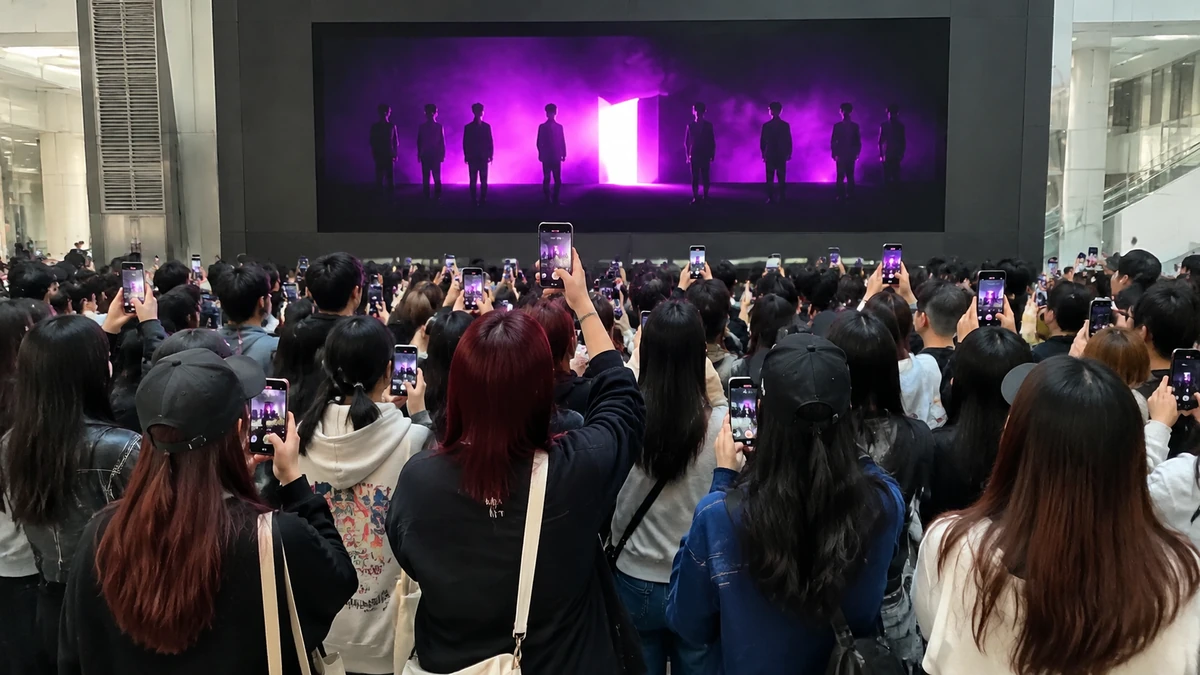
A comeback that moved more than music
When BTS makes a move, the ripple effect rarely stops at streaming charts. This time, the group’s return appears to be lifting an entire digital ecosystem built around modern fandom. Weverse, the fan platform operated by HYBE, said its monthly active users climbed to 13.37 million in the first quarter, up 20% from the previous quarter, as excitement over BTS’s new album and tour plans drove a sharp surge in activity.
For American readers, it may help to think of Weverse not as the equivalent of just Instagram, Ticketmaster, YouTube or an artist merch store, but as an attempt to combine pieces of all of them into one place. Fans use it to read official announcements, post in artist communities, watch media, buy albums and merchandise, and tune into livestreams. In K-pop, where fan participation is often organized and highly interactive, that kind of integration matters. A comeback is no longer only the day an album drops. It is a cascade of teaser posts, preorder links, tour notices, live broadcasts, fan reactions and purchases that can all happen across the same platform within hours.
That broader point may be the most important takeaway from the new Weverse figures. BTS’s return did not simply attract more eyeballs to a single announcement. It changed how fans moved through the platform, how long they stayed and what they did once they got there. In the streaming era, American pop fans are used to surprise releases and carefully timed social media drops. K-pop has taken that logic a step further, turning the comeback into a coordinated, multiplatform event. The new data suggests BTS remains one of the clearest examples of how that machinery works at global scale.
The Korean term “comeback” can be misleading to English speakers because it does not necessarily mean an artist has been gone for years or is recovering from a slump. In K-pop, a comeback generally refers to a new promotional cycle: a fresh album, a concept, appearances, performances and a new chapter in the artist’s ongoing story. It is a release strategy, a marketing moment and a communal event all at once. BTS’s latest comeback appears to have activated every part of that system.
And that matters far beyond fan circles. For the entertainment business, it offers a window into how music companies increasingly want to own not just the songs, but the digital space where attention turns into community, commerce and repeat engagement. In an industry that has long depended on third-party platforms to distribute music and shape fan behavior, Weverse is part of a larger push to keep more of that activity under one roof.
The numbers behind the BTS effect
The strongest evidence of BTS’s impact came in the immediate response to the group’s album announcement. According to figures released by Weverse Company, the platform drew 3.37 million visitors on Jan. 5, the day the new BTS album was announced through Weverse. That represented a 246% jump from the previous day. In practical terms, it showed how quickly the group’s global fan base can mobilize — and where that attention now tends to gather first.
The increase did not fade after the initial burst. On Jan. 14 and Jan. 16, announcements related to the BTS world tour “ARIRANG” and preorder sales for the album of the same name pushed daily visitors even higher, averaging 5.24 million across those two dates. Weverse said the platform had averaged 2.71 million daily visitors from Jan. 1 through Jan. 13 before those notices were posted. By that measure, the Jan. 14 and Jan. 16 spikes represented about a 93% increase over the earlier average.
Those figures are notable not only because they are large, but because they show a pattern familiar to anyone tracking digital media habits in 2024 and 2025: announcements are no longer passive information drops. They are calls to action. Fans saw the album news, then returned for tour details, then moved into preorder behavior, content consumption and community response. In another era, an artist might announce a new project on television, direct fans to record stores and rely on radio to sustain momentum. Now the whole arc can unfold on a phone screen, within a platform that captures each step.
That gives entertainment companies richer, more immediate data about what fans care about and when. It also helps explain why user metrics such as monthly active users, or MAU, have become so closely watched. MAU is a common tech-industry measure that counts how many unique users engage with a service in a given month. For a platform like Weverse, rising MAU is more than a vanity number. It can signal greater opportunity for advertising, sales, subscriptions, livestream viewership and merchandise conversion.
In BTS’s case, the numbers underscore the group’s unusual ability to turn anticipation into measurable action. American fans may know the shorthand already: when Taylor Swift announces tour dates, websites strain under demand; when Beyoncé drops an album, social media and streaming services light up. BTS operates on that level of cultural force, but within a K-pop framework that channels fan energy into a more centralized digital pathway. That is part of what makes the Weverse increase so revealing. It is not just proof of fandom enthusiasm. It is a map of how that enthusiasm is being organized.
Why Weverse matters in the K-pop economy
To understand why these numbers are drawing attention, it helps to understand what Weverse is trying to be. In the United States, music fandom is often spread across disconnected services: Instagram for updates, X or TikTok for reaction, YouTube for video, Discord or Reddit for community, Spotify or Apple Music for listening, and Ticketmaster or artist storefronts for transactions. Weverse compresses many of those behaviors into a single platform. That makes it especially useful for a genre like K-pop, which depends on tightly coordinated fan participation and a steady flow of official content.
Weverse Company said roughly 30 different service areas were used in connection with BTS’s “ARIRANG” rollout, including community features, commerce, media and livestreaming. That is a telling detail. It suggests the platform is no longer functioning as a simple message board or fan cafe, but more like an operating system for fandom — a place where discovery, emotional investment and spending behavior reinforce one another.
From the fan’s perspective, the appeal is straightforward. Instead of jumping from app to app, a user can see the official announcement, watch related clips, react with other fans, place a preorder and later return for a livestream without leaving the same digital environment. That shortens the path between emotion and action. If excitement is the fuel of fandom, convenience is the engine that keeps it moving.
From the company’s perspective, the advantages are just as obvious. A platform that hosts the announcement, the discussion and the purchase is better positioned to hold onto user attention and collect first-party data. In entertainment, where algorithms on outside platforms can change with little warning, direct access to the audience is increasingly valuable. HYBE is hardly alone in seeking that kind of control, but BTS gives Weverse a uniquely powerful draw. The group’s scale means that each major release becomes a stress test for how well the platform can convert worldwide excitement into sustained engagement.
This is also where K-pop’s business model differs in important ways from the standard American pop rollout. K-pop agencies often design not just the music itself, but the participation structure around it. Fans are encouraged to follow teaser schedules, join presales, watch exclusive videos, buy collectible physical albums and interact within a community that treats each release as an unfolding narrative. The new Weverse data suggests that strategy remains highly effective when paired with a superstar act whose audience spans continents.
More than an album: how K-pop turns releases into shared events
One of the easiest mistakes outsiders make about K-pop is assuming the business runs mainly on catchy songs and polished choreography. Those things matter, of course. But the genre’s global success also depends on something else: the ability to transform a release into a shared, serialized experience. Fans are not simply waiting at the end point for the music. They are invited into the process from the moment a comeback is announced.
That helps explain why the announcement itself can produce traffic spikes dramatic enough to move quarterly platform numbers. In the BTS rollout, interest did not concentrate on one piece of information alone. First came the album announcement. Then came tour dates. Then came preorder sales. Each moment created a new reason to log in, react, organize and spend. Rather than existing as separate news items, those elements formed a connected chain of activity.
In K-pop culture, buying an album in advance is not always seen as a routine retail transaction. It can feel more like an opening act of participation — a way for fans to signal support and become part of the comeback narrative from the start. Likewise, a world tour announcement is not merely a practical schedule update. It can trigger city-by-city anticipation, ticket strategy, travel planning, online organizing and a flood of new content consumption. Put those pieces together in one platform, and the growth in traffic begins to look less surprising.
There is an American parallel here, though not a perfect one. Think of the way Comic-Con announcements, Marvel post-credit teases or the Super Bowl halftime show can generate waves of speculation, memes, purchases and online discussion that extend far beyond the original event. K-pop comebacks channel a similar kind of collective anticipation, but with even tighter coordination between the artist, the company and the fan platform. The result is an entertainment cycle that feels part album launch, part social media campaign and part digital town square.
BTS did not invent that structure, but the group has become one of its most powerful global ambassadors. The band’s fan base, known as ARMY, is famous for mobilizing quickly across time zones and languages. That makes BTS a particularly strong case study in how a comeback can function as both a musical release and a platform event. The first-quarter Weverse results suggest that when BTS enters a new promotional cycle, fans do not just consume the finished product. They move with the story in real time.
Online momentum meets real-world crowds
The digital side of the story is only part of what makes the new Weverse figures compelling. The same week the platform data drew attention, BigHit Music said BTS’s “ARIRANG” world tour stop in Mexico City drew 150,000 fans over three shows held on March 7, 9 and 10. All three concerts sold out as soon as tickets went on sale, according to the company, underscoring how the online build-up translates into physical turnout.
Mexico City is an important stop in this story because it shows the international scope of the BTS effect in concrete terms. The group’s popularity in Latin America has long been one of the clearest reminders that K-pop’s center of gravity is not confined to Seoul, Los Angeles or Tokyo. In Mexico, as in many parts of the world, fans have built active communities that treat BTS not as a niche import but as a major cultural presence. A three-night draw of 150,000 people is the kind of figure American audiences would associate with top-tier stadium acts.
There was also a layer of local cultural connection in the performances themselves. Reports from the tour stop said the shows incorporated nods to Mexican culture, including references tied to lucha libre, the country’s distinctive professional wrestling tradition, along with localized moments woven into the performance. Those touches matter because they show how global pop acts build intimacy at scale. The digital platform may be where anticipation is concentrated, but the concert stage is where that relationship becomes tangible.
In other words, the Weverse numbers are not floating in abstraction. Behind every spike in traffic is a real-world behavior: fans discussing dates, rushing to buy preorders, planning trips, trading information, purchasing merchandise or preparing for live events. The platform tracks that movement, but it does not create the passion by itself. What it does is capture and amplify it.
That relationship between online and offline fandom has become central to K-pop’s global expansion. A tour announcement can drive app activity. App activity can increase content consumption and product sales. Those interactions deepen fan commitment, which in turn strengthens turnout for the next live event. It is a self-reinforcing system, and BTS remains one of the clearest examples of it working at massive scale.
What this says about the future of entertainment platforms
The broader business lesson from the Weverse surge is that fan platforms are increasingly competing on the quality of experience, not merely on raw sign-up numbers. The goal is not just to get users through the door, but to keep them there long enough to build habits across multiple forms of engagement. Community, shopping, exclusive media and livestreams all work best when they feed into one another.
That strategy is hardly unique to K-pop, but the genre may be ahead of the curve in making it visible. In recent years, American entertainment companies have also chased more direct-to-fan relationships through newsletters, private memberships, subscription communities and premium apps. The underlying logic is the same: if you can control the place where fans gather, you have a better chance of controlling the economics around their attention.
What makes K-pop especially instructive is how deliberately it structures that attention. The music is the starting point, but the surrounding experience is treated as part of the product. That includes not just videos and merchandise, but the architecture of anticipation itself. Each teaser, each presale window and each official update becomes another point of return. BTS’s latest comeback appears to have activated that architecture with unusual force.
The numbers also point to a larger reality about global fandom in the smartphone era. Distance matters less when a platform can reduce the time gap between announcement and reaction. A fan in Chicago, Manila, São Paulo or Seoul can respond to the same post almost instantly. That compression of time helps create the feeling of a worldwide event rather than a local release with international aftershocks. For a group like BTS, whose fan base is intensely international, that is a major strategic advantage.
It is also why metrics like Weverse’s first-quarter MAU deserve attention beyond K-pop trade coverage. They offer a clearer picture of where cultural influence is being exercised now: not only on the Billboard charts or in sold-out arenas, but in the digital infrastructures that organize fan life. Entertainment companies have always wanted loyal audiences. What is changing is how directly they can now measure, guide and monetize that loyalty.
Why American audiences should pay attention
For readers in the United States, this story is about more than one fan app posting a strong quarter. It is about a shift in how pop culture works globally. BTS remains one of the most recognizable acts to emerge from South Korea, but the real significance of the Weverse spike is structural. It shows that a music release can now function simultaneously as a community event, a retail event, a media event and a live-event trigger — all inside one branded ecosystem.
That has implications for how American artists, labels and tech companies may think about the future of fandom. The old model separated promotion, conversation and commerce into different lanes. The emerging model tries to connect them. K-pop did not invent the desire to build deeper fan loyalty, but it has become especially adept at operationalizing that desire with digital tools and a highly engaged audience.
There is also a cultural lesson here. Much of K-pop’s success has come from understanding that fans do not only want access to songs. They want context, ritual and a sense of participation. They want to feel present at the moment something begins. That is why a comeback announcement can matter almost as much as the comeback itself. It opens the door to a shared timeline.
In the case of BTS, that timeline appears to be powerful enough to lift a platform’s quarterly user base by millions. The group’s return has once again shown that in today’s entertainment economy, music is still the spark — but the fire often spreads through systems designed to keep fans watching, talking, buying and coming back. Weverse’s latest numbers suggest that when BTS reenters the picture, that system can light up fast.
For now, the headline figure is 13.37 million monthly active users, up 20% in the first quarter. But the more revealing story may be what the number represents: a fan culture that increasingly lives at the intersection of technology, commerce and emotional connection, and a K-pop industry that has become highly skilled at turning all three into one continuous experience.
Comments
Post a Comment