
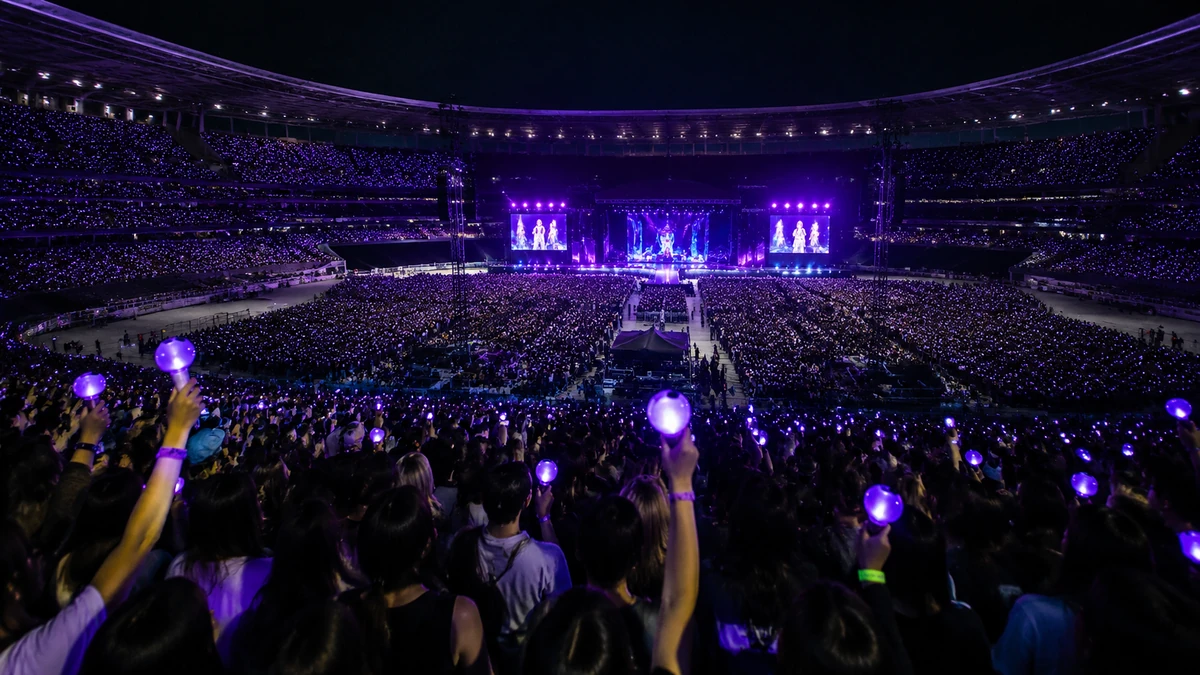
A stadium-scale return more than a decade in the making
BTS returned to Mexico City for a full-group concert run for the first time in nearly 11 years, and the response was the kind of turnout most touring acts in the world would envy. Across three shows held on May 7 and May 9-10 local time in the Mexican capital, the South Korean supergroup drew a combined 150,000 fans, according to South Korean media reports citing Yonhap News Agency. The concerts were part of the group’s world tour, titled “Arirang,” and all three dates sold out as soon as tickets went on sale.
On paper, those numbers tell a familiar BTS story: a globally dominant act filling massive venues across continents. But the Mexico City shows suggest something bigger than raw box office power. They offered a window into what K-pop looks like in its current, more mature phase — not simply a Korean export that travels well, but a pop phenomenon that increasingly succeeds by making room for the local culture of the places it visits.
That distinction matters. In the United States, audiences are used to major pop tours moving like traveling franchises, with largely identical sets from city to city and only minor variations in banter. There is efficiency in that model, and for many artists it works. But BTS’ Mexico City run appears to have leaned into a different strategy: preserving the scale and polish of a global pop spectacle while making fans in one specific city feel recognized, named and understood.
That is part of what makes the group’s return to Mexico so notable. A long gap can be unforgiving in pop music. Fans age, trends change, algorithms shift and competition multiplies. Even for megastars, a market can cool if it is left unattended for too long. Yet BTS came back to one of Latin America’s most symbolically important concert cities and drew the sort of crowd that signals not nostalgia, but continuity. The turnout was not merely an echo of old popularity. It was evidence that the group’s connection with Spanish-speaking audiences remains current, active and deeply organized.
For American readers, it may be tempting to read the story only through the lens of celebrity scale: another giant BTS crowd, another international triumph. But the more revealing angle is how that crowd was sustained. K-pop’s globalization is no longer just a question of whether acts can break through abroad. The more interesting question is how they keep those relationships alive over time, especially in regions outside the industry’s usual U.S.-Europe axis. In Mexico City, BTS appears to have answered that question with unusual precision.
Why Mexico City matters in the global pop map
Mexico City is not just another stop on an international tour. It is one of the largest urban centers in the world, one of the most important live entertainment hubs in the Spanish-speaking market and a city whose audiences have long helped define what counts as a genuine Latin American breakthrough. For artists from the United States, selling out in Mexico City can be a sign that they have moved beyond crossover novelty and into durable regional relevance. The same logic increasingly applies to artists arriving from Asia.
That makes BTS’ success there significant well beyond one weekend of sold-out shows. In practical terms, Mexico offers access to a large and passionate fan base with strong ties to the broader Latin American cultural sphere. Symbolically, it is a proving ground. If a global act can create real emotional resonance in Mexico City, it often means that act is not simply circulating through the region, but becoming part of its popular culture conversation.
That is especially true for a group like BTS, whose success has often been discussed in the United States through a narrow set of milestones: Billboard rankings, stadium dates in Los Angeles, Grammy appearances or record-breaking streaming numbers. Those markers are meaningful, but they can obscure a larger reality. BTS’ influence has never been confined to English-language markets, and some of the clearest evidence of the group’s global staying power has emerged in places where fandom functions as a deeply communal, multilingual and transnational force.
Mexico City also carries weight because it is a place where public space, identity and spectacle often overlap in memorable ways. The group reportedly referenced the Zocalo, the city’s historic central square and one of the most recognizable civic spaces in Latin America, in remarks to the audience. That kind of reference is not trivial. For someone unfamiliar with the city, it may sound like a routine shoutout. But calling out the Zocalo is more like an artist performing in New York and invoking Times Square, or in Washington and mentioning the National Mall — it signals that they understand the symbolic geography of the place they are in.
For K-pop, that kind of awareness matters more than ever. The genre’s global rise was built initially on digital access, tightly choreographed performance and fandom culture that could transcend language barriers. But as the industry matures internationally, fans increasingly expect more than polished replication. They want acknowledgment that their city is not interchangeable with every other stop on the tour. Mexico City, with its scale and cultural confidence, is exactly the sort of place where that expectation becomes impossible to ignore.
The small details that turned a concert into a conversation
Much of the reporting around the Mexico City concerts focused not only on attendance, but on the way BTS localized the performances. That phrase — “localized the performance” — can sound corporate in English, as if it belongs in a marketing deck. In practice, what it seems to have meant here was simpler and more human: the group integrated Mexican references in ways that made the crowd feel seen rather than pandered to.
One widely noted example involved “Airplane pt.2,” a song that includes the lyric, “We goin’ from Mexico City.” Performing that track in Mexico City gave the line a different charge than it would have elsewhere. Pop songs often take on new meaning depending on where they are sung. In the same way Bruce Springsteen invoking a hometown can electrify a local crowd, or Taylor Swift altering a set list can make fans feel singled out, BTS’ use of a song that directly names the city appears to have turned geography into part of the emotional architecture of the night.
There was also a visual gesture that resonated locally: during the performance of “Aliens,” dancers appeared wearing masks inspired by lucha libre, the high-flying Mexican professional wrestling tradition that is as much a cultural symbol as a sport. For Americans unfamiliar with the reference, lucha libre occupies a place in Mexico somewhat akin to the status wrestling has held at various times in the U.S., but with a distinct iconography of masks, theatrical personas and generational folklore. Using lucha libre imagery onstage can go wrong if it is treated as costume shorthand or exotic decoration. What appears to have made the moment land was that the masks were integrated into the visual language of the performance rather than deployed as a cheap prop.
Even smaller moments mattered. One member, V, was reported to have picked up a local snack called banderilla during a performance of “Idol.” For non-Korean and non-Mexican readers, this may sound almost absurdly minor. But live concerts are often remembered not only for the fireworks, the video walls or the setlist climaxes. They are remembered for flashes of spontaneity that make a giant production feel immediate. A major star casually engaging with a familiar local street-food item can become the kind of detail fans carry home because it collapses the distance between spectacle and everyday life.
The group also addressed the audience in Spanish and told fans they would return. In global pop, using the local language is no longer rare. Plenty of touring stars memorize a greeting or a thank-you. The difference is usually in specificity. Generic phrases can feel transactional. Specific references — to a city, a landmark, a shared moment, a local emotion — tend to register as sincere. That, in essence, was the thread running through the Mexico City shows: not reinvention, but recognition.
What BTS is showing about K-pop’s next phase
To understand why this matters beyond one group, it helps to place the concerts in the broader arc of K-pop’s international growth. For years, stories about Korean pop in American media often began with novelty: the viral surprise of Psy’s “Gangnam Style,” the flashy unfamiliarity of idol training systems or the social media intensity of fandoms. Those stories were not wrong, but they belonged to an earlier stage of the global conversation, when K-pop was still routinely introduced as a curiosity or a phenomenon in need of explanation.
That is no longer enough. K-pop today is part of the mainstream international music economy. It commands chart attention, brand partnerships, arena and stadium infrastructure, fan-organized buying power and a transnational media ecosystem that functions around the clock. The real question now is not whether K-pop can travel. It is what kind of cultural relationship it builds when it arrives.
BTS’ Mexico City concerts offer one answer. The performances suggest that K-pop’s current edge lies not simply in synchronized choreography or loyal fandoms, but in a flexible touring model that can preserve a group’s core identity while allowing space for local adaptation. This is not the same as changing the music to fit every market. It is closer to what savvy political campaigns, sports franchises and legacy entertainers in the U.S. have long understood: people respond when they feel a national or global institution has taken the time to understand the local stakes.
In that sense, localization is not dilution. It is respect. The music remains BTS. The performance scale remains unmistakably K-pop. But the frame around the show shifts just enough to make the audience feel like participants rather than passive recipients of a prepackaged export. That may be one reason the genre has proved more durable than many skeptics predicted. It is no longer built solely on aspiration — the dream of reaching global audiences — but on a more complicated and sustainable form of exchange.
This is where the Mexico City story intersects with a larger trend in global entertainment. Streaming flattened access to content, but it also raised expectations for relevance. Viewers and listeners anywhere in the world can consume nearly everything now. What they increasingly value, then, is not mere availability but reciprocity — signs that cultural products can reflect them back. BTS’ reported choices in Mexico City, from language to imagery to food to song selection, fit squarely within that expectation.
The importance of the long gap — and why the sellouts matter
The nearly 11-year gap since BTS last held a team concert in Mexico gives the story its deeper tension. Long absences can produce pent-up demand, but they can also expose whether a fan base has thinned or whether a cultural wave has passed its peak. In a music landscape reshaped constantly by TikTok virality, streaming churn and new idol debuts, sustained anticipation over that kind of time span is difficult to achieve.
That all three Mexico City shows sold out immediately suggests the demand was not passive or nostalgic. Fans were not just happy the group had returned; they were ready. In practical terms, instant sellouts show organizational strength within fandom, purchasing urgency and confidence from promoters that a multi-night run could be supported at scale. In symbolic terms, they show that absence did not erode relevance.
That is no small feat. American pop history is filled with artists who could once dominate internationally but found that time away from a market changed the equation. A return date can generate headlines, but it does not guarantee renewed heat. What BTS demonstrated in Mexico City was something harder: the ability to convert a long silence into a fresh event, not merely a reunion lap.
The distinction matters because fans themselves change over a decade. Some who saw the group in 2015 may now be older professionals with more spending power. Others may be newer fans who discovered BTS through streaming, social media clips or the group’s wider global visibility during the years when no Mexico team concert was taking place. When a three-night run still draws 150,000 people after that kind of demographic turnover, it signals a fandom capable of reproducing itself across generations.
From the perspective of the live music business, that kind of longevity is gold. Touring has become the central revenue engine for many artists in an era when recorded music economics remain volatile. But touring success is increasingly shaped by trust — fans need to believe the event is worth the cost, the travel, the online scramble for tickets and the emotional investment. BTS’ Mexico City turnout indicates that this trust remains exceptionally high, even after a long gap and in a market sophisticated enough to distinguish hype from commitment.
Why American readers should pay attention
For audiences in the United States, it is easy to focus on K-pop only when it intersects directly with American institutions — the Hot 100, Coachella, late-night TV, brand campaigns or awards shows. But that framework can be limiting. It treats the U.S. as the default stage on which global relevance is validated, when in fact some of the most revealing developments in pop are taking place in connections that do not pass through American gatekeepers at all.
BTS’ Mexico City concerts are one of those developments. They show a South Korean act operating at the highest level in a major Latin American capital, not as a novelty import but as an artist capable of building a culturally literate live experience for tens of thousands of Spanish-speaking fans. That says something important about where global pop power now sits and how it moves.
It also complicates the old narrative that K-pop’s rise was powered mainly by one-off virality or fan labor online. Those forces were important, and still are. But what the Mexico City shows demonstrate is infrastructure: a stable transnational fandom, a touring strategy calibrated to local meaning and a performance language sophisticated enough to make a giant event feel personal. In American terms, it is the difference between being famous on the internet and having the kind of durable live draw that can fill arenas and stadiums year after year.
There is also a broader cultural lesson here. The most successful global entertainment no longer behaves as if scale alone is enough. Whether in film, sports, streaming or music, the winners are increasingly those who can move fluidly between the universal and the local. They offer a recognizable core product, but they also signal that they understand the place they are in. BTS’ Mexico City run appears to have done exactly that.
That may be why the concerts feel less like a repeat of an old K-pop success story and more like a marker of where the genre is heading. The future is not just bigger crowds, more markets or more chart records. It is a more relational kind of globalism — one in which artists do not simply arrive, perform and leave, but build the show so audiences can recognize themselves inside it. In Mexico City, before 150,000 people, BTS offered a vivid example of what that looks like now.


0 Comments