Bus-Car Pileup on South Korea’s Main Expressway Injures 5, Underscoring the Strain on Seoul-Area Traffic
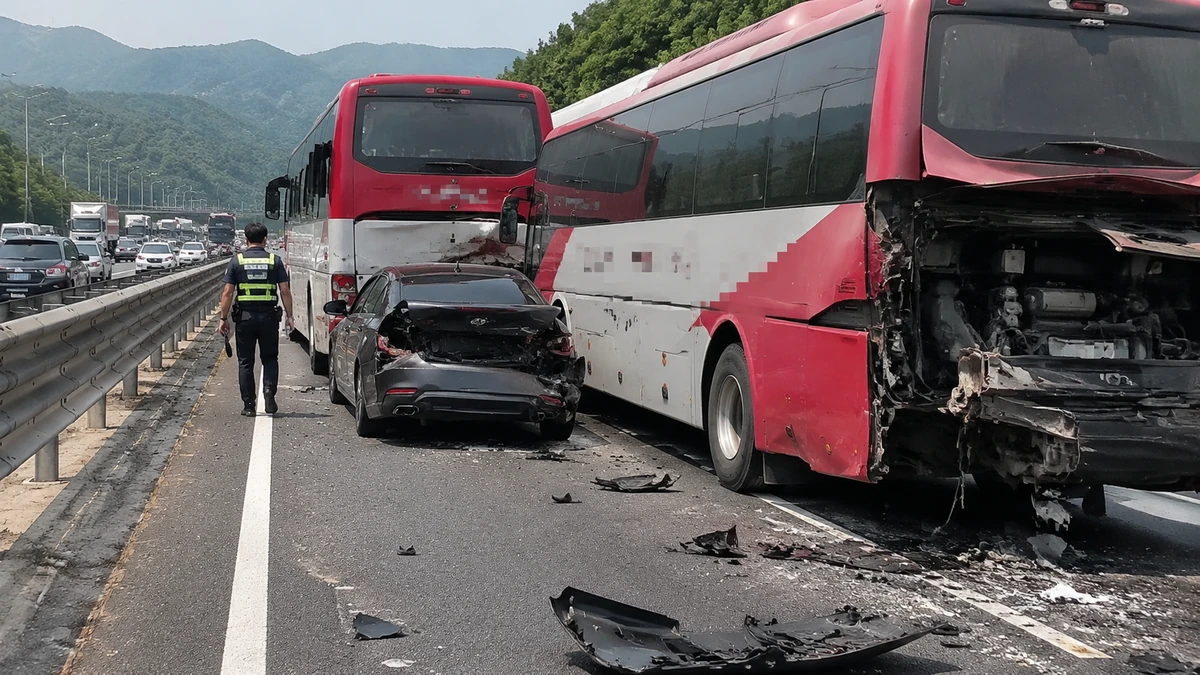
A midday crash on one of South Korea’s busiest roads
A three-vehicle pileup involving two buses and a passenger car injured five people Tuesday on the Gyeongbu Expressway, one of South Korea’s most important highways, in an accident that briefly disrupted traffic heading into Seoul and highlighted the fragility of transportation networks in one of the world’s most densely connected metropolitan regions.
The crash happened at about 12:45 p.m. near the Jukjeon rest area in Yongin, a large city just south of Seoul, according to South Korean authorities as cited by Yonhap News Agency. Police said the collision involved two buses and a Hyundai Sonata sedan traveling in the Seoul-bound direction of the expressway.
Five people suffered minor injuries and were taken to hospitals, officials said. About 30 passengers were on board the two buses at the time of the crash. Police temporarily shut down the first and second lanes of the five-lane roadway for roughly an hour while crews responded, cleared damaged vehicles and worked to prevent a secondary accident. Traffic backed up for about 2 kilometers, or roughly 1.2 miles.
On paper, the numbers may sound limited by the standards of major highway disasters: three vehicles, five injuries, a partial closure lasting about an hour. But in South Korea, where expressways serve as vital arteries linking the Seoul metropolitan area with the rest of the country, even a relatively modest crash can quickly become a significant public-safety and traffic-management event.
For American readers, the closest comparison may be a chain-reaction collision on Interstate 95 outside New York or on Interstate 5 approaching Los Angeles at a busy midday hour. The incident itself may not be catastrophic, but the location matters. When a crash occurs on a road that functions as a central economic and commuter corridor, the ripple effects can spread far beyond the scene.
That is especially true on the Gyeongbu Expressway, the backbone of South Korea’s highway system. Running broadly north-south and connecting Seoul with major cities including Daejeon, Daegu and Busan, the route has long been more than just a road. It is part transportation corridor, part symbol of the country’s industrial development, similar in national importance to the role the interstate system has played in the United States since the postwar era.
How the crash unfolded
Authorities said the accident began when the Sonata, which had been traveling in the second lane, encountered congestion ahead and changed into the first lane, a bus-priority lane in that section of the expressway. After that maneuver, a route bus and then an intercity bus struck the rear of the vehicles ahead, producing a three-way collision.
Based on the information released so far, the sequence appears to reflect a familiar and dangerous highway scenario: traffic moving at a relatively steady pace suddenly compresses, a driver reacts to slowing or stopped vehicles ahead, and larger vehicles approaching from behind have limited time and distance to stop. On any freeway, that combination can turn a split-second judgment into a multivehicle crash.
There is an added element here that American readers may not immediately recognize. In South Korea, certain lanes on major roadways are reserved for buses during designated stretches or times, especially in and around high-volume corridors serving the capital region. The purpose is to improve the speed and reliability of public transportation in a metropolitan area where buses carry huge numbers of commuters and intercity travelers each day. A lane reserved for buses functions somewhat like a high-occupancy or transit-priority lane in parts of the United States, though the Korean system is often more deeply integrated into everyday traffic operations.
That context matters because lane changes into bus-priority lanes can create particular hazards when traffic conditions shift quickly. Buses are larger, heavier and require more distance to brake than passenger cars. When a sedan moves into that space in response to sudden congestion, the margin for error can shrink almost instantly, especially if a following bus is already committed to its line of travel.
Police have described the physical sequence of the collision, but the available information does not establish legal responsibility or final fault. That distinction is important. Early traffic reporting often focuses on what happened rather than who, if anyone, will ultimately be found negligent under the law. Investigators will typically consider vehicle spacing, speed, lane position, reaction time and other roadway conditions before reaching more formal conclusions.
For now, what is clear is that the crash was a classic chain-reaction event on a road where traffic flow can change fast and where the mix of private cars, scheduled buses, long-distance travel and rest-area merging traffic creates an especially complex driving environment.
Why the location matters more than it might seem
The site of the crash, near the Jukjeon rest area, is not just another patch of pavement on the way into Seoul. In South Korea, rest areas are a prominent feature of expressway culture. Unlike the often utilitarian highway service plazas familiar to many Americans, Korean rest stops are frequently busy mini-hubs, offering food courts, convenience stores, coffee shops and quick breaks for families, truckers, commuters and bus passengers. They are part of the rhythm of long-distance road travel.
That means the roadway near a rest area is often affected by a blend of traffic types: vehicles re-entering the expressway, buses maintaining schedules, private drivers adjusting routes and travelers navigating congestion as they approach the capital region. It is a setting where the transition from smooth movement to sudden backup can happen with little warning.
Yongin, where the crash occurred, sits within the broader Seoul metropolitan area, one of the largest urban concentrations in the world. The region’s transportation system is highly developed and, much of the time, remarkably efficient. But that efficiency depends on constant flow. When one or two lanes are blocked on a major Seoul-bound route, the disruption can build rapidly because the system is already operating under persistent demand.
The fact that this happened around midday is also notable. In many American cities, people tend to associate severe traffic snarls with the morning and evening commute. In greater Seoul, heavy traffic is hardly confined to rush hour. Commercial deliveries, intercity bus operations, private vehicle use and steady daytime movement all place pressure on major roadways. A noon-time crash, then, is not an off-hour anomaly; it is a reminder that urban congestion in advanced metropolitan corridors is often a full-day reality.
That helps explain why a closure affecting just two lanes produced a visible queue stretching roughly 2 kilometers behind the crash site. The backup was not simply the result of damaged vehicles on the road. It reflected the tight coupling of mobility demand in and around Seoul, where a single incident can expose the limits of even a modern, high-capacity highway network.
For global audiences, that may be one of the story’s more recognizable dimensions. Whether in Seoul, Washington, Atlanta or London, dense metropolitan regions share a common vulnerability: transportation systems engineered for efficiency can become surprisingly brittle when something interrupts the flow. The faster and more interconnected the movement, the less room there is for mistakes.
Minor injuries, but wider public concern
Officials said the five injured people complained of minor injuries. In the language of traffic reporting, that often signals the absence of life-threatening trauma. It also suggests that, in relative terms, the crash could have been much worse. Given that buses were involved and dozens of passengers were aboard, the fact that only five people were taken to hospitals appears, at least from the initial facts, to be a fortunate outcome.
Still, “minor injuries” can be misleading if read too casually. In public transportation incidents, even relatively limited physical injuries carry broader consequences. Passengers may experience lingering soreness, anxiety or disruption to work and travel plans. For people on scheduled route buses or intercity coaches, a crash can mean missed appointments, delayed returns home or a shaken sense of security in a transportation mode they use because it is supposed to be dependable.
That broader social dimension is especially significant in South Korea, where buses play a central role in daily life. City buses, regional buses and intercity coaches are not niche services. They are mainstream transportation used by office workers, students, older adults and travelers moving between cities. In that sense, a bus crash is not merely a story about vehicles colliding. It is a story about public infrastructure, routine mobility and the trust people place in shared transportation.
The involvement of both a route bus and an intercity bus deepens that point. A route bus typically serves local or metropolitan transit needs, while an intercity bus connects destinations over longer distances, somewhat analogous to a commuter coach or regional bus service in the United States. When both types are caught in the same collision, the impact reaches across multiple layers of the transit system at once.
That is one reason crashes involving buses often draw attention beyond the immediate injury count. They raise questions not just about the moment of impact, but about roadway design, traffic enforcement, operator training, lane discipline and how governments manage public confidence after incidents that affect shared transport.
None of that means this particular crash should be overstated. It was not a mass-casualty event, and the currently available facts do not suggest an infrastructure collapse or a broader emergency. But the public sensitivity surrounding bus-related crashes is real, because the people affected are not just drivers making private decisions behind the wheel. They are passengers who entrusted their safety to a system.
Police response and the risk of a second crash
After the collision, police blocked the first and second lanes of the five-lane expressway for about an hour, according to the reported account. That response may sound routine, but on a high-speed roadway, it is one of the most important tools authorities have to keep a bad situation from getting worse.
Traffic safety experts often emphasize that the first crash is only part of the danger on a freeway. Secondary collisions can occur when approaching drivers fail to recognize stopped traffic or emergency activity ahead. In fast-moving traffic, especially around curves, lane merges or congestion points, drivers may not have enough time to react unless authorities quickly secure space around the crash scene.
In this case, the lane closures likely served several purposes at once: allowing emergency personnel to check for injuries, creating room to move damaged vehicles, protecting first responders on foot and warning approaching drivers that normal flow had been interrupted. For the public stuck in backup, such closures can be frustrating. But from a safety standpoint, they are often the difference between a contained incident and a widening chain reaction.
The crash also illustrates how modern traffic management is about more than asphalt and signage. It depends on real-time response: police officers directing vehicles, emergency crews assessing injuries, tow operators clearing lanes and public agencies communicating changing road conditions. In a country like South Korea, which is known for advanced infrastructure and dense urban coordination, those human-response systems are a crucial part of keeping road networks functional under stress.
Americans may recognize the same dynamic from large interstate accidents at home. A crash scene is not resolved the moment the ambulance arrives. It is resolved only when the immediate hazard is controlled, the vehicles are cleared and the surrounding traffic is stabilized enough to resume without triggering another impact.
That appears to have been the priority here. Even with only minor injuries reported, the response was aimed at restoring order on a major corridor while preventing a second collision involving vehicles approaching the scene from behind.
A familiar problem in a highly connected society
At one level, Tuesday’s crash is a straightforward local traffic story: a sedan changed lanes near slowing traffic, two buses struck from behind, five people suffered minor injuries and traffic backed up on the approach to Seoul. At another level, it speaks to a larger reality about life in a high-density, high-mobility society.
South Korea is often described abroad through the lens of its technology, exports and pop culture — K-pop, Korean film, beauty brands and global electronics. But the country’s day-to-day reality is also shaped by something more prosaic and universal: the challenge of moving large numbers of people safely and efficiently through compressed urban spaces.
The Seoul capital area, home to a substantial share of the nation’s population, depends on a tightly layered transportation web of subways, buses, expressways and regional links. That network enables extraordinary mobility. It also means that small disruptions can generate outsized consequences. A single lane change at the wrong moment, near the wrong bottleneck, can become a reminder of how little slack exists in a system built for constant motion.
There is an irony in that. The more advanced and efficient a transportation system becomes, the more people rely on it, and the harder it can be to absorb sudden shocks. That is not a uniquely Korean problem. It is the common condition of modern metropolitan life, from East Asia to North America.
What makes the Korean case especially instructive is the way private driving and public transit share the same pressured corridors. The accident near Jukjeon brought together an ordinary passenger sedan, a local route bus, an intercity coach, a bus-priority lane, a rest-area zone and a Seoul-bound bottleneck — all within a matter of seconds. In that sense, it was not just a random mishap. It was a collision shaped by the structure of the road itself and the intensity of the region it serves.
There is no need to force a sweeping moral from a single crash. But the incident does reinforce several durable lessons: sudden congestion is one of the most dangerous conditions on a highway; lane changes in heavy traffic carry risks that increase dramatically when large vehicles are involved; and prompt traffic control can be as important as medical response in limiting the scope of harm.
For South Korea, the crash is another small but telling case study in the everyday pressures facing a sophisticated transportation network. For American readers, it offers a recognizable scene in a different national setting: a crucial highway, a few split-second decisions, a short closure that snarls traffic, and a reminder that modern mobility remains vulnerable to human timing and human error.
As investigators continue reviewing the circumstances, the known facts remain relatively contained. No deaths were reported. The injuries were minor. Traffic eventually resumed. Yet the event still matters, because in a region as interconnected as greater Seoul, even a limited accident can reveal the thin line between orderly movement and sudden gridlock. That, perhaps more than the injury count alone, is why this kind of roadway crash draws attention in South Korea — and why it feels immediately understandable far beyond its borders.
Comments
Post a Comment