Explosion Aboard Korean-Operated Vessel in Strait of Hormuz Becomes a Test of Seoul’s Crisis Diplomacy
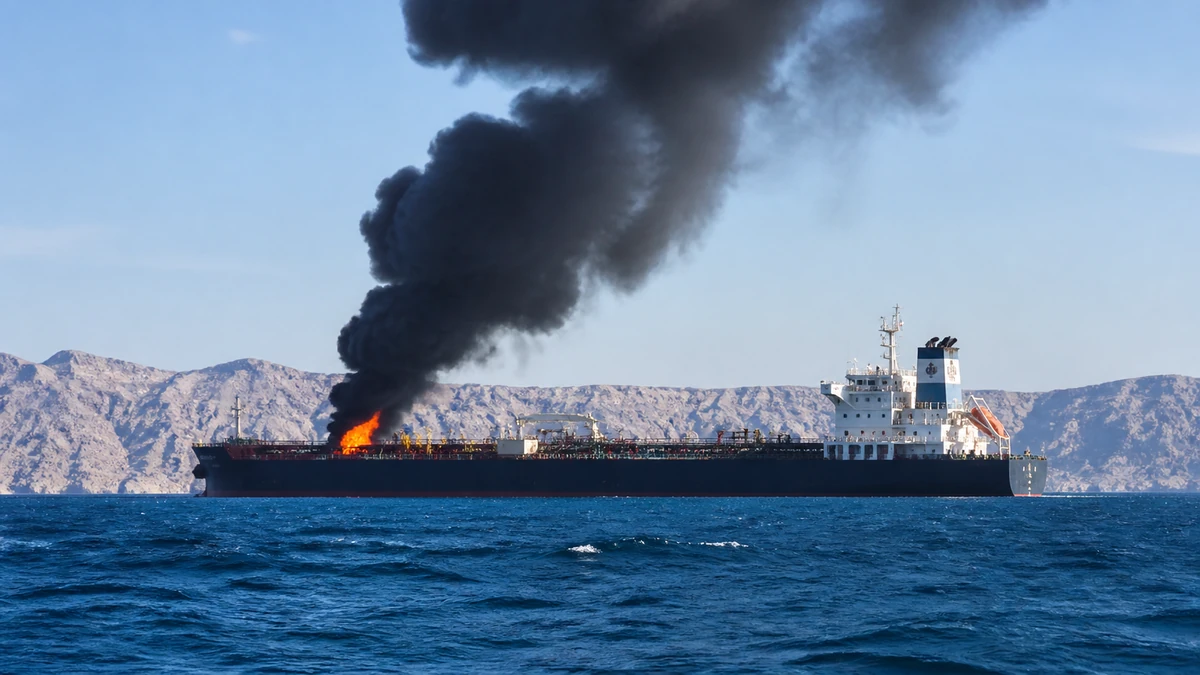
A shipboard explosion in one of the world’s most sensitive waterways
An explosion and fire aboard a Korean-operated vessel near the Strait of Hormuz has quickly grown from a maritime accident into a diplomatic test for South Korea, underscoring how a single incident at sea can ripple far beyond shipping lanes and into the realm of foreign policy, crew protection and regional security.
According to South Korean authorities, the blast occurred around 8:40 p.m. local time on Aug. 4 aboard the Namu, a vessel operated by HMM, the South Korean shipping company formerly known as Hyundai Merchant Marine. Officials said there were no immediate reports of casualties, but they have not yet determined the cause of the explosion or whether the vessel was struck from outside. That uncertainty is central to the story.
The ship was in waters near the United Arab Emirates, on the inner side of the Strait of Hormuz, and South Korean officials said it had been effectively stuck there under Iranian control of the surrounding area. That detail sharply raises the stakes. A fire at sea is always serious. A fire at sea in or near a choke point long associated with geopolitical tension is something else entirely.
For American readers, the Strait of Hormuz is best understood as one of the world’s most strategically important maritime bottlenecks — a narrow passage between the Persian Gulf and the Gulf of Oman through which a significant share of the world’s oil and gas exports move. It is the kind of place where shipping accidents, military miscalculations and diplomatic friction can collide. When trouble happens there, governments pay attention not only because of the vessel involved, but because of what the incident might signal about broader regional stability.
That is why South Korea is treating the case not as a closed shipping mishap, but as an active diplomatic matter. Seoul’s Foreign Ministry has emphasized that it is working to verify the facts, communicate closely with relevant countries and secure safety measures for both the vessel and its crew. In the careful language of diplomacy, that amounts to saying the government does not yet know enough to label the incident — and knows better than to move too fast.
Why this matters far beyond one ship
At first glance, an explosion aboard a ship operated by a private company might seem like a matter for marine investigators, insurers and the company’s crisis team. But the circumstances here make that reading too narrow. The vessel may not fly the South Korean flag — it is registered in Panama — but it is operated by a major South Korean shipping firm, and six South Korean nationals were among the 24 people on board. The other 18 crew members were foreign nationals.
That mix of facts places the South Korean government in a familiar but delicate position. Modern global shipping often involves ships registered in one country, owned in another, managed from somewhere else and staffed by multinational crews. This system, common across the industry, is legal and routine, but it can complicate responsibility when something goes wrong. In a crisis, formal flag-state rules do not erase the public expectation that a government should protect its citizens and support nationally important companies operating abroad.
In South Korea’s case, the pressure is especially acute because the country is deeply dependent on maritime trade. Like Japan, and in some respects like an island economy despite being attached to the Asian mainland, South Korea relies heavily on uninterrupted sea routes for energy imports, industrial supply chains and exports. A threat to shipping is never just about one company’s balance sheet. It can touch national economic security, foreign policy credibility and public confidence in the state’s ability to respond.
That is one reason the story has taken on political significance in Seoul. The government is not only being asked to determine what happened. It is also being judged on how it handles uncertainty. Does it protect the crew? Does it coordinate with other governments without inflaming the situation? Does it give the public enough information to maintain trust while avoiding premature claims that could backfire diplomatically? Those are the kinds of questions that turn a maritime emergency into a measure of statecraft.
For Americans, there is a recognizable parallel in the way U.S. administrations respond when commercial aircraft incidents, energy disruptions or attacks on American-linked vessels overseas suddenly become matters of national diplomacy. The legal details may differ, but the logic is familiar: once lives, strategic trade routes and regional tensions overlap, the incident stops being merely operational and becomes political.
The crucial unknown: accident, attack or something in between
The most important unresolved question is whether the explosion was the result of an onboard accident or an external strike. South Korean officials have been explicit that they are still confirming the facts, including whether the ship was hit. That restraint is not bureaucratic vagueness. It is a deliberate attempt to avoid assigning meaning before the evidence is clear.
In a region as sensitive as the waters around the Strait of Hormuz, words matter. Calling something an attack too early can trigger diplomatic escalation, affect financial markets and narrow the room for communication with countries that may control access to the vessel or surrounding waters. On the other hand, downplaying a potentially hostile act could expose a government to criticism that it failed to protect its nationals or recognize a broader threat.
That is why South Korea’s public messaging so far has focused on what is known: there was an explosion, there was a fire, there are no immediate reports of casualties, and the government is in close communication with relevant parties. Everything else remains under review.
In American news coverage, this kind of phrasing can sound cautious to the point of frustration, especially to readers accustomed to real-time analysis and definitive takes. But in diplomatic crises, uncertainty is not a side note. It is often the story. Governments are not simply gathering facts; they are managing the consequences of whatever those facts turn out to be. A mechanical failure would point toward one set of next steps involving technical investigation and shipping safety. An external strike, by contrast, would raise questions about maritime security, deterrence and the conduct of regional actors.
There is also a middle ground that officials cannot ignore: an incident that may not fit neatly into either category at first. Fires and explosions aboard ships can stem from engine problems, fuel systems, cargo issues or accidental ignition. In tense waters, however, even a seemingly ordinary accident can be interpreted through a political lens. The challenge for Seoul is to avoid letting the location dictate the conclusion before investigators have enough evidence to support it.
That balancing act is visible in the Foreign Ministry’s language. Officials have acknowledged the seriousness of the event without characterizing it beyond what can be verified. It is a classic crisis-management posture: protect the people first, preserve diplomatic space second and define the event only when the factual record is stronger.
A multinational crew and the broader duty of protection
One detail that deserves more attention is the composition of the crew. South Korean officials said six Koreans and 18 foreign nationals were aboard when the explosion happened. That matters because it highlights the deeply international nature of commercial shipping and expands the stakes beyond one country’s domestic politics.
In practical terms, it means the response cannot be limited to consular support for South Korean citizens alone. A Korean-operated vessel carrying a multinational crew becomes a test of how both the company and the government handle obligations in a global industry. Crew welfare, evacuation planning, medical support and ongoing communication all carry implications for South Korea’s international reputation.
That is not just a moral issue. It is also an economic and strategic one. Shipping operates on trust — trust that vessels are managed responsibly, that emergencies are handled competently and that states tied to those vessels can work effectively across borders. When something goes wrong aboard a ship linked to a major operator, the response is watched not only by the families of those on board, but by insurers, regulators, business partners and foreign governments.
For U.S. readers, it may help to think of the crew like the mixed-nationality workforce on an international airline or a large cargo carrier. An emergency involving Americans would trigger U.S. concern, but the same event would also draw in multiple governments whose citizens were on board. The burden on the company and the relevant state is not reduced by that complexity; it increases.
So far, the absence of reported casualties is an important point of relief. But no injuries does not mean no crisis. An explosion and fire aboard a vessel in a tightly controlled and politically sensitive maritime environment remains a high-risk event, especially if the ship is not free to simply depart the area or operate normally. Crew members may no longer face immediate flames, but they can still be exposed to uncertainty, stress and potential secondary dangers depending on the condition of the ship and the security environment around it.
That is why South Korea’s emphasis on safety measures is significant. It suggests the government sees this as an ongoing protection issue, not a one-night emergency that ended once the fire was contained. In crisis reporting, the public often focuses on the first dramatic moment. Governments, by contrast, have to deal with the aftermath: access, accountability, safe harbor, inspections, communications and the possibility of renewed danger.
Why the Strait of Hormuz changes the diplomatic equation
Location is not just background here. It is the reason the story has become diplomatically charged. The Strait of Hormuz is a narrow corridor through which huge volumes of global energy supplies move, making it one of the most monitored waterways on the planet. Iran, Gulf Arab states, the United States and other outside powers all view the area through a security lens. Commercial ships transiting or waiting nearby do not move through a purely civilian space. They operate in a region where military posture and political signaling are constant facts of life.
The summary provided by South Korean reporting adds a particularly sensitive element: the vessel was in a state of being stuck in the area under Iranian control. Even without going beyond the confirmed account, that alone makes the situation more complex than a routine port or anchorage incident. If a ship is stationary, constrained and operating in an environment shaped by political authority and regional tension, then an onboard explosion cannot be viewed in isolation from the conditions surrounding it.
That does not prove hostile action. But it does explain why Seoul cannot treat the event as a standard industrial accident until more is known. It must consider freedom of navigation, access to the crew, the legal and diplomatic status of the vessel’s position, and the possibility that any public statement could be interpreted as a message to one or more governments in the region.
For South Korea, this is a particularly delicate challenge. Seoul is a close U.S. ally, but it has generally approached Middle East issues with caution, prioritizing stability, energy security and pragmatic diplomacy over headline-grabbing declarations. That does not mean passivity. It means choosing measured language and practical coordination over public confrontation whenever possible, especially before the facts are fully established.
That approach can sometimes frustrate audiences who want sharper rhetoric. But it reflects a reality many middle powers face: when you have citizens and commercial interests exposed abroad, access often matters more than posture in the early hours of a crisis. If officials need to speak with local authorities, secure the crew’s safety or gain information from the scene, leaving room for diplomacy is not weakness. It is often the most functional form of leverage available.
The complication of flags, ownership and national responsibility
The Namu’s Panamanian registration may sound like a minor technical detail, but it illuminates a larger truth about the shipping industry. Ships are frequently registered under so-called flags of convenience, a system that allows them to operate under the laws and regulations of countries other than where the operating company is based. Panama is one of the best-known flag states in global shipping, alongside places such as Liberia and the Marshall Islands.
To many Americans outside the maritime world, that arrangement can seem strange. Why would a Korean-operated vessel be Panamanian? The short answer is that global shipping has long been structured around flexible registration systems tied to costs, regulations, taxation and operational convenience. It is standard industry practice, not evidence of anything improper by itself.
But in a crisis, the arrangement complicates the public understanding of who is responsible. Legally, the flag state has an important role. Politically and morally, however, the operating company’s home country often cannot step back. If South Korean nationals are on board and a major South Korean shipping company is involved, the expectation in Seoul will be that the government acts — and acts visibly.
This intersection of corporate globalization and national duty is one reason the incident has become such a revealing case. It shows how quickly the boundaries between private enterprise and public responsibility collapse when danger erupts overseas. A ship can be Panamanian on paper, Korean in management, multinational in crew and Middle Eastern in location, yet still become a domestic political issue in Seoul within hours.
That is not unique to South Korea. The same dynamic applies to many globally connected economies, including the United States. But for South Korea, where trade dependence is especially high and major conglomerates remain central to the national economy, the relationship between corporate exposure and government response is particularly visible.
What comes next for Seoul — and why the response will be watched closely
In the coming days, the key questions are likely to remain the same: What caused the explosion? Was there any external strike or hostile action? How secure are the crew and vessel now? And can South Korea manage the flow of information in a way that is both credible and diplomatically sustainable?
The challenge for officials is not simply to speak, but to speak in sequence. If too little is said for too long, uncertainty fills the gap and public trust can erode. If too much is said too quickly, and later turns out to be wrong, the diplomatic costs can be substantial. That tension between speed and accuracy is familiar in every national crisis, but it becomes sharper when an incident unfolds far from home, in a contested region and with multiple governments potentially involved.
South Korea’s early posture suggests it understands this. The focus has been on safety, communication with relevant countries and continued verification of the facts. That may not produce dramatic headlines, but it is often how competent crisis diplomacy looks at the beginning: careful, unspectacular and determined not to mistake speculation for evidence.
Still, the political stakes are real. If the cause points to an attack or externally caused damage, public pressure for a stronger response could grow. If the matter turns out to be an accident, questions may shift toward vessel safety, operating conditions and the circumstances that left the ship in such a precarious position. Either way, Seoul is unlikely to escape scrutiny.
For American and other English-speaking readers, the larger significance of this episode lies in what it reveals about South Korea’s place in the world. The country is often covered internationally through the lenses of North Korea, semiconductors, K-pop and major elections. But this incident highlights a different dimension: South Korea as a globally exposed trading power whose diplomacy must function far beyond East Asia.
A fire aboard a ship near the Strait of Hormuz may seem far removed from daily life in Seoul, New York or Los Angeles. In reality, it is a reminder of how deeply connected global commerce, regional security and state responsibility have become. One blast on one vessel can immediately raise questions about energy routes, international law, crew safety, government competence and geopolitical risk.
That is why this story matters. Not because the facts are all known yet, but because they are not. South Korea is now being tested not only on what happened to a ship, but on how a modern, trade-dependent democracy manages danger, uncertainty and diplomacy at the same time.
Comments
Post a Comment