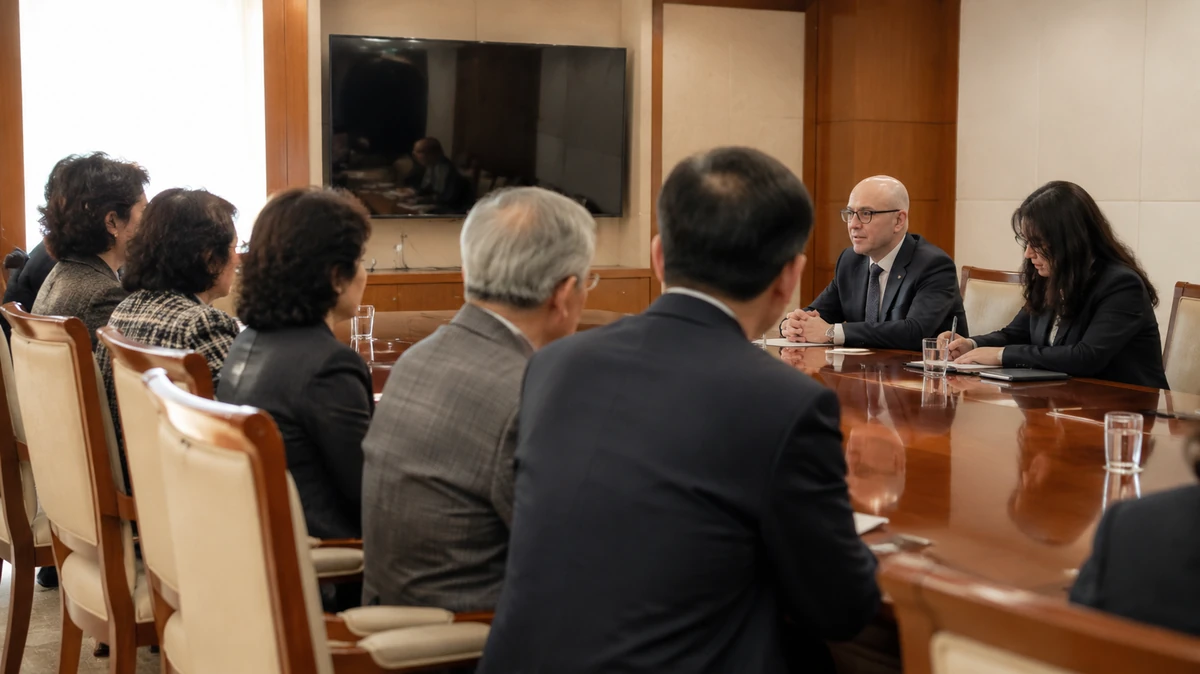
A Long-Unresolved Korean Tragedy Returns to the International Stage
For many Americans, the Korean Peninsula is most familiar as a place of missile tests, nuclear brinkmanship and summit diplomacy. The headlines tend to focus on presidents, generals and the latest cycle of threats between Washington, Seoul and Pyongyang. But on Thursday in Seoul, another side of the Korean story came into view: the private anguish of families who say their loved ones were abducted by North Korea, detained there for years without meaningful contact, or never allowed to come home after war.
Relatives of South Koreans who were kidnapped during the Korean War, families of South Korean prisoners of war, and relatives of current detainees in North Korea met privately with Volker Türk, the United Nations high commissioner for human rights, during his visit to South Korea. Their appeal was direct and morally unambiguous: Do not remain silent.
That phrase carries unusual force in the Korean context, where some wounds are so old they risk being treated as historical background rather than active human rights emergencies. For the families, this is not abstract diplomacy and not simply a chapter from the 1950-53 Korean War. It is an ongoing crisis measured in empty seats at family tables, birthdays missed across decades, and the most basic unanswered questions: Is this person alive? Can they communicate? Will they ever come home?
The meeting itself was closed to the public, but its significance extends well beyond one room in Seoul. It represented an effort by South Korean families to move their cause out of the realm of quiet mourning and into the formal language of international human rights. Rather than relying only on emotional testimony, the groups handed Türk written letters laying out specific demands, including confirmation of life status, permission for family contact and immediate release for those still being held.
In a world where human rights crises compete constantly for international attention, that act matters. It signals that these families are asking not merely for sympathy but for documentation, prioritization and intervention. They want the United Nations and the broader international community to treat the issue not as a sentimental appeal from grieving relatives, but as a recordable, actionable and ongoing violation of basic human dignity.
Why Three Different Family Groups Appeared Together
The unusual power of Thursday’s meeting came in part from who showed up together. Three separate organizations joined the private session: a group representing families of civilians abducted during the Korean War, a group representing families of South Korean prisoners of war, and a group representing families of South Korean citizens currently detained in North Korea.
On paper, these are different categories separated by time, circumstance and legal framing. One traces back to the chaos of the early 1950s, when North Korean forces are believed to have taken thousands of South Koreans to the North during the war. Another concerns South Korean soldiers captured during that same conflict and, according to family members and activists, never properly repatriated even after the 1953 armistice halted the fighting. The third is more contemporary and includes South Koreans detained in North Korea in recent years, among them Christian missionaries and others accused by Pyongyang of hostile acts.
But for the families, the distinctions only go so far. Their common experience is separation prolonged by the state power of one of the world’s most closed and repressive governments. Their shared grievance is that ordinary rights most people take for granted — knowing whether a loved one is alive, exchanging letters, making a phone call, securing release after detention, recovering remains after death — have been suspended for years or generations.
That is why their joint appearance mattered. By standing together while still submitting separate letters, the groups made two arguments at once. First, these are not isolated cases that can be dismissed as one-off diplomatic complications. Second, the differences among the cases should not erase their common core: the denial of family unity and the refusal to provide transparency about human lives.
American readers may recognize something familiar in that strategy. Families affected by very different harms often band together when they believe the system responds only after patterns become impossible to ignore. That has been true in the United States in movements around hostages abroad, missing military personnel and victims of state violence. The Korean families are making a similar calculation. Alone, each story can be treated as tragic but exceptional. Together, they present a structural human rights issue that demands attention beyond the peninsula.
What “Do Not Stay Silent” Means in South Korea
The families’ appeal to “not stay silent” was not a throwaway slogan. It was a carefully chosen rebuke to years of delay, inertia and, in the view of many relatives, public fatigue.
Silence in this context means more than a lack of comment. It refers to the way unresolved suffering can be absorbed into the background noise of geopolitics. North Korea policy is often discussed through the language of deterrence, sanctions, denuclearization and alliance coordination. Those are real and urgent matters. But they can also eclipse the personal consequences of Pyongyang’s behavior, including the fate of those taken or held by the regime.
Silence also points inward, toward South Korean society itself. The families’ message is not only for the United Nations or foreign governments. It is a challenge to their own country: Have officials, civic leaders and the public spoken clearly enough about what these families actually need? Have they emphasized the concrete demands of relatives, or have they allowed the issue to be diluted into generic rhetoric about reconciliation and security?
There is a particular poignancy here for South Korea, a democracy that has achieved extraordinary prosperity, global cultural influence and political maturity while still living under the shadow of an unresolved war. The Korean War did not end with a peace treaty. Technically, the two Koreas remain at war, separated by the heavily fortified Demilitarized Zone. That unfinished conflict has shaped nearly every aspect of inter-Korean relations, including how issues like abductions, detainees and prisoners of war are discussed — and, just as importantly, how they are sometimes postponed.
For families, however, postponement is not neutral. Time is its own form of cruelty. Parents die without answers. Siblings age out of hope. Children who barely remember a missing father or uncle become senior citizens themselves. In that sense, “do not stay silent” is also a demand not to let time become an accomplice.
The families’ insistence on specific goals — proof of life, communication, immediate release — is an attempt to cut through that fog. Rather than arguing first about a grand political settlement, they are asking the international system to affirm a minimum standard of humanity. You do not need to resolve every security dispute on the peninsula to say that relatives deserve to know whether their loved ones are alive. You do not need a breakthrough in nuclear negotiations to say that detainees should be allowed contact with family. And you do not need ideological agreement to oppose indefinite detention without transparency.
The Case That Put a Human Face on the Appeal
Among those pressing the issue was Kim Jeong-sam, the brother of Kim Jung-wook, a South Korean missionary who has been detained in North Korea for more than a decade. Kim Jeong-sam reportedly urged Türk to prioritize the cases of three missionaries who have been held by the North for more than 11 years, calling for confirmation of whether they are alive, permission for family contact and their immediate release.
Those requests are striking partly because they are so basic. They do not ask first for a sweeping diplomatic concession. They begin with the essentials that underpin any meaningful human rights framework. Is the detainee living? Can the detainee communicate with family? Will the detainee be freed?
For American readers, the closest parallel may be the families of U.S. citizens wrongfully detained overseas, who often say the worst part is not only the captivity itself but the prolonged uncertainty. A government accusation, however questionable, at least creates a visible process. Total opacity creates a different kind of torment. It deprives families of facts, timelines and even the ability to advocate effectively because they do not know what condition their loved one is in or what leverage may exist.
North Korea is especially notorious for this opacity. The regime has long treated detainees, foreigners and domestic critics as instruments of state control. Information is tightly managed. Access is restricted. Independent verification is extremely difficult. In such an environment, even a simple confirmation that a person is alive becomes an urgent humanitarian demand.
The presence of missionaries in this story also requires cultural explanation for readers outside Korea. Christian missionaries have played an unusually visible role in South Korea’s modern history. South Korea is home to one of the world’s largest and most active Christian communities, and many South Korean churches support missionary work abroad, including humanitarian and religious outreach connected to China and the North Korean border region. In North Korea, however, missionary activity is treated as a profound political threat. The state regards independent religion not merely as belief but as a rival source of loyalty.
That means detainee cases involving missionaries sit at the intersection of religion, ideology, human rights and national security. Yet the families’ appeal seeks to cut through those layers. Whatever North Korea claims about these detainees, they argue, the minimum obligations remain: disclose their status, allow contact, release them.
Kim Jeong-sam’s request that the matter be elevated on the North Korean human rights agenda is especially important. In international institutions, issues do not move simply because they are morally compelling. They move when they are assigned priority. Human rights concerns are often acknowledged in broad terms, but unless a case is placed near the front of the agenda, momentum fades. The families understand this. They are not only asking the U.N. to care; they are asking it to rank this issue high enough that caring leads to action.
Why a Closed-Door Meeting Can Matter More Than a Public Event
To some outside observers, a private meeting may sound less consequential than a televised news conference or a dramatic public statement. In reality, closed-door sessions can be where the most meaningful human rights work begins.
Because the meeting in Seoul was not staged as a public spectacle, relatives had room to present their concerns in detail and in writing. That matters for several reasons. It allows officials such as the U.N. rights chief to receive not only a symbolic plea but a documentary record. It creates a paper trail. And it reduces the risk that a complex issue will be flattened into a single emotional image before the substantive requests are fully absorbed.
There is also a practical reason for privacy. Issues involving North Korea remain highly sensitive, touching on diplomacy, intelligence, domestic politics in South Korea and the safety of individuals still believed to be in the North. A quieter format can sometimes make it easier for families to speak candidly about the failures they have experienced and the steps they want international actors to take.
That does not mean private meetings are enough. Families of the missing and detained know better than anyone that closed rooms can also become places where urgency disappears. The significance of this meeting lies in whether it breaks a pattern rather than repeating one. If the letters handed to Türk enter the machinery of U.N. advocacy, reporting and pressure, the meeting may become an important marker. If not, it risks joining a long archive of dignified but unanswered appeals.
Still, the families’ approach reflects a sophisticated understanding of how international human rights systems work. Public demonstrations attract attention; written submissions create records. Testimony humanizes; documentation institutionalizes. The combination suggests these groups are trying to ensure their cause cannot be easily brushed aside as temporary outrage.
The Korean War Is Not Over for These Families
To understand why this issue still carries such emotional force in South Korea, Americans need to remember that the Korean War remains unfinished in more than a technical sense. The 1953 armistice stopped active combat but did not deliver closure. The peninsula was left divided, families were separated, and thousands of individual fates remained unresolved.
For many Americans, the Korean War is sometimes called the “Forgotten War,” overshadowed in public memory by World War II and Vietnam. In South Korea, it is anything but forgotten. It is woven into family histories, politics and geography. The war explains why millions of Koreans have relatives on the other side of the border, why the North-South divide is both ideological and intimate, and why questions of missing civilians and unreturned prisoners still resonate so deeply.
What makes Thursday’s meeting compelling is that it resists treating these cases as relics. The families are saying, in effect, that unresolved history is not past tense when its consequences are still active. If a family still does not know whether a loved one abducted in wartime ever lived out his life in the North, that is not only history. If a prisoner of war was never fully repatriated, that is not only history. If a missionary detained in the 2010s remains cut off from family, that is unmistakably present tense.
This distinction matters because governments often classify such issues according to diplomatic convenience. Some are filed under “legacy issues,” others under “security,” others under “humanitarian matters.” Families experience all of them as one reality: forced separation without accountability.
There is another reason the issue remains politically delicate in South Korea. Approaches to North Korea fluctuate depending on who is in power in Seoul. Progressive administrations have often placed greater emphasis on engagement and dialogue, while conservative governments have tended to stress deterrence, alliance strength and human rights abuses by the North. Families sometimes fear their cause will be instrumentalized in one political season and sidelined in another. Their appeal to the United Nations is, in part, an attempt to move the issue above the swings of domestic politics.
What the International Community Can Actually Do
Skeptics may reasonably ask what practical effect a meeting with the U.N. human rights chief can have on one of the most isolated governments in the world. It is a fair question. The United Nations cannot force North Korea to open prison doors on command, and the regime has a long record of deflecting criticism.
But international attention is not meaningless. Human rights advocacy works incrementally and often indirectly. It can elevate cases in official U.N. reporting, increase diplomatic pressure, inform sanctions discussions, support allied governments pressing the issue in bilateral talks and provide moral legitimacy to families who fear being ignored. In some hostage and detainee cases around the world, sustained external attention has helped keep people from disappearing completely into bureaucratic or political oblivion.
The families’ demands also align with principles that are globally recognizable, not culture-bound or ideologically niche. Confirmation of life status is a basic humanitarian issue. Family contact is a basic humanitarian issue. Release from arbitrary detention is a basic human rights issue. By centering these requests, the families increase the chances that international actors with different political agendas can still rally around core facts.
For the United States and other allies of South Korea, the challenge is whether these concerns will be treated as integral to North Korea policy or merely appended to it. Washington often frames North Korea primarily through the nuclear threat it poses to the United States and its allies. That focus is understandable. Yet the risk is that human rights concerns become secondary unless they are repeatedly reinserted into the conversation. The families who met Türk are insisting that the personal costs of North Korea’s conduct be kept visible.
There is also a broader lesson here for how democracies talk about authoritarian states. Security policy tends to operate at the level of missiles, troop deployments and deterrence doctrine. Human rights advocacy tends to operate at the level of names, faces and families. Effective policy requires both. One without the other either becomes cold strategy or powerless sentimentality. Thursday’s meeting was a reminder that behind every hard-security discussion about North Korea are individual lives suspended by state secrecy.
A Test of Whether the World Still Knows How to Listen
In the end, the families who met the U.N. rights chief in Seoul did not ask the world for a grand theory of Korean reconciliation. They asked for something much more elemental and, for that reason, much harder to dismiss. Tell the truth about the missing. Press for contact. Press for release. Refuse the comfort of silence.
That appeal lands at a moment when global attention is fragmented and compassion is constantly stretched. International institutions face war in Europe, conflict in the Middle East, democratic backsliding, refugee crises and mounting competition among major powers. In such an atmosphere, old cases can drift from urgency to obscurity. The danger is not only that injustice persists, but that it becomes normalized through repetition.
The families in Seoul were pushing back against that normalization. Their message was that endurance should not be mistaken for resolution. The fact that a family has carried grief for decades does not mean the grievance has become less valid. If anything, the persistence of the pain is evidence of how thoroughly the system has failed them.
For English-speaking readers far from the Korean Peninsula, this story is worth attention precisely because it is not only Korean. Its core questions are universal. What do families deserve from the international community when a state refuses even the most basic transparency? How long can the world ask relatives to wait before waiting becomes another form of abandonment? And what is the purpose of a human rights system if not to speak where power prefers silence?
The private meeting in Seoul is unlikely, by itself, to transform North Korea’s behavior overnight. The families who attended almost certainly know that. But they also know that every long struggle has turning points that do not look dramatic at first. Sometimes the crucial step is simply to force a durable record into existence, to make it harder for officials and institutions to say later that they did not know, did not hear or did not understand what was being asked of them.
What was asked in Seoul was simple enough for any reader, in any country, to grasp: Someone is missing. Someone is being held. Someone has not been allowed to return. Do not look away. Do not let procedure swallow urgency. Do not stay silent.
Comments
Post a Comment