
A memorial in a neighborhood park marks a new phase of grief
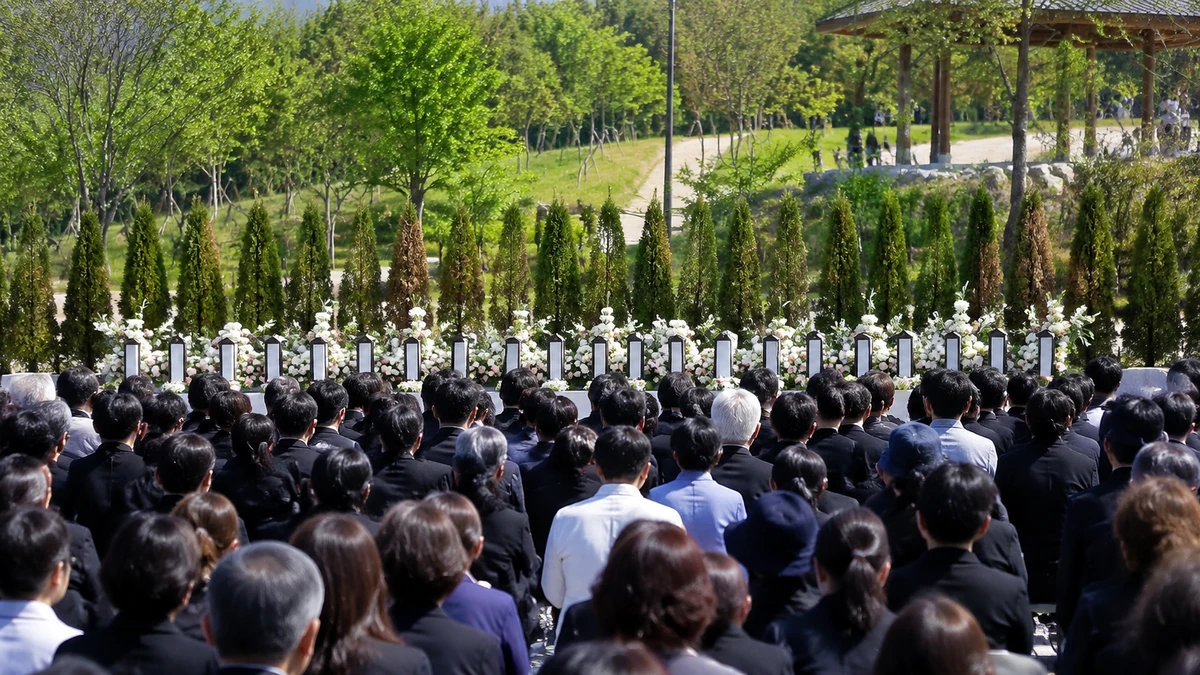
DAEJEON, South Korea — Fifty days after a fire tore through an auto parts factory in the central South Korean city of Daejeon, killing 14 people and injuring 60 others, families, officials and residents gathered Friday in a neighborhood park to mourn the dead and confront the long aftermath of an industrial disaster that has shaken the community.
The memorial ceremony, held at Munpyeong Park in Daejeon’s Daedeok district, came well after the initial emergency response, when firefighters, hospital workers and government officials were focused on rescue, treatment and identifying victims. In many countries, including the United States, public attention around workplace disasters often fades once the flames are out and the headlines move on. But the ceremony in Daejeon underscored something more enduring: For grieving families and co-workers, the hardest part often begins after the cameras leave.
According to South Korea’s Yonhap News Agency, the event was organized to share in the pain of bereaved relatives and honor workers killed in the blaze at Saeon Industrial, an auto parts manufacturer. The factory fire left a total of 74 casualties — a figure that includes both those who died and those who survived with injuries, some of whom are likely to face long recoveries, financial strain and trauma that may last for years.
The choice of venue gave the memorial added emotional force. Munpyeong Park is near the factory and is described as a familiar space for many of the victims — a place they may have passed on the way to work or visited for a break from long shifts. That detail matters. Rather than holding remembrance only inside a government building, the city and the national Ministry of the Interior and Safety moved a joint public mourning altar from Daejeon City Hall to the park earlier this week, bringing official grief into a setting tied to the rhythms of daily life.
In the United States, readers might think of a roadside cross near the site of a fatal crash, or a vigil in a school gymnasium after a mass tragedy — places that are not formally sacred, but become sacred because of what happened nearby and because of who returns there to remember. Munpyeong Park appears to have taken on that kind of role for this community.
Photos from the ceremony showed bereaved relatives weeping before memorial tablets for the dead. In Korean mourning traditions, memorial tablets bearing the names of those who died are often placed at altars where mourners bow, offer incense and pay respects. The ritual is both deeply personal and public. It is a way of saying that those lost are not merely part of a death toll, but individuals whose names, labor and lives deserve acknowledgment.
Why the location matters in South Korea’s culture of public mourning
To an American audience, a memorial altar being moved from city hall to a public park may sound like an administrative detail. In South Korea, it can carry broader meaning. Public mourning after a major accident frequently involves temporary altars, flowers, portrait displays and designated spaces where citizens can come to bow, leave messages or simply stand in silence. These sites are not only about private grief; they also represent the state’s recognition that a loss belongs to the wider public.
At first, city hall made sense as the site of a joint mourning altar. Government buildings in South Korea often become central places for official response after major accidents, whether the issue is a natural disaster, transportation accident or industrial tragedy. Such spaces communicate responsibility, visibility and the involvement of public institutions. They tell families: the state sees what has happened.
But moving the memorial to Munpyeong Park altered the emotional geography of mourning. The center of gravity shifted from a formal civic space to a lived-in neighborhood environment, one near the factory and connected to the workers’ routines. That move suggests an effort not only to continue official remembrance, but to place that remembrance closer to the victims’ actual lives. Instead of asking people to travel into an administrative building, authorities brought mourning into a space where the boundary between industry and ordinary life is thin.
That distinction helps explain why the ceremony resonates beyond a single day. Factories are often discussed in the language of production, supply chains and employment. Parks are places of rest, families and everyday movement. When a memorial is held in a park next to an industrial workplace, it becomes harder to keep those worlds separate. The workers are no longer abstractions in a report about labor conditions. They become neighbors, parents, commuters and people who once occupied the same physical spaces as everyone else.
South Korea has seen several major public tragedies over the past two decades, and with them has developed a visible culture of public mourning that is both communal and political. Mourning sites become places where sorrow, memory and accountability overlap. Even when a ceremony is framed primarily as a tribute to victims and comfort for families, it can also serve as a quiet reminder that industrial growth and urban convenience carry human costs when safety fails.
That appears to be part of what made Friday’s ceremony significant. It was not simply a ritual marking the passage of time. It reflected a decision about how, and where, a city should remember workers whose deaths took place in the course of ordinary labor.
A tragedy measured not only in deaths, but in the lives altered afterward
The scale of the fire is difficult to ignore. Fourteen people were killed. Sixty more were injured. Together, the 74 casualties make the incident one of the kind of workplace disasters that can leave a deep mark not just on a company, but on an entire region.
American readers are often accustomed to seeing fatality figures as the main measure of a disaster. But in industrial accidents, injury counts can reveal a second, less visible wave of suffering. Burn injuries, smoke inhalation, orthopedic trauma and psychological shock can keep survivors in treatment long after public ceremonies end. Their families may face job loss, caregiving burdens, legal battles or uncertainty over compensation. Co-workers who escaped physical harm may still carry guilt, fear or recurring trauma after witnessing the event.
The summary of the Korean report does not detail the medical status of those injured, nor does it say what caused the blaze or whether investigations have concluded. Those unanswered questions matter, especially when public mourning begins to coexist with demands for explanation and reform. Still, even without full investigative findings, the numbers alone help explain why the city has continued organized remembrance 50 days later.
The setting of the disaster also matters. This was an auto parts factory, part of the industrial backbone that supports one of the world’s most export-driven economies. South Korea is often celebrated abroad for its consumer technology, pop culture and high-speed modernity. Yet beneath the gleam of K-pop, Korean dramas and advanced manufacturing lies a labor system in which factory workers, subcontracted employees and shift laborers often shoulder difficult and sometimes dangerous conditions to sustain economic output.
That tension is not unique to South Korea. The United States has its own painful history of workplace disasters, from the Triangle Shirtwaist Factory fire in New York in 1911 to more recent explosions, mine collapses and warehouse accidents. In both countries, large-scale tragedies tend to revive familiar questions: Were safety rules followed? Were warnings missed? Did production pressures outweigh worker protection? Were the dead treated as essential when they were alive, or only after they were gone?
Even in the absence of those answers, a memorial held 50 days later sends a message that the dead cannot be reduced to an unfortunate cost of doing business. The workers are being remembered as members of a community whose absence remains active and painful. The city, in effect, is refusing to let the tragedy collapse into a single day on the calendar.
Fifty days later, grief has moved beyond emergency into memory
The timing of the ceremony is significant. In the immediate aftermath of a disaster, institutions are consumed by urgent tasks: extinguishing flames, identifying victims, accounting for missing workers and treating the injured. Those first days are about triage. Fifty days later, the questions are different. How do families live with what happened? How does a city remember people who died at work? What obligations remain once the initial crisis has passed?
That is what Friday’s memorial seems to have addressed. The ceremony did not center on reliving the minute-by-minute chronology of the fire. Instead, it highlighted the longer emotional timeline of loss — one that often receives less attention because it cannot be neatly resolved. Public mourning in this phase becomes an acknowledgment that grief does not keep to the schedule of an investigation or a news cycle.
In Korea, as in many societies shaped by strong communal traditions, mourning is not purely private. Families grieve, but communities and institutions also take part in structured acts of remembrance. Condolence visits, memorial offerings and public ceremonies can function as a social language of solidarity. They communicate that the burden of loss should not rest on the bereaved alone.
That cultural context helps explain why the ceremony’s stated purpose — to share in the pain of the families — is not just a formulaic line. It signals that grief is being recognized as a collective responsibility. In an American context, this may resemble community vigils after school shootings or church services after natural disasters, where people gather not because they can solve the harm, but because a public expression of grief itself carries moral weight.
The photos of relatives crying at the memorial tablets also underscore another truth common to disasters everywhere: trauma is not linear. The 50th day after a fire is not necessarily easier than the fifth. Administrative processes may be advancing, but emotionally, the event can still feel immediate. Rituals of remembrance provide families a sanctioned place to express that reality, especially in cultures where public formality can otherwise shape how grief is shown.
For residents of Daejeon, the memorial likely served another function as well. It anchored the tragedy in a familiar landscape. Residents passing the park are reminded that the losses occurred not in some distant industrial zone disconnected from ordinary life, but within the orbit of homes, streets and routines they know. The result is a form of civic memory: a neighborhood carrying, in plain sight, the knowledge of what happened there.
The role of government in mourning and what it signals about accountability
The participation of Daejeon city officials and South Korea’s Ministry of the Interior and Safety gives the memorial broader meaning. In South Korea, major accidents often trigger a visible government presence not only in rescue efforts, but also in the rituals that follow. Joint mourning altars are a familiar part of that response. They are meant to offer dignity to the dead and accessibility to the public, while signaling that authorities recognize the scale of the loss.
Still, official mourning is never just symbolic. It raises questions about what the public is entitled to expect from government after a tragedy. Sympathy matters, but so do sustained support, transparent investigation and policy change where failures are found. When a ministry and a city government help operate a public memorial, they are not only sharing grief. They are also stepping into a visible relationship with the victims’ families — one that many citizens may later judge by whether it leads to action.
That dynamic is familiar in the United States as well. Public officials routinely attend memorials after disasters, standing with families and praising first responders. But those moments often become touchstones against which later action is measured. Were safety regulations strengthened? Were victims compensated? Did inspections improve? Did agencies tell the truth? A ceremony can provide comfort, but it can also become a moral promise.
In the Daejeon case, the move of the joint mourning altar from city hall to Munpyeong Park may suggest an effort to keep public remembrance accessible and meaningful rather than bureaucratic. It recognizes that mourning must sometimes leave official corridors and inhabit the places where the dead once lived their routines. At the same time, because the memorial is supported by public institutions, it becomes part of the record of how the state responded after the worst of the emergency had passed.
South Korea’s recent history has made citizens acutely aware of how institutional response after tragedy can shape public trust. Whether the issue is transportation, public safety or labor conditions, memorials are often read not only as expressions of sorrow, but as tests of sincerity. They ask whether the state can honor lives without reducing them to ceremony.
For that reason, the significance of Friday’s event likely extends beyond Daejeon. It offers a case study in how a modern industrial society publicly grieves workers who died in the course of routine labor — and how the location, structure and official backing of that grief can reflect the values of the society itself.
Why this story matters beyond South Korea
For international readers, and especially for Americans who may know South Korea primarily through entertainment, technology brands or geopolitical headlines, this story offers a different window into the country. It is a reminder that South Korea is also a place of factory districts, municipal politics, labor risk and communities negotiating how to remember those lost on the job.
There is something universal in that. A worker leaves for a shift. A family expects that person home. An industrial accident turns an ordinary day into a permanent before-and-after. The location may be Daejeon, but the emotional and civic questions raised by the fire are recognizable in nearly any country with warehouses, manufacturing plants or construction sites.
What makes the Daejeon memorial especially resonant is that it links those universal questions to the specifics of place. A park near a factory. A public altar moved from city hall. Families crying before memorial tablets. A city marking 50 days not because the story is new, but because the grief is not over. Those details show how communities build memory out of physical spaces and shared rituals.
The ceremony also points to a broader truth about labor that can be easy to forget in affluent, consumer-driven societies. Behind every vehicle component, smartphone part or industrial shipment are workers whose labor is often invisible until a catastrophe reveals the risks they carry. The factory fire in Daejeon has become, at least in part, a story about visibility — about making sure the people who kept an industry running are not remembered only as numbers in the aftermath of its failure.
In that sense, Friday’s memorial was not just about the dead. It was about the living obligations left behind: to grieve honestly, to remember publicly and, eventually, to reckon with whatever conditions allowed the disaster to happen. The ceremony at Munpyeong Park marked the beginning of that longer civic process, when a community moves from shock into memory and from memory, perhaps, into demands that such losses not be repeated.
Fifty days after the fire, Daejeon is still mourning. And in the park where workers once passed through ordinary hours, the city has made clear that ordinary life cannot simply resume unchanged.



0 Comments