
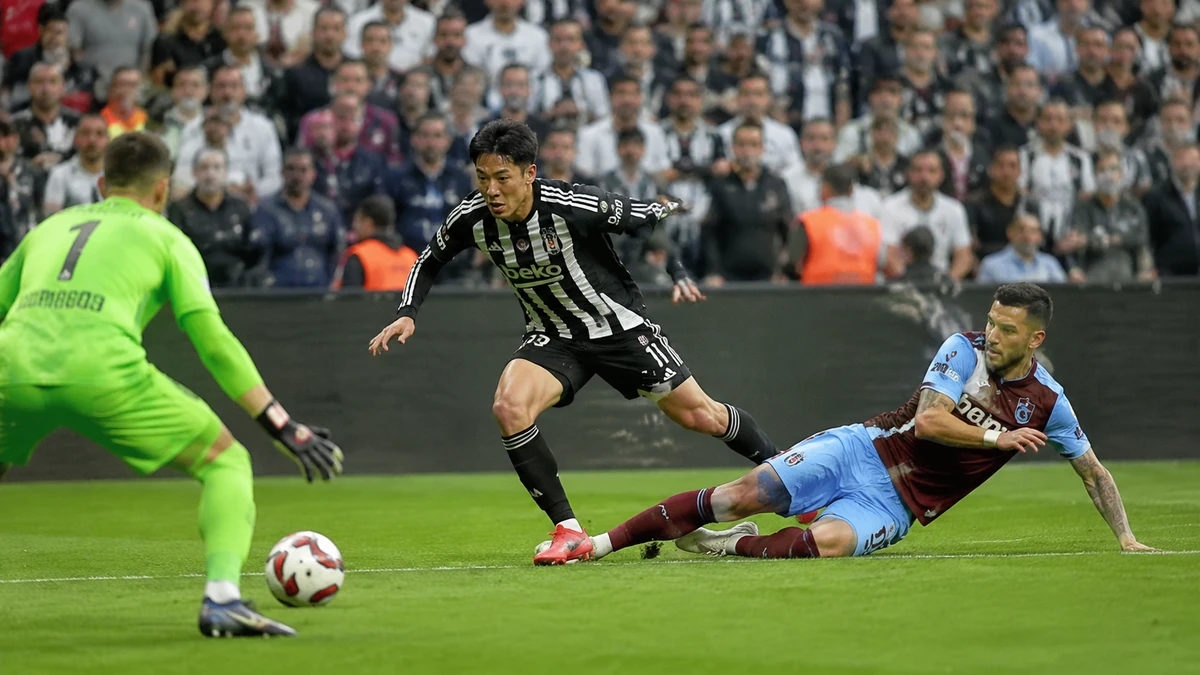
A loss on the scoreboard, but not a quiet night
For American sports fans skimming box scores, the line from Besiktas’ latest Turkish Super Lig match might not look especially memorable. South Korean striker Oh Hyeon-gyu played 90 minutes, registered one shot and did not score. His club, one of Turkey’s historic powers, lost 2-1 to Trabzonspor after surrendering an early lead. In the simplest telling, it was a disappointing night for both player and team.
But soccer, especially at the top professional level, rarely fits neatly inside a stat line. And for followers of South Korea’s expanding footprint in global soccer, Oh’s performance in Istanbul offered a revealing example of how a modern center forward can shape a game without delivering the kind of highlight that instantly travels on social media.
According to South Korean media reports summarizing the match, Oh drew the penalty that led to Besiktas’ opener in the 14th minute by aggressively pressing the opposing goalkeeper. The play did not come from a flashy dribble, a long-range shot or a clinical finish in the box. It came from something less glamorous but increasingly valuable in the modern game: forcing a mistake high up the field before a defense can settle.
That distinction matters. In an era when strikers are still judged first by goals but increasingly evaluated by everything around them, Oh’s night was a reminder that a forward’s influence can begin well before the final touch. Besiktas failed to turn that influence into points. Still, the moment said something important about the 23-year-old Korean international and about the way Korean players are making themselves indispensable abroad.
For readers in the United States, the easiest comparison may be to an NFL edge rusher who does not finish with a sack but hurries the quarterback into a game-changing turnover, or an NBA guard whose stat line looks modest but whose on-ball pressure blows up the opponent’s offense. The box score may not fully reward the work, but coaches, teammates and serious viewers know what they saw.
The play that changed the game’s opening script
Besiktas lined up in a 4-1-4-1 formation, with Oh as the lone striker responsible not just for finishing moves but for disrupting Trabzonspor’s buildup from the back. That role can be physically punishing. It demands repeated sprints, sharp timing and the ability to read where a defender or goalkeeper wants to play the next pass.
In the 14th minute, Oh did exactly that. Pressing the goalkeeper with urgency, he pounced on a vulnerable moment and was fouled in the process, earning a penalty kick. It was the kind of sequence that often gets overlooked in casual conversation because the replay is shorter and less glamorous than a curling goal into the top corner. Yet tactically, it can be just as significant. A penalty is one of the highest-percentage scoring chances in soccer, and winning one through pressure is not an accident. It is a skill.
There is a tendency among general audiences to think of pressure as effort and effort alone. At the elite level, it is much more precise than that. Press too early, and the goalkeeper simply passes around you. Press too late, and the chance is gone. Take the wrong angle, and you open a passing lane that leaves your own team exposed. The best pressing forwards combine stamina with anticipation. They understand when an opponent is off balance, when a touch has run too far, or when a defender is trying to reset play under stress.
That is what made Oh’s contribution meaningful. He did not merely run hard. He turned pressure into a tangible scoring chance. Even though he did not take the penalty himself, he created the event that led to Besiktas’ early advantage. For a striker, that is real production, even if it does not fit neatly into the traditional categories of goal or assist.
Besiktas ultimately could not protect the lead and fell 2-1, but that later collapse should not erase the quality of the initial intervention. If anything, it sharpened the contrast between what one forward can influence and what still requires a full team performance over 90 minutes.
Why American readers should care about the details
To many American fans, especially those who follow the Premier League, the Champions League or major international tournaments but not necessarily the Turkish league week to week, this may sound like a niche story. A Korean striker in Turkey wins a penalty in a loss. Why does it matter?
The answer has to do with the broader map of global soccer and South Korea’s place in it. Korean players abroad are no longer a novelty. They are part of the normal flow of talent across Europe and beyond, from Son Heung-min in England to Kim Min-jae in Germany and Italy before that, and Lee Kang-in in France. But not every Korean export is already a star. The more revealing stories are often about players like Oh, who are trying to establish themselves in demanding leagues where reputation matters less than daily utility.
Turkey’s Super Lig occupies an interesting place in that ecosystem. It is not one of Europe’s so-called Big Five leagues, but it is intensely competitive, emotionally charged and full of clubs with giant fan bases and high expectations. Besiktas, based in Istanbul, is one of Turkey’s traditional heavyweights, a club where scrutiny is constant and patience can be limited. Performing there means doing it in a loud, high-pressure environment, the soccer equivalent of playing for a big-market franchise where every result becomes a public argument.
For a Korean striker, that setting presents both opportunity and pressure. South Korean athletes abroad are often discussed at home through a national lens. Every game becomes part of a larger story about how Korean players compare on the international stage. Fans back in Seoul or Busan may be watching highlights before breakfast. Local media often track appearances, starts, goals and tactical roles with remarkable intensity, especially for national team players.
That helps explain why a play like Oh’s penalty-winning press resonates beyond one weekend result. It is evidence of how a Korean forward competes outside his comfort zone, in a foreign language environment and within a different tactical culture. It is also a reminder that the Korean soccer identity long associated with discipline, work rate and tactical buy-in is still very much part of how players from the country earn trust abroad.
What “presence” means in Korean soccer discourse
The Korean framing around Oh’s performance centers on a word that often appears in sports coverage there: presence, or visible impact even when numbers are limited. In American sports media, a rough equivalent might be saying a player “made his presence felt.” The idea is not mystical. It refers to a player imposing himself on the game through positioning, effort, timing or tactical intelligence in ways that may not immediately show up in the scoring summary.
That concept can be especially important in evaluating forwards. In much of the world, and certainly in South Korea, strikers live under the hardest judgment. Goals are the currency. If a forward scores, the rest can be forgiven. If he does not, the rest often needs explaining.
But modern soccer has changed the job description. The center forward is still expected to finish, yet he may also be asked to initiate the press, occupy center backs, create space for wide players, receive with his back to goal, contest long balls and trigger defensive transitions. In other words, he can function as both first attacker and first defender.
Oh’s game against Trabzonspor fit squarely into that evolution. On paper, his numbers were sparse: full match, one shot, no goal contributions in the conventional sense. In practice, he influenced Besiktas’ best early moment by doing one of the most demanding jobs a lone striker can do well: making the other team uncomfortable before it has a chance to breathe.
There is a broader cultural context here, too. Korean athletes are often praised domestically for traits such as diligence, sacrifice and team-first mentality. Those descriptions can become clichés, but they remain powerful because they align with how many Korean fans want their athletes to be seen internationally: not only talented, but reliable and industrious. When a player like Oh forces a penalty through relentless pressing, that image finds a concrete soccer expression.
At the same time, there is always a tension between symbolism and production. No one in professional soccer survives on good intentions alone. Oh will still be judged by goals over time, by whether he can convert chances and decide matches with finality. But on a night when the scoreboard alone did not flatter him, the texture of his performance mattered.
A lesson in how team failure and individual value can coexist
One reason this match stands out is that it tells two stories at once. The first is about Besiktas’ shortcomings. The club had entered the match on a modest unbeaten run and was trying to build momentum after a 2-0 win over Gaziantep. Instead, it conceded the initiative after going ahead and finished with a 2-1 defeat, remaining on 59 points and in fourth place. For a club of Besiktas’ stature, that is not where the conversation ends. The bigger questions are about game management, defensive stability and the inability to convert a strong opening into a complete result.
The second story is about Oh’s role inside that larger failure. American audiences are familiar with this split in other sports. A baseball pitcher can throw seven strong innings and still get tagged with a no-decision because the bullpen blows the lead. A wide receiver can run the route that opens the field even if someone else gets the touchdown. Individual execution does not always rescue collective weakness.
That is essentially what happened here. Oh helped create Besiktas’ early edge, but the team could not sustain it. The penalty sequence demonstrated a clear tactical function: the striker as disruptor, not just finisher. The eventual comeback loss demonstrated something else: one useful contribution at the top of the formation cannot compensate for every lapse that follows.
That does not lessen the importance of Oh’s performance. If anything, it makes it easier to isolate. In a match where Besiktas did not do enough over the full 90 minutes, one of the most vivid positive actions belonged to its Korean striker. That is part of why his outing drew attention despite the final result.
For coaches and scouts, this is the kind of detail that can matter as much as a shot count. Did the striker understand the tactical assignment? Did he execute with intensity? Did he create stress for the opponent? Did he remain on the field for the entire match because the staff trusted his role? By those measures, there was substance in Oh’s night.
The Korean path abroad is about adaptation as much as talent
South Korean players have built a strong reputation overseas, but the process is rarely smooth. Moving into a foreign league means more than adjusting to a new coach or a new formation. It can involve language barriers, different locker-room cultures, unfamiliar food, altered training rhythms and fan expectations that may be harsher or more immediate than what a player knew at home.
For Korean players, there is also the added layer of national visibility. Because South Korea is a highly connected sports market with a passionate digital fan culture, players abroad often exist under constant remote observation. A goal can trend quickly. So can a dry spell. Every appearance becomes part of a rolling public referendum on whether a player is thriving, stalling or deserving more opportunities with the national team.
In that environment, one of the fastest ways to earn respect is to do things a coach can trust right away. Press correctly. Defend from the front. Stick to the tactical script. Make yourself useful even before your finishing form peaks. This is where Oh’s performance becomes instructive. He showed a kind of contribution that translates across languages and systems. Any coaching staff can appreciate a forward who forces mistakes and sets the defensive tone from the top.
For American readers who may know Korean soccer primarily through stars like Son, it is worth remembering that the pipeline does not produce only elegant attackers or headline scorers. It also produces hard-running, tactically disciplined professionals who survive by embracing difficult assignments. In many ways, those players reveal more about a country’s soccer culture than the occasional superstar does.
Oh, still in the stage of his career where each appearance can affect his standing, appears to be operating in that lane. He is not asking the game to bend entirely around him. He is trying to show he can be central to how the team functions. Sometimes that means scoring. Other times, as it did against Trabzonspor, it means forcing the play that gives your team its best opening.
What comes next for Oh and for the way he is evaluated
The challenge now is consistency. One high-impact pressing sequence can spotlight a player’s value, but long-term credibility for a striker still rests heavily on end product. That is true in Turkey, true in South Korea and true anywhere else serious soccer is played. If Oh wants to strengthen his standing at club level and with the national team, he will need not only nights like this one but also goals to match the effort.
Still, there is a reason this performance deserves notice. It showed that even in defeat, Oh could bend the match’s early rhythm through awareness and aggression. It showed that he was trusted to lead the line for the full match. And it showed that the evaluation of a Korean forward abroad is becoming more sophisticated than a simple tally of goals and assists.
That sophistication matters because it reflects how soccer itself is changing. The old stereotype of the striker as a player waiting in the box for service has been fading for years. Today’s forward often begins the team’s defensive work and can create offense by destroying the opponent’s composure. Oh’s penalty-winning press was a small but clear case study in that evolution.
For South Korean fans, the takeaway is likely to be familiar: he did not score, but he mattered. For American readers, the broader lesson may be that some of the most revealing stories in global soccer happen outside the usual spotlight. They unfold in leagues that many U.S. fans do not watch regularly, through players who are still building their international reputations, in moments that challenge the idea that only scorers truly shape games.
Besiktas lost, and that remains the headline for the club. But for Oh Hyeon-gyu, the match offered a different kind of headline — one about presence, tactical value and the difficult, often underappreciated work of proving yourself abroad. In a sport obsessed with finishers, he reminded viewers that sometimes the most important thing a striker does is not the last touch. It is the first disruption.



0 Comments