
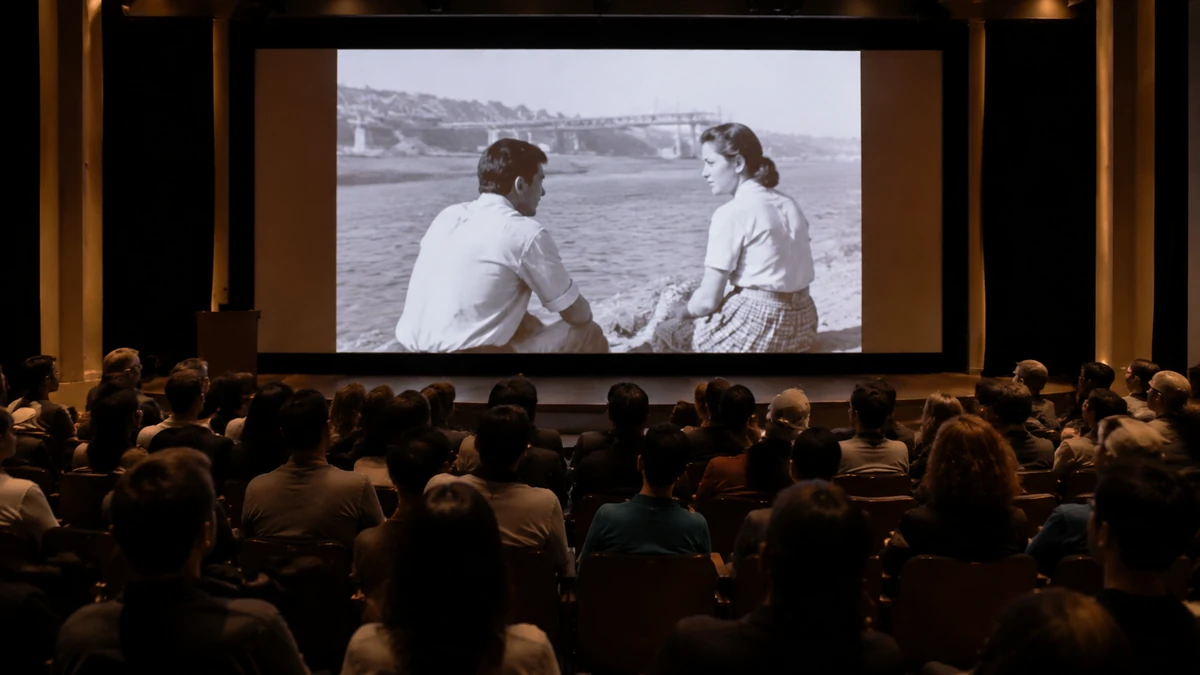
A different kind of Korean Wave arrives in New York
For many Americans, Korean screen culture begins with the sleek and globalized entertainment of the past two decades: the class warfare of “Parasite,” the survival drama of “Squid Game,” the zombie thrills of “Train to Busan,” or the meticulously engineered world of K-pop videos and prestige streaming series. But a new film program in New York is asking audiences to look further back — well before Korean pop culture became a global export, and long before streaming platforms turned subtitled viewing into a mainstream habit.
The Korean Cultural Center New York said it will present a special showcase of 1970s Korean cinema from July 15 to July 26, with screenings split between the Walter Reade Theater at Lincoln Center and the center’s own Manhattan venue. The series will feature 29 feature and short films from one of the most complicated and formative decades in South Korean film history.
That may sound like a niche event for archivists or festival regulars, but the program carries a broader significance. At a moment when Korean culture is one of the most recognizable international brands in American entertainment, this retrospective shifts the conversation away from what is newest and hottest and toward what made the current moment possible. It offers New York audiences a rare chance to see how Korean filmmakers were experimenting with form, genre, satire and social commentary decades before Hollywood fully took notice.
In practical terms, the showcase functions as both a film event and a kind of cultural backstory. It introduces English-speaking audiences to a period that is often overlooked outside Korea, even though its themes — youth unrest, gender conflict, authoritarian pressure, urban anxiety and the clash between tradition and modern life — still feel startlingly current. In symbolic terms, the setting matters too. New York remains one of the great gateways of global culture, and a screening series here can shape how a national cinema enters the broader international conversation.
Rather than treating Korean film history like a museum piece, the program appears designed to make that history legible to contemporary viewers. That means not just showing old films, but framing them in a way that connects them to the Korean storytelling that global audiences already know. For American viewers who came to Korean culture through Netflix, arthouse theaters or K-pop fandom, this is a chance to see the roots beneath the phenomenon.
Why the 1970s matter in Korean film history
To understand the importance of the series, it helps to understand the decade it highlights. In South Korea, the 1970s were years of rapid industrial change, strict government control and deep social tension. Under President Park Chung-hee’s authoritarian rule, censorship was a defining reality of public culture. Filmmakers worked under heavy constraints, and the industry itself was shaped by political regulation and commercial pressure.
Yet periods of restriction often produce unusual artistic responses. In the United States, filmgoers understand this idea through examples like 1970s New Hollywood, when social upheaval reshaped what movies looked and sounded like, or through the way directors working under the old Hollywood Production Code found indirect ways to address taboo subjects. Korean filmmakers of the 1970s were dealing with a different political system and a different society, but they too found creative language in limitation. Their movies often carried social critique through metaphor, melodrama, genre conventions or unsettling psychological portraits.
The decade also came during a dramatic transformation of everyday life in South Korea. The country was urbanizing quickly. Traditional family structures were under pressure. Economic development promised upward mobility but also created dislocation and inequality. Students and young people were caught between aspiration and disillusionment. Women’s roles were being renegotiated, though often through deeply unequal terms. Those tensions fed directly into the movies.
For Americans accustomed to seeing South Korea through the lens of its current prosperity and technological sophistication, these films can be revelatory. They show a country in the midst of reinvention, wrestling with modernity rather than comfortably inhabiting it. They also complicate the common assumption that Korean cinema became bold only in the late 1990s and 2000s. The evidence of risk-taking, formal invention and social unease was already there.
That is one reason a 1970s-focused program makes sense now. It reminds viewers that Korea’s cultural rise did not begin with streaming algorithms or Oscar campaigns. It was built over decades, through filmmakers who were developing a visual and emotional vocabulary under circumstances that were often politically and materially difficult.
A lineup that maps a hidden cinematic tradition
The series includes several major titles that, taken together, suggest a deliberately broad portrait rather than a single-director tribute or a narrowly defined genre package. Among the most attention-grabbing selections are “Woman of Fire” by Kim Ki-young, “March of Fools” by Ha Gil-jong and “Break Up the Chain” by Lee Man-hee.
For audiences unfamiliar with Korean classics, those names may not carry the immediate recognition of Bong Joon Ho or Park Chan-wook. But they should. Kim Ki-young, in particular, has long been revered by critics and filmmakers for his feverish, psychologically charged style. His work can feel at once melodramatic, erotic, satirical and unnerving — the kind of cinema that leaves viewers slightly off balance. “Woman of Fire,” one of his best-known films, is the sort of movie that can instantly challenge simplistic assumptions about what older Asian cinema looked like. It is not polite heritage programming; it is volatile, sensual and strange.
“March of Fools,” directed by Ha Gil-jong, speaks to another key thread in Korean film history: youth culture and the frustrations of a generation trying to find space in a tightly controlled society. For American audiences, the title may resonate as a time capsule of student life and social restlessness, but it is more than a nostalgia object. Movies about drifting youth, disappointed ambition and fragile hope tend to travel well because they tap into near-universal experiences. If “The Graduate” or early Martin Scorsese films helped capture a mood of dislocation in the United States, Korean films like this registered their own national version of uncertainty and rebellion.
Then there is “Break Up the Chain,” from Lee Man-hee, a director often associated with technical control and genre versatility. Its inclusion signals that the retrospective is not trying to tell one story about 1970s Korean cinema, but many: art cinema, social critique, commercial filmmaking and stylistic experimentation all coexist in the same decade.
The program also revisits early work by Im Kwon-taek, one of the central figures in Korean film history. While many international audiences know him for later landmark achievements, the inclusion of his earlier films “The Genealogy” and “Wangsimni” shifts attention to his formative period. That is an important curatorial choice. Instead of presenting a master only in finished, canonical form, the series shows an artist in development — testing themes, wrestling with history and building the craft that would later define his reputation.
In another telling move, the organizers have paired this historical material with a much newer film: Kim Jee-woon’s 2023 feature “Cobweb.” The movie, introduced by the Korean Cultural Center as an homage to Korean cinema of that earlier era, acts as a bridge for viewers who know contemporary Korean filmmaking better than its predecessors. It suggests that the 1970s are not merely a closed chapter preserved in academic memory, but an active source of inspiration. In other words, the past is still talking to the present.
Restoration is not just preservation — it is access
Many of the films in the program will be shown in remastered versions made possible through restoration and digitization by the Korean Film Archive, South Korea’s national institution for film preservation. That detail may sound technical, but it is central to why a retrospective like this can matter outside a specialist audience.
Old films do not survive in any meaningful public sense simply because reels exist in storage. They survive when viewers can actually see them — clearly, comfortably and in formats that work in modern theaters. Restoration is often described as conservation, but it is also a form of translation. It brings the work into present-day circulation without erasing its age. For international audiences, especially, that process can determine whether a film becomes newly alive or remains effectively inaccessible.
Anyone who has struggled through poor subtitles, damaged prints or muddy transfers knows the difference. The barrier is not just technological; it is cultural. A classic film from another country already asks viewers to cross distances of language, history and sensibility. If the presentation itself is inadequate, the gap widens. Good restoration narrows it.
That matters especially in a city like New York, where audiences are famously curious but also flooded with options. To persuade viewers to spend an evening on a 1970s Korean film they may never have heard of, the experience has to feel inviting rather than dutiful. Remastered prints and digital presentation help make that possible. They allow the films to be encountered not as decaying artifacts, but as works with texture, immediacy and cinematic force.
There is also a larger cultural point here. In the age of streaming, audiences have grown used to thinking of access as instant. But the global circulation of film history still depends on labor-intensive institutional work: locating materials, restoring images and sound, creating subtitles, securing exhibition partners and building public interest. The Korean Film Archive’s role underscores that Korean soft power today is not only about producing the next hit series or blockbuster. It is also about investing in memory — and making memory exportable.
That effort increasingly resembles what major film institutions in the United States and Europe have done for decades with their own national canons. The difference is that Korean cinema is reaching a moment when global demand has finally caught up with the richness of the archive. As a result, restorations are no longer solely preservation projects for domestic audiences. They are also invitations to the world.
Why Lincoln Center and the Korean Cultural Center make sense together
The structure of the event says almost as much as the lineup itself. The series is being organized by the Korean Cultural Center New York in collaboration with Film at Lincoln Center and Subway Cinema. That partnership matters because it combines three different kinds of credibility and reach.
The Korean Cultural Center represents official cultural diplomacy — a state-backed effort to present Korean arts and culture abroad. In many countries, these institutions play a role similar to those of the Goethe-Institut for Germany or the British Council for the United Kingdom. Their job is not simply promotion, but context-building: helping foreign audiences understand a country’s culture on its own terms.
Film at Lincoln Center, meanwhile, occupies a different place in the American cultural ecosystem. For serious moviegoers, it is one of the country’s most established homes for international and independent cinema, a venue with the power to legitimize a program within broader film discourse. Screening at the Walter Reade Theater signals that these films are not being presented merely as an ethnic or community event, but as part of world cinema worthy of critical attention.
Subway Cinema adds another dimension. Long known in New York for championing Asian genre cinema and helping introduce American audiences to forms of filmmaking that fall outside conventional arthouse categories, the group has often served as a bridge between devoted fans and wider audiences. Its presence suggests that the program may be trying to reach both committed cinephiles and curious newcomers.
The split venues deepen that strategy. Lincoln Center offers a place inside the mainstream conversation of international film culture. The Korean Cultural Center offers a more explicitly Korean setting, one where audiences may be encouraged to connect the screenings with broader aspects of Korean history and arts programming. Together, the two locations create a dual framing: Korean cinema as both national culture and global art.
The support of the Korean Film Council, or KOFIC, also points to a wider institutional logic. This is not just about exporting a few marketable titles. It is about curating the historical depth of Korean film as a coherent story for international audiences. That kind of long-view thinking matters if Korea wants its cinematic reputation to endure beyond the current cycle of pop-cultural enthusiasm.
What American audiences may discover in these films
For viewers in the United States, one of the most rewarding aspects of a retrospective like this is the chance to recognize familiar concerns in unfamiliar settings. Korean films of the 1970s emerged from a social world distinct from America’s, but their emotional and political tensions are often immediately legible.
Take youth disaffection. American cinema has a long tradition of movies about young people alienated from institutions, from “Rebel Without a Cause” to 1970s campus and counterculture films to the slacker portraits of later decades. Korean films of the same era approached student life and young adulthood through a different political lens, but they likewise captured a generation struggling against expectations it did not fully believe in. That resonance can be a powerful entry point for audiences new to the material.
Or consider gender. Films like “Woman of Fire” speak to domestic power, sexual anxiety and the instability of social roles in ways that can feel both culturally specific and uncannily universal. American audiences may see traces of Gothic melodrama, psychological horror and feminist critique colliding in a single work. The result is not a simple lesson in Korean culture, but a more challenging encounter: a recognition that the pressures shaping women’s lives and family structures in 1970s South Korea were distinct, yet not wholly disconnected from struggles reflected in American cinema of the same period.
The same goes for modernization. South Korea in the 1970s was moving fast, with all the unease that rapid transformation brings. Americans watching these films may think about their own country’s periods of upheaval, when old neighborhoods disappeared, class divisions hardened and prosperity arrived unevenly. The details differ, but the emotional logic travels.
That ability to travel is partly why classic Korean cinema has gained more attention in recent years. Once audiences get past the mental barrier that older foreign-language films are “homework,” they often discover something more vivid and less predictable than expected. Korean cinema, especially, has a way of blending tones — comedy with despair, melodrama with social satire, realism with flashes of the grotesque — that can feel startlingly modern. Contemporary Korean directors did not invent that elasticity from scratch. They inherited it.
For those already steeped in newer Korean films and dramas, the retrospective offers another pleasure: seeing motifs and sensibilities in earlier form. The fierce household conflicts, the suspicion of authority, the interest in class performance, the willingness to turn suddenly from humor to menace — all of these qualities have deep roots. Watching the 1970s films is a way of tracing the genealogy of what audiences now recognize as distinctly Korean cinematic energy.
More than nostalgia, a case for cultural memory
There is a temptation, whenever old films are revived, to treat the exercise as nostalgia — a backward glance for specialists or older viewers. But the stronger argument for this New York series is that it belongs to a broader movement in how Korean culture is presenting itself globally.
Korean entertainment has already won the battle for visibility. The next question is whether it can sustain curiosity about its history, not just its latest releases. In that sense, a retrospective of 1970s cinema marks a shift from trend to tradition. It suggests that the Korean Wave, or Hallyu — the term used to describe the international spread of Korean popular culture — is maturing. It is no longer defined only by current consumption. It is beginning to ask for historical attention.
That is an important distinction. Plenty of countries produce cultural crazes; fewer successfully teach international audiences how to understand the deeper lineage behind them. When that lineage becomes visible, a national cinema gains durability. It becomes harder to dismiss as a passing fashion because it can now be seen as an evolving body of work across generations.
The New York program arrives alongside related efforts inside South Korea to reinterpret film history for contemporary audiences, including exhibitions that use film titles, graphic design and moving images to tell broader stories about Korean society and cinema. Together, those projects point to a growing awareness that archives are not enough on their own. History has to be curated, narrated and staged.
That may be the clearest takeaway from this showcase. The event is not simply saying, “Here are some old Korean movies.” It is making a larger argument: that the global audience now exists for this history, that the tools of restoration and presentation are in place, and that Korean cinema’s international story should begin earlier than many people think.
For New Yorkers — and for Americans more broadly, who often encounter world cinema only after it has already been filtered through awards buzz or streaming trends — that is an invitation worth taking seriously. Today’s Korean cultural boom did not emerge from nowhere. It was built by generations of artists working through censorship, social upheaval and industrial change, creating films that still pulse with urgency decades later.
If the current Korean Wave has taught American audiences anything, it is that subtitles are no barrier to emotional force, humor, suspense or artistic ambition. This retrospective asks viewers to take the next step: to recognize that behind the global phenomenon is a much longer cinematic history, one still rich with discovery. In New York this month, that history will not sit behind glass. It will be on the screen, where it belongs.


0 Comments