
A furniture company makes a real estate play
In South Korea, where housing is not just shelter but one of the country’s most emotionally and financially charged subjects, a corporate move by a home interior company can say a lot about where the broader economy is headed. That is part of what makes Hanssem’s latest decision notable.
Hanssem, one of South Korea’s best-known home furnishing and interior brands, said it will absorb its subsidiary Hanssem Nexus and use the reorganization to strengthen its business-to-business operations, with an eye on high-end residential development in some of Seoul’s most exclusive neighborhoods. On paper, the move is a merger. In practical terms, it looks more like a strategic reset.
For American readers unfamiliar with the company, Hanssem occupies a space that blends elements of a kitchen-and-bath specialist, a large-scale home interiors brand and a project contractor. It is not a direct equivalent of any one U.S. company, but it may be easiest to imagine something that sits somewhere between a premium cabinetry firm, a home remodeling brand and a supplier with the scale to serve both individual consumers and major housing developers.
According to the company’s announcement, the goal is to combine Hanssem’s special sales division at headquarters with the business-to-business capabilities of Hanssem Nexus, then reorganize that B2B structure in the second half of this year. The company says it plans to target premium redevelopment and reconstruction projects, including the luxury residence market in key districts along Seoul’s Han River.
That may sound technical, but the underlying message is straightforward: Hanssem wants to move beyond being seen primarily as a retailer or product supplier. It wants a larger role in shaping high-value housing projects from earlier in the process, where design decisions, brand positioning and profit margins can all be more substantial.
At a moment when many consumer-facing businesses in Asia are grappling with slower domestic growth, Hanssem’s move offers a window into how Korean companies are trying to protect profitability: not by chasing more of the same retail sales, but by climbing the value chain.
Why the merger matters beyond corporate paperwork
Mergers inside a corporate family do not always make headlines, and plenty of them amount to little more than administrative cleanup. But in this case, the significance lies in what is being consolidated and where the combined organization is expected to compete.
Hanssem said the first purpose of the merger is to integrate the capabilities of its existing special sales operation and Hanssem Nexus’ B2B organization. In Korean business, “special sales” generally refers not to a consumer promotion but to large-scale institutional or project-based sales — supplying products and services to apartment developers, builders, commercial clients or other large accounts rather than individual households shopping for a sofa or kitchen island.
That distinction matters. Selling to consumers is one business. Selling into large housing projects is another entirely. It requires winning contracts, coordinating with developers and architects, managing timelines, aligning delivery and installation, and making sure a brand’s products fit into larger construction schedules. When those responsibilities are split across separate organizations, decisions can slow down and accountability can blur.
By folding the subsidiary into the parent company, Hanssem appears to be simplifying that chain of command. That could help it respond faster to clients, present a more unified pitch and execute large projects with greater consistency. The company has framed this as a B2B reorganization, but the broader implication is that it wants to be taken more seriously as an integrated project partner.
That is a meaningful distinction in an economy like South Korea’s, where major residential developments can carry enormous symbolic and commercial value. A company that enters a project early can influence design choices, secure more favorable pricing and raise its profile far more than one that shows up late simply to fill an order.
In the U.S., there is a rough parallel in the way some building-products companies seek to become specified partners in luxury condo towers, multifamily developments or major mixed-use projects rather than compete transaction by transaction in showrooms. Hanssem’s move suggests it wants that kind of position in Korea’s residential market — not just supplying interiors, but becoming part of the package that developers sell to affluent buyers.
The meaning of Seoul’s luxury housing belt
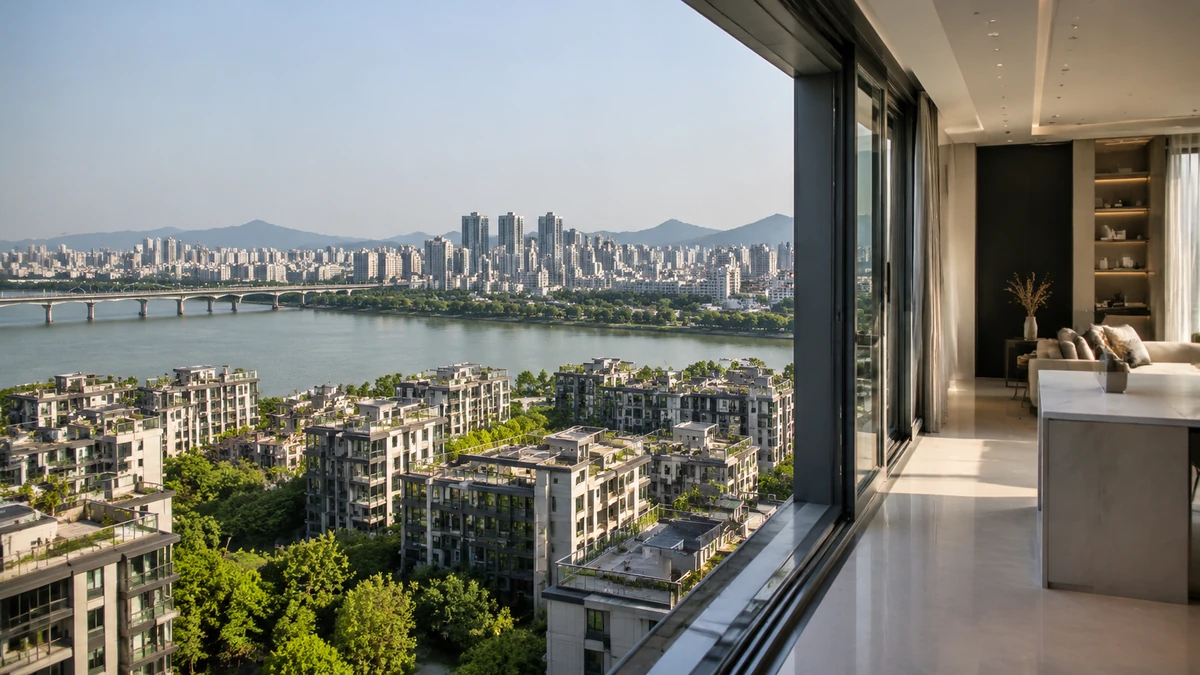
Hanssem said it plans to target high-end redevelopment and reconstruction projects in areas such as Apgujeong, Seongsu and Hannam, all major districts along or near the Han River in Seoul. For readers outside South Korea, those neighborhood names may not immediately resonate. In the Korean context, they are loaded with social, economic and cultural meaning.
If Manhattan’s Upper East Side, parts of Brooklyn’s luxury waterfront and a stretch of Beverly Hills symbolism were somehow compressed into a few high-stakes urban districts, that would begin to capture the aura. These neighborhoods are associated with wealth, status, exclusivity and the future of urban living in the capital. They are also central to Seoul’s intense redevelopment culture, where older apartment complexes are often replaced by more upscale towers with higher prices and stronger branding.
Redevelopment and reconstruction in South Korea are not niche issues. They are central to the country’s politics, household wealth and urban identity. Apartment complexes are a dominant form of housing, especially in Seoul, and the redevelopment of older sites can become the focus of years of debate among residents, developers, investors and local officials. A successful project can reshape a neighborhood’s value and prestige almost overnight.
That makes the luxury residential market especially consequential. In these projects, the interior experience is not an afterthought. Floor plans, finishes, kitchen systems, storage solutions, concierge-adjacent amenities and the overall “lifestyle” promise all matter. Buyers are not just purchasing square footage. They are buying a branded living environment.
Hanssem’s decision to highlight those areas signals that it is aiming at the top tier of that market, where each contract may be limited in number but outsized in influence. One marquee project can serve as a calling card for the next one. In that sense, this is not only about near-term revenue. It is also about establishing credibility in a part of the market where reputation compounds.
In South Korea, where premium apartment branding can carry a cachet similar to elite school districts or luxury building names in the United States, securing a role in a flagship project has implications beyond sales. It can elevate a company’s image with consumers, developers and investors all at once.
Why a home interiors brand wants more control
One of the most revealing phrases in the company’s announcement was its intention to secure greater initiative in the construction and real estate market. That is ambitious language for a home interiors specialist, and it helps explain why this story is about more than furniture or cabinetry.
Traditionally, interior brands are most visible near the end of the housing pipeline, after land is assembled, permits are secured, towers rise and units are ready to be fitted out. But in the premium housing market, the lines separating planning, construction, design and branding are becoming less distinct. A developer trying to sell multimillion-dollar residences in an elite Seoul district is not only building homes; it is selling a lifestyle package. The interior partner becomes part of that pitch.
That gives companies like Hanssem a reason to move upstream. If it can participate earlier — not merely as a vendor but as a strategic collaborator — it can help shape the design language of a project, lock in larger contracts and gain more leverage over both execution and price.
This is part of a broader trend in advanced urban markets, where lifestyle industries increasingly intersect with real estate. In cities from Seoul to New York to Singapore, consumers at the upper end of the market expect a residence to come with a coherent identity. Materials, layouts, appliances, storage systems and even the “feel” of the common spaces are expected to communicate status and taste. In that environment, interior specialists that once sold components are trying to sell complete experiences.
Hanssem appears to be positioning itself for that shift. The company is effectively saying that it does not want to compete solely on whether a kitchen is well made or a closet system is efficient. It wants to be part of the broader vision for how premium housing is conceived and marketed.
That can be especially important in South Korea, where apartment living is deeply tied to class aspiration and social mobility. Housing has long played an outsized role in household wealth accumulation, and premium residential branding can influence both sale prices and public perception. For a home interiors company, being linked to prestigious projects can create a halo effect across the rest of its business, including consumer-facing retail.
What this says about South Korea’s economy
Seen through a wider lens, Hanssem’s move is a case study in how Korean companies are adjusting to a more difficult growth environment. South Korea remains a global export powerhouse, but domestic-facing businesses have faced a more complicated landscape, shaped by cautious spending, housing market uncertainty and fierce competition in mature consumer categories.
For companies that rely heavily on retail demand, that creates a strategic problem. There are only so many ways to distinguish yourself if the basic business model is selling products to households in a crowded marketplace. Moving toward large projects and premium contracts offers a different path: fewer deals, perhaps, but each with more value and more room for differentiation.
This is not unique to South Korea. In the United States, companies from appliance makers to flooring brands have long sought stable, high-volume business through builder relationships, multifamily contracts and commercial projects. What makes the Korean case distinctive is the country’s dense urban housing market and the social importance of redevelopment zones in Seoul. When a company like Hanssem signals that it wants a bigger foothold there, the move carries broader economic meaning.
It suggests that value in the housing ecosystem is shifting toward firms that can combine manufacturing, design, logistics and branding into one integrated offering. It also underscores how lifestyle businesses in Korea are becoming more sophisticated industrial players. They are not simply selling taste. They are embedding themselves in complex, capital-intensive urban projects.
There is also a timing element here. Hanssem has said the B2B restructuring will move ahead in the second half of the year, meaning this is not just a conceptual statement. The market will be watching whether the organizational merger translates into faster bidding, stronger project wins and a more coherent presence in the premium redevelopment segment.
For the Korean economy, the story is less about one company alone than about the methods companies are using to keep growing. In uncertain periods, some businesses retrench and cut costs. Others try to push into markets where margins are better and brand power matters more. Hanssem is signaling that it prefers the second option.
The cultural backdrop: housing as status, identity and political issue
To understand why this move may attract outsized attention in South Korea, it helps to appreciate just how central housing is to public life there. In the United States, real estate is a major issue, but it competes with many other markers of status and security. In South Korea, especially in Seoul, housing has an even more concentrated symbolic role.
Apartment ownership is often tied not only to wealth but also to educational opportunity, neighborhood identity and family standing. The quality and location of a home can affect everything from commute times to access to elite schools to one’s social image. That has made housing policy one of the most politically sensitive topics in the country.
It has also helped produce a culture in which premium residential projects are marketed with extraordinary care. The name of a development, the river view, the finishing materials, the built-in systems and even the reputation of participating brands can all carry weight. For an American audience, think of the difference between buying a standard suburban subdivision home and buying into a branded luxury tower where every surface and amenity is curated. In Seoul’s top market, that gap can be especially dramatic.
That is why Hanssem’s stated interest in neighborhoods like Apgujeong, Seongsu and Hannam matters. These are not just expensive districts. They are places where urban prestige is manufactured and displayed. Entering those projects means competing in a market where design credibility, execution and image all matter at once.
There is another cultural factor at work as well: South Korea’s redevelopment and reconstruction system often turns aging apartment complexes into arenas for intense competition over future value. Residents vote, developers campaign and brands angle for visibility. In that atmosphere, a company that can present itself as both premium and operationally reliable has an advantage.
Hanssem’s merger should be read in that context. It is not just reorganizing an org chart. It is preparing for a segment of the market where homes are sold as polished, status-laden products and where interior quality can influence the entire identity of a development.
What is known, and what remains unproven
As with any corporate announcement, it is important to separate confirmed facts from strategic aspirations. What is known is that Hanssem said it will absorb Hanssem Nexus, reorganize its B2B business structure in the latter half of this year and target premium redevelopment, reconstruction and luxury residence sales in key Seoul districts.
What is not yet known is how successful that strategy will be. The company has outlined its direction, but results — contract wins, revenue gains, operational efficiencies and lasting influence in the premium housing market — have yet to be demonstrated.
That distinction matters because the South Korean housing and construction sectors are competitive and cyclical. Prestige alone does not guarantee execution. High-end projects are demanding, and the firms involved are judged on everything from design cohesion to supply-chain performance. A merger can simplify operations, but it does not automatically ensure that a company will win the most desirable work.
Still, investors and industry observers often pay close attention to where a company chooses to deploy its resources. Mergers are among the clearest ways management can signal priorities. By tying this integration directly to premium residential targets in Seoul, Hanssem has made its ambitions unusually legible.
In effect, the company is telling the market that it sees its future less in incremental retail gains and more in securing a role inside the country’s most visible and lucrative housing projects. Whether that proves prescient will depend on execution, but the strategy itself reflects a wider shift underway in Korea’s lifestyle and housing sectors.
For American readers, the simplest way to understand the story is this: a major South Korean home interiors company is trying to become more than a seller of products. It wants to help define the look, feel and marketability of luxury urban housing in the nation’s most important real estate arena. In a country where apartments carry enormous economic and cultural weight, that is not a narrow corporate maneuver. It is a bet on where influence and value in the housing business will come from next.
A signal from one company, and perhaps an industry
Corporate restructurings can be dry on the surface, but sometimes they reveal the shape of an industry in transition. Hanssem’s decision appears to be one of those cases.
By absorbing Hanssem Nexus and emphasizing integrated B2B capabilities, the company is repositioning itself for a market where premium housing is increasingly judged as a total package rather than a collection of separate inputs. It is also signaling confidence that design, logistics, project management and brand identity can be combined into a stronger competitive proposition.
That matters in South Korea, where the built environment is evolving quickly and where redevelopment in Seoul’s elite neighborhoods can influence consumer expectations across the wider housing market. If Hanssem succeeds, the move could help define a new template for Korean home interior firms: less dependent on walk-in retail and more embedded in the planning and execution of top-tier residential projects.
If it falls short, the announcement will still stand as evidence of how urgently domestic companies are searching for growth beyond conventional consumer channels. Either way, the story offers a revealing snapshot of the current Korean economy — one in which brand-name companies are not simply trying to sell more, but to occupy more strategic ground in the industries around them.
In that sense, Hanssem’s merger is not just about business efficiency. It is about positioning, prestige and a larger struggle over who gets to shape the spaces where Korea’s wealthiest urban residents will live. In Seoul, that is a contest with implications far beyond interior decor.



0 Comments