PSG Defends Its European Crown Against Arsenal, With South Korea’s Lee Kang-in Part of a Historic Night
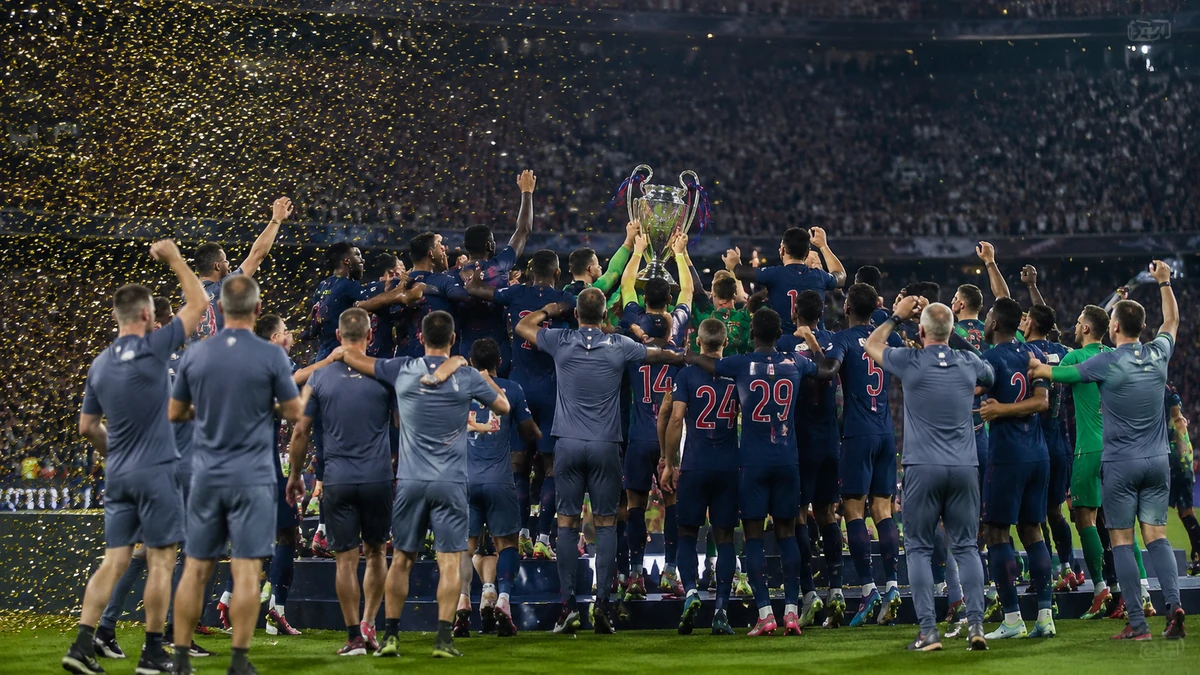
PSG wins again on Europe’s biggest club stage
Paris Saint-Germain defended its UEFA Champions League title on Saturday night, beating Arsenal in a tense final that stretched through extra time and into a penalty shootout before the French club prevailed 4-3. The match ended 1-1 after regulation and extra time at Puskas Arena in Budapest, Hungary, giving way to the kind of nerve-rattling finish that turns a championship game into a test of poise as much as skill.
For American readers who may be more familiar with the Super Bowl, the College Football Playoff or the NBA Finals, the Champions League final is the closest soccer has to a one-night summit of club competition. It is not a national-team event like the World Cup. Instead, it brings together the best professional clubs in Europe after a seasonlong gauntlet that is widely considered the hardest annual competition in the sport. Winning it once can define a generation for a club. Winning it twice in a row places a team in rare company.
That is what made this victory so significant for PSG. The French powerhouse won its first Champions League title last season, breaking through after years of lavish spending, global branding and repeated heartbreak in Europe. By returning the following year and winning again, PSG did more than add another trophy. It answered the question that lingers after every first-time champion: Was it a breakthrough, or a one-off? Against Arsenal, PSG delivered the most convincing answer possible.
The triumph also carried special meaning in South Korea and among many Asian soccer fans because midfielder Lee Kang-in, one of the country’s best-known players abroad, was part of the title-winning squad. Lee did not get off the bench in the final, just as he did not appear in last season’s title match. Still, he was there in the technical area and in the trophy celebration, a member of a team that has now won back-to-back European crowns.
That distinction matters. In elite soccer, especially at clubs stocked with world-class talent, the line between starter, substitute and squad player is often thin and constantly shifting. Even so, simply belonging to the roster of the best team in Europe is no small achievement. For South Korean fans, Lee’s presence in that setting is a source of pride, but it also raises harder questions about his role and what comes next.
A final defined by pressure, patience and penalties
The scoreline alone tells part of the story. A 1-1 draw after 120 minutes suggests two teams that were closely matched, and that was exactly the feel of the night. Arsenal, one of England’s most prominent clubs, pushed PSG deep into a championship game in which any mistake could have been fatal. Finals are not always artistic. Often, they are cagey, compressed and emotionally draining. This one fit that description.
Unlike league play, where a single bad result can be absorbed over the course of a long season, a Champions League final offers no second chance. In that sense, it resembles a Game 7 in American sports, except it stands alone and is watched globally. Every pass is magnified. Every defensive lapse feels larger. Every substitution can be dissected for years. That pressure becomes even more intense in extra time, when fatigue begins to scramble decision-making and the fear of making the decisive mistake can be as powerful as the desire to create the winning moment.
PSG survived that environment. That may be the clearest measure of how much the club has matured. For years, PSG was often judged as a glamorous project still searching for the steel of a true European champion. It had stars, money and domestic success, but Europe’s top competition repeatedly exposed its fragility. The club that beat Arsenal looked different: steadier, more disciplined, and able to endure a final that became as psychological as it was tactical.
Penalty shootouts are sometimes described as cruel or random, but that shorthand overlooks the mental demands involved. A shootout strips soccer down to its starkest confrontation: one player, one goalkeeper, one kick, with the entire emotional weight of the season concentrated into a few seconds. PSG emerged from that crucible with a 4-3 edge, and that outcome reinforced a larger point. Champions are not only measured by the beauty of their victories. They are measured by whether they can hold themselves together when the game turns ugly, tense and unforgiving.
Against Arsenal, PSG did exactly that. The club did not coast. It did not overwhelm its opponent with flashy superiority. It endured, absorbed pressure, and found a way through. In a sport where narratives often chase spectacle, there is something especially revealing about a champion that can win a final on a night when control is incomplete and the margins are razor-thin.
What Lee Kang-in’s bench role means, and what it does not
For many English-speaking readers, Lee may be less familiar than some of the bigger European names, but in South Korea he has long been one of the country’s most closely watched soccer players. He first drew wide attention as a precocious talent and later built a reputation in Spain before joining PSG. His technical skill, vision and attacking creativity made him one of the most intriguing Korean players of his generation, especially in the years after Son Heung-min established himself as Asia’s most recognizable soccer star in Europe.
That is why Lee’s role in this final invites a mixed reaction. On one hand, being part of a Champions League-winning squad two years in a row is a remarkable career line. On the other, elite athletes are judged most sharply on the biggest stages, and Lee did not play in either of PSG’s two title-clinching finals. Those facts can coexist. So can pride and frustration.
American sports fans will recognize the tension. A player can earn a championship ring in the NBA, NFL or Major League Baseball without being the focal point of the decisive game, and fans often debate what that means for the individual’s legacy. Soccer provokes similar conversations, especially because substitutions are limited and opportunities in a final can vanish quickly. If a coach does not call your number in a match of this size, it naturally raises questions about trust, pecking order and tactical fit.
Still, it would be simplistic to reduce Lee’s season to one night on the bench. Clubs do not navigate league play and European competition with 11 players alone. Squads are built over months, across injuries, rotation, tactical experimentation and congested schedules. A player can matter deeply to a successful season without appearing in the final act. That does not erase the disappointment of not playing; it puts it in context.
There is also a broader symbolic dimension here. South Korea, a nation of about 52 million people, has become a consistent exporter of soccer talent to Europe’s top leagues. But the Champions League remains the sport’s most exclusive club competition, and repeated Korean representation on its winning side is still notable. To see Lee standing with the trophy, even without entering the match, signals that Korean soccer is not merely producing players who can survive abroad. It is producing players who can belong inside the sport’s most demanding environments.
That symbolic value should not be dismissed as mere sentiment. In global sports culture, presence matters. Visibility matters. Young players in Seoul, Incheon or Busan do not only dream of making it to Europe; they dream of standing on the biggest stages once they get there. Lee’s experience, even with its frustrations, broadens that imagination for the next generation.
Why South Korean fans talk about “championship luck”
Korean coverage of Lee’s situation often uses the phrase “u-seung bok,” which can be loosely rendered as “championship luck” or “a knack for being around winning.” Like many culturally specific expressions, it does not translate perfectly into English. In Korean usage, it can imply more than simple luck. It suggests that a player’s career has intersected with winning teams and important moments in a way that feels meaningful, even if not every contribution is visible in box-score terms.
For an American audience, the closest parallel may be the way fans sometimes talk about athletes who seem to land on contenders at the right time, or players described as having a “winning pedigree” even when their statistical impact is not always central. The phrase can be affectionate, admiring and slightly teasing all at once. It acknowledges that team sports are collective endeavors, but it also recognizes that careers are shaped by timing, circumstance and the environments players inhabit.
Applied to Lee, the phrase captures the duality of this moment. He did not step onto the field in the final. Yet he is again part of the group lifting the most prestigious trophy in club soccer. That matters because championship teams impose standards that can shape a player well beyond any single appearance. Training expectations, tactical discipline, psychological resilience and familiarity with high-stakes matches all become part of a player’s development. Those assets are hard to quantify, but they can change a career.
In that sense, “championship luck” is not simply about fortune smiling on a player. It can also serve as shorthand for accumulated experience inside elite structures. A player who spends key years at a club competing for every major trophy is learning under pressure all the time, not just on match day. He sees how veteran leaders respond to setbacks, how coaches prepare for knockout games, and how thin the margin is between panic and composure in season-defining moments.
There is, of course, a limit to how far symbolism can go. Eventually, top players want minutes, responsibility and the chance to leave fingerprints on major matches. No athlete wants to be known only as a bystander to history. But in the immediate aftermath of PSG’s latest title, the Korean phrase helps explain why Lee’s story resonates. The image of him celebrating with Europe’s top prize is not just about what happened Saturday night. It is about how a player’s career can be shaped by proximity to greatness, even while the question of his individual spotlight remains unresolved.
PSG’s double underscores its domestic and continental power
The Champions League title did not stand alone. With this win, PSG completed a domestic league and European double, having also captured France’s Ligue 1 crown this season. The club fell short in the French Cup, exiting in the round of 32, but winning the league and the Champions League remains an enormously significant achievement. Those are the two trophies that most define a modern European campaign.
To American fans, the distinction may require a little context. European clubs compete on multiple fronts at once. There is the domestic league, which rewards consistency over many months; domestic cup competitions, which are knockout tournaments; and, for the best teams, continental competition against top clubs from other countries. Excelling in one format does not guarantee success in another. A club built to dominate a league can still fail in a knockout tournament where one off-night ends everything.
That makes PSG’s season especially impressive. It demonstrated both endurance and adaptability. Winning Ligue 1 says a team can handle the week-to-week demands of a long campaign, where depth, injury management and focus are constantly tested. Winning the Champions League says a team can survive high-pressure, high-variance matches where tactical flexibility and nerve become decisive. Doing both in the same season is a mark of a truly elite side.
For PSG, there is also a historical layer to this success. For much of the past decade, the club’s domestic dominance in France was viewed in some corners of Europe as incomplete without a Champions League title. Critics argued that all the resources in the world did not matter unless PSG could conquer the continent. Last season’s breakthrough changed that conversation. This season’s repeat strengthened it further. PSG is no longer chasing validation. It is defending status.
That evolution changes how the club is perceived globally. In American terms, it is the difference between a franchise winning its first championship after years of hype and then returning to prove it can sustain excellence. The second title often carries a different kind of authority. It suggests infrastructure, not just momentum. It hints at culture, not just talent. And for players like Lee, being inside that ecosystem has value even when their role remains the subject of debate.
Arsenal’s defeat adds drama to an already loaded result
The opponent mattered, too. Arsenal is one of England’s biggest clubs and one of the most heavily scrutinized teams in world soccer, thanks in part to the Premier League’s enormous global reach. For many American viewers, Arsenal is also one of the most familiar European teams because English soccer has become so accessible on U.S. television and streaming platforms. Beating Arsenal in a Champions League final therefore gives PSG’s victory an added layer of visibility and drama.
The matchup also underscored the level of difficulty PSG faced. Arsenal is not simply a famous brand; it is a team capable of controlling games, punishing mistakes and thriving in high-intensity environments. A final against English opposition carries its own psychological pressure because Premier League clubs are often treated, fairly or not, as the benchmark for depth and pace in modern European soccer. PSG not only met that standard. It matched Arsenal blow for blow and then outlasted it.
The fact that the match remained level through regulation and extra time says plenty about Arsenal’s resistance. Yet it also sharpens the meaning of PSG’s victory. Champions are most revealing not when everything goes right, but when a worthy opponent drags them into discomfort. This final forced PSG to prove it could win without glamour and without easy control. It passed that test.
For Korean fans following Lee, the Arsenal angle added another dimension. Premier League clubs occupy an outsized place in the South Korean soccer imagination, in part because of the league’s global visibility and in part because of Son’s long-running success at Tottenham. A Korean player attached to the winning side against a major English club naturally draws attention. Even with Lee on the bench, his presence in that story helps explain why the result resonated so strongly back home.
The bigger question now is Lee’s future role
Saturday’s celebration does not settle the most interesting question surrounding Lee Kang-in. It sharpens it. What comes next for a player talented enough to belong at a club like PSG, but not yet secure enough to play in back-to-back Champions League finals? That question should be approached carefully. The known facts are straightforward: Lee was an unused substitute in this final, and he was also on the bench for last season’s final. Anything beyond that invites speculation.
Still, the issue is impossible to ignore. At the highest level of soccer, players in Lee’s position eventually face a familiar crossroads. Is the greater value in staying with a title contender, training in an elite environment and competing for major honors? Or is it in seeking a larger on-field role elsewhere, where regular minutes may accelerate growth and sharpen identity? There is no universal answer. Some players blossom by staying patient at top clubs. Others need the responsibility that only comes with more playing time.
For South Korean supporters, the emotional stakes are easy to understand. They want to see one of their own not just sharing in history, but driving it. They want the image of a Korean player in a Champions League final to include decisive touches, key passes, goals or game-changing substitutions. That desire is not unfair. It is the natural next step after years of progress by Korean players in Europe.
Yet this moment should not be framed only as a disappointment. There is genuine significance in the fact that Lee is embedded in a club operating at the highest possible level. He is part of a team that has now gone back-to-back in Europe, something only a handful of clubs can even dream about. Those experiences are not empty. They can become the foundation for the next stage of his career, whether that stage unfolds in Paris or elsewhere.
What Saturday made clear is that Lee’s story remains unfinished in a compelling way. PSG’s historic repeat gave him another winner’s medal and another night on the grandest club stage in the sport. It also left open the central competitive question: when will he move from being present at these moments to shaping them directly?
A global game, seen through a Korean and American lens
There is a reason this story travels so well across borders. For French fans, it is about PSG cementing itself as Europe’s champion. For Arsenal supporters, it is a painful near miss on the biggest stage. For South Koreans, it is another reminder that one of their national team stars is attached to the very top of the global game, even if his exact role remains under scrutiny. And for American audiences increasingly invested in international soccer, it is a vivid example of how the sport’s biggest narratives often intersect with national identity, celebrity and ambition all at once.
Soccer’s global power lies in this layering. A final in Budapest can matter in Paris, London, Seoul and Los Angeles for different reasons, each equally real to the people watching. PSG’s 2-1 edge was never secured in open play; instead, the game stayed deadlocked at 1-1 until penalties decided it. But the result carried consequences far beyond the score. It confirmed a champion, deepened a debate about a player’s standing, and offered another snapshot of how tightly connected the modern soccer world has become.
For Lee Kang-in, the night was both triumphant and incomplete. He celebrated Europe’s top trophy again. He also watched the entire final from the bench again. Those two truths do not cancel each other out. Together, they explain why his role in PSG’s victory feels so fascinating. He is close enough to history to be photographed inside it, but still waiting for the moment when he can seize the center of the frame.
For now, the facts are sturdy and impressive enough on their own: PSG beat Arsenal after a 1-1 draw and a 4-3 penalty shootout in Budapest. The French club won the Champions League for the second straight year and completed a league-and-Europe double. Lee Kang-in was part of the winning squad, adding another chapter to the long, evolving story of Korean players in world soccer. The next chapter, and the more personally revealing one, will be about whether he can turn championship proximity into championship influence.
Comments
Post a Comment