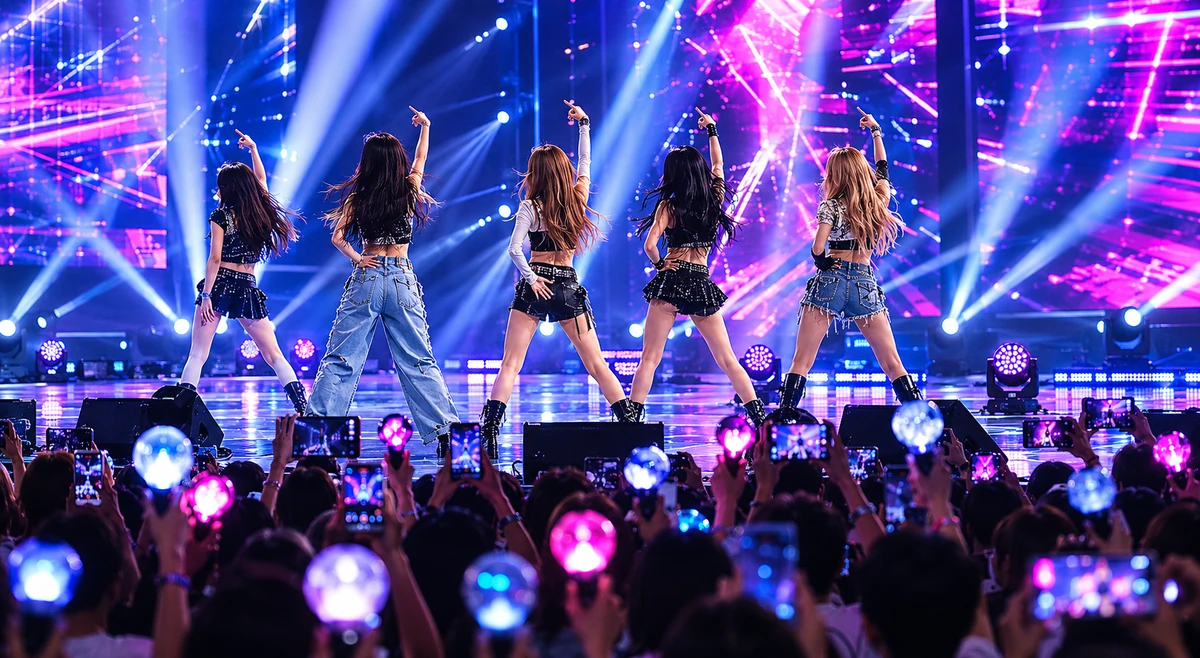
A spring release rush signals a shift in K-pop’s calendar
In South Korea’s music business, summer has long been treated the way Hollywood treats Memorial Day weekend: a prime launch window for big, bright commercial bets. For years, that has been especially true for K-pop girl groups, whose upbeat dance tracks, festival-ready performances and colorful promotional campaigns often peak as temperatures rise. But this year, the industry’s unofficial summer kickoff came early.
Instead of waiting for June or July, some of K-pop’s biggest girl groups packed their return releases into May, creating an unusually dense month of new music from teams tied to the country’s four major entertainment powerhouses. According to reporting by South Korea’s Yonhap News Agency, BABYMONSTER opened the month on May 4 with “CHOOM,” followed by NMIXX on May 11, ITZY on May 18, LE SSERAFIM on May 22 and aespa on May 29.
That schedule matters not just because of the names involved, but because of what it says about how K-pop now operates. These are not fringe acts fighting for scraps of attention. They are headline-level artists backed by companies with global ambitions, international fan bases and sophisticated release strategies. When so many top-tier girl groups land within the same month, it suggests something more than coincidence. It suggests the industry is reorganizing its clock.
For American readers, it may help to think of this like a season in which Taylor Swift, Olivia Rodrigo, Sabrina Carpenter, Blackpink and NewJeans-adjacent peers all chose to release major projects within weeks of one another. Even in a fragmented streaming era, that kind of clustering would shape the conversation. It would dominate fan communities, music media, social feeds and playlist culture. In South Korea, where comeback schedules are tightly watched and heavily choreographed, the effect is even more pronounced.
In K-pop, a “comeback” does not necessarily mean an artist is returning from a long absence. It is industry shorthand for a new promotional cycle: a single, EP or album accompanied by teaser images, music videos, television appearances, fan events, streaming pushes and live performances. A comeback is less a casual release than a full campaign launch. When several of those campaigns overlap at once, the result can feel less like a normal release calendar and more like an ongoing cultural event.
That is what May appeared to become: not simply a month with many releases, but a concentrated showcase for one of K-pop’s most commercially powerful categories.
Five major groups, one crowded month
The most striking feature of this year’s May lineup was the density. Rather than one blockbuster release followed by a lull, the market got a near-weekly handoff from one major girl group to the next. BABYMONSTER started the month, then NMIXX, ITZY, LE SSERAFIM and aespa followed in close succession, sustaining attention without allowing the conversation to cool.
That kind of sequencing is important in K-pop, where momentum is built not only through the songs themselves but through the surrounding ecosystem: teaser drops, concept photos, dance challenges, music show performances, chart tracking, fan-made edits and reaction videos. A fan who arrives for one group’s comeback can easily stay engaged through the next one, and then the next after that. For casual listeners, it creates the sense that something significant is happening in Korean pop even if they are not tracking every detail.
It also helps that these groups do not occupy identical creative lanes. BABYMONSTER, the younger act from YG Entertainment, has been closely watched as a successor-generation player in a company known for producing swagger-heavy pop with global crossover ambitions. NMIXX and ITZY, both under JYP Entertainment, bring different identities despite sharing a corporate home: NMIXX has leaned into experimental vocal arrangements and concept-heavy production, while ITZY built its brand on confident, high-energy anthems and performance-driven charisma. LE SSERAFIM, tied to Source Music and the Hybe orbit, has cultivated a sleek, disciplined image that blends fashion-world polish with messages about resilience and self-possession. aespa, one of SM Entertainment’s flagship groups, remains known for its futuristic visuals, digital-world mythology and crisp, high-concept pop construction.
Because each act arrives with a distinct brand, the crowded schedule does not automatically collapse into sameness. If anything, the variety may reduce fatigue. Fans are not being offered five versions of the same product. They are being invited into five different story worlds, each with its own visual language, sonic signature and fandom culture. That helps explain why a packed calendar can energize the market rather than simply cannibalize it.
In practical terms, the month becomes a rolling festival. Instead of one weekend event, it is a serial spectacle, renewed every few days. In the United States, music consumers are used to Friday release cycles, but K-pop turns release timing into a visible competitive ritual. Track the dates closely enough, and an industry narrative emerges. This May, the narrative was unmistakable: girl groups were driving the center of gravity.
Why May, not summer?
The bigger question is why the industry appears to have pulled forward a release pattern traditionally associated with summer. Yonhap’s reporting pointed to several outside pressures, including world tours and even global sporting events such as the World Cup, as reasons agencies may be rethinking timing. That explanation tracks with the way K-pop has evolved over the past decade from a domestically anchored industry into a global scheduling machine.
In earlier eras, release timing in Korean pop was more closely tied to local television cycles, domestic competition and seasonal listening habits. Summer rewarded bright songs, choreographed spectacle and youth-oriented energy, all areas where girl groups often excelled. But K-pop’s expansion has scrambled the old logic. A top-tier release now has to account for international touring, overseas press, streaming platform strategy, social video rollout, fan engagement across time zones and competition for attention in multiple markets at once.
World tours are an especially important factor. They are not side projects anymore; they are central business operations. Touring requires rehearsal time, travel windows, venue coordination and strategic spacing between promotion and performance. A comeback can help sell tickets, but it can also be swallowed by a busy live schedule if the timing is wrong. Agencies increasingly have to find release windows that serve both recorded music and the road.
Major international events create another complication. Something like the World Cup may not seem directly connected to a K-pop comeback, but in a global media economy, giant events pull oxygen from the room. They shift viewing habits, social conversation and advertiser attention. Entertainment companies know that even digitally native fan bases do not exist in isolation. If the world is looking elsewhere, music launches may struggle to command the same intensity of attention.
Seen that way, May’s crowding is less a scheduling anomaly than a rational adaptation. These agencies may be concluding that the best time to release is no longer the most traditional time to release. The decision is not simply about weather, mood or old industry custom. It is about maximizing visibility while minimizing collisions with global commitments.
For Americans who have watched film studios juggle release dates around the Olympics, the Super Bowl or giant franchise debuts, the logic is familiar. K-pop companies are making similar calculations, just with a more elaborate blend of live performance, digital fandom and international platform strategy. The result is a calendar shaped less by seasonality than by logistics.
What the charts say about fan behavior
This early girl-group push was not merely symbolic. Yonhap reported that multiple new girl-group songs quickly found places on major Korean music charts, including aespa tracks such as “WDA” and “LEMONADE,” NMIXX’s “Heavy Serenade,” and LE SSERAFIM’s “BOOMPALA.” Chart placement in South Korea is not a perfect measure of long-term impact, but it does offer a useful real-time snapshot of audience attention.
The notable thing here is that simultaneous competition did not automatically produce a zero-sum bloodbath. Several songs were able to gain traction at once. That suggests the month’s concentrated release strategy may have expanded overall interest in the category rather than forcing one act to wipe out the others. In other words, competition among girl groups may have functioned as promotion for girl groups writ large.
That is a dynamic American readers can recognize from other entertainment sectors. A strong season for one genre often lifts adjacent titles. During a crowded superhero summer, viewers sometimes consume more superhero content overall. During a major country-pop moment, audiences who stream one artist may quickly end up sampling several more. Abundance can create its own momentum, especially when algorithms, fan chatter and media coverage keep funneling attention back toward the same cluster of acts.
In K-pop, fandom plays an outsized role in intensifying that effect. Fan communities are highly organized, digitally fluent and accustomed to tracking performance metrics, whether that means chart positions, streaming counts, music show wins or video milestones. But fandom in this context is not just about rivalry. It is also about ritual participation. Fans watch teaser rollouts, decode styling choices, compare concepts, circulate clips and turn each release into an event. When several major groups are active at once, the market becomes noisier, faster and harder to ignore.
That has consequences beyond the core fan base. Casual listeners, who might not know every member of every group, still encounter the music through playlists, short-form video, entertainment news coverage and chart visibility. If enough major acts land at once, the broader public can begin to perceive a larger movement. The story stops being that one group had a hit and becomes that girl groups, collectively, are setting the pace.
That seems to be part of what made May stand out. The significance was not only in who ranked No. 1 on a given day. It was in the cumulative presence: multiple high-profile groups, multiple charting tracks and a sustained sense that this corner of the industry had become the main arena of action.
The power of the big four agencies
Another reason this moment drew attention is that it involved the companies often described in Korea as the industry’s major agencies: SM Entertainment, JYP Entertainment, YG Entertainment and, in this case through Source Music, the Hybe-affiliated orbit that now shapes a large share of the market. These firms are more than record labels in the traditional American sense. They are full-spectrum entertainment systems, responsible for training, branding, production, international marketing and fan-community management.
When multiple agencies of that size all move aggressively into the same release window, it sends a broader market signal. Their internal strategies may differ, and each group may have its own timetable, but the collective effect suggests a shared read on current conditions. Put plainly: the people with the best data, the largest budgets and the most at stake appear to believe that May is now worth fighting over.
That matters because top agencies often function as trend setters. Smaller companies watch their moves closely. Broadcasters, advertisers, streaming platforms and promoters respond to their calendars. If these firms begin treating late spring as prime territory for marquee girl-group releases, the industry’s seasonal map could start changing in a more durable way.
It also reinforces the degree to which K-pop has become an exercise in long-range planning. Agency decisions are rarely about one song alone. They involve album arcs, tour routes, endorsement deals, merchandising, social media campaigns and fan-club activation. A comeback is the visible tip of a much larger operation. The fact that so many of these operations converged in May indicates that the industry’s definition of the ideal launch window may be shifting under pressure from global realities.
For outsiders, the term “big four agencies” can sound abstract, but the practical point is simple: these are the players with the resources to shape the rules of engagement. When they move in tandem, even loosely, their choices help define what the rest of the market will consider normal.
What this says about K-pop right now
The broader takeaway is that girl groups are not just participants in K-pop’s current phase. They are central engines of it. May’s crowded comeback schedule underscored how quickly girl-group releases can generate conversation, activate fandoms, chart songs and sustain industry-wide attention. The competition was intense, but it also highlighted the health of the category as a whole.
That does not mean boy groups have lost their importance. Yonhap noted, for example, that JYP Entertainment recently said Stray Kids’ “MIROH” music video surpassed 200 million views on YouTube, while the video for “Easy” topped 100 million, and the group’s cumulative album shipments across Korean and Japanese releases exceeded 40 million copies. Those are blockbuster numbers by any standard. They underline a larger truth about K-pop today: the industry is driven not only by release-day excitement, but by long-term global accumulation, with artists building catalogs, touring ecosystems and international communities that keep generating value over time.
Still, girl groups occupy a particularly visible role in the current moment because of how effectively they convert concepts into quick cultural heat. A comeback from a major girl group is rarely just a song drop. It is a fashion statement, a choreography package, a social media template and a conversation starter. It can move through the culture at high speed, especially when several such releases overlap.
There is also a symbolic dimension. K-pop’s girl-group landscape has become one of the clearest windows into how the genre balances domestic identity with global ambition. The songs may be rooted in a Korean production system, but their rollout assumes international audiences from the start. Fans in Los Angeles, Manila, São Paulo and London are not afterthoughts. They are built into the strategy. That is one reason a Korean release calendar can matter to English-speaking readers thousands of miles away.
If you want to understand where K-pop is headed, watching these release patterns is instructive. The timing of comebacks reveals how agencies are reading the market. The chart response shows how audiences are behaving. And the ability of multiple groups to thrive at once offers a clue about the genre’s current depth. In May, the message was that K-pop’s girl-group sector is not merely crowded. It is structurally important, globally calibrated and nimble enough to turn scheduling pressure into a monthlong showcase.
Why international audiences should pay attention
For American and other English-speaking audiences, this story is about more than a busy month in Korean pop. It is about how a once regionally concentrated music industry now thinks on a global scale. Release timing in Seoul is increasingly shaped by touring demands, worldwide fan engagement and international events that affect attention everywhere. That is the kind of logic familiar to any major entertainment business in the streaming era, but K-pop often applies it with unusual intensity and precision.
It is also a reminder that the Korean Wave, or “Hallyu,” is no longer best understood as a novelty export. Hallyu refers to the global spread of South Korean popular culture, including music, television, film, fashion and beauty. In the United States, many people first encountered it through Psy’s “Gangnam Style,” then later through Oscar-winning film director Bong Joon Ho, Netflix dramas such as “Squid Game,” and the international success of BTS and Blackpink. What stories like this show is the infrastructure beneath those breakout moments. K-pop is not riding on spontaneity alone. It is coordinated, strategic and increasingly synchronized with global entertainment patterns.
The packed May calendar gave international fans a compressed lesson in how the industry works. It showed how agencies stack releases, how distinct group identities coexist inside a crowded market, how charts can reflect category-wide momentum rather than pure elimination, and how business considerations far beyond South Korea can shape the timing of a domestic launch.
Most of all, it offered a snapshot of K-pop at full speed. If summer once belonged to the girl-group showdown, this year May grabbed the spotlight first. And if that shift holds, it may tell us something lasting about where the genre’s power now lies: not in old seasonal habits, but in the ability to adapt faster than the calendar.
For now, the simplest conclusion may be the most useful one. In 2026, at least for one pivotal stretch, the hottest month for K-pop girl groups was not the start of summer. It was spring.
Comments
Post a Comment