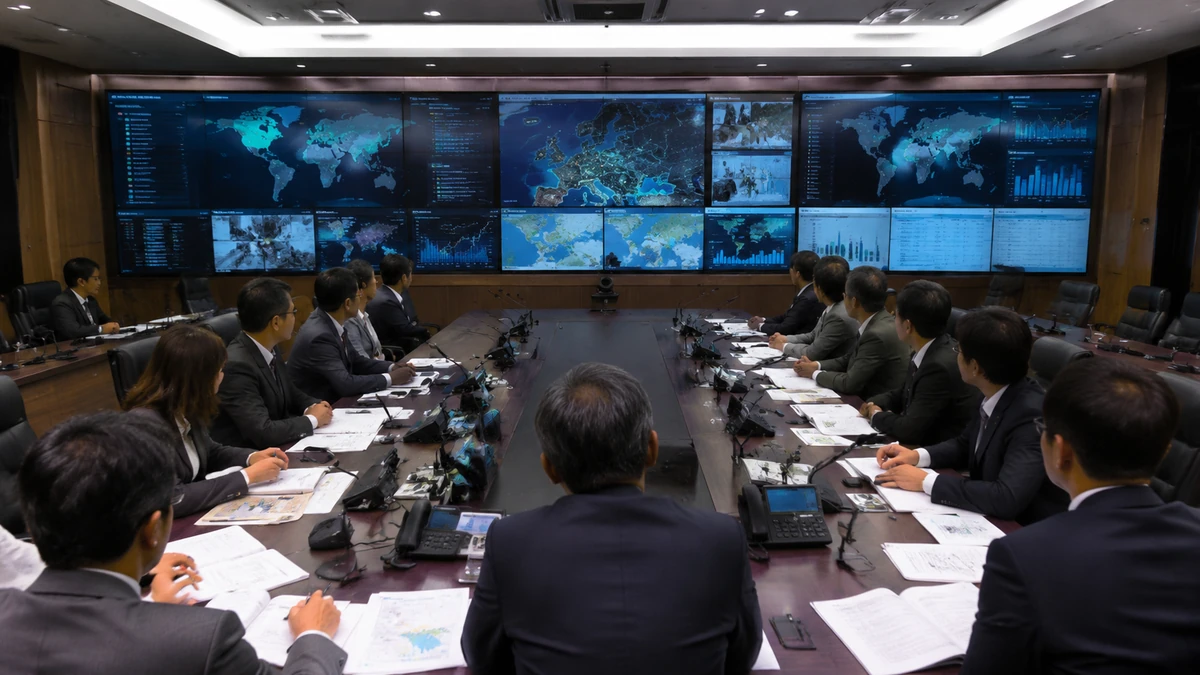
A routine meeting with unusually high stakes
As Russia prepares for Victory Day, one of the most politically charged dates on its calendar, South Korea’s Foreign Ministry has moved into a higher state of vigilance, convening an emergency joint review with officials in Seoul and diplomats stationed overseas to assess safety measures for South Korean nationals in Russia and Ukraine.
On its face, that may sound like standard diplomatic housekeeping. Governments regularly issue travel alerts, monitor embassies and tell their citizens abroad to stay informed. But the timing and tone of Seoul’s response suggest something more serious: South Korean officials are treating the days around Russia’s May 9 commemoration as a period of elevated risk, not just symbolic tension.
The ministry’s action follows reported warnings from Russia’s Foreign Ministry that there is a risk of attacks on Moscow during the Victory Day period, along with the possibility of large-scale Russian retaliatory strikes against Ukraine. Russian authorities, according to reports cited by South Korea’s Yonhap News Agency, urged foreign nationals and diplomatic missions in Kyiv to consider leaving. That kind of warning raises concern on both sides of the war zone, because it points not to a single isolated threat but to the possibility of a broader cycle of attack and response.
For South Korea, the immediate priority is not taking a new public position on the war. It is making sure South Koreans in the region are accounted for, informed and able to get help quickly if the situation deteriorates. In practical terms, that means checking communication lines between headquarters and embassies, reviewing emergency protocols and continuously updating citizens on the ground.
That kind of response rarely generates dramatic images. There is no summit handshake, no headline-grabbing agreement, no soaring diplomatic language. Yet this is often what foreign policy looks like in real life: a government’s ability to protect its citizens when events in another part of the world suddenly become more dangerous.
Why Victory Day matters far beyond a parade
To American readers, Victory Day may be most comparable in broad emotional weight to a mix of Memorial Day, Veterans Day and the Fourth of July, though none of those analogies is exact. In Russia, May 9 marks the Soviet Union’s victory over Nazi Germany in World War II, known there as the Great Patriotic War. It is one of the country’s most important civic and political observances, typically featuring military parades, patriotic ceremonies and a strong message about national sacrifice and strength.
That symbolism matters because anniversaries like these can intensify security concerns. A major national holiday tied to military pride and wartime memory is not just a ceremonial date; it is also a moment when threats are viewed through a heightened political lens. Any perceived challenge, especially one involving the capital, carries greater symbolic weight. Governments often increase defenses around such events, and opponents may calculate that even a small disruption could have outsized psychological or political impact.
That appears to be part of the logic driving Seoul’s urgent review. South Korean officials are responding to a calendar moment that carries significance not only inside Russia but also across the wider diplomatic community. If officials believe the threat environment around Victory Day is more volatile than usual, then simply maintaining normal embassy operations without a fresh review would risk appearing complacent.
That is especially true in a war that has repeatedly shown how quickly conditions can change. Even in places far from the front lines, drone strikes, missile threats and retaliatory actions have altered assumptions about what areas are safe and when. A warning tied to Victory Day, therefore, is not just about a parade in Moscow. It is about the possibility that symbolic politics could trigger real-world danger in multiple cities at once.
Seoul’s focus is consular protection, not political theater
The South Korean Foreign Ministry said its headquarters and overseas missions reviewed safety measures for South Koreans staying in the affected region. The key embassies involved are those in Ukraine and Russia, which have been checking on citizens’ safety, posting notices and staying in close communication with Seoul.
That language may sound dry, but it points to the mechanics of modern crisis management. In diplomatic emergencies, governments generally rely on three pillars: contact, information and coordination. First, they try to determine where their citizens are, whether they are safe and whether they may need help relocating. Second, they issue clear safety notices so people know what risks to watch for and what actions to take. Third, they coordinate constantly between the foreign ministry at home and officials on the ground, because decisions about warnings, evacuations or temporary service changes need to reflect both local reality and central oversight.
South Korea’s foreign ministry, like the U.S. State Department, has a consular safety apparatus designed to handle exactly these situations. The official who underscored the need for continuous contact between headquarters and missions was Yoo Byung-seok, head of the ministry’s consular and safety bureau, a division responsible for protecting South Koreans overseas. His message was notably operational rather than rhetorical: maintain around-the-clock communication, monitor developments closely and leave no gaps in securing the safety of citizens and embassy staff.
That emphasis is revealing. In times of international crisis, there is often pressure on governments to make broad political statements. Seoul’s wording instead highlighted process, vigilance and readiness. In other words, South Korea is signaling that this is not primarily a moment for diplomatic grandstanding. It is a moment to make sure the phones are answered, the alerts are current and the chain of command is functioning.
For Americans, one useful comparison might be how U.S. embassies operate during periods of unrest, whether in the Middle East, Eastern Europe or parts of Africa. Much of the work happens quietly: security reviews, accountability checks, travel advisories, contingency planning and rapid communication with citizens. South Korea’s latest move fits squarely within that tradition of practical statecraft.
Why embassy staff safety matters as much as citizen alerts
One detail in the South Korean response deserves particular attention: officials explicitly referred not only to the safety of South Korean nationals but also to the safety of embassy personnel. That may seem obvious, but in crisis management it is crucial.
Embassies are not abstract symbols. They are the physical and administrative hubs through which governments assist citizens abroad. If embassy staff face threats, movement restrictions or communication breakdowns, the government’s ability to help its citizens can quickly weaken. In extreme cases, consular operations can be reduced, relocated or suspended, leaving travelers, businesspeople, students and long-term residents with fewer options for urgent assistance.
That is why experienced foreign ministries think about institutional resilience as well as individual safety. Protecting embassy staff helps preserve the mission’s ability to function, whether that means answering emergency calls, coordinating with local authorities, issuing updated advisories or helping people arrange transportation out of a dangerous area.
South Korea’s stress on continuous communication between headquarters and missions reflects that reality. In a rapidly changing environment, embassies need to be able to tell Seoul what is happening on the ground, and Seoul needs to be able to direct resources and decisions efficiently. The goal is not just to know that tension is rising. It is to maintain the machinery needed to respond if tension turns into immediate danger.
That matters in both Kyiv and Moscow, though for different reasons. In Kyiv, concern centers on the possibility of intensified Russian strikes if events around Victory Day trigger retaliation. In Moscow, concerns may center on the threat of attack or increased security restrictions around a major political event. For a foreign ministry trying to protect its nationals, both environments require monitoring, even if the risk profiles are different.
What this says about South Korea’s role in a turbulent world
South Korea is often discussed internationally through the lens of technology, trade and popular culture. Americans know it as the home of Samsung, Hyundai and global entertainment exports ranging from K-pop to Oscar-winning films and hit streaming dramas. But Seoul is also a middle power with a large global footprint, and that means its government must increasingly manage the fallout from crises far from the Korean Peninsula.
That reality is easy to miss when diplomacy is portrayed mainly through high-level meetings and security summits. In practice, one of the clearest tests of a country’s diplomatic capacity is whether it can protect its citizens overseas during instability. A foreign ministry’s competence is measured not only by what it says at the United Nations or during a presidential visit, but by whether it can maintain a functioning support network when commercial flights are disrupted, cities come under threat or embassy staff need to shift into emergency mode.
Seen in that light, the ministry’s review ahead of Victory Day offers a snapshot of how South Korea sees its responsibilities. This is a country that is geographically distant from the Russia-Ukraine war but not insulated from its consequences. South Korean nationals live, work and travel abroad. South Korean embassies operate in conflict-affected regions. South Korean companies and institutions maintain international ties that can be disrupted by war. Distance does not eliminate exposure.
There is also a broader political point. South Korea’s response underscores that modern diplomacy is as much about administration and risk management as it is about negotiation. A government builds trust not only by securing strategic partnerships but also by proving to its citizens that it can look after them when the global environment turns unstable. That kind of trust is less visible than a treaty signing, but it can be just as important.
In Washington, similar debates often arise after evacuations, travel warnings or embassy incidents: Did officials act quickly enough? Were they communicating clearly? Did they distinguish between symbolic reassurance and practical help? South Korea’s latest actions suggest its foreign ministry wants to show that it is focused on operational readiness before a worst-case scenario unfolds, not after.
A warning without panic, and vigilance without overstatement
Another notable feature of Seoul’s response is its restraint. The ministry did not appear to indulge in alarmist language, nor did it dismiss the concern as routine noise. Instead, it framed the issue as one requiring close monitoring and necessary action. That may sound like careful bureaucratic wording, but it reflects a common challenge in crisis communication: how to be credible without causing unnecessary panic.
If governments overstate a threat and nothing happens, they can lose credibility. If they understate it and the situation worsens, the consequences can be far more serious. The most effective crisis messaging often lands somewhere in the middle, telling citizens what is known, acknowledging uncertainty and reinforcing practical steps.
That balance is especially important when dealing with an active war and a major national commemoration that could alter security calculations. No foreign ministry can guarantee how events will unfold. What it can do is prepare for a range of possibilities, maintain live communication with those at risk and update its guidance as facts change.
South Korea’s approach, at least from what has been publicly described, appears to follow that template. Officials reviewed the situation, reiterated that embassies are checking on citizens and posting safety notices, and said they would continue watching developments closely. The emphasis is on continuity: not a one-time warning, but an ongoing system of observation and response.
That may prove to be the most significant point of all. In crisis zones, safety is not produced by a single announcement. It depends on repeated contact, accurate information and institutions that continue to function under pressure. The phrase “constant communication,” used by South Korean officials, may be the least dramatic part of the story, but it is likely the most important.
What to watch next
For now, the publicly confirmed facts are limited but meaningful. South Korea held a joint situation review on May 7. Its embassies in Russia and Ukraine have continued safety checks and public notices for South Korean nationals. Senior consular officials have instructed missions to maintain continuous communication and to ensure there are no gaps in securing the safety of both citizens and embassy staff.
What happens next will depend on events around Victory Day and any military or security developments that follow. If the period passes without major incident, Seoul’s response may fade quickly from public attention. If tensions escalate, however, the systems reviewed this week could become the backbone of a larger emergency response.
Either way, the episode highlights an aspect of international affairs that often receives less attention than battlefield maps or geopolitical rhetoric: the everyday but essential work governments do to protect their people abroad. For South Korea, that means recognizing that a war in Eastern Europe can create immediate responsibilities for a ministry in Seoul. For Americans watching from afar, it is a reminder that diplomacy often matters most when it looks least glamorous.
In the end, this is not a story about diplomatic spectacle. It is a story about readiness. Ahead of one of Russia’s most sensitive national anniversaries, South Korea is signaling that it sees a period of heightened uncertainty and is responding accordingly. In an era when conflict can escalate rapidly and symbolism can carry operational consequences, that kind of sober, methodical preparation may be one of the clearest markers of a government taking its responsibilities seriously.
Comments
Post a Comment