
A lopsided score, but not a simple story
South Korea’s men’s table tennis team is out of the 2026 World Team Table Tennis Championships after a 3-0 quarterfinal loss to China in London, a result that on paper looks decisive and familiar. China remains the sport’s gold standard, the nation every other table tennis power measures itself against. When the knockout rounds arrived, that hierarchy held.
But the final score alone misses why this match mattered, and why it drew such close attention in South Korea and across the wider table tennis world. This was not just another quarterfinal between a favorite and an underdog. It was a rematch layered with recent history, pressure and possibility. Earlier in the tournament, South Korea had stunned China in seeding-group play, claiming its first men’s team victory over the Chinese in 30 years. In a sport where China’s dominance can feel as structural as it is athletic, that kind of breakthrough lands with the force of a seismic event.
So when the teams met again in the quarterfinals, the question was larger than whether South Korea could reach the semifinals. The real question was whether that earlier upset had been a one-day flash or evidence that South Korea’s men had genuinely closed some of the distance on the world’s deepest and most accomplished program. The answer, at least for now, was complicated. South Korea lost 3-0. It also showed enough fight, especially in its opening singles match, to suggest the upset was not pure accident.
For American readers less familiar with table tennis’ global pecking order, imagine a smaller soccer nation beating Brazil in group play at a major international event, then having to face Brazil again in the knockout stage once the favorite has fully locked in. Or think of a college basketball team that shocks a blue-blood power in the regular season but then sees that same powerhouse return in March with sharper focus and its best lineup. That was the emotional and competitive shape of South Korea’s challenge here.
The match ended South Korea’s tournament in the quarterfinals. It did not end the conversation about where the team stands, or where it may be headed next.
Why any win over China carries outsized meaning
To understand why South Korea’s defeat could still be framed as meaningful, it helps to understand what China represents in table tennis. In much of the English-speaking world, table tennis is often treated casually, as a basement or rec-room pastime. Internationally, especially in East Asia and parts of Europe, it is something very different: a highly technical, deeply competitive sport with national prestige attached to its biggest events. In that world, China has spent decades operating like a dynasty with almost no modern equivalent.
Chinese players have long dominated the men’s and women’s games through a combination of elite infrastructure, relentless internal competition and a pipeline that keeps producing world-class talent. The country’s top athletes are not just champions; they are often the benchmark for how the sport is played. Beating China in a team event is not like upsetting a good program. It is more like knocking off the New York Yankees of their most feared era, the U.S. women’s national soccer team at its peak, or the golden-age Olympic basketball Americans once expected to win every time.
That is why South Korea’s earlier victory over China in seeding-group play resonated so strongly. According to South Korean and wire reports, it marked the country’s first men’s team win over China in 30 years. In sports, anniversaries can sometimes be a convenient way to dramatize routine results. This was not one of those cases. Three decades is an entire generation of athletes, coaches and fans. It means a breakthrough many people involved in the sport had never personally seen at this level.
In South Korea, table tennis has a proud history and a recognizable place in the broader sports culture, even if it no longer draws the day-to-day attention reserved for baseball, soccer or the Olympics. It carries echoes of past national success and of an era when Korean players were more frequent disruptors on the world stage. A win over China did not instantly restore that old balance, but it did reopen a door that had seemed sealed shut for years.
That is what made the quarterfinal rematch so compelling. It was not only about survival in the bracket. It was about whether South Korea could prove that its earlier win reflected something durable: better depth, sharper preparation, stronger nerves, or perhaps the emergence of a player capable of altering the matchup.
Oh Jun-sung’s stand against the world No. 1
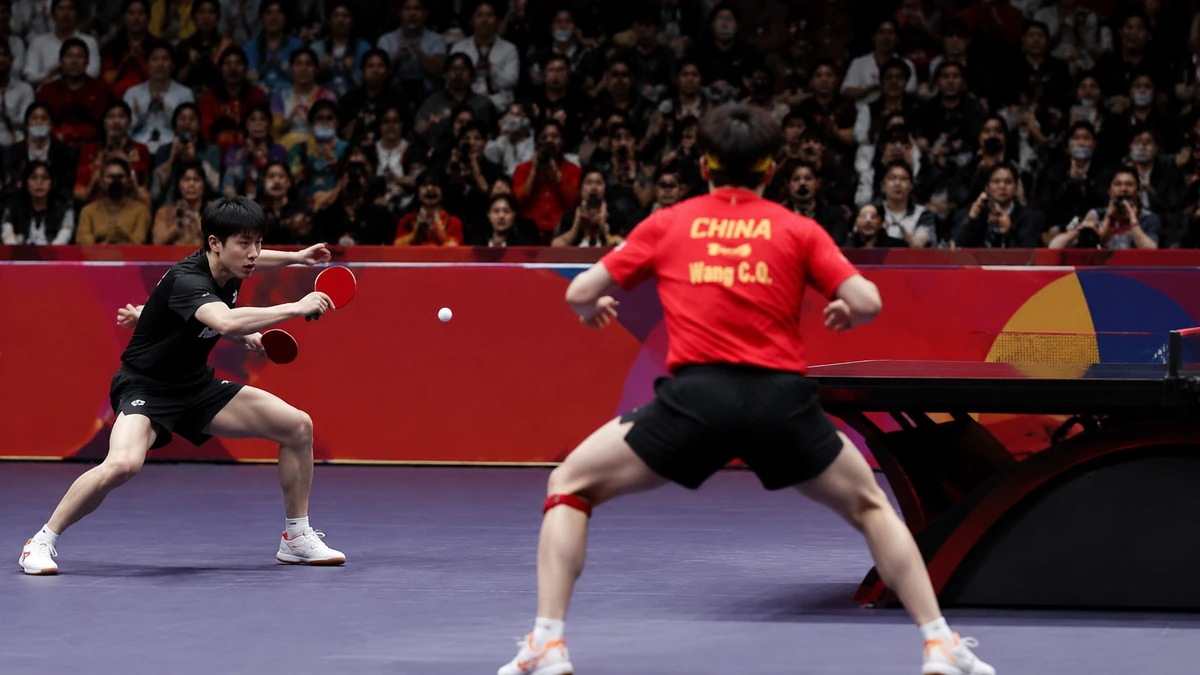
The most closely watched figure in that effort was Oh Jun-sung, who had been central to South Korea’s earlier triumph over China. In the seeding-stage meeting, Oh reportedly delivered two singles victories by himself, making him the obvious emotional centerpiece of the rematch. South Korea once again put him forward first, effectively signaling that if another upset was going to take shape, it might begin with the same player who had sparked the first one.
This time, however, the challenge was even steeper. Across the table stood Wang Chuqin, the world No. 1 and one of the biggest names in the men’s game. He had not played in the earlier loss to South Korea, which meant this quarterfinal was not just a repeat meeting. China had returned with one of its strongest possible cards on the table.
That matters in team table tennis, where lineup decisions can be every bit as tactical as substitutions in baseball or pitching rotations in a playoff series. Team matches are made up of individual contests, but the order of play, the psychological tone set by the opener and the way one result influences the next all matter enormously. By sending out Wang first, China made clear it intended to reassert control immediately. By countering with Oh, South Korea showed it was not backing away from that confrontation.
The match itself appears to have justified the anticipation. Oh dropped the first two games, a dangerous place to be against the top-ranked player in the world. Against an opponent of Wang’s caliber, falling behind early can quickly turn into a straight-line defeat. Instead, Oh pushed back. He took the third and fourth games, extending the contest and forcing a real test of nerve and execution.
For fans who do not follow table tennis closely, this is one of the sport’s most compelling qualities. Matches can turn on tiny margins: a serve receive read half a second late, a topspin rally shifted just slightly wider to the backhand, a player finding rhythm on third-ball attacks after spending a game searching for timing. Momentum is visible and immediate. A player who looks overmatched can suddenly start seeing the ball better, forcing longer exchanges and testing the favorite’s composure. That appears to be what Oh did, even if he could not ultimately complete the comeback.
South Korea lost the match, and in team competition that means losing the first point of the tie. But Oh’s resistance mattered because it reinforced the broader message South Korea has tried to send in this tournament: that it can now stand in against the sport’s most powerful team and make China work for control.
What a 3-0 loss does and does not say
There is no reason to soften the basic competitive truth. A 3-0 team loss is decisive. South Korea did not capture a single match in the tie and did not advance to the semifinals. China remains the world’s dominant force, and when elimination pressure rose, it was China that responded like a champion.
At the same time, sports are full of results that require more interpretation than the scoreboard gives them. A team can lose 3-0 and still reveal progress. Another can win narrowly and expose weaknesses. This quarterfinal falls into the first category for South Korea. The result was harsh, but it was not empty.
The reason is simple: beating a powerhouse once and consistently challenging that powerhouse are two very different stages of development. South Korea already cleared the first hurdle in London when it snapped that 30-year drought against China in group play. The quarterfinal showed how much harder the second task is. It is one thing to produce a breakthrough result when confidence is high and circumstances align. It is another to do it again when the opponent has adjusted, fortified its lineup and entered with no margin for error.
That distinction is familiar across sports. An NFL team can spring one upset in October; proving it belongs with the conference elite requires doing it repeatedly. A tennis player can defeat a top seed once; becoming a genuine rival means forcing that player into trouble again and again. South Korea’s men are somewhere in that transition now. They are no longer trying merely to prove they belong on the court with China. In this tournament, they did that. The next step is learning how to convert that belief into repeatable outcomes under maximum pressure.
That is why the quarterfinal loss can be read as both a setback and a measuring stick. It showed the gap that remains. It also showed that the gap is no longer so large that a challenge itself feels implausible.
The significance of coach Oh Sang-eun’s project
South Korea’s team is led by coach Oh Sang-eun, himself a familiar name in the country’s table tennis history. In South Korea, as in many sports cultures, former star athletes who become national-team coaches carry a particular burden. They are asked not only to manage tactics and lineups, but also to reconnect a program with its own memory of success. Every tournament result becomes part performance review, part referendum on direction.
By that standard, this championship leaves behind a mixed but meaningful record for Oh’s team. The quarterfinal exit is disappointing; knockout losses always are. Yet the tournament also delivered a result South Korean men’s table tennis had not managed against China in three decades. That alone gives the campaign substance beyond its finish.
Team table tennis, moreover, is especially revealing about coaching because it is not just a collection of individual rankings. Coaches have to decide who opens, who is trusted in swing matches and how to balance current form against matchup dynamics. The decision to center so much of South Korea’s China strategy around Oh Jun-sung appears to have been validated by the earlier upset and by Oh’s willingness to take on Wang in the quarterfinal opener.
That does not mean every tactical question has been answered. If anything, the loss clarified the next ones. Can South Korea build enough depth so that a challenge to China does not rely so heavily on one player’s spark? Can it prepare for the ways elite teams adjust after an upset? Can it translate emotional momentum from a breakthrough win into steadier execution in the bracket, where there is less room for volatility and more punishment for slow starts?
Those are not signs of failure so much as signs of a team moving into a more demanding phase of ambition. When a program is far from the top, the question is whether it can dream. When it edges closer, the question becomes whether it can sustain pressure, absorb counterpunches and do the hard, unglamorous work of staying there. South Korea now seems closer to the second category.
Why this matters beyond South Korea
For international audiences, especially readers in the United States, a story like this offers a useful reminder that the center of gravity in global sports does not always align with what dominates American headlines. Table tennis may sit outside the U.S. sports mainstream, but in Asia and much of Europe it carries real strategic depth, strong national programs and intense rivalries. Within that ecosystem, a South Korea-China quarterfinal is not a niche event. It is a meeting with history, hierarchy and regional prestige built into it.
It also speaks to a broader pattern in South Korean sports. The country is often best known internationally for cultural exports like K-pop, Korean dramas and Oscar-winning cinema, but its sports story is just as rich and in some ways more revealing. South Korean athletes have repeatedly tried to carve out space against larger powers in disciplines ranging from archery and fencing to baseball, soccer and speed skating. Table tennis fits that pattern. The appeal lies not just in winning, but in the recurring willingness to challenge systems that look entrenched.
That helps explain why South Korean coverage of this loss emphasized the meaning of the attempt rather than treating the result as a dead end. In Korean sports discourse, there is often close attention to what a team’s performance says about trajectory, not merely placement. A quarterfinal defeat can still matter if it shows a team has rediscovered competitive edges that were missing before. That framing may sound sentimental if stripped of context, but here it is grounded in an undeniable fact: South Korea had already done something in this tournament it had not done against China in 30 years.
For China, the takeaway is different but equally significant. Dynasties are defined not only by titles but by how they answer challenges. After absorbing a rare team loss earlier in the event, China responded with a clean 3-0 result in the knockout round. That is what enduring powers do. They tighten the screws, adjust personnel and restore order before uncertainty can spread.
For South Korea, the tournament ends with frustration, but not with irrelevance. The team leaves London having reminded the sport that China can be touched, even if not yet consistently toppled. It leaves with a player in Oh Jun-sung who emerged as a central figure in that effort. And it leaves with a set of questions that are far more ambitious than the ones it carried into the event.
In the short term, the record will show a quarterfinal exit after a 3-0 loss. In the longer view, this may be remembered as a tournament in which South Korea’s men proved that one burst of celebration against the sport’s dominant power was not just a lucky afternoon. It was a warning shot, an unfinished argument and a reason to keep watching the next time these teams meet.



0 Comments