South Korea’s President Hails Possible Honam Chip Investment as ‘Historic,’ Turning Factory Siting Into a National Political Test
A factory debate becomes a presidential message
In the United States, arguments over where to build a major semiconductor plant usually sound like a mix of economic development pitch, national security strategy and local jobs politics. Think of the competition for Intel projects in Ohio, TSMC in Arizona or the yearslong campaign to spread the benefits of the CHIPS and Science Act beyond the coasts. South Korea is now having its own version of that debate, but with its characteristic intensity: compressed, highly political and unfolding in real time on social media.
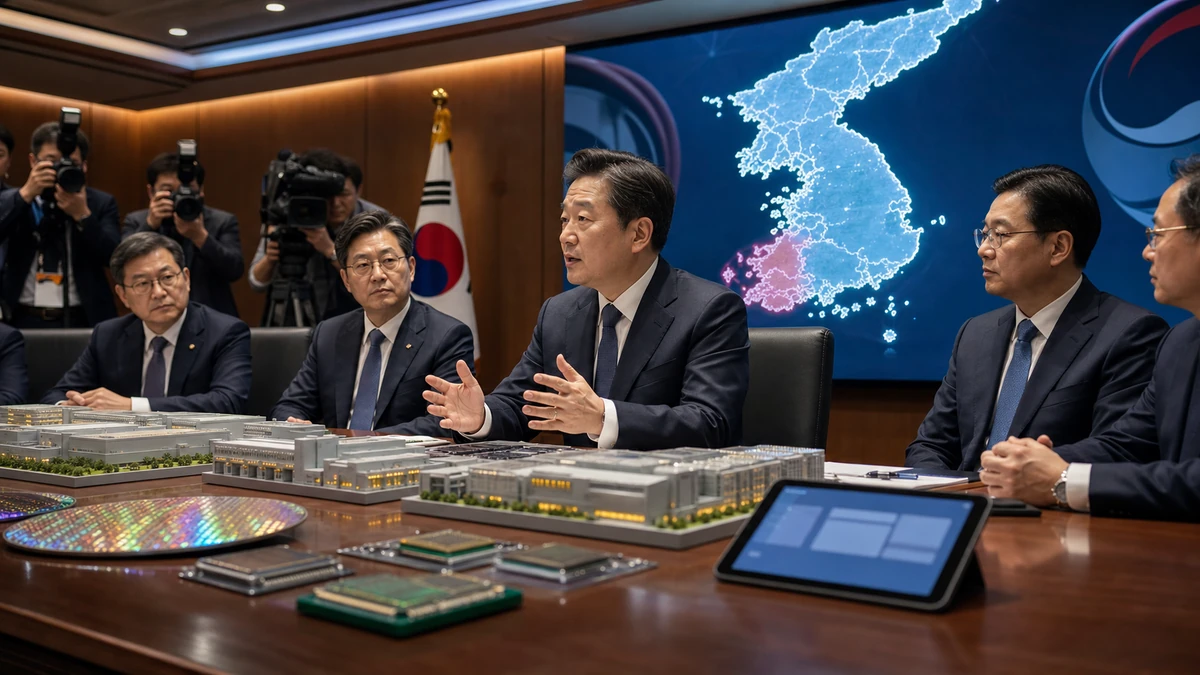
President Lee Jae Myung has publicly celebrated the prospect of a large-scale semiconductor investment in the country’s Honam region, calling it a “historic achievement” and linking it to what he described as South Korea’s “survival strategy.” His comments, posted repeatedly on X, formerly Twitter, have helped transform what might otherwise have been a question of corporate site selection into a major national political issue.
The immediate subject is the possibility that Samsung Electronics and SK hynix — South Korea’s two dominant chipmakers, sometimes collectively referred to in shorthand as “Samjeonniks” in Korean political conversation — could make major investments in semiconductor facilities in the southwest. The companies have not been described in the available reporting as having finalized a binding announcement. That distinction matters. At this stage, the controversy is not about a factory that is already under construction. It is about whether the expectation of such an investment, and the political celebration of it, signal a deeper shift in how industrial policy is being used and talked about in South Korea.
What makes this more than a business story is Lee’s insistence that the issue belongs at the center of his governing agenda. By posting multiple times in a single day, he effectively told the country that semiconductor geography — not just semiconductor output — is now a matter of presidential significance. In South Korea, where chips are not merely another export sector but a pillar of national competitiveness, that is a powerful message. It also guarantees scrutiny.
For American readers, the closest analogy may be a White House effort to frame a chip plant in an economically lagging region not simply as a jobs win, but as proof that Washington can rebalance the national economy. That kind of message can energize supporters. It can also invite accusations that government is pressuring companies to make politically useful investments. South Korea is now wrestling with exactly that tension.
Why Honam matters in Korean politics
To understand why this debate has become so charged, it helps to understand what “Honam” means in South Korea. The term generally refers to the country’s southwest, including the city of Gwangju and South Jeolla province. In Korean politics, Honam is more than a map label. It is one of the country’s most politically and historically significant regions, long associated with democratic activism, regional identity and, crucially, a sense that development has often been concentrated elsewhere.
South Korea’s economic rise was never evenly distributed. Like many industrialized countries, it built powerful growth corridors, especially around the capital region and major existing industrial clusters. In practical terms, that has meant heavy concentration of people, capital and advanced manufacturing in and around Seoul and other established hubs. The result has been a recurring political argument over “balanced national development,” a phrase familiar in Korean public policy that refers to deliberate efforts to reduce regional disparities.
That framework is central to Lee’s argument. He did not describe possible semiconductor investment in Honam as a routine corporate choice. He portrayed it as the fulfillment of a core administrative duty: public officials, he said, were doing what they should do to achieve balanced national development. In his telling, this is not just a local subsidy fight or a regional favor. It is a state objective tied to national survival.
That language reflects a broader Korean view of semiconductors as strategic industry. South Korea, like the United States, increasingly sees chip production through the lens of resilience, technology leadership and geopolitical competition. But Lee’s intervention adds another layer: he is saying that where the chip industry grows inside the country is itself part of the national strategy. In other words, industrial policy is no longer only about how much South Korea makes, or how globally competitive its firms remain. It is also about whether the benefits of that industry can be spread to places that have historically had less access to flagship investment.
Supporters in the ruling Democratic Party have emphasized that Honam should not be dismissed as a symbolic or politically convenient choice. Lawmakers from Gwangju have argued that the region has practical advantages, including water and electricity supply — both essential for semiconductor fabrication and related facilities. In that respect, they are making a technocratic case as much as a regional one: this is not charity, they say, but rational industrial planning.
Still, in South Korea, regional development arguments rarely remain technocratic for long. They quickly become political because they touch long-standing questions of representation, fairness and whether national power is concentrated too heavily in the capital and existing industrial centers. That is why the Honam issue resonates so far beyond one potential investment.
The political risk of celebrating a possibility
Lee’s enthusiastic framing has created both momentum and vulnerability. Praising a not-yet-confirmed investment as a “historic achievement” can project confidence and determination. It can also raise uncomfortable questions. Has the government moved ahead of the companies? Is it presenting an aspiration as an accomplishment? And if the investment does materialize, how much of the decision will critics say came from market logic versus political influence?
Those questions are especially sensitive in South Korea, where the relationship between government and the giant family-influenced conglomerates known as chaebol has always drawn attention. Samsung and SK are not ordinary companies in the Korean economy. They are national champions whose investment decisions affect employment, exports, local ecosystems and market sentiment. When a president speaks forcefully about where such companies may invest, it inevitably revives an old debate: where does industrial coordination end and political pressure begin?
Opposition figures have already pushed in that direction, suggesting that the government may be steering or pressuring major companies toward a politically favored region. Ruling party lawmakers have strongly rejected that interpretation, arguing that critics are reducing a serious discussion about future industry to crude partisan conflict. One Democratic lawmaker denounced the idea that the location debate should be judged through the language of political combat rather than industrial logic.
The clash points to a broader issue in modern Korean governance. South Korea’s state has historically played an assertive role in economic transformation, far more directly than Americans often expect from advanced democracies. That legacy helps explain why industrial policy remains politically potent. It also explains why even the appearance of state direction toward a preferred region can trigger suspicion. To some, active state involvement is a necessary tool for strategic development. To others, it is a step toward “government-led management” of private business decisions.
The fact that the current discussion centers on a “possibility” rather than a confirmed, detailed corporate announcement makes the political optics even more delicate. If the companies later confirm a major Honam investment with clear operational logic, Lee may be credited with giving political cover to a bold development push. If the plans stall or narrow, the White House-like celebration beforehand could look premature. The political stakes, in other words, are inseparable from the timing.
Social media, message control and a familiar modern problem
The controversy has also highlighted a feature of contemporary politics that will be familiar to American readers: the difficulty of using social media as both a governing tool and a precision instrument. Lee did not rely on a single formal statement. He posted repeatedly on X, underscoring the urgency he attaches to the matter. That direct communication style can energize supporters and allow a president to frame events without media mediation. It can also produce interpretive chaos when tone outruns context.
One line in particular intensified scrutiny. Lee used a phrase that roughly translates to the idea that “a pig sees only pigs,” language that drew speculation over whether he was taking a swipe at intra-party critics or political opponents. The presidential office later said the remark was about the semiconductor factory issue and urged against overinterpretation in news coverage.
That episode illustrates the compression effect of social media politics. A long-term industrial policy question involving infrastructure, capital investment, workforce planning and regional economics was suddenly refracted through one sharply worded post. The policy substance did not disappear, but it had to compete with the viral mechanics of metaphor, insult and factional reading. This is not unique to South Korea. It is a recurring problem in democracies where executives use social media to dominate the message cycle: the platform rewards emotional shorthand, while the policy requires nuance.
In Lee’s case, the challenge is especially acute because he is trying to elevate a developmental argument. He wants the public to see semiconductor siting as part of a national doctrine, not a backroom bargain. But the more he personalizes the message, the more the story becomes about his rhetoric, his motives and the political signals embedded in his wording. What could have remained a debate over industrial geography becomes, instead, a referendum on presidential communication style.
For global readers, there is a revealing lesson here. In a country where semiconductors are central to national power, even the location of a future facility can become a political theater involving corporate strategy, regional identity and presidential branding. Social media accelerates that transformation. It turns a policy debate into an event.
Can balanced development and corporate autonomy coexist?
At the heart of the dispute is a question that extends far beyond South Korea: how should governments promote strategic industries while respecting the independence of companies making multibillion-dollar decisions? This tension is hardly limited to Seoul. The United States has also moved toward more explicit industrial policy, especially in semiconductors, clean energy and critical supply chains. Public subsidies, local tax breaks and federal incentives all aim to shape corporate behavior. Yet American officials still usually speak carefully about preserving the private sector’s decision-making role.
South Korea faces the same balancing act under more intense conditions. The country is smaller, its industrial base is more concentrated and its flagship corporations are more dominant relative to the size of the economy. That makes every major siting decision feel bigger. A semiconductor facility is not just a factory. It is a cluster, an ecosystem and often a statement about which regions are included in the next chapter of growth.
Lee’s supporters argue that there is nothing contradictory about encouraging investment in Honam while acknowledging corporate economic logic. They say Gwangju and South Jeolla offer genuine industrial advantages and that the country should stop treating regional development as inherently suspect. Their underlying argument is one many Americans would recognize from debates about reviving the Midwest or directing new manufacturing toward overlooked regions: if government never tries to alter the geography of opportunity, market concentration simply hardens.
Critics counter that once a president openly claims political credit for a possible investment by the nation’s largest firms, it becomes harder to distinguish encouragement from pressure. Even if no formal coercion exists, the message can still shape expectations. In highly coordinated economies, expectations matter. Companies may conclude that certain decisions are politically favored and others politically costly.
Both arguments contain truth. Balanced development usually requires state action; regional inequality does not correct itself automatically. But credible strategic investment also depends on companies believing that decisions will be judged by operational merit, not political choreography. The Lee administration’s challenge is to prove that Honam’s case can withstand hard scrutiny on infrastructure, cost, workforce and supply-chain logic, not merely rhetorical appeal.
That is why the next phase of the debate will likely center less on applause lines and more on verification. If concrete plans emerge, analysts will want to know the size of the investment, the type of facility involved, the timeline, the role of local and national incentives and whether the project fits broader production strategy for Samsung or SK hynix. Until those details are public, both celebration and criticism are operating partly on inference.
An unexpected wrinkle: cautious support from the right
One of the more interesting aspects of the controversy is that it has not broken neatly along party lines. A conservative politician from the Honam area, former People Power Party figure Lee Jung-hyun, reportedly offered a measured but notable form of support. He said verification is necessary, but warned that scrutiny should not be used to smother the effort at its outset. He also argued that conservatives should be willing to root for Honam’s growth, suggesting that stronger local economies, more jobs for young people and greater political competition would benefit not only the region but Korean democracy as a whole.
That argument is significant because it breaks from the most cynical version of regional politics. Instead of treating Honam’s industrialization as a partisan win for one side and a loss for the other, it frames development as something that can expand the political marketplace itself. The logic is straightforward: when a region becomes more economically dynamic, its voters are less likely to be seen merely as a fixed political bloc, and parties have more incentive to compete there seriously.
For American readers, this may sound similar to arguments that sustained investment in historically one-party or economically neglected regions can reshape political competition over time. Economic development does not automatically produce ideological moderation or partisan turnover, but it can alter the conditions under which politics happens. That is part of what makes the Honam debate bigger than chips.
At minimum, the conservative response shows that the issue is not reducible to a simple ruling-party talking point. There is a constituency, including outside the left, for the idea that South Korea’s future industrial map should be broader than its current one. The disagreement is over how to get there and how to ensure that strategic ambition does not slide into political overreach.
What to watch next
For now, the most important point is what has not yet happened. Based on the information available, there is still no fully confirmed public investment announcement laying out exact 규모, location, schedule and contractual details from Samsung Electronics or SK hynix. That means the story remains in a politically volatile interim stage — advanced enough to generate presidential triumphalism and opposition suspicion, but not settled enough to resolve either.
The next test will be whether the discussion moves from rhetoric to evidence. If the companies formally outline a project in Honam, the administration will claim vindication and likely argue that South Korea is entering a new era of regionally distributed strategic growth. If the plans are more limited than expected, or if the companies emphasize internal business considerations over political encouragement, the current messaging may come under sharper review.
Either way, Lee has already accomplished one thing: he has moved industrial policy from the background of Korean governance to the front page of Korean politics. That shift matters. It suggests that in today’s South Korea, debates once confined to ministries, planners and corporate boardrooms can quickly become symbols of national philosophy. Is growth something that radiates naturally from existing winners, or something government must intentionally rebalance? Is a chip factory primarily an investment decision, or also a social contract?
Those are not abstract questions in Seoul, and they are not abstract questions in Washington either. Around the world, governments are rediscovering industrial policy under the pressures of supply-chain vulnerability, technological rivalry and domestic inequality. South Korea’s Honam semiconductor debate shows what that rediscovery looks like in a country where the stakes are unusually concentrated and the politics unusually immediate.
Lee’s phrase — “historic achievement” — may ultimately prove accurate, premature or politically costly. But the larger development is already visible. In South Korea, the future of chips is no longer just about what gets built. It is about where, for whom and under what kind of political story.
Comments
Post a Comment