A Vatican ceremony with meaning beyond sports
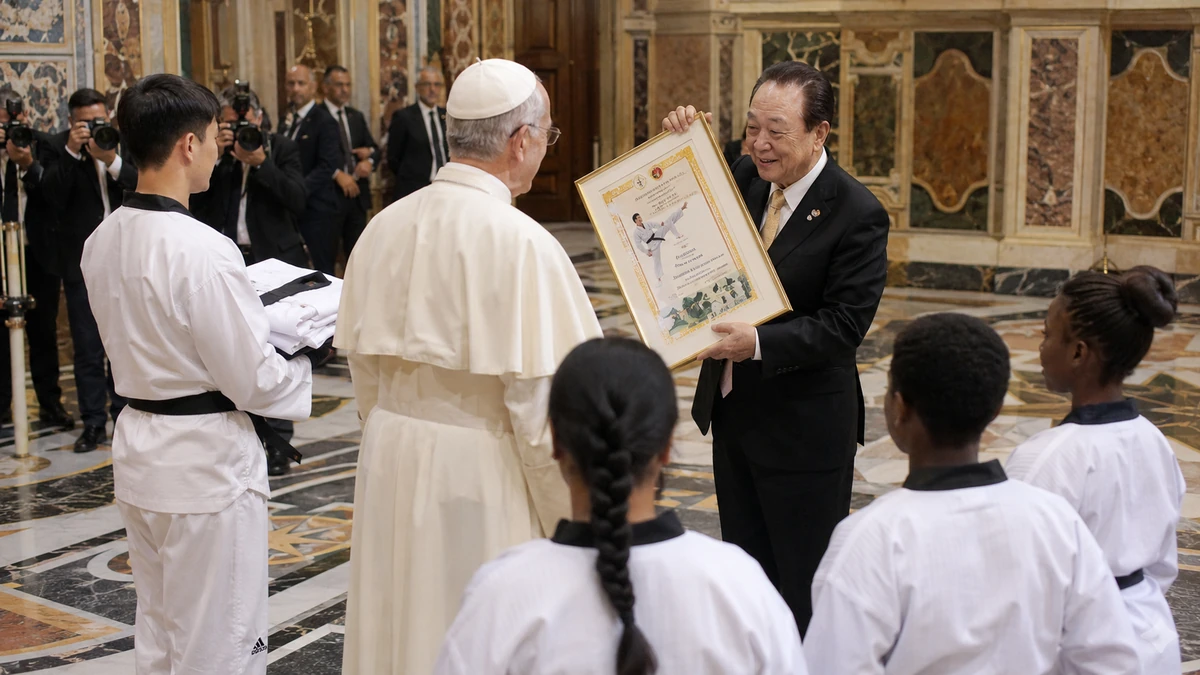
In a moment that said as much about diplomacy and identity as it did about athletics, Pope Leo XIV received an honorary 10th-degree black belt certificate and a taekwondo uniform at the Vatican this week from World Taekwondo President Choue Chung-won. On its face, the ceremony might sound like a niche sports event: a governing body honoring a global religious figure with the highest symbolic distinction in a martial art. But the scene carried a broader message, one likely to resonate far beyond Korea, Rome or the taekwondo community.
Taekwondo is one of South Korea’s most recognizable cultural exports, alongside K-pop, Korean film, television dramas and cuisine. For many Americans, the first point of contact with Korea may have come through a neighborhood taekwondo studio long before the rise of BTS or the Oscar triumph of "Parasite." It is both a combat sport and a discipline rooted in etiquette, self-control and respect. Since becoming an official Olympic sport in 2000, it has also served as a visible marker of South Korea’s global reach.
That helps explain why this week’s Vatican event mattered. According to South Korean media reports citing World Taekwondo, the honorary 10th dan, or degree, was presented in recognition of the pope’s humanitarian work and his efforts to promote peace. In taekwondo, a 10th-degree black belt is not a rank most practitioners earn through ordinary testing. It is the art’s highest symbolic honor, reserved for exceptional stature and meaning. By giving that honor to the pope, World Taekwondo was not grading his kicking technique. It was making a statement about the values the sport wants to project to the world.
For an American audience accustomed to seeing sports diplomacy through the lens of the Olympics, the World Cup or headline-grabbing gestures at the White House, this was a different kind of image. There were no medals, no anthem, no competition. Instead, there was a Korean martial art, the leader of the Roman Catholic Church and a ceremony framed around peace, dignity and humanitarian purpose. It was a quiet spectacle, but a telling one.
The event also underscored how modern South Korea uses culture in ways that are more layered than simple national branding. The country’s influence is often measured through entertainment, technology and trade. Yet taekwondo occupies a special category. It is not just made in Korea; it is identified with Korea in an unusually direct way. At a time when nations compete for soft power as much as for economic leverage, that kind of symbolic association matters.
Why taekwondo carries unusual weight for Korea
To understand the significance of the Vatican gesture, it helps to understand what taekwondo represents in Korean life. The sport emerged in modern Korea through the blending and systematizing of martial traditions after the Japanese colonial period and the Korean War. Over time, it became both a national sport and a cultural emblem, taught in schools, practiced in military settings and exported through federations, tournaments and local academies across the globe.
In the United States, taekwondo has long had a familiar place in suburban life. Countless strip malls have housed dojangs, or training halls, where children learn kicks, forms and discipline after school. For many parents, taekwondo has functioned as a hybrid of youth sport, character education and self-defense training. That accessibility helped turn it into one of Korea’s earliest and most durable forms of grassroots cultural influence in America.
But taekwondo’s meaning in Korea extends further. It is often discussed not merely as a sport but as a tradition carrying ethical aspirations: perseverance, courtesy, self-command and mutual respect. Like judo in Japan, it can serve as a shorthand for national heritage translated into a modern international language. That is one reason ceremonial moments involving taekwondo can hold significance that goes beyond athletics.
In Korea, fans who closely follow baseball, soccer or Olympic competition may still see an event like this as a point of national pride, even without a scoreboard. That is because it suggests that Korean sports culture has prestige outside competitive results. The Vatican ceremony was, in effect, a reminder that a nation’s sporting legacy is not measured only in championships but also in the values and institutions it exports.
The honorary 10th-degree recognition fits squarely into that idea. It is less comparable to winning a title than to receiving a lifetime civic honor. Who gets that distinction tells the world what taekwondo, as an institution, wants to stand for. In this case, the answer was clear: humanitarianism, peace and solidarity across borders.
The image that defined the day: the pope and refugee children
If the formal presentation gave the event its official weight, the most powerful image may have come from who stood beside the pope afterward. Joining the ceremony were seven young taekwondo athletes from refugee camps in Jordan, ranging in age from 7 to 14, according to the Korean reports. All were born and raised in refugee camps, and this was said to be their first trip abroad.
That detail transformed the event from a ceremonial exchange into something more vivid and human. After receiving the certificate and uniform, Pope Leo XIV posed for photographs surrounded by the children. It was the kind of image that does a great deal of work without words: the head of the Catholic Church, a Korean-born global sport and children from some of the world’s most precarious circumstances sharing the same frame.
Sports organizations often speak in lofty language about inclusion and opportunity. Sometimes those claims can feel detached from reality. But in this case, the symbolism was difficult to miss. Refugee children who grew up in camps were not present as abstract beneficiaries of charity; they were there as athletes, participants and visible representatives of taekwondo’s reach. The moment suggested that the sport’s global identity is not built only in elite arenas or Olympic venues, but also in places where structure, hope and belonging can be hardest to find.
For American readers, there is a familiar parallel in the way basketball courts, soccer fields or boxing gyms can provide community and direction for young people facing instability. Taekwondo plays a similar role in many parts of the world. In refugee settings especially, the discipline of training, the ritual of uniforms and the simple fact of being recognized as an athlete can become a source of dignity. That does not solve displacement or poverty. But it can create a path, however narrow, toward confidence, mobility and connection.
The children who attended the Vatican audience were also in Rome to compete in a youth taekwondo event later in the week, the Kim and Liu tournament at Foro Italico. That matters because it links symbolism to lived experience. The papal ceremony honored past service and moral leadership; the tournament points toward the future. It suggests that the sport’s claims about peace and solidarity are not just retrospective, but operational, embedded in programs that move real young people from the margins to the international stage.
More than a belt: a message about peace, prestige and soft power
World Taekwondo said the honor recognized the pope’s dedication to humanitarian causes and peace-building. In diplomatic terms, that makes the belt and uniform a form of soft-power language. Nations and international organizations often rely on symbols to communicate values more effectively than official statements can. A ceremonial gift, especially one rooted in tradition, can function as a bridge between institutions that do not usually share the same vocabulary.
For South Korea, the significance is amplified because taekwondo is not just another sport in the global marketplace. It is one of the clearest examples of a national cultural asset that has become international without losing its origin story. Millions may practice it in dozens of countries, but its Korean identity remains front and center. That gives gestures like the Vatican ceremony an added layer: every time taekwondo is elevated in a global setting, Korea’s cultural stature rises with it.
There is also a strategic dimension here. South Korea’s international image has expanded dramatically over the last two decades, helped by electronics, cinema, music and streaming-era entertainment. Yet governments and civil institutions know pop culture can be cyclical. Sports traditions, by contrast, can accumulate credibility slowly and endure across generations. Taekwondo’s institutional depth — with federations, Olympic status, humanitarian programming and youth development — makes it a particularly resilient form of national influence.
That is why this week’s ceremony should not be dismissed as simple pageantry. It was not just about honoring a pope. It was about reaffirming taekwondo as a language Korea can use in global civil society, one that speaks not only to competition but to education, inclusion and peace. In a fractured world, that is a notable claim for any sport to make.
And because the Vatican remains one of the most symbolically potent stages on earth, the setting mattered. Even for non-Catholics, papal imagery carries global weight. A photo from an Olympic venue may speak to athletic excellence. A photo from the Vatican, especially one involving a pope and refugee children, signals moral and humanitarian aspiration. World Taekwondo clearly understood that distinction.
A continuing relationship between taekwondo and the papacy
This was not the first time World Taekwondo had extended its highest symbolic honor to a pope. Choue previously presented an honorary 10th-degree black belt to Pope Francis in 2017. That continuity is important. One-off ceremonies can generate headlines and then vanish. Repeated engagements, especially across different papacies, suggest a more durable relationship between the sport and causes associated with peace and humanitarian outreach.
In practical terms, continuity gives credibility to the claim that taekwondo is trying to position itself as more than a medal sport. If the 2017 event had remained an isolated moment, it might be remembered mainly as a novelty. By returning to the Vatican with a similar honor, and by linking the occasion to refugee athletes and youth competition, World Taekwondo reinforced the idea that it has a sustained agenda at the intersection of sports and social impact.
That matters in a global sports environment often dominated by commercial rights deals, superstar endorsements and controversy over governance. Many international federations speak about values, but not all have convincing ways to dramatize them. Taekwondo’s leaders appear to be making a deliberate effort to build a legacy around what might be called moral visibility: showing the sport in places and circumstances where competition is not the central story.
For Korea, the result is what some analysts would describe as symbolic capital. This is prestige that accumulates not from a single champion or an isolated event, but from repeated associations with widely admired institutions and causes. When those associations are reinforced over time, they become part of how the world reads a country’s cultural footprint.
That footprint does not replace sporting excellence; it broadens it. Korea does not need taekwondo to stop being a serious competitive sport in order for it to become a tool of diplomacy and humanitarian engagement. The point is precisely that it can be both.
A light moment, and why it mattered
Not every meaningful diplomatic gesture is solemn. Part of what made the Vatican event memorable was a brief exchange of humor. According to reports, Choue joked that the pope could even wear the taekwondo uniform while playing tennis. The pope laughed.
On one level, it was an ordinary icebreaker, the kind of remark that eases ceremony and humanizes public figures. On another, it conveyed something important about taekwondo’s image. Martial arts are often seen by outsiders as rigid, intimidating or highly formal. By introducing humor — and by tying the uniform to a sport as globally familiar as tennis — the exchange made taekwondo feel less distant and more approachable.
That matters because cultural influence is not built only through grandeur. Sometimes it is built through recognizability, warmth and a sense that a tradition can enter everyday life without losing dignity. For Americans, the joke works because tennis is a familiar reference point and because it recasts the uniform not as an exotic costume but as a conversational bridge.
The moment also subtly illustrated a common feature of successful cultural diplomacy: it works best when it is not overburdened by its own seriousness. The Vatican event carried a heavy moral theme — peace, refugees, humanitarian service — but the small burst of humor prevented it from feeling staged or didactic. It reminded viewers that sports, even when they carry deep values, remain an arena of human connection and delight.
What this says about Korean influence outside the medal count
For years, conversations about South Korea’s global rise have centered on consumer and entertainment power: Samsung phones, Korean skincare, "Squid Game," Blackpink and the international spread of Korean food. Those phenomena are real, and they matter. But the Vatican ceremony points to another dimension of Korean influence — one rooted not in trend cycles but in institutions, rituals and civic values.
That is why this story is larger than taekwondo itself. It shows how a country can shape global culture through a practice that carries identity, history and purpose all at once. Taekwondo is Korean in origin, global in participation and increasingly universal in the values its leadership is trying to foreground. In a media environment where international stories are often filtered through conflict, scandal or economic rivalry, that is a noteworthy alternative narrative.
It is also a reminder that sports can matter most when they are not answering the question of who won. The enduring image from Rome is not of a podium but of a shared scene: a pope in white, children from refugee camps, a Korean martial art and a ceremonial gesture that linked them all. It is the kind of tableau that invites broad interpretation but rests on concrete facts — an official Vatican meeting, a recognized honor, refugee youth participants and public gratitude for humanitarian work linked to the sport.
For Korean audiences, the scene is likely to register as a source of pride. For international audiences, especially those in the United States who may know taekwondo mainly through local studios or Olympic broadcasts, it offers a wider frame. Taekwondo is not only a contest of speed and precision. It is also, at least in its most ambitious self-presentation, a vehicle for peace, inclusion and global citizenship.
That may sound lofty, but this week’s Vatican moment gave the idea an unusually vivid form. A belt certificate and a white uniform became more than ceremonial objects. They became symbols of how Korea continues to speak to the world — not only through entertainment and technology, but through a sport that has learned to carry both national pride and universal aspiration.
In that sense, the most important thing that happened at the Vatican was not that a pope received taekwondo’s highest symbolic honor. It was that the ceremony made visible a larger truth about modern Korea: some of its most lasting global influence happens not in headline-grabbing victories, but in the quieter, more human spaces where culture, dignity and shared values meet.
Comments
Post a Comment