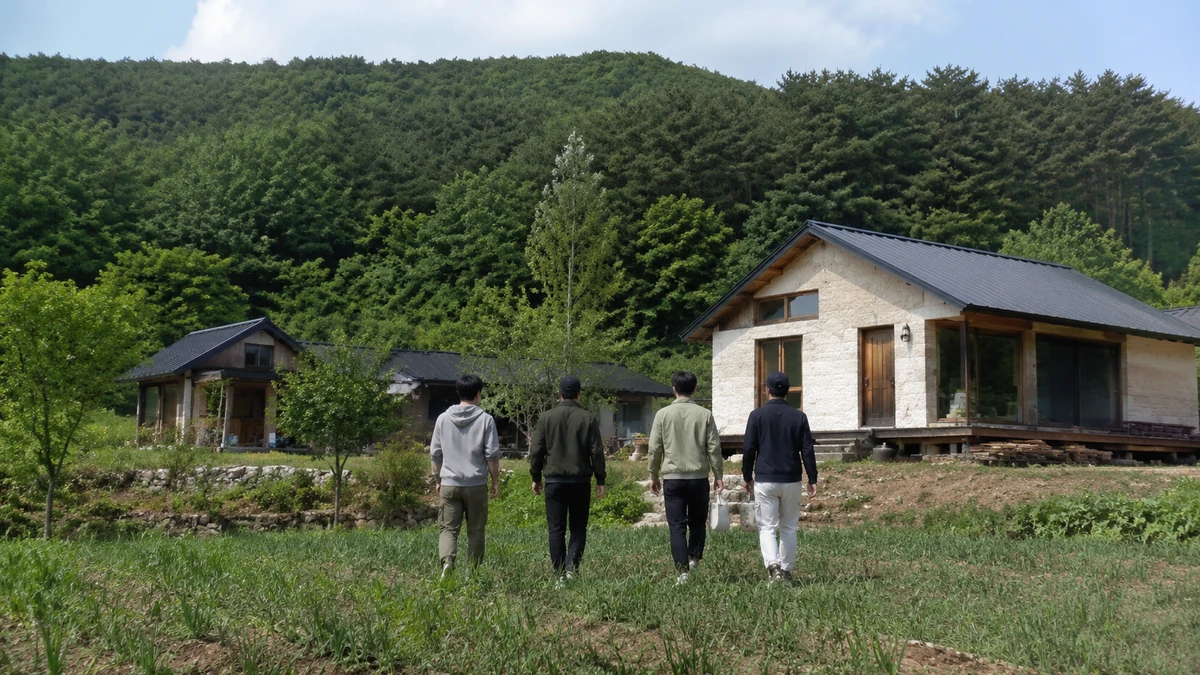
A Korean superstar heads from the island to the mountains
South Korean singer Lim Young-woong, one of the country’s most commercially powerful and broadly beloved entertainers, is returning to television with a new SBS variety series set to premiere June 23 at 9 p.m. local time. The program, titled Mountain Bachelor Hero, places him in a remote mountain home and builds its premise around what producers describe as a “pollution-free life” — not in the literal environmental sense alone, but in the emotional language common in Korean entertainment, where a calmer, gentler and more restorative viewing experience has become a major draw.
For American audiences who may know Korean pop culture mostly through high-gloss K-pop performances, Netflix thrillers or Oscar-winning films, the significance of this announcement is not just that a singer is adding another TV credit. It is that a major Korean star is once again stepping outside the highly managed setting of the concert stage and into a format built on ordinary routines, social chemistry and the appeal of watching famous people inhabit slower, less scripted spaces.
That may sound modest by U.S. reality TV standards, where competition, conflict and dramatic confessionals often drive viewership. But in South Korea, one of the most successful strains of television in recent years has leaned in the opposite direction. These shows often center on cooking, travel, rural life, housekeeping or friendship, asking viewers not to brace for eliminations or scandals but to settle into a mood. Lim’s new series fits squarely into that tradition, and his participation says something important about what celebrity means in Korea today.
The title itself also matters. Mountain Bachelor Hero follows an earlier fixed-cast variety program, Island Bachelor Hero, which aired last year and helped establish Lim as more than a singer with a devoted fan base. In the new show, he moves from the sea to the mountains, from island rhythms to a secluded highland setting. That shift is more than a change in backdrop. It suggests an intentional expansion of a successful television persona: the star not as untouchable icon, but as a figure audiences can watch adapt to place, routine and companionship.
In the United States, the closest comparison might be when a chart-topping musician steps away from arena tours and appears in a stripped-down docuseries or a celebrity travel program that reveals how they interact offstage. But the Korean version is often less self-exposing and less confessional than American celebrity reality programming. It is less about revelation than atmosphere, less about breakdown than presence. What viewers are buying into is not necessarily a shocking new truth about a star, but the pleasure of seeing a familiar figure recontextualized.
That is what makes Lim’s latest move notable in the broader Korean Wave, or Hallyu: it highlights the way Korean entertainment packages not only songs and performances, but also personality, space and emotional tone as exportable cultural products.
Why Lim Young-woong matters in South Korea
To understand why this series is getting attention, it helps to understand Lim’s place in the Korean entertainment landscape. Lim is not simply another idol singer in a crowded pop market. He occupies a particularly unusual and powerful niche: he is a major recording star with broad cross-generational appeal, especially strong among older audiences who have long been underserved in global conversations about K-pop.
While international coverage of Korean music often focuses on polished idol groups and younger fandoms, Lim rose to fame in a space that overlaps with ballad traditions, emotional storytelling and the Korean trot boom. Trot, a genre with deep roots in Korean popular music, is sometimes loosely compared for foreign audiences to a form of easy-to-sing, sentiment-rich popular music with old-school appeal, though the comparison is imperfect. Lim’s image blends vocal prowess, sincerity and accessibility. He is a stadium-scale star, but also one whose fan base prizes warmth and character as much as hit songs.
That distinction helps explain why variety television is such a natural extension of his brand. In South Korea, a singer’s public identity is rarely contained to music alone. Fans watch livestreams, interview clips, backstage footage, travel content, game shows and domestic reality formats. A star’s popularity is reinforced not only by what they perform, but by how they react, joke, cook, rest and relate to others. If American celebrity culture often separates “the artist” from “the personality,” Korean entertainment has long been more integrated, with variety shows serving as one of the key places where public affection is built and maintained.
Lim has already proved he can thrive in that environment. His earlier series, Island Bachelor Hero, drew attention not because it reinvented television but because it successfully relocated a familiar star into a lifestyle-oriented format. Viewers who already admired him as a singer were invited to spend time with him in a more relaxed setting, while casual audiences could encounter him outside the pressure of chart rankings and live performance. In media industries everywhere, there is value in discovering that a star can hold attention without doing the thing that made them famous. Lim appears to have done exactly that.
That ability matters commercially and culturally. Korean stars today compete not only for music sales and streaming numbers but for continuity of attachment. A concert may deliver awe. A variety show can deliver intimacy — or at least the carefully produced feeling of it. Lim’s appeal in this format lies in the sense that he can project steadiness and likability even when the premise is built on everyday life rather than artistic spectacle.
The rise of “healing” television in South Korea
The phrase used to describe the show’s concept — a “pollution-free life” in a remote mountain house — points to a recognizable current in Korean television. Over the past decade, some of the country’s most durable unscripted formats have offered what Korean viewers often call “healing” entertainment. That term does not refer to therapy in the clinical Western sense. In Korean popular culture, “healing” usually means comfort, emotional decompression and relief from social fatigue.
That language reflects real pressures in South Korea, a fast-paced, highly competitive society where long work hours, expensive housing, academic intensity and urban density shape everyday life. In that context, television set in fishing villages, countryside homes, guesthouses or quiet kitchens can function almost like visual exhale. The pleasure is partly aspirational — imagine leaving the city behind — and partly relational, centered on watching cast members develop rapport through mundane tasks.
American viewers can think of it as a tonal cousin to the popularity of cozy food television, slow travel shows or low-stakes home-renovation comfort viewing, though Korean variety often has a distinctive ensemble rhythm and a more deliberate interest in social hierarchy, respect, age dynamics and shared labor. The setting is not just scenery. It is a device that changes how people talk, who takes charge, who becomes funny and who surprises viewers with hidden practical skills.
That is why Mountain Bachelor Hero is more than a rebrand of the previous program. Moving Lim from an island setting to a mountain setting offers producers a new palette of textures and routines. The sea suggests fishing, weather, remoteness and open horizons. The mountains suggest self-sufficiency, enclosed quiet, physical chores and a different kind of seasonal mood. Korean unscripted television often relies on these environmental shifts to refresh a familiar concept without abandoning what already worked.
The word “bachelor” in the title also deserves some explanation. In this context, it does not necessarily signal a dating show or romantic premise in the way an American audience might initially assume. Instead, it evokes a rustic, single-man household image — someone living simply, maybe awkwardly, maybe earnestly, outside the polished urban mainstream. The title is branding shorthand for a lifestyle scenario, not necessarily a search for love. That nuance is important because Korean variety titles often carry tonal cues that can be misleading if translated too literally.
When producers pitch a celebrity living in the mountains with a group of actors, comics and musicians, they are not promising cliffhangers. They are selling vibe, interaction and emotional temperature. For a global fan base increasingly interested in Korean culture beyond the most visible music exports, that format is part of the story.
An ensemble built for unpredictability
SBS says the new series will feature an eclectic cast around Lim, including actors Cha Seung-won, Hyun Bong-sik and Kim Do-hoon; comedians Heo Kyung-hwan and Kwak Beom; and singers Jo Jjaez, Nucksal and Roy Kim. Even for viewers unfamiliar with all those names, the structure is easy to recognize: this is an ensemble designed to create shifting dynamics rather than revolve around a single polished star turn.
That matters because Korean variety shows often live or die by chemistry. Unlike scripted dramas, where character arcs can be engineered in advance, lifestyle entertainment depends on timing, temperament and the small social frictions that emerge when different public personas share space. One cast member may dominate conversation. Another may become unexpectedly funny through silence or incompetence. A singer known for emotional ballads may turn out to be practical in a kitchen. A respected actor may become the butt of jokes. The unpredictability is the point.
For Lim, being the central figure does not necessarily mean controlling every moment. In fact, some of the strongest variety performers are those who can anchor a show without overpowering it. If the premise is to let audiences experience his “daily life” persona, then the surrounding cast functions as contrast and catalyst. They set the conversational pace, generate comic friction and create situations that reveal how the star reacts under ordinary pressure.
That ensemble approach also broadens the audience. A show built around one mega-popular singer might easily become fan service for existing supporters. A show mixing actors, comedians and musicians creates multiple entry points. Someone tuning in for Cha Seung-won’s veteran screen presence may stay for Lim. A viewer who follows Roy Kim’s music may become interested in the cast’s collective dynamic. In American television terms, it is the difference between a pure star vehicle and a hangout show.
This is one of the more underappreciated aspects of the Korean Wave. Global audiences often encounter Korean entertainment through individual breakthroughs — one hit group, one movie, one breakout drama star. But inside South Korea, the ecosystem is intensely collaborative and format-driven. Personal brands are constantly recombined through variety, talk shows, music programs and streaming content. Mountain Bachelor Hero fits that system neatly: it uses Lim’s broad appeal as a foundation while designing a cast capable of producing new narrative energy around him.
For overseas viewers who discover clips through YouTube, fan translations or social media snippets, that ensemble format also increases shareability. One moment may circulate because Lim appears humble. Another may spread because a veteran actor and a rapper clash playfully over chores. The show’s reach may depend as much on these fragments as on its linear broadcast audience in Korea.
From music star to lifestyle protagonist
The most interesting cultural point in this story may be the way it reframes what a successful singer is allowed — even expected — to be. In many entertainment markets, especially in the United States, there is still a sharp line between artistic credibility and overexposure. Stars must manage the risk that appearing too often, in too many casual contexts, could dilute mystique. Korean entertainment operates under a somewhat different logic. Familiarity, if carefully curated, can deepen rather than weaken devotion.
Lim’s new show illustrates that principle. The summary of the series contains almost no mention of competition, musical performance or sensational twists. Instead, it foregrounds setting, companionship and demeanor. In effect, the producers are betting that Lim’s appeal can travel from the concert hall into the grammar of daily life. That is a test of celebrity durability, and one he seems especially well positioned to pass.
There is also an important class and cultural dimension to the image being constructed. A rural mountain home, a simplified routine and a “clean” emotional atmosphere carry symbolic weight in Korea, where urban concentration is extreme and Seoul often dominates both opportunity and cultural production. Shows set in remote places allow celebrities to appear temporarily freed from the machinery of city life, status performance and industry pressure. The result is less an authentic escape than a carefully staged alternative to urban overdrive.
For fans, that can be deeply appealing. It presents a star as someone who remains grounded, cooperative and emotionally legible when stripped of professional glamour. In Lim’s case, that image aligns well with the public persona that has helped him attract a devoted following across age groups. He is not marketed only as aspirational. He is also marketed as dependable — a quality that can be surprisingly potent in a media environment saturated with churn.
This is why the article announcing the show emphasizes that Lim is not merely returning to television, but expanding a proven “life narrative” format. Korean media increasingly treats celebrity not as a fixed image but as an ongoing story world. One chapter happens onstage. Another unfolds in a rural house. Another appears in award speeches, interviews or holiday specials. The star becomes the connective tissue across formats. Mountain Bachelor Hero is the next chapter in that serialized intimacy.
For English-speaking readers trying to understand why such a premise qualifies as K-pop news, the answer is simple: in Korea, fandom is rarely limited to songs. It extends to personality, routine and emotional continuity. The product is not just music. It is sustained closeness, delivered through multiple media forms.
The legacy of the first show — and why the sequel matters
The earlier series, Island Bachelor Hero, aired from August to September last year and generated enough attention to justify what is essentially a second-season continuation under a new setting. That alone signals success. In a competitive television market, producers do not revisit a format unless they believe it has remaining audience value and unfinished narrative potential.
The earlier show also carried a significance beyond ratings chatter. Lim reportedly received an ESG-related honor at the 2025 SBS Entertainment Awards for the program, a detail that may puzzle some American readers accustomed to hearing ESG — environmental, social and governance — mainly in corporate or investor contexts. In South Korean broadcasting, the term can be used more broadly to describe content associated with social value, sustainability, coexistence or positive public messaging. In other words, the program was seen as more than disposable celebrity content.
That kind of recognition matters because it frames Mountain Bachelor Hero not as a cynical spin-off, but as an extension of a show that resonated with broader cultural values. It suggests the earlier series was received as something gentler and more socially meaningful than a standard star-driven observational format. Whether the new installment can live up to that reputation remains to be seen, but it begins with goodwill that many celebrity reality projects never get.
For SBS, one of South Korea’s major terrestrial broadcasters, the program also reinforces the ongoing relevance of network television in an era dominated by streaming and digital clips. While international audiences may encounter Korean content primarily through Netflix, Disney+ or short-form social media, Korean broadcast networks still play a major role in shaping national celebrity narratives. A prime-time SBS launch gives the show institutional heft. It is not niche digital content aimed only at core fans; it is meant for a broad domestic audience.
That broad positioning is part of why the story travels internationally. Fans around the world increasingly follow not only albums and tours but also the supporting media ecosystems that define Korean stardom. Even without immediate global distribution, news of the show will circulate through fan accounts, subtitled clips and entertainment coverage. For many overseas viewers, that secondary circulation is now part of how they experience Korean culture — not all at once, but in excerpts, explanations and social media translations.
If the first show proved that Lim could be compelling in a laid-back ensemble setting, the new series tests whether that appeal can scale into a repeatable franchise. In television terms, that is a meaningful jump. One successful experiment is interesting. A sustainable format is a brand.
What American audiences should watch for
When Mountain Bachelor Hero premieres June 23, American viewers who come across clips or coverage should resist the temptation to judge it by the standards of U.S. reality competition or celebrity scandal programming. The likely pleasures of the show will be subtler: how the cast settles into shared routines, how Lim navigates the group, how humor emerges from discomfort and how the mountain setting reshapes the show’s emotional pace.
That, in many ways, is the larger takeaway from this news. The global rise of Korean entertainment has taught foreign audiences to expect excellence in music production, choreography, serialized drama and visual polish. But one of the Korean industry’s quieter strengths is its ability to transform everydayness into a marketable, emotionally resonant form of content. A star can sell out venues and still be compelling while making food, managing chores or adjusting to an unfamiliar house in the countryside.
Lim’s new show is a reminder that celebrity in the Korean Wave is not sustained by spectacle alone. It is sustained by repetition, relatability and the careful expansion of a public image across formats. For fans, this offers another way to feel close to a performer they already admire. For broadcasters, it provides stable programming built on proven affection rather than volatile controversy. And for overseas observers, it offers a window into how Korean television turns mood and personality into cultural currency.
There is no guarantee, of course, that the new series will match or exceed the impact of its predecessor. Sequel logic in television is never foolproof, and atmosphere is one of the hardest things to reproduce. But the ingredients are plainly visible: a major star with unusual cross-demographic loyalty, a successful earlier template, a cast built for chemistry and a concept that aligns with a durable Korean appetite for restorative viewing.
In that sense, the story is not just about Lim Young-woong returning to TV. It is about how Korean entertainment continues to widen the definition of performance. The stage remains central, but it is no longer enough. In the current media environment, especially within K-pop-adjacent celebrity culture, stars are also expected to inhabit stories of place, routine and connection. Mountain Bachelor Hero appears ready to do exactly that — taking one of Korea’s most recognizable singers and asking viewers to follow him not under concert lights, but into the quieter drama of daily life.
Comments
Post a Comment