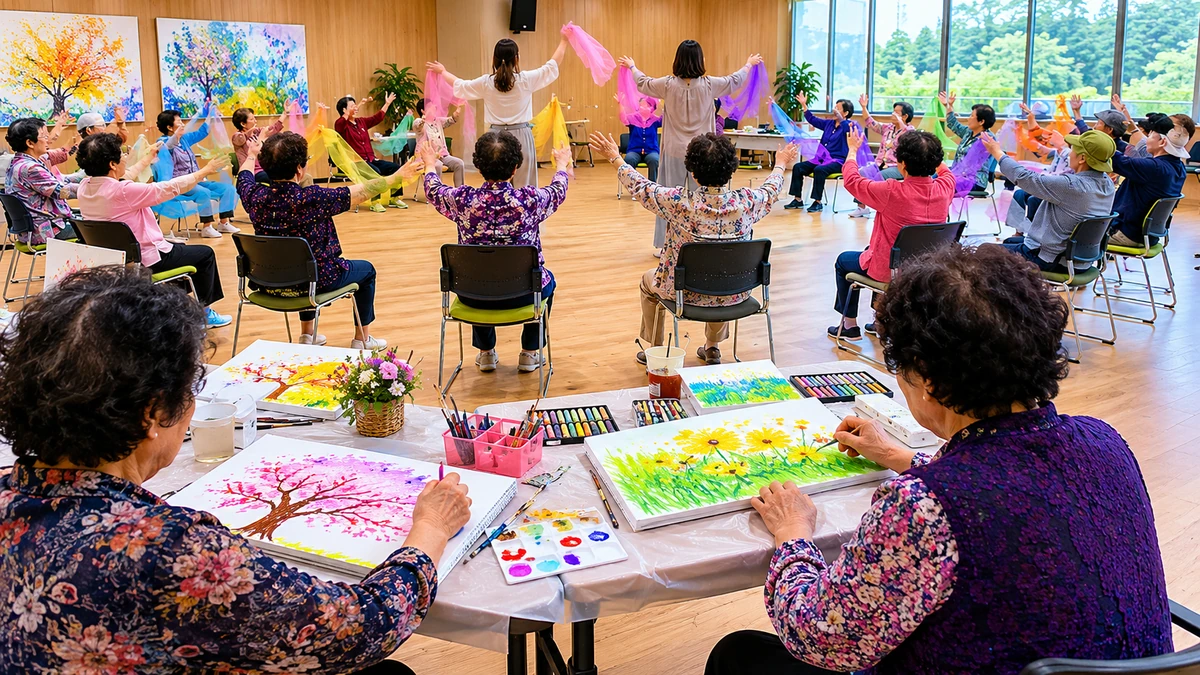
A local program with a larger meaning
In the South Korean city of Miryang, officials are betting that some of the most important tools for healthy aging may not look like medicine at all. Instead of announcing a new drug, a hospital expansion or a breakthrough medical device, the city said this week it will run a program called “Mind Healing, Like Spring” for older adults with mild cognitive impairment, using art and dance to support memory, concentration and emotional stability.
That may sound modest by the standards of global health headlines. But in a country aging as quickly as South Korea, the decision points to a bigger shift in how local governments are thinking about elder care: less as a problem to be addressed only after serious decline sets in, and more as a question of how to preserve daily functioning, social connection and quality of life before symptoms worsen.
The program will be operated through Miryang’s Dementia Relief Center, a community-based institution that is part of South Korea’s broader public system for dementia prevention and support. It will work in partnership with a specialized arts-healing organization, combining local health infrastructure with expertise in creative programming. The arrangement matters because it moves the idea of “healing” out of the clinic and into the rhythms of everyday life.
For American readers, the closest comparison may be the growing use of music therapy in nursing homes, memory cafes for seniors with early dementia, or museum programs designed for people with Alzheimer’s and their caregivers. Those efforts in the United States have often emerged through nonprofits, hospitals or philanthropic partnerships. What stands out in Miryang is that a similar idea is being treated not as a side project, but as an official public-health initiative at the municipal level.
In other words, this is not simply a cultural program with a wellness label attached. It is a local government saying that cognitive health and emotional well-being deserve practical, organized support in the community, especially for older adults who are showing early signs of decline.
Why mild cognitive impairment matters
The target group is especially important. Miryang said the program is aimed at seniors with mild cognitive impairment, often referred to as MCI. In plain terms, MCI describes a stage in which a person has noticeable problems with memory or thinking that are greater than normal age-related changes, but not severe enough to amount to dementia. Someone may forget appointments more often, struggle to stay focused or feel increasingly uncertain in daily tasks, while still largely functioning independently.
That middle ground is where many families begin to worry but often do not know what to do next. In the United States, too, mild cognitive impairment occupies an uneasy space between ordinary aging and a more serious diagnosis. Doctors may monitor it. Families may adjust routines. But treatment options are limited, and much of the conversation revolves around slowing decline, maintaining routines and supporting mental engagement.
That is what makes the Miryang approach noteworthy. Rather than waiting until a senior’s condition progresses further, the city is focusing on the stage when intervention may still help sustain function and confidence. It is a practical public-health strategy for an aging society: catch decline early, create ways for people to stay engaged and try to strengthen the invisible parts of health that matter most in daily life, including memory, attention, mood and motivation.
This is also a reminder that healthy aging is not only about blood pressure readings, prescriptions or fall prevention, important as those are. It is also about whether someone can feel oriented in the world, follow the thread of a conversation, take pleasure in activity and experience enough emotional steadiness to move through the day with dignity. Those goals are harder to measure than cholesterol, but they are often closer to what families actually care about.
South Korea has strong reasons to pay attention. The country has one of the world’s fastest-aging populations, with low birthrates and a growing number of older residents living alone or with limited support. As that demographic change accelerates, policymakers are under pressure to think beyond hospital treatment and build community systems that help seniors remain socially and cognitively active for as long as possible.
Why art and dance are at the center
Miryang’s chosen tools are visual art and dance. That is not just an aesthetic choice. It reflects a practical view of how older adults may be more willing and able to participate in programs that rely on movement, sensory stimulation and expression rather than lectures or paperwork-heavy instruction.
Art can engage fine motor skills, visual attention, decision-making and memory all at once. Even simple activities such as drawing, painting or arranging colors require planning and concentration. They also produce something visible and personal, which can reinforce a sense of accomplishment. Dance, meanwhile, combines rhythm, balance, body awareness and coordinated movement. Even low-impact movement set to music can stimulate attention and encourage social participation in ways that feel less clinical than formal therapy.
Anyone who has watched the success of senior dance classes at YMCAs, chair yoga sessions in community centers or storytelling workshops for older adults in libraries will recognize the basic logic. Participation is often easier to sustain when people enjoy the activity and do not feel as though they are being treated as patients first and foremost. A program that offers connection and expression may keep people coming back in a way that a standard health seminar might not.
That is especially relevant in Korea, where older adults may be reluctant to openly discuss psychological distress or cognitive decline. Like many societies, South Korea still carries stigma around mental health and dementia. A program framed around healing, creativity and seasonal renewal may lower the barrier to participation. Even the title, “Mind Healing, Like Spring,” suggests recovery and warmth rather than crisis or burden.
For Americans unfamiliar with the cultural context, the wording matters. In Korean public language, policy names are often crafted to sound approachable and emotionally resonant, not just administrative. The phrase “like spring” evokes a return of energy, color and possibility after a hard winter. It signals hope, but in a soft, nonconfrontational way that may be more inviting to seniors and families than a bluntly medical label.
The broader implication is that the line between cultural activity and health support is becoming more porous. For years, health policy in many countries treated the arts as optional enrichment. Programs like this suggest a different understanding: that creative activity can function as a legitimate community resource for well-being, especially in later life, when isolation and emotional instability can reinforce cognitive decline.
The role of Korea’s Dementia Relief Centers
A key part of this story is the institution running it. Miryang’s Dementia Relief Center is not an ad hoc community club. It is part of a network created by local governments to provide front-line support related to dementia, including screening, education, counseling and family assistance. These centers reflect South Korea’s effort to build a recognizable public system around one of the country’s most pressing aging-related challenges.
For U.S. readers, these centers may be best understood as a hybrid of a county public-health office, a senior-services hub and an early dementia support center. They are designed to be accessible at the community level rather than concentrated only in major hospitals. That is crucial because dementia care is not just about medical expertise; it is also about repeated contact, follow-up and trust.
When officials say the center was selected as a participating institution and will work with a specialized arts-healing operator, they are describing something many public programs struggle to achieve: clear implementation. Good intentions are common in policy. What matters is who identifies the participants, who runs the sessions, who checks attendance, who builds continuity and who makes sure the program does not remain a one-time symbolic event.
In Miryang, the division of labor appears straightforward. The Dementia Relief Center provides the link to residents and the public-health framework. The arts-healing organization provides content and professional know-how. That kind of structure is easy to overlook, but it is often the difference between a grant-funded pilot that fades quickly and a service that becomes part of ordinary community care.
There is another quiet but important message here: the city is not leaving early cognitive decline solely to families. Across East Asia, as in the United States, much elder care still falls on relatives, especially women. Public programs that step in before a crisis signal that the burden should not rest entirely in private households. Even a modest arts-based initiative can communicate a broader social principle: aging and cognitive vulnerability are community issues, not just family problems.
When culture policy and health policy meet
According to the Korean report, Miryang’s initiative is part of a broader cultural arts healing support project backed by South Korea’s Ministry of Culture, Sports and Tourism and the Korea Arts and Culture Education Service. That alone makes the program notable. In many countries, health and culture are treated as separate bureaucratic universes, each with its own budget logic, goals and vocabulary. Here, they are being deliberately connected.
This kind of cross-sector approach reflects an increasingly common realization in aging societies: quality of life cannot be protected by medical care alone. Older adults need treatment when they are sick, but they also need routine, connection, stimulation and purpose when they are not in a hospital bed. The most effective support may come not only from doctors and nurses, but also from community workers, artists, exercise leaders and peer groups.
Americans have seen versions of this idea take shape in the language of “social prescribing,” a term more often associated with Britain but increasingly discussed in U.S. health circles. The concept is simple: not every health problem is best addressed by medication or acute care. Sometimes people also need structured social activity, exercise groups, arts participation or community engagement. Miryang’s program fits neatly into that global conversation, even if Korea uses a different administrative framework and terminology.
It is also telling that this initiative comes through the culture ministry’s support system rather than exclusively through a health ministry pipeline. That suggests the Korean government is willing to use cultural administration not just to produce performances or fund arts education, but to help address social needs. In a practical sense, it broadens what government thinks culture is for. Art is not only entertainment or heritage preservation; it can also be part of the public response to loneliness, stress and cognitive decline.
That idea may resonate strongly in the United States, where debates over arts funding often revolve around whether the arts are a luxury or a necessity. Programs like Miryang’s argue, implicitly, that they can be infrastructure for well-being. Not a replacement for medicine, but a complement to it, particularly in communities trying to support older residents before their needs become more severe and expensive.
Beyond treatment: the recovery of daily life
One of the most striking aspects of the Miryang program is what it is not claiming to do. It is not presented as a cure. It is not described as a medical intervention in the narrow sense. Instead, its stated goal is to help improve cognitive function and emotional stability. That puts the focus squarely on sustaining daily life.
In an American context, that distinction is easy to understand. Families dealing with early memory loss often know that the central question is not just how to stop disease progression, but how to preserve ordinary life for as long as possible. Can a loved one remain engaged? Can they keep a routine? Can they feel less anxious, less withdrawn, more confident? Can there still be moments of pleasure and connection?
Miryang’s approach seems built around those questions. The use of art and movement suggests an effort to reach older adults where they live emotionally and socially, not just diagnostically. The underlying message is that health support can happen outside the exam room, and that interventions aimed at mood, participation and self-expression are not secondary concerns. They are part of what makes life livable.
That matters because cognitive decline rarely unfolds in isolation. It often arrives with loneliness, fear, frustration and shrinking social worlds. A senior who forgets more frequently may begin to avoid gatherings out of embarrassment. Someone who feels less steady may become less active. Over time, reduced activity and isolation can feed back into worse mood and weaker functioning. Breaking that cycle does not always require high technology. Sometimes it requires a setting where people can move, make, share and feel capable again.
There is also a subtle policy lesson for readers anywhere: preventive health is not only about diet and exercise in the conventional sense. It can also mean creating community environments where older adults have reasons to leave the house, interact with others and use their minds and bodies in meaningful ways. In that respect, a city-run arts-healing program may be less a niche experiment than a preview of what aging policy will need to look like in many parts of the world.
What a small Korean city may be showing the rest of the world
Miryang is not Seoul. It is not the center of Korea’s tech industry, political power or international celebrity. That is part of why this story is so revealing. Innovations in aging policy do not always begin with headline-grabbing scale. Sometimes they emerge in local systems where officials are close to residents and can see plainly what older adults need: not just treatment when something goes wrong, but support that helps life keep its shape.
South Korea’s aging challenge is often described through dramatic statistics, and for good reason. But demographic change becomes real in places like Miryang, where municipal governments must decide how to respond to increasingly common experiences of memory loss, frailty, isolation and emotional distress. A program such as “Mind Healing, Like Spring” suggests one answer: bring health services closer to daily life, partner with cultural experts and treat emotional and cognitive well-being as part of public responsibility.
For global audiences, including American readers, the story carries a familiar question. As populations age, should elder care become more medicalized, with ever greater emphasis on diagnosis, pharmaceuticals and institutional treatment? Or should it also move in the opposite direction, toward neighborhood-based support, meaningful activity and ways of preserving identity and connection? Miryang’s answer leans clearly toward the latter, without abandoning the value of formal health institutions.
That balance may be the most important takeaway. The city is not rejecting medicine. It is expanding the frame around what counts as health care in practice. Cognitive health is being addressed not only as a matter of pathology, but as a matter of participation. Emotional stability is being supported not only through counseling or crisis intervention, but through creative engagement. Aging is being approached not solely as a burden to manage, but as a stage of life that still deserves beauty, rhythm and community.
Whether Miryang’s specific program produces measurable gains in memory or mood remains to be seen, and local initiatives like this often rise or fall on consistent funding and sustained participation. But even at the announcement stage, it says something meaningful about the direction of public policy in South Korea. In a country confronting rapid aging, local government is beginning to treat art and movement not as extras, but as practical tools for helping older adults stay connected to themselves and to the world around them.
That may be why this relatively small announcement deserves attention far beyond one Korean city. In an era when aging is a shared challenge from Busan to Boston, Miryang is testing a simple but consequential idea: that protecting the mind may sometimes begin with a paintbrush, a step to music and a community willing to make room for both.
Comments
Post a Comment