More Than a Pop-Culture Roadshow
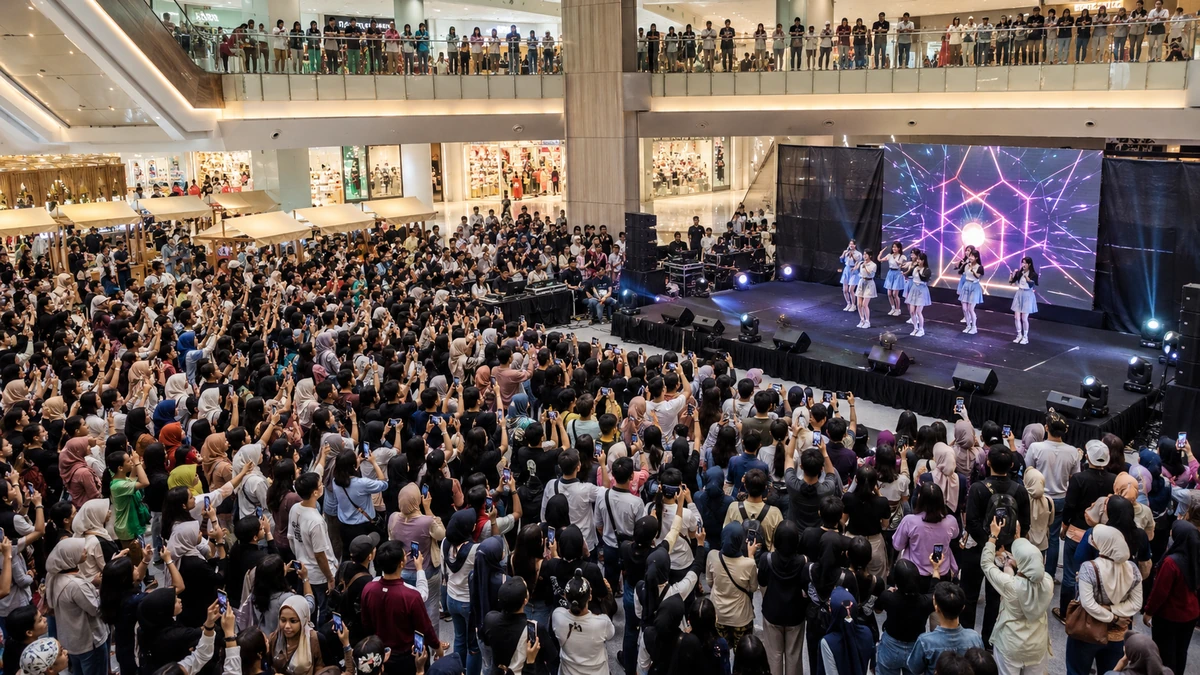
A Korean cultural festival held in Bandung, Indonesia, might sound, at first glance, like the kind of upbeat lifestyle event that rarely breaks into the international news cycle. There were K-pop performances, Korean food, beauty demonstrations and enthusiastic local crowds. But the reason this event matters goes beyond catchy songs or trendy skincare. What took place in Bandung offers a revealing look at how South Korea is expanding its influence abroad — not through military power or hard-nosed diplomacy, but through everyday culture, carefully tailored to local audiences.
According to the South Korean Embassy in Indonesia, the event, called the “K-Public Diplomacy Spectrum,” was held July 5 at two locations in West Java: the 23 Paskal Shopping Center, a major commercial complex in Bandung, and Telkom University, one of the region’s prominent campuses. The program was organized not just by the embassy, but with the participation of a broad network of Korean institutions, including the Korean Cultural Center in Indonesia, the Jakarta office of the Korea Agro-Fisheries and Food Trade Corp., the Jakarta office of the Korea Foundation, the Korean Education Center in Indonesia and the Jakarta branch of the Korea Tourism Organization.
That list matters. In practical terms, it means South Korea was not simply exporting entertainment. It was staging a full-spectrum introduction to modern Korean life: what people watch, what they eat, how they travel, how they study and how they imagine a connection to Korea. For American readers, the easiest comparison might be a cross between a Smithsonian cultural showcase, a university study-abroad fair, a food festival and a pop concert — all rolled into one and designed to deepen long-term ties with a foreign public.
That is why the Bandung event deserves attention as more than a feel-good festival story. It illustrates a bigger shift in how South Korea engages the world. The Korean Wave, often referred to by its Korean term “Hallyu,” began decades ago as the export of television dramas and pop music. Today, it has grown into something much larger: a multilayered cultural ecosystem that connects media, consumer habits, tourism, education and national branding. Bandung showed what that strategy looks like on the ground.
What “Public Diplomacy” Looks Like in Real Life
The phrase “public diplomacy” can sound abstract, even bureaucratic. In Washington, it often calls to mind exchange programs, embassy receptions or government-backed messaging campaigns. But in the Korean context, public diplomacy has increasingly become tactile and immersive. It is less about lecturing foreign audiences on policy and more about creating experiences that make Korea feel familiar, appealing and relevant.
That is precisely what happened in Bandung. The festival’s structure brought together different pieces of Korean cultural life that might once have been promoted separately. Visitors could move from K-pop to K-food to K-beauty, not as disconnected attractions but as parts of one recognizable cultural package. Instead of treating Korean culture as a niche interest for music fans alone, the event presented it as an entire lifestyle.
This is an important development in the global story of Hallyu. For years, many outsiders understood Korea’s cultural rise largely through blockbuster dramas, BTS, Blackpink or the Oscar-winning success of “Parasite.” Those touchstones remain important, especially for American audiences who first encountered modern Korean culture through Netflix, YouTube, streaming charts or the Academy Awards. But South Korea’s institutions are now working from the assumption that global curiosity about Korean content can lead to broader engagement — interest in Korean food products, university programs, travel destinations, cosmetics and language study.
Seen that way, the Bandung event was not a sideshow to diplomacy. It was diplomacy. It used popular culture as the front door, then opened into deeper forms of connection. South Korea’s message was not simply, “Watch our music videos.” It was, in effect, “Come experience how Korean culture fits into everyday life, and imagine how your own life might intersect with it.”
That is a sophisticated form of soft power. Soft power, a term popularized by American political scientist Joseph Nye, refers to a country’s ability to attract and persuade rather than coerce. South Korea has become one of the clearest contemporary examples of that idea in action. The Bandung festival showed that Korea’s soft power strategy is maturing from star-driven fandom into institutional, long-term relationship building.
From K-Pop to K-Food and K-Beauty
One of the clearest messages from the festival was that Korean culture abroad is no longer being defined by a single genre. K-pop may still be the most visible engine of global attention, but it is increasingly part of a broader cultural bundle. In Bandung, organizers deliberately emphasized that bundle by placing music alongside food and beauty culture.
That approach reflects how people actually encounter Korea today. A teenager may first discover Korea through a dance challenge on TikTok, then become interested in Korean ramen, sheet masks, makeup techniques, fashion or language classes. A college student may start with a hit drama and then research study opportunities in Seoul. A family might try Korean barbecue after seeing it featured online, then later consider a vacation to Busan or Jeju. In that sense, the Korean Wave is no longer just about fandom. It is about habit formation, consumer choices and a growing sense of familiarity.
The Bandung festival leaned into that reality. By creating a shared space where local residents could listen, taste and participate, organizers turned Korean culture into a lived sequence of experiences. The event reportedly drew strong interest for its K-pop dance competition, which is significant in its own right. Dance contests convert audiences into participants. They invite people not just to admire polished performances but to reinterpret Korean culture through their own bodies, communities and local styles.
That kind of participation matters. It suggests that Hallyu is moving from a spectator culture to an interactive one. In earlier phases, foreign audiences might have consumed Korean entertainment much like any imported media product: watched from afar, appreciated from a distance. Today, many fans want to cover the dances, cook the food, learn the language and post their own versions online. The result is a feedback loop in which Korean culture becomes embedded in local social life rather than remaining a distant export.
The inclusion of K-beauty is also telling. For American readers, K-beauty may evoke popular skincare brands at Sephora or viral trends like glass skin. But in Asia and beyond, Korean beauty culture has become one of the most durable expressions of South Korea’s global consumer appeal. It combines product innovation, visual branding and aspirational lifestyle marketing. When Korean beauty appears alongside music and food at a diplomatic event, it signals that South Korea sees daily consumer experience as part of its international identity.
Why Halal Food Was a Big Deal
One detail from the event deserves special attention: the presentation of halal-certified Korean food. For many Americans unfamiliar with Indonesia, this may seem like a small logistical note. It is not. Indonesia is the world’s most populous Muslim-majority country, and halal certification — confirming that food complies with Islamic dietary rules — is a central part of consumer trust and everyday life for many Indonesians.
By featuring halal-certified Korean foods, organizers were doing more than expanding menu options. They were signaling cultural respect and practical adaptation. In other words, South Korea was not asking Indonesian consumers to meet Korean products on Korean terms alone. It was adjusting those products to Indonesian standards and expectations.
This is one of the most important reasons the Bandung festival has broader international significance. Global cultural influence does not endure simply because a country produces exciting content. It lasts when that country learns how to localize without losing its identity. American companies have long understood this principle when entering overseas markets, whether by altering fast-food menus, marketing strategies or product formulas. South Korea appears to be applying a similar logic to culture itself.
That matters because the future of Hallyu will depend not just on viral popularity but on whether Korean products and experiences can become durable parts of daily life in diverse societies. Halal-certified Korean food is one example of that. It shows Korea’s awareness that successful cultural outreach in Southeast Asia requires not just visibility, but sensitivity to local religious and social norms.
For American readers, it may help to think of this as the difference between dropping a touring concert into a city and actually learning what the community needs in order to participate fully. The Bandung event suggests South Korea is increasingly focused on the second model. That makes its cultural diplomacy more inclusive — and likely more effective.
Why Bandung, Not Just Jakarta, Matters
The location of the festival is another reason the story stands out. Bandung is a major Indonesian city in West Java, but it is not the national capital. For many international governments, high-profile cultural events tend to cluster in capitals, where embassies, elite institutions and national media are concentrated. Holding this event in Bandung suggests a more decentralized approach.
That is significant because it points to the next phase of Korea’s overseas cultural strategy: moving beyond symbolic showcase events in top-tier capital cities and building connections in regional centers where younger and more diverse audiences live, study and shop. Bandung is known in Indonesia as a creative, youthful city with a strong student population and a history of intellectual and political significance. It is the kind of place where trends spread organically through campuses, social networks and consumer spaces.
For South Korea, that makes Bandung an ideal laboratory for long-term influence. Reaching people outside the capital means engaging audiences who may not be part of diplomatic or policy circles but who are central to the future of cultural consumption. If Korea wants to be present not just as a headline but as a habit — in what people eat, wear, stream and aspire to — then cities like Bandung matter enormously.
There is also a broader geopolitical point here. Southeast Asia has become a crucial arena for cultural and economic competition, with countries seeking influence not only through trade and infrastructure but through media, education and tourism. South Korea has been particularly active in the region, where Korean entertainment and consumer brands already enjoy widespread popularity. By strengthening ties in cities beyond national capitals, Seoul is effectively broadening its grassroots footprint.
That strategy may be less dramatic than a summit or a trade pact, but it can be powerful in the long run. Culture often reaches people before politics does. It shapes impressions, builds familiarity and creates low-pressure channels of trust. In that sense, Bandung was not peripheral to diplomacy. It was one of its most revealing front lines.
The Symbolism of a Mall and a University
The choice of venues — a shopping complex and a university — may be the most revealing detail of all. Each space represents a different but complementary form of influence. The mall is where culture meets consumption. The university is where culture meets aspiration, learning and identity formation. Together, they create a map of how modern soft power works.
At 23 Paskal Shopping Center, Korean culture entered a space of everyday commerce. This is where trends become purchases and curiosity becomes market behavior. Visitors are already primed to browse, compare, sample and buy. Placing Korean food and beauty experiences in that environment allows organizers to translate cultural interest into tangible consumer familiarity. It brings Hallyu out of the screen and into the shopping basket.
At Telkom University, by contrast, the focus shifts to youth, education and future networks. Universities are not just event venues. They are incubators of taste, ambition and social identity. Students who encounter Korean culture on campus today may become tomorrow’s language learners, business partners, tourists, content creators or graduate students abroad. They are also likely to be the ones who carry those interests into wider circles, whether through clubs, online communities or future careers.
For an American audience, there is a familiar logic here. Think of how countries court foreign students through exchange fairs, film festivals, visiting lecturers and language programs on U.S. campuses. Those efforts are rarely just about one afternoon’s attendance. They are investments in long-term affinity. The same principle applies in Bandung. By pairing a university with a mall, South Korea effectively targeted both imagination and consumption, both future identity and present-day lifestyle.
The combination is especially powerful because it reflects how young people navigate culture today. They do not separate entertainment, shopping, self-expression and education into neat categories. Those experiences overlap constantly — online and off. Korea’s approach in Bandung appears to recognize that reality. It treated culture not as a formal performance to be observed from a distance, but as something that flows across social spaces and daily routines.
What the Ambassador’s Remarks Really Signaled
South Korean Ambassador to Indonesia Yoon Soon-gu said in a congratulatory message that the event would serve as an opportunity for the two countries to better understand one another and grow closer through culture. Diplomatic remarks often sound ceremonial, but in this case the statement captured the essence of what was happening.
The key idea is reciprocity. This was not framed merely as Korea presenting itself to Indonesia. It was presented as a bridge between two societies. That distinction matters. Public diplomacy works best when it is not just promotional but relational — when it acknowledges that cultural exchange involves adaptation, listening and mutual recognition.
That appears to be exactly the logic behind the event. The use of local venues, the inclusion of halal-certified food and the emphasis on participatory programming all suggest a strategy built on meeting people where they are. South Korea is not simply broadcasting a national image. It is designing encounters that make local audiences feel seen as participants, not just consumers.
There is also a subtle but important shift here in how states build international goodwill. In an era when official government messaging often struggles to win trust, culture can travel through less defensive channels. Food, music and beauty are not politically neutral, but they often feel more approachable than policy speeches or formal campaigns. They enter public life through senses and routines — what people hear, taste, wear and share.
That does not make them trivial. In fact, it can make them more effective. By the time someone becomes interested in Korea’s universities, tourism opportunities or business links, their first point of connection may already have been emotional and personal. That is what the ambassador’s comment ultimately points to: culture as the groundwork for relationships that are social before they are strategic.
Why Global Audiences Should Pay Attention
For readers outside Korea and Indonesia, the Bandung festival offers a useful snapshot of how cultural power is evolving in the 21st century. It shows that South Korea’s rise as a cultural force is no longer dependent on a single superstar, a breakout TV drama or a one-off viral moment. Instead, it is increasingly supported by institutions, coordinated strategy and an ability to adapt to local contexts.
That is why this story qualifies as international news rather than just an entertainment brief. It speaks to larger questions about how countries build influence, how youth cultures travel across borders and how consumer experience can become part of diplomacy. South Korea is not the only country trying to do this, but it may be among the most nimble. It has learned to connect state-backed outreach with the energy of private-sector trends and fan-driven enthusiasm.
There is also a lesson here for anyone tracking Asia’s growing global cultural presence. Much of the Western conversation about international influence still revolves around traditional measures: defense alliances, trade volumes, elections and summit meetings. Those are essential, but they do not tell the whole story. Influence also grows through subtler channels — through playlists, beauty aisles, food courts, tourism campaigns and campus events. Bandung is a reminder that these spaces are not peripheral to world affairs. Increasingly, they are part of the infrastructure of it.
For Americans, South Korea offers a particularly legible case because its cultural ascent has already reshaped mainstream life in the United States. Korean films win Oscars. Korean shows dominate streaming platforms. Korean skincare has a foothold in retail chains. Korean food, from bibimbap to fried chicken, is familiar in cities far beyond Los Angeles or New York. What happened in Bandung suggests that this is not a passing phase. It is the result of a widening, increasingly deliberate network of cultural engagement.
The lesson from Bandung is straightforward: Korea’s global appeal is becoming less like a sudden craze and more like an enduring system. It reaches people through entertainment, but it stays with them through food, beauty, study, travel and shared experience. That is why a festival in an Indonesian city became more than a local event. It became a case study in how a country turns cultural popularity into lasting international presence.
Comments
Post a Comment