One woman dies after two are swept out by waves at a South Korean beach, underscoring the razor-thin margins of coastal rescue
A deadly accident on a holiday morning
A predawn beach accident on South Korea’s east coast left one woman dead and another rescued Saturday, a stark reminder that in the ocean, the difference between survival and tragedy can be measured in minutes — or even seconds.
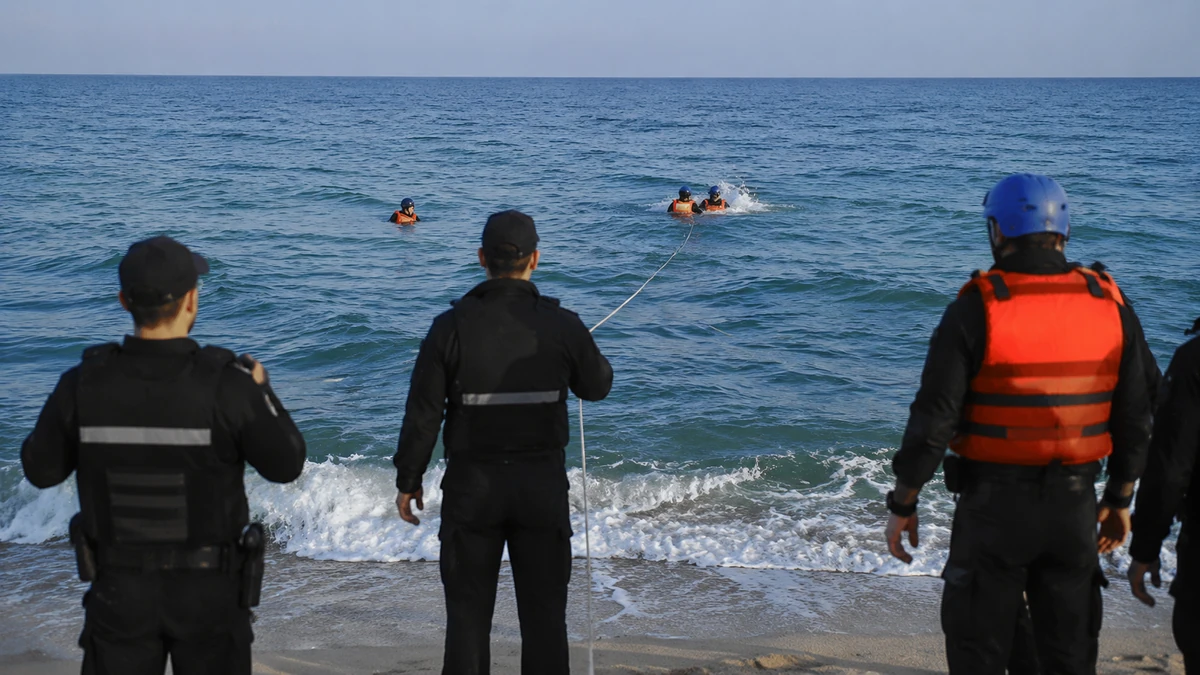
According to South Korean authorities and local reporting, two women were swept away by waves at Yeongjin Beach in the coastal city of Gangneung at about 5:09 a.m. on June 6. Rescue teams were dispatched after an emergency report of swimmers or beachgoers in distress, and a coastal patrol team from the Jumunjin police outpost entered the water using rescue ropes and pulled both women to safety.
But rescue at the shoreline did not mean both would survive. One of the women, reportedly in her 30s, was found unconscious and in cardiac arrest when responders reached her. Members of the Korea Coast Guard administered CPR and other emergency aid before transferring her by ambulance to a hospital, but she was later pronounced dead.
The other woman survived.
In the compressed language of a breaking-news brief, the sequence sounds almost straightforward: report, dispatch, water rescue, CPR, ambulance, hospital. Yet the outcome reveals something more sobering. Even when public emergency systems work quickly and in sequence, the sea can still overpower the timetable of rescue.
That is one reason this incident resonates beyond a local police blotter item. It was not simply an accident at a beach. It was a real-time test of South Korea’s coastal safety net — and an example of its strengths and its limits.
The timing made the news especially jarring. June 6 is a national holiday in South Korea, known as Memorial Day, when the country honors soldiers and others who died in service to the nation. For many Americans, the closest reference point is Memorial Day in the United States, though the Korean observance falls on a fixed calendar date and carries its own national rituals, including moments of remembrance and ceremonial events. That such a fatal accident unfolded at dawn on a public holiday added to the emotional weight of the story.
What happened at Yeongjin Beach
The confirmed facts are limited but significant. The Gangneung branch of the Korea Coast Guard said it received a distress call at 5:09 a.m. identifying the location as Yeongjin Beach, in Gangneung, a city in Gangwon Province on the country’s eastern shoreline. The report concerned people in the water.
Rescuers were sent to the scene, and the coastal patrol team from Jumunjin — a nearby area known for its fishing port and seaside access — conducted a direct water rescue. Authorities said the team used rescue ropes and went into the sea, rather than waiting from shore for the victims to drift closer. That detail matters. It suggests the conditions were urgent enough that a passive shoreline response was not considered adequate.
Both women were pulled from the water. One, however, was already unresponsive.
Emergency personnel began resuscitation efforts at the scene, then transferred her to a hospital by 119 ambulance. In South Korea, “119” serves the role that 911 does in the United States for fire and medical emergencies, and ambulance transport is integrated into that broader emergency response system. The woman did not survive.
Authorities have not publicly detailed what the women were doing before they were swept away, who first called emergency services, or what the precise sea conditions were at that moment. Those unanswered questions are not unusual in the first stage of accident reporting. But the lack of detail does not lessen the significance of what is already known: two people were caught by waves, both were rescued from the water, and one still died.
That sequence alone tells a hard truth familiar to coastal communities around the world, from Southern California to Cape Cod to Florida’s Gulf Coast: rescue can be fast, professional and brave, and still arrive too late to reverse what has already happened in the water.
Why beach rescues can turn fatal so quickly
To many readers, especially those who associate beaches with leisure, boardwalks and vacation snapshots, it may be hard to grasp how quickly a wave-related incident can become lethal. But ocean safety experts have long warned that the danger at a shoreline is often not dramatic in the way people imagine. It does not always involve towering surf or a visible storm. Sometimes it begins with a misstep, a sudden pull, a drop-off beneath the feet, cold water shock, panic, fatigue or disorientation in rough water.
That appears to be part of what makes the Gangneung case so troubling. The emergency call came just after 5 a.m., and by the time rescuers physically reached the women, one was already in cardiac arrest. The implication is not necessarily that responders were slow. Rather, it points to the grim physiology of drowning and near-drowning incidents. Once a person is submerged, inhaling water or unable to breathe effectively, the body can deteriorate with frightening speed.
That dynamic is well understood in coastal rescue operations. In many water emergencies, the question is not simply whether rescuers arrive, but whether the victim remains in a survivable condition when they do. The distinction is crucial. Public discussion after accidents often centers on response time, and that is important. But in ocean incidents, the starting point of the emergency itself can be so sudden and violent that even a rapid chain of response cannot guarantee survival.
The facts of this case underscore that point. The patrol team did its job well enough to get both women out of the water. One lived. One did not. That split outcome does not show a system that failed to respond; it shows how unforgiving the sea can be even when response begins quickly.
Americans have seen variations of this pattern in their own coastal tragedies. Rip currents at beaches in the Carolinas or Florida, sneaker waves along the Pacific Northwest, and unexpected surf surges in Hawaii have all led to incidents in which victims were recovered rapidly but could not be revived. The details differ from place to place, but the underlying lesson is the same: the ocean does not offer much margin for error.
A look at South Korea’s coastal emergency system
For American readers unfamiliar with how maritime emergencies are handled in South Korea, the response structure in this case offers useful context. The Korea Coast Guard functions in some ways like a blend of the U.S. Coast Guard and a specialized marine public safety agency, with local stations responsible for patrol, rescue and law enforcement along the coast. In a beach emergency, that means trained personnel can be mobilized quickly and, when necessary, enter the water themselves.
In this case, the patrol team from Jumunjin used rescue ropes and performed what reports described as an in-water rescue. That detail should not be overlooked. Entering rough or unstable surf is dangerous not only for victims but also for responders. Water rescue requires judgment, physical skill and coordination, especially when waves are strong enough to sweep people away from shore.
After the extraction, another part of South Korea’s public safety system took over. The woman in cardiac arrest received CPR, then was transported by 119 ambulance to a hospital. The 119 system, widely recognized in South Korea, is the country’s core emergency hotline and dispatch framework for fire and medical assistance. In practical terms, it means a maritime rescue can connect quickly to a land-based ambulance and hospital network.
That continuity matters. In many emergencies, survival depends not just on one heroic act but on whether multiple agencies work in sequence without delay: the emergency call is received, the location is identified, the nearest team is dispatched, the victim is reached, resuscitation starts immediately, and transport to definitive medical care follows. According to the available account, that chain did function here.
And yet the fatality still occurred.
That is the uncomfortable reality at the center of this story. Public safety systems are essential, and South Korea’s appears to have activated rapidly in this instance. But the existence of a functioning response system is not the same thing as a guarantee of a good outcome. A system can perform as designed and still confront the physical limits imposed by time, oxygen deprivation and the violence of moving water.
In that sense, the Gangneung rescue is not only a story about loss. It is also a story about the visible presence of the state in moments of crisis — coast guard personnel entering the water, emergency care beginning on scene, the handoff to an ambulance — and about the painful recognition that even competent institutions cannot always outrun nature.
Why this local tragedy carries national meaning
Beach accidents are often treated as isolated local incidents, especially when the initial facts are sparse. But this case carries broader significance in South Korea for several reasons.
First, it happened in a public recreational space on a national holiday. That matters in any country. When an accident takes place not in a remote industrial zone or on a restricted site, but at a beach where ordinary people gather for rest and leisure, it raises wider questions about risk awareness, safety communication and public expectations. Americans know this instinctively. A drowning at a neighborhood pool, a heat death at a national park or a boating accident on a holiday weekend quickly becomes more than a local item because it touches a shared space and a shared assumption of normalcy.
Second, the story highlights a recurring challenge in modern public safety: systems can be responsive and outcomes can still be devastating. Much public debate about emergency policy tends to assume a simple formula — faster response equals prevention of death. Often that is true. But not always. Some incidents unfold so rapidly that the state’s role is not to erase danger altogether but to reduce harm, save whoever can be saved and prevent even greater loss.
That appears to be the framework through which many in South Korea are likely to understand this case. The rescue team saved two people from the water in the immediate sense that both were brought out alive enough for emergency treatment to continue. But one woman’s condition had already deteriorated to cardiac arrest. The event therefore becomes a lesson in both rescue capability and rescue limitation.
Third, the incident lands in a country that is acutely sensitive to public safety failures and emergency preparedness. South Korea, like many developed nations, has had periods of national introspection after high-profile disasters. That history shapes how even smaller-scale tragedies are read. A coastal death is not merely sad; it can also prompt scrutiny about preparedness, warnings, public behavior and institutional readiness.
None of that means there was necessarily negligence here. At least from the limited reported facts, there is no basis to say that officials failed to act. If anything, the available details suggest the opposite: a distress call came in, responders moved, and a coastal patrol team carried out a direct rescue. But the very fact that one woman still died is what gives the story its social weight. It forces the public to confront the limits of intervention.
The cultural context Americans may miss
For readers outside Korea, several details in this story may need translation not of language, but of context.
Gangneung is a major coastal city on South Korea’s east coast, known for beaches, seafood, tourism and winter sports connections in the broader Gangwon region. In recent years, it has also become familiar to some international audiences through Korean popular culture and domestic travel content. Beaches in the Gangneung area can draw visitors seeking sunrise views over the East Sea, which Koreans commonly use as the name for the body of water internationally known as the Sea of Japan. Early morning beach visits are not unusual, particularly around holidays or travel weekends.
Yeongjin Beach itself may be recognizable to some fans of Korean television dramas, as parts of the Gangneung coastline have appeared in popular screen productions and social media travel posts. That kind of visibility can create an image of the coast as scenic and inviting, much the way American audiences might think of Malibu, Cape May or the Outer Banks through a mix of tourism advertising and entertainment. But picturesque coastlines can also mask serious hazards.
There is also the matter of the holiday. June 6 in South Korea is Memorial Day, known locally as Hyeonchung-il. It is a solemn national observance honoring those who died for the country. Flags are flown at half-staff, ceremonies are held, and many people also use the day off for family time or short trips. The mix of commemoration and leisure may seem familiar to Americans, whose own Memorial Day weekend often combines remembrance with travel, barbecues and the unofficial start of summer. In both countries, that blend can put more people into recreational spaces where seasonal risks are still very real.
Finally, the naming of agencies may sound unfamiliar. The Korea Coast Guard and the 119 ambulance system are central parts of the country’s emergency framework. To a U.S. audience, the easiest analogy is that a maritime emergency might involve a local beach patrol, the Coast Guard, firefighters-paramedics and an ambulance service all in quick succession. South Korea’s system is structured differently, but the practical logic is similar: specialized responders handle the water, then emergency medical transport takes the patient to the hospital.
The long questions left by a short report
One striking feature of the case is how little information is needed to pose large public questions. We do not know exactly how the women ended up in the water. We do not know whether they were standing near the shoreline, walking at dawn, taking photographs, fishing nearby or engaged in some other activity. We do not know what the surf looked like to the naked eye, whether warning signs were present or whether conditions shifted suddenly.
And yet the core issue is already clear: coastal danger often arrives faster than public intuition does.
That gap between risk and perception is not unique to South Korea. In the United States, beach safety officials have repeatedly struggled with tourists who underestimate currents, overestimate their swimming ability or treat warning advisories as suggestions rather than serious alerts. The most dangerous conditions are not always the most visually dramatic. A beach can appear calm to an inexperienced eye while still producing currents or wave action strong enough to overwhelm someone in moments.
The Gangneung incident may lead to renewed discussion in South Korea about how coastal warnings are communicated, how early-morning beach access is monitored, and how people assess danger in shoreline environments that feel familiar or picturesque. It may also reinforce a broader public lesson: emergency systems are the last line of defense, not the first.
That does not diminish the value of rescue. In fact, the survival of the second woman demonstrates why those systems matter so much. The same call, the same beach, the same wave event produced two different outcomes. That alone is evidence that rapid intervention can save lives, even if it cannot save every life.
For journalists, this is where the story expands beyond the immediate tragedy. It becomes a report not only on what happened, but on what the event reveals. A public safety net was present. It moved quickly. It performed dangerous work. It helped prevent what could have been a double fatality. And still, one person died.
Those are difficult truths to hold at the same time, but they are often the truths most worth reporting.
A final reminder from the shoreline
There is a tendency in modern news cycles to sort events into tidy categories: either the system failed or it succeeded; either a death was preventable or it was inevitable; either a place is safe or it is dangerous. Real life, especially around water, is less neat than that.
The events at Yeongjin Beach on Saturday morning resist easy conclusions. They show responders acting with urgency. They show one life saved. They show another life lost despite that effort. They show how a public institution can do nearly everything expected of it and still meet a force it cannot fully defeat.
For South Korea, the case is a local tragedy with national resonance. For American readers, it is also familiar in the most unsettling way. Beach communities everywhere live with the same contradiction: the shoreline is one of the most democratic and beloved public spaces a society has, and one of the most unpredictable. Families go there for rest, reflection and escape. Emergency crews go there knowing that a calm-looking horizon can turn lethal without warning.
On a holiday morning meant, in part, for remembrance, one woman in Gangneung did not make it home. Another did. Between those two outcomes lies the whole story of coastal risk: how quickly danger can arrive, how hard rescuers work against it, and how narrow the margin can be between rescue and loss.
Comments
Post a Comment