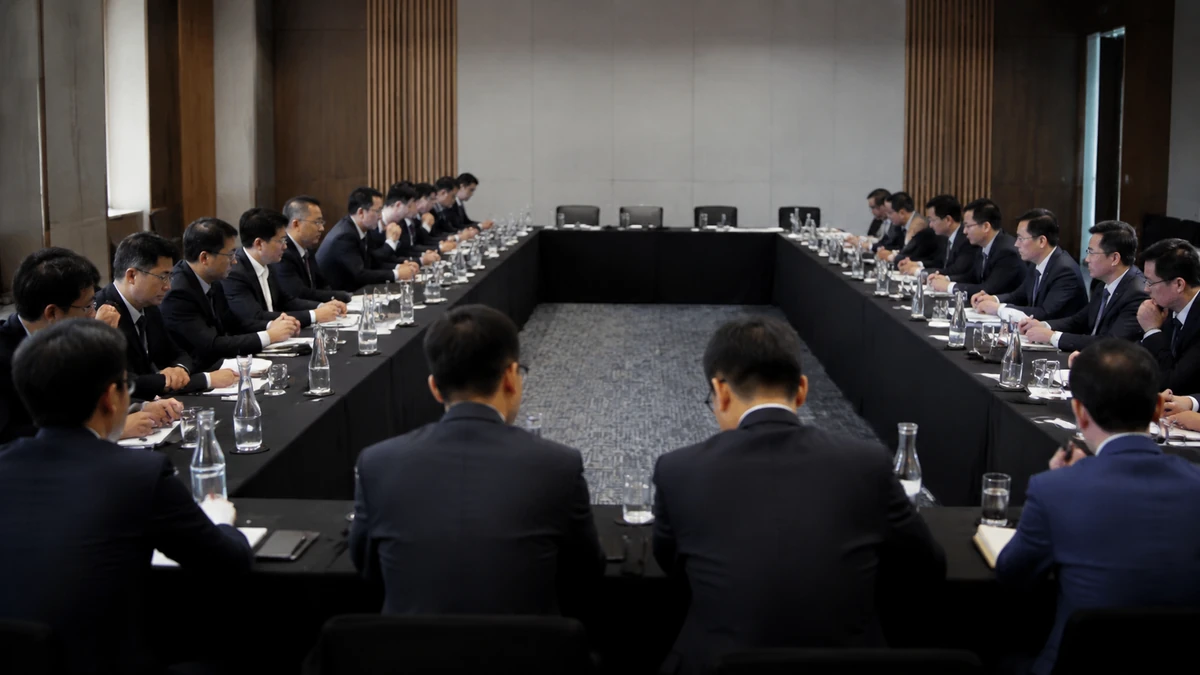
South Korea turns an industry forum into a geopolitical message
South Korea is making an unusually broad diplomatic push in Canada, using an energy and natural resources forum in Ottawa to send a much larger message: Seoul wants to be seen not just as a customer or exporter, but as a long-term strategic partner. At the center of that effort is a major Canadian defense decision expected later this month — the selection process for a next-generation submarine program that has drawn intense interest from foreign suppliers, including South Korea.
According to the South Korean government’s account of the June 2 meetings in Ottawa, the visit was framed around supply chain cooperation in energy and critical resources. But the political significance goes well beyond oil shipments or trade promotion. The moment offers a clear look at how South Korea is increasingly blending diplomacy, economic security and defense exports into a single package — a style of statecraft that has become more common as countries rethink supply chains after the pandemic, Russia’s war in Ukraine and growing U.S.-China tensions.
For American readers, a useful comparison might be the way Washington increasingly talks about semiconductors, clean energy, critical minerals and military alliances as parts of the same strategic map. Seoul is doing something similar. In its approach to Canada, the South Korean government is signaling that a modern defense partnership should rest not only on weapons performance, but also on trust, resource security, industrial cooperation and long-term political alignment.
That message was reinforced by the stature of the official sent to Ottawa. Kang Hoon-sik, the presidential chief of staff, traveled as President Lee Jae-myung’s special envoy for strategic economic cooperation. In the South Korean system, the presidential chief of staff is one of the most powerful unelected figures in government — closer in influence to a White House chief of staff than to a conventional trade official. His presence suggested that this was not simply a business delegation or routine ministry visit, but a coordinated, government-level effort carrying the authority of the president’s office.
Before the public forum, Kang held a meeting with Canada’s natural resources minister, Tim Hodgson, to discuss the direction of bilateral cooperation in energy and resources. South Korea said both sides agreed they see one another as trustworthy partners in a rapidly shifting global supply chain landscape and that they would seek broader cooperation across oil, liquefied natural gas and critical minerals. In diplomatic terms, that is the kind of language countries use when they want to establish the political foundation for relationships that can last decades.
Why a submarine bid is shaping the politics of the visit
The immediate backdrop is Canada’s looming decision on its future submarine fleet, a project with major strategic and industrial implications. While the details of Canada’s final procurement choice remain its own, the South Korean side is plainly treating the competition as a priority. Its strategy appears to be straightforward: do not pitch only a submarine; pitch a durable partnership.
That matters because large defense acquisitions rarely come down to hardware specifications alone. Military procurement at this scale is about much more than who offers the fastest platform or the lowest sticker price. Governments weigh interoperability, industrial offsets, maintenance relationships, political trust and the broader trajectory of bilateral ties. A submarine fleet is not a one-time purchase like buying commercial equipment off the shelf. It typically implies training, maintenance, upgrades, dockyard cooperation and strategic coordination lasting decades.
That is why South Korea’s energy diplomacy in Ottawa is politically significant. By linking submarine talks to cooperation on oil, liquefied natural gas and critical minerals, Seoul is effectively telling Canada that it can offer a wider ecosystem of partnership. In other words, South Korea is trying to define itself not as a vendor, but as a country prepared to deepen ties across sectors that matter to national security and economic resilience alike.
This kind of bundling is increasingly common in international politics, even if governments do not always say so explicitly. Countries offering high-value defense systems often try to present themselves as providers of something more comprehensive: supply chain stability, investment, technology sharing and diplomatic alignment. South Korea’s version of that pitch reflects how far the country’s industrial and strategic ambitions have evolved. Once known primarily as an export powerhouse in consumer electronics, autos and shipbuilding, South Korea is now also a serious player in global defense markets, from artillery and armored vehicles to naval systems.
Sending a senior presidential aide as special envoy underscores that the submarine competition is not being handled as a narrow commercial matter. It is being treated as a strategic test of how successfully South Korea can persuade an ally like Canada that bilateral cooperation should be measured across a larger canvas. Even before Canada announces any final decision, Seoul’s activism tells its own story: the government believes defense sales at this level are won through diplomacy as much as engineering.
Oil, gas and critical minerals are now foreign policy tools
One of the most striking details in the South Korean account of this diplomatic push is the reported increase in Canadian crude oil imports to South Korea, which it said have expanded by roughly 3.3 times. On its face, that may sound like a dry trade statistic. In the current geopolitical environment, it is anything but.
Energy diversification has become one of the defining concerns of the past several years. For countries that import most of their energy, including South Korea, overreliance on a narrow group of suppliers can create economic vulnerability and political risk. That is true not only for oil and gas, but for the critical minerals used in batteries, advanced manufacturing, defense systems and clean-energy technologies. The lesson many governments have drawn is that supply chains once treated mainly as business concerns are now matters of national strategy.
Americans have heard versions of this debate in discussions about rare earths, electric-vehicle batteries, semiconductor fabrication and the push to “friend-shore” supply chains to countries seen as politically reliable. South Korea is using much the same logic in its dealings with Canada. Ottawa brings several attractive advantages: it is a major resource producer, a stable democracy, a U.S. ally and a country whose regulatory and political system is broadly legible to Western partners. For Seoul, closer energy and minerals cooperation with Canada fits a larger effort to reduce exposure to uncertainty elsewhere while strengthening ties with countries considered dependable.
That is why the conversation in Ottawa covered not just one commodity, but the full range of strategic resources — crude oil, LNG and critical minerals. Each sits at the intersection of economics and security. Oil remains foundational to transportation and industry. LNG can be critical for power generation and energy stability. Critical minerals are essential for advanced manufacturing, batteries and defense technology. Taken together, they form the backbone of what many policymakers now call economic security.
From Seoul’s perspective, expanding imports and cooperation in these areas does more than keep factories running. It also creates political ballast. Trade relationships tied to vital resources often become more resilient because both sides have reasons to invest in continuity. That, in turn, can make a defense partnership more credible. If Canada is evaluating who it wants to work with on a long-term submarine program, South Korea wants Canada to see a country with which it is already building deeper forms of interdependence.
The symbolism of Ottawa: government, industry and diplomacy moving together
The June 2 forum in Ottawa was jointly hosted by South Korea’s Ministry of Trade, Industry and Energy and Canada’s Department of Natural Resources, with support from KOTRA, South Korea’s trade and investment promotion agency. On paper, that may sound like a standard bilateral business event. In practice, the staging matters.
One theme emerging from the South Korean presentation of the event is that multiple arms of the state were moving in concert: the presidential office, the trade and industry bureaucracy, public trade institutions and the diplomatic apparatus. That is significant because it reflects a deliberate government style. Seoul is not presenting energy security, industrial cooperation and defense outreach as separate lanes handled by separate bureaucracies. It is trying to align them into a common strategy.
For Americans, there is an echo here of how economic policy has changed in Washington. Industrial policy, once treated as a technocratic or even unfashionable term, has returned to the center of politics. The Biden administration’s focus on chips, clean energy manufacturing and strategic competition with China made clear that trade, industry and national security are now deeply intertwined. South Korea, a major U.S. ally with an export-driven economy, has adapted to the same reality.
The Ottawa meetings also carried symbolic weight because they unfolded on two levels at once. There was the high-level political meeting between Kang and the Canadian minister, which delivered a message of state-to-state seriousness. And there was the public policy-and-business forum, which offered a platform for translating diplomatic intent into practical areas of cooperation. That pairing matters. Diplomacy without industry follow-through can look performative; business dialogue without political support can look tentative. South Korea was aiming to show both.
Even absent a summit-level declaration, the political signal was hard to miss. Natural resource cooperation is rarely just about trade volume. It touches environmental policy, export controls, industrial strategy, infrastructure investment and long-term geopolitical positioning. By elevating the discussion and wrapping it around a broader strategic narrative, Seoul demonstrated that it sees these sectors as levers of statecraft. This is one reason the Ottawa visit is more than a footnote in trade diplomacy. It shows how middle powers with advanced industries are learning to operate in a world where economics and security are fused.
South Korea’s evolving diplomatic playbook
The broader significance of the Canada push is that it highlights an evolution in South Korean foreign policy. Seoul has long relied on trade and export competitiveness as pillars of national strength. What appears to be changing is how explicitly the government packages those strengths. Rather than separating resource diplomacy, industrial policy and defense cooperation, South Korea is increasingly presenting them as interconnected.
This does not mean ideology or values no longer matter. South Korea still operates within a network of alliances and partnerships built around shared democratic principles and security interests. But the grammar of diplomacy has become more transactional in a sophisticated sense. Countries are expected to bring tangible proposals to the table: investment, technology, supply chain resilience, development cooperation, manufacturing capacity or energy security. South Korea seems increasingly comfortable speaking that language.
That approach has surfaced in other settings as well, including Seoul’s outreach to countries in Africa on energy, economic cooperation and development. But the Canada case is especially revealing because it involves a highly developed partner and a potential defense agreement with long strategic horizons. In that context, South Korea’s pitch is clear: we are not merely selling equipment; we are offering a framework for long-term cooperation rooted in mutual need and mutual benefit.
For a country with few natural resources of its own, this is a notable shift in posture. South Korea is still a major importer of energy and raw materials, but it no longer approaches those relationships as a passive buyer. Its value proposition now includes world-class shipbuilding, advanced manufacturing, high-end defense production and an ability to serve as a stable industrial partner. That combination gives Seoul a stronger hand in negotiations with resource-rich countries such as Canada.
It also reflects South Korea’s growing confidence on the world stage. The country has spent years expanding its profile through technology brands, cultural exports and multilateral diplomacy. The Korean Wave — the global spread of South Korean pop culture through K-pop, television and film — made the country more familiar to foreign audiences. But behind that soft power is a harder reality: South Korea is also a serious industrial and strategic actor. The Ottawa outreach is a reminder that the same country known to many Americans for BTS, “Parasite” and Samsung is also competing to shape 21st-century supply chains and defense partnerships.
What Canada is weighing — and why the outcome matters beyond one contract
For Canada, any decision on a next-generation submarine program will necessarily involve its own defense priorities, alliance commitments, industrial considerations and budget realities. It is not simply a matter of responding to South Korea’s diplomacy. Ottawa will assess what kind of fleet it wants, what capabilities it needs in an era of rising maritime competition and how any procurement fits within its broader defense strategy.
Still, South Korea’s latest push may affect how Canada thinks about the overall relationship, even if it does not determine the outcome by itself. Countries do notice when a partner commits senior political capital to a relationship. They notice when an arms supplier also offers deeper economic cooperation. And they notice when a prospective defense partner frames the relationship in terms of long-term strategic trust rather than a one-off sale.
Whatever happens later this month, one conclusion already seems clear: South Korea is willing to use the full range of government tools to support critical overseas bids in strategic sectors. That has political implications at home as well. The visible coordination among the presidential office, trade officials and public institutions suggests an administration that sees diplomacy, industry and security as mutually reinforcing. In a country as dependent on global trade and stable supply chains as South Korea, that is not just a style choice. It is a governing strategy.
The deeper lesson for American readers is that medium-sized powers are becoming more agile and more ambitious in how they pursue national interests. The old lines between commerce, diplomacy and defense have blurred. Energy imports can reinforce security relationships. Mineral access can shape industrial alliances. Arms competitions can become tests of a country’s broader diplomatic credibility.
That is why the scene in Ottawa deserves attention beyond the immediate submarine contest. It captures a larger trend in international affairs: the rise of economic security as a central organizing principle of foreign policy. South Korea is not alone in adopting that model, but it is executing it with growing sophistication. In Canada, Seoul is making the case that modern partnerships are built across multiple strategic domains at once.
If Canada ultimately chooses South Korea for its submarine program, the Ottawa diplomacy may be remembered as a decisive late-stage push that helped frame Seoul as more than an exporter. If it does not, the episode may still stand as evidence of how South Korea now conducts high-level diplomacy — with an integrated pitch that binds resources, industry and security into a single narrative. Either way, the message is unmistakable: South Korea wants a larger strategic role, and it is increasingly prepared to negotiate for it in the language today’s world understands best — resilience, reliability and long-term partnership.
Comments
Post a Comment