Why Jensen Huang’s Korea Visit Matters: Nvidia’s Seoul Meetings Signal South Korea’s Rising Role in the AI and Robotics Race
A high-profile visit with bigger meaning
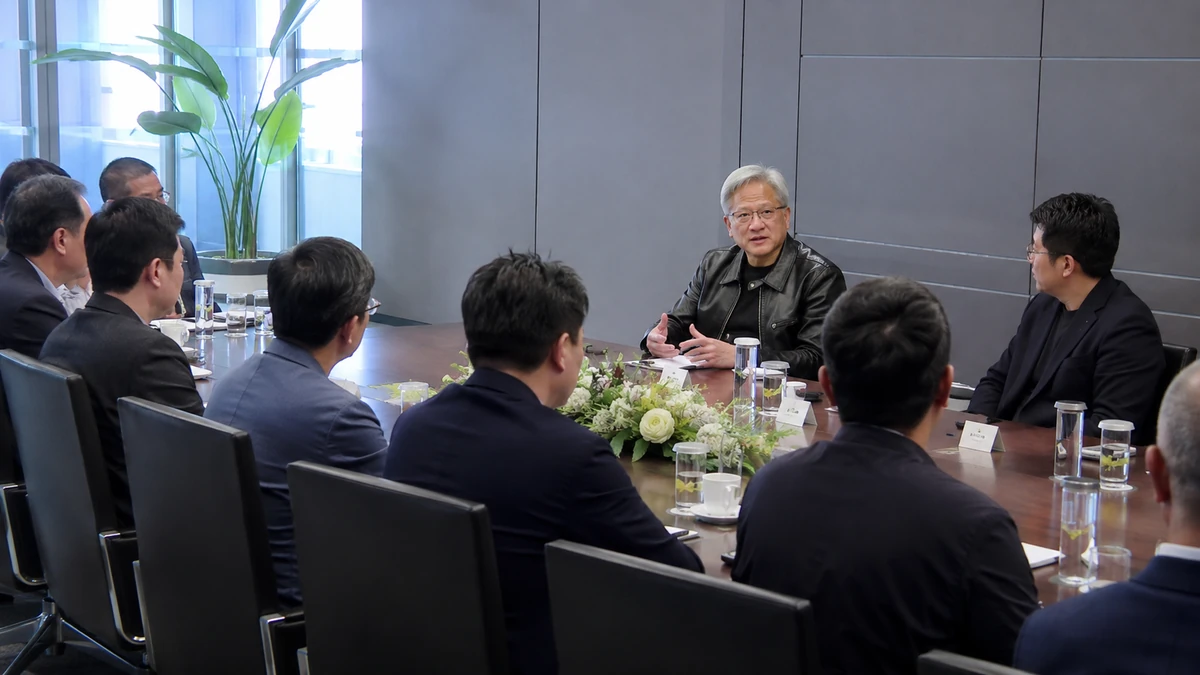
When Nvidia CEO Jensen Huang lands in South Korea and sits down not only with executives from household-name conglomerates but also with startup founders in artificial intelligence and robotics, the symbolism reaches beyond corporate scheduling. In South Korea, where business visits by global technology leaders are watched almost like state events, Huang’s itinerary is being read as a marker of the country’s changing place in the global AI economy.
According to South Korean reports, Huang is expected to meet a string of local AI startup leaders, including Kim Sung-hoon, the head of Upstage, a prominent Korean AI startup. He is also expected to meet robotics startups in Korea for the first time during the visit, while separately visiting major Korean companies including LG, Hyundai Motor Group and Naver. Taken together, those meetings suggest this is not a courtesy stop or a ceremonial handshake tour. It is a mapping exercise by one of the most influential figures in global technology, and South Korea is the terrain being closely studied.
For American readers, the easiest comparison may be to Silicon Valley’s periodic efforts to scout the next major platform shift. When top executives from companies like Apple, Microsoft or Amazon carve out time to meet not just suppliers but younger companies building future-facing technologies, it usually signals they believe something larger is taking shape. That is what makes Huang’s schedule in Korea notable. The head of the company that has become the central hardware power in the generative AI boom is looking beyond chips alone and into the broader ecosystem where AI software, robotics, manufacturing and real-world deployment come together.
In that sense, the news is less about one CEO’s travel plans than about an emerging consensus: South Korea is no longer being viewed only as a place that makes the world’s electronics, displays, cars and memory chips. It is increasingly being treated as a place where the next generation of AI-enabled products might be designed, tested and deployed.
Why South Korea has become strategically important
For years, Americans have tended to understand South Korea through a few familiar lenses: Samsung smartphones, Hyundai and Kia cars, K-pop, Oscar-winning films and the continuing security tension with North Korea. Those reference points are real, but they only partially explain why global technology firms are paying closer attention to Seoul now.
South Korea occupies a rare position in the world economy. It combines advanced manufacturing, dense urban infrastructure, fast consumer adoption of new technology and a concentration of globally competitive industrial firms. In practical terms, that means Korea can offer something many countries cannot: a relatively compact national market where software, hardware, supply chains and live testing environments exist in close proximity.
That matters especially in what some in the industry call “physical AI,” a term increasingly used to describe AI systems that do not stay confined to chatbots or cloud applications but instead operate in machines moving through the real world. Think factory robots, warehouse automation systems, autonomous mobility platforms, service robots, smart industrial equipment and AI-powered machines that sense, decide and act. If generative AI has largely played out on screens so far, physical AI is about what happens when those models begin to power hardware in workplaces, streets, hospitals, logistics hubs and homes.
South Korea has a strong claim to relevance in that next chapter. It is home to major automakers, electronics manufacturers, battery companies, semiconductor leaders, logistics networks and internet platforms. That industrial mix gives it an edge as a proving ground. A company like Nvidia does not just need customers for its chips. It needs partners that can build products, create demand for AI computing and turn abstract model capabilities into working systems at scale. Korea offers all three.
This is why Huang’s reported schedule matters. Visiting LG points to consumer electronics and industrial systems. Visiting Hyundai signals interest in mobility, robotics and manufacturing. Visiting Naver suggests an eye toward platforms, data, services and Korean-language AI applications. Meeting startups alongside those conglomerates tells a second story: Nvidia appears to be looking not only at Korea’s current industrial champions, but also at the smaller, faster-moving companies that may define where AI actually gets commercialized next.
From semiconductors to startups: A broader Korean technology story
Much of South Korea’s reputation in technology has long rested on scale. The country is known for giants such as Samsung Electronics, SK hynix, Hyundai and LG — companies that can spend billions of dollars, operate global supply chains and shape entire categories. But innovation ecosystems are not built by giants alone. They also depend on startups that can move quickly, experiment aggressively and target niche problems too small or too risky for conglomerates to tackle at first.
That is the backdrop for Huang’s reported meetings with Korean AI startups, including Upstage. Founded by AI researchers and entrepreneurs, Upstage is part of a growing cohort of Korean firms trying to turn the country’s technical talent into products and platforms with global relevance. While many American readers may not know these companies by name, the pattern is familiar. Every mature tech economy eventually reaches a point where the question is not whether it has industrial heavyweights, but whether it can produce a startup layer capable of translating foundational technologies into new businesses.
Korea has been trying to answer that question for years. The country has strong engineering education, world-class broadband and manufacturing depth, but it has also faced long-running concerns about whether its startup culture could thrive in the shadow of its conglomerates, known in Korea as chaebol. The chaebol system — family-controlled business empires with outsized influence over the economy — has historically driven growth but also shaped a more hierarchical corporate environment than the freewheeling mythology Americans associate with Silicon Valley.
That is part of what makes direct engagement from Nvidia meaningful. Startups everywhere seek validation, but validation from a company sitting at the heart of the AI boom carries unusual weight. Even absent an announced investment, partnership or contract, a face-to-face meeting can help founders refine strategy, attract talent, win investor attention and better understand the technical direction of the market. In an industry moving as quickly as AI, access to the right conversations can matter almost as much as access to capital.
The fact that Huang is reportedly meeting a sequence of founders, rather than making a one-off stop at a single company, also suggests a wider interest in the Korean startup landscape. It implies South Korea is being evaluated not simply as a source of one promising firm, but as an ecosystem worth monitoring. For a country that has spent years trying to move from manufacturing strength to platform and software influence, that distinction matters.
The first robotics meetings in Korea carry special symbolism
Perhaps the most striking detail in the reported schedule is that Huang is expected to meet robotics startups in South Korea for the first time. First meetings can be easy to dismiss. They often involve exploration more than execution. But in technology, being included in a first round of exploration is itself significant. It means a market has developed enough momentum, talent or strategic relevance to command attention from the center of the industry.
Robotics is an especially important area in the Korean context. South Korea has long been well positioned for robotics adoption because of its manufacturing base, aging population and emphasis on automation. It is also a country where the line between industrial necessity and technological ambition can be thin. Robots are not only a futuristic talking point there; they are a practical response to labor shortages, productivity demands and the pressure to remain competitive in advanced manufacturing.
For American audiences, it may help to think of Korea as a place where the conditions for robotics adoption are unusually favorable. The country has dense cities, globally competitive factories, sophisticated logistics systems and consumers accustomed to digital interfaces. It also has a cultural comfort with high-tech public life, from robot coffee servers to advanced delivery systems, that can make pilot projects easier to imagine and test.
If Nvidia is exploring partnerships or technical alignment around physical AI in Korea, robotics is an obvious focal point. Nvidia’s influence in AI has come through the compute infrastructure that trains and runs advanced models. But the next commercial frontier is not just better text generation or image synthesis. It is the translation of AI into embodied systems that interact with physical environments. That means sensors, simulation, edge computing, machine vision, mobility systems and precision control — all areas where Korea’s industrial capabilities could become highly relevant.
For Korean startups, this is where opportunity expands. They do not need to outbuild global giants in every layer of the stack. Instead, they can specialize in perception systems, industrial software, robot applications, vertical integration for factories or domain-specific AI tools tailored to manufacturing and logistics. A market does not need to dominate every category to become indispensable. It needs to become hard to ignore in the categories that matter next.
What Nvidia appears to see in Korea’s industrial structure
Huang’s expected stops at LG, Hyundai Motor Group and Naver are revealing because they cut across different corners of the Korean economy. Each company represents a distinct lane of AI commercialization. LG spans electronics, components and industrial systems. Hyundai is not just an automaker but a broader mobility and robotics player, especially through its investments and ambitions in automation. Naver, often described to Americans as Korea’s closest equivalent to a combined search, content and digital services platform, brings strengths in local-language AI, consumer internet ecosystems and software deployment.
That combination reflects one of South Korea’s core advantages: connectivity between sectors. In many countries, the AI conversation remains siloed. One group talks about data centers, another about software, another about autonomous vehicles, another about factories. Korea’s industrial structure makes cross-sector conversation easier because the actors are geographically close, technologically sophisticated and already accustomed to deep supply-chain interdependence.
That matters to Nvidia because the company’s future growth depends not only on selling chips into hyperscale data centers but on making itself indispensable across the wider economy. As AI migrates from cloud-centric use cases into cars, robots, industrial systems and edge devices, platform companies need places where those transitions can happen quickly. South Korea offers a concentrated environment to see how AI can move from model to machine.
There is also a geopolitical subtext. The global AI race is no longer just a contest among U.S. firms. It increasingly involves how allied economies align their strengths in semiconductors, manufacturing, software and advanced industry. South Korea has become an essential node in that network. It is a treaty ally of the United States, a semiconductor heavyweight and a country trying to reduce strategic vulnerability while climbing the value chain. Stronger ties between companies like Nvidia and Korean firms fit into that broader realignment, even when the meetings themselves are strictly commercial.
That does not mean every meeting produces immediate deals. In fact, the absence of flashy announcements can sometimes be the more important sign. It suggests the work is moving upstream, into the early design and architecture phase where partnerships are scoped before products become public. In business journalism, there is often a temptation to focus only on signed contracts. But ecosystems are shaped well before the press releases arrive.
What this means for South Korea’s economy
For South Korea, the significance of the visit is not simply prestige. It is economic positioning. For years, the country’s role in the global technology economy was often framed around production: making chips, assembling devices, building cars, supplying components. Those remain crucial strengths. But the higher-margin power in technology increasingly comes from participation in design, standards, platforms and ecosystem control.
If Korean companies are now being engaged not only as suppliers or customers but as potential co-architects of future AI and robotics applications, that marks a meaningful shift. It suggests Korea is being seen less as a downstream market and more as a place where the next industrial uses of AI can be developed in conversation with global platform leaders.
That distinction is critical in a country that has spent years trying to deepen its innovation base. South Korea’s policymakers and business leaders have repeatedly emphasized the need to move beyond a growth model centered on legacy manufacturing dominance. AI, robotics and automation offer a path toward higher value-added industries, especially as demographic pressures intensify. Like Japan, South Korea faces an aging society and low birthrate, which increase the appeal of labor-saving technologies and productivity-enhancing systems.
There is also a signaling effect for the startup scene. When a global figure such as Huang spends time meeting founders in Seoul, it can help attract outside investors who may have previously viewed the Korean market as too local, too insular or too dominated by conglomerates. It can also reinforce a message to Korean talent: building at home does not necessarily mean building at the periphery. In a globally connected AI market, a startup in Seoul can be part of the main story if it sits at the intersection of software and real industry demand.
None of this guarantees success. Korea still faces challenges common to many innovation economies, including startup financing bottlenecks, global scaling hurdles and the difficulty of converting technical strength into platform leadership. But high-level engagement from Nvidia suggests those barriers are no longer enough to keep the country outside the most important conversations.
A wider picture of Korea’s global economic ambitions
The timing also fits into a broader pattern in South Korea’s economic strategy. On the same day as the reports about Huang’s visit, Korean business groups were also highlighting expanded international outreach in other areas, including economic discussions with African partners. That parallel matters because it illustrates the dual-track nature of Korea’s ambitions: on one hand, pursuing new export markets and geopolitical partnerships; on the other, moving deeper into frontier technologies that could define the next era of industrial competition.
South Korea has long depended on global openness for its prosperity. It is a trade-heavy economy with world-class companies but a relatively small domestic market compared with the United States, China or the European Union. That has forced Korean firms to be outward-looking. The emerging AI and robotics wave presents both risk and opportunity in that model. If Korea remains only a hardware supplier, it could be squeezed by larger platform ecosystems elsewhere. If it succeeds in embedding itself into the design and deployment of AI-powered industry, it could expand its influence far beyond its size.
That is why Huang’s visit is being interpreted in Seoul as more than a corporate news item. It is a test of whether the country’s long-cultivated strengths — manufacturing sophistication, engineering depth, digital infrastructure and fast adaptation — are finally converging into a new kind of relevance. Not the relevance of a supporting player, but of a partner whose ecosystem is important enough to court directly.
For Americans watching the global technology race, South Korea is worth more attention than it often gets. It is one of the few places where AI’s next phase can be observed not just in labs or apps, but in factories, vehicles, logistics systems and networked urban life. If Silicon Valley remains the center of software ambition and Nvidia remains a cornerstone of AI computing, South Korea increasingly looks like one of the places where that computing power may find some of its most consequential real-world uses.
In the end, the most important takeaway may be the simplest: when the CEO of the world’s most strategically important AI chip company spends time with Korean startups, robotics founders and industrial giants in one trip, he is acknowledging that South Korea belongs in the front rank of countries shaping what AI becomes next. The deals, if they come, may arrive later. But the message has already landed.
Comments
Post a Comment